Exodus 24:16
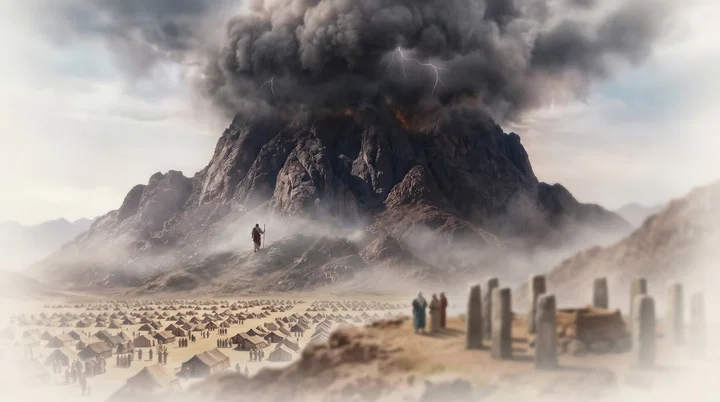
And the glory of the LORD abode upon mount Sinai, and the cloud covered it six days: and the seventh day he called unto Moses out of the midst of the cloud.
Translations
And the glory of the LORD stayed on mount Sinai, and the cloud covered it six days: and the seventh day he called to Moses out of the middle of the cloud.
King James Version, Revised Version
And the glory of the LORD abode upon mount Sinai, and the cloud covered it six days: and the seventh day he called unto Moses out of the midst of the cloud.
And the glory of the Lord abode upon mount Sinai, and the cloud covered it six days: and the seventh day he called unto Moses out of the midst of the cloud.
And the glory of the LORD abode upon mount Sinai, and the cloud covered it six days: and the seventh day he called to Moses from the midst of the cloud.
And the glory of Jehovah abode upon mount Sinai, and the cloud covered it six days: and the seventh day he called unto Moses out of the midst of the cloud.
and the honour of Jehovah doth tabernacle on mount Sinai, and the cloud covereth it six days, and He calleth unto Moses on the seventh day from the midst of the cloud.
And the glory of Jehovah abode on mount Sinai, and the cloud covered it six days; and on the seventh day he called to Moses out of the midst of the cloud.
And the glory of Yahweh rested upon Mount Sinai, and the cloud covered it six days,—then called he unto Moses on the seventh day, out of the midst of the cloud.
Berean Standard Bible, Majority Standard Bible
and the glory of the LORD settled on Mount Sinai. For six days the cloud covered it, and on the seventh day the LORD called to Moses from within the cloud.
The LORD’s glory settled on Mount Sinai, and the cloud covered it six days. The seventh day he called to Moses out of the middle of the cloud.
And the glory of the Lord was resting on Mount Sinai, and the cloud was over it for six days; and on the seventh day he said Moses' name out of the cloud.
And the glorie of the Lord abode vpon mount Sinai, and the cloude couered it sixe dayes: and the seuenth day he called vnto Moses out of the middes of the cloude.
Douay-Rheims (Challoner revision)
And the glory of the Lord dwelt upon Sinai, covering it with a cloud six days: and the seventh day he called him out of the midst of the cloud.
Pictures
Cross-references 20 of 57
- Exodus 19:5-8
Now therefore, if ye will obey my voice indeed, and keep my covenant, then ye shall be a peculiar treasure unto me above all people: for all the earth is mine:
Israel agrees to obey God’s words in the covenant at Sinai.
- Exodus 24:3-8
And Moses came and told the people all the words of the LORD, and all the judgments: and all the people answered with one voice, and said, All the words which the LORD hath said will we do.
The people pledge obedience, and Moses ratifies the covenant with blood.
- Exodus 31:18
And he gave unto Moses, when he had made an end of communing with him upon mount Sinai, two tables of testimony, tables of stone, written with the finger of God.
God gives Moses the stone tablets, written with God’s finger, after their time on the mountain.
- Exodus 32:1-6
And when the people saw that Moses delayed to come down out of the mount, the people gathered themselves together unto Aaron, and said unto him, Up, make us gods, which shall go before us; for as for this Moses, the man that brought us up out of the land of Egypt, we wot not what is become of him.
While Moses remains on the mountain, the Israelites make and worship a golden calf.
- Exodus 20:1-17
And God spake all these words, saying,
God speaks the commandments to Israel at Sinai before Moses receives the stone tablets.
- Exodus 24:12
And the LORD said unto Moses, Come up to me into the mount, and be there: and I will give thee tables of stone, and a law, and commandments which I have written; that thou mayest teach them.
God calls Moses up Mount Sinai to receive the written law on stone tablets.
- Exodus 34:28
And he was there with the LORD forty days and forty nights; he did neither eat bread, nor drink water. And he wrote upon the tables the words of the covenant, the ten commandments.
Moses spends forty days with the LORD on the mountain and writes the covenant’s commandments.
- Exodus 25:40
And look that thou make them after their pattern, which was shewed thee in the mount.
Moses is told to make the sanctuary according to the pattern shown on the mountain.
- Deuteronomy 9:9
When I was gone up into the mount to receive the tables of stone, even the tables of the covenant which the LORD made with you, then I abode in the mount forty days and forty nights, I neither did eat bread nor drink water:
Recalls Moses’ stay on the mountain to receive the covenant tablets.
- Exodus 19:16-19
And it came to pass on the third day in the morning, that there were thunders and lightnings, and a thick cloud upon the mount, and the voice of the trumpet exceeding loud; so that all the people that was in the camp trembled.
Describes the Lord’s majestic descent on Sinai before the laws were given.
- Hebrews 8:5
Who serve unto the example and shadow of heavenly things, as Moses was admonished of God when he was about to make the tabernacle: for, See, saith he, that thou make all things according to the pattern shewed to thee in the mount.
Moses was shown the sanctuary pattern on the mountain.
- Exodus 34:29-30
And it came to pass, when Moses came down from mount Sinai with the two tables of testimony in Moses’ hand, when he came down from the mount, that Moses wist not that the skin of his face shone while he talked with him.
Moses’s shining face reflects God’s glory after he comes down from Sinai.
- Deuteronomy 4:12-13
And the LORD spake unto you out of the midst of the fire: ye heard the voice of the words, but saw no similitude; only ye heard a voice.
God speaks the commandments from the midst of the cloud and declares them as his covenant.
- Matthew 17:1-2
And after six days Jesus taketh Peter, James, and John his brother, and bringeth them up into an high mountain apart,
Both describe divine glory manifested on a mountain.
- Exodus 32:16
And the tables were the work of God, and the writing was the writing of God, graven upon the tables.
The tablets and their writing are described as God’s work.
- Exodus 34:1
And the LORD said unto Moses, Hew thee two tables of stone like unto the first: and I will write upon these tables the words that were in the first tables, which thou brakest.
God promises to write the words from the first stone tablets on their replacements.
- Exodus 20:18-21
And all the people saw the thunderings, and the lightnings, and the noise of the trumpet, and the mountain smoking: and when the people saw it, they removed, and stood afar off.
Israel fears God’s presence at Sinai and asks Moses to speak for them.
- Exodus 24:3
And Moses came and told the people all the words of the LORD, and all the judgments: and all the people answered with one voice, and said, All the words which the LORD hath said will we do.
The people promise to obey the LORD’s words as the covenant is ratified.
- Hebrews 9:18-20
Whereupon neither the first testament was dedicated without blood.
The blood-ratified covenant ceremony precedes Moses’ ascent.
- Exodus 13:21
And the LORD went before them by day in a pillar of a cloud, to lead them the way; and by night in a pillar of fire, to give them light; to go by day and night:
The guiding cloud manifests God’s presence with Israel and rests on Mount Sinai.
Commentary
Each commentary is drawn from primary sources: the writings of Ellen G. White and Adventist pioneers and periodicals. Each commentary is separate. Its own words are not a quotation; follow the references to read the source passages.
Ellen G. White
29 sources
The glory of the Lord rested upon Mount Sinai with the cloud covering it for six days, and on the seventh day, the Sabbath, He called Moses out of the midst of the cloud, while to Israel below the glory appeared as devouring fire and Moses entered the cloud to remain forty days and forty nights.Lt 160, 1906, par. 3–9PP 313.2Ms 93, 1908, par. 31–35ST May 13, 1880 During the six days Moses received no revelation, for they were a watched-for time of preparation in which common thoughts were to be put away and he was to wait, examine himself, and sanctify himself by meditation and prayer until fitted to endure God's glory and enter direct communion.ST May 13, 18801SP 241.1–242.1SG3 272.1–273.1PP 313.1 It was Christ who spoke from within the cloud, veiling His glory so that mortal Moses could endure what he beheld and be strengthened to receive the message for the people.Lt 160, 1906, par. 3–9Ms 170, 1904, par. 2–3Lt 124, 1900, par. 25–29 Moses was thus called into the mount and beheld God's glory before receiving the law, the decalogue on stone with directions for the sanctuary and further judgments, showing that communion with God prepares a person before God uses him in a great work.Lt 160, 1906, par. 3–9Ms 97, 1899, par. 3–4ST May 13, 1880ST Jul 27, 1915 The instruction given in the mount is to be obeyed and studied now just as verily as by Israel then, for the delay while Moses was enveloped in the cloud tested whether the people would remain faithful, and instead of sanctifying themselves and keeping the covenant while God's glory was before their eyes they grew impatient, forgot their pledge, and went into idolatry with the golden calf.Lt 160, 1906, par. 3–9ST May 13, 18804T 514.1–2Lt 124, 1900, par. 25–29RH Jul 29, 1873
Sinai Setting and Call
The glory of the Lord rested upon Mount Sinai, and the cloud covered the mount six days, and on the seventh day He called Moses out of the midst of the cloud.Lt 160, 1906, par. 3–9Ms 93, 1908, par. 31–35ST May 13, 18801SP 241.1–242.1SG3 272.1–273.1 To Israel below that glory looked like devouring fire on the top of the mount, while Moses went into the midst of the cloud and up into the mount to remain there forty days and forty nights.Lt 160, 1906, par. 3–9Ms 93, 1908, par. 31–35ST May 13, 18804T 514.1–2 The seventh day on which God called Moses out of the cloud was the Sabbath, when the thick cloud opened in the sight of all Israel and the glory broke forth like devouring fire.PP 313.2 The forty days and forty nights Moses then spent in the mount did not include the six days of covering and waiting.PP 313.2
During those six days Joshua was with Moses, and together they ate manna and drank from the brook that came down out of the mount, while Aaron and Hur assisted by the elders were left below.PP 313.2ST May 13, 1880 Joshua did not enter the cloud with Moses but remained outside eating and drinking daily, while Moses fasted during the entire forty days.PP 313.2 The cloud covering the mount for those six days was a sign of God's special presence, yet during those days Moses received no revelation or message from God.PP 313.1 The surrounding passage records the covenant ceremony in which the people heard God's words and judgments and pledged to obey, then renewed the pledge when the terms were read aloud, and ratified the covenant with sacrifices and sprinkled blood.PP 311.5–312.2
The One who spoke from within the cloud was Christ, who veiled His glory in cloud so that mortal Moses as His human instrument could endure what he beheld and heard.Lt 160, 1906, par. 3–9Ms 170, 1904, par. 2–3Lt 124, 1900, par. 25–29 Strengthened by partaking of the divine nature, Moses received the message and could give its substance to the people.Ms 170, 1904, par. 2–3 The laws given there within the concealing cloud will unfold more fully in the future life.3MR 258.3–259.1
Preparation for Communion
Even Moses could not go up at once and come near God and endure the exhibition of His glory.ST May 13, 18801SP 241.1–242.1SG3 272.1–273.1 The glory rested upon the mount and the cloud covered it six days, and only on the seventh day was he called out of the midst of the cloud, while to Israel below that glory appeared as devouring fire on the mountaintop.ST May 13, 1880 He could not approach God at once but had to be prepared to converse with his Maker.1SP 241.1–242.1SG3 272.1–273.1
The six days were a watched-for time of preparation to meet God.ST May 13, 18801SP 241.1–242.1SG3 272.1–273.1 Common thoughts and feelings had to be put away while he waited patiently, examined himself, devoted his thoughts to God, and sanctified himself by meditation and prayer until prepared to converse with his Maker and enter direct communion.ST May 13, 18801SP 241.1–242.1SG3 272.1–273.1PP 313.1 During those days he received no revelation or message from God, using the time for self-examination, meditation, and prayer before entering into direct communion.PP 313.1
God concealed His great glory so that mortal Moses could endure what he was able to behold and hear.Ms 170, 1904, par. 2–3 The One speaking from within the cloud veiled His glory in cloud so as not to extinguish Moses as the human instrument who was to voice His words to the people.Lt 124, 1900, par. 25–29 Strengthened through partaking of the divine nature, he received the message and could give its substance to all the people.Ms 170, 1904, par. 2–3
Moses was called into the mount and beheld God's glory before receiving God's law as the representative of his people.ST Jul 27, 1915 This shows that communion with God prepares a person before God uses him in a great work. The call carries God's invitation to come up higher into communion, and the beholding gives preparation and moral power for appointed work.ST Jul 27, 1915
After the call Moses went into the midst of the cloud and up into the mount to remain forty days and forty nights, which time was given for this communication.Lt 160, 1906, par. 3–9ST May 13, 1880Ms 170, 1904, par. 4–6 There he was summoned to receive the decalogue inscribed on stone, the testimony of the ten commandments engraven on two tables of stone by Divine Majesty, with tables of stone and law and commandments to teach the people.Lt 160, 1906, par. 3–9ST May 13, 1880 He received directions for building a sanctuary and tabernacle for the special manifestation of the divine presence, to be carried from place to place from which God could reveal Himself, with further instruction regarding the Sabbath, and God's instructions, judgments, and laws, including laws written in a book that guard against doing injustice and guide dealings with one another.Lt 160, 1906, par. 3–9ST May 13, 1880Ms 170, 1904, par. 4–6 The specifications for building the tabernacle teach that supreme honor is to be given to God, and that the skill, genius, and wisdom brought into the work were given by God to be used for His glory.Ms 97, 1899, par. 3–4
Instruction and Warning Today
The instruction given in the mount in Exodus 19 to 24 is to be obeyed now just as verily as by Israel in Moses' day, to be studied and presented before the people in detail to end all contention and to bring brotherly love with softened and subdued hearts.Lt 160, 1906, par. 3–9 It lays down the principles of God's government for the multitude brought out of slavery, plainly specified to be cherished in all relations of life so that injustice is guarded against and character is fitted for the family of God in the heavenly courts.Lt 160, 1906, par. 3–9Lt 124, 1900, par. 25–29 They are the same principles Christ presented in His own teaching in human flesh, and the apostles repeat those same principles in plain speech to counter the sophistries of Satan.Lt 160, 1906, par. 3–9Lt 124, 1900, par. 25–29 They stand with the call to receive tables of stone and law and commandments to teach the people, and lead to the requirements for a tabernacle to be carried from place to place from which He could reveal Himself, and to the laws written in a book that guide dealings with one another.Lt 160, 1906, par. 3–9
Supreme honor is to be given to God, and the skill, genius, and wisdom brought into the work of building the tabernacle were given by God to be used for His glory.Ms 97, 1899, par. 3–4 Moses going up the mountain into God's presence to receive the pattern for the work is the example for leaders who seek God in prayer and behold His glory, who are to follow the pattern God gives and bring their best ability into His work.Ms 97, 1899, par. 3–45T 549.216MR 137.1–3 They are to seek a higher, holier outlook rather than manage sacred work by ordinary, cheap standards.16MR 137.1–3
The scene presents the pattern for all who seek God's presence and light, who are called into the mount to talk with Him in close communion.STPW91 37.2Ms 80, 1899, par. 1–6 When by faith they behold Him who is invisible there, their speech and writing are changed, so their words are no longer cheap and common but pure, elevated and sanctified for sowing seed unto eternal life.Ms 80, 1899, par. 1–6 Those who trust in God and make His Word their guide are kept by God's power calm and composed amid accusations and turmoil, above boisterous shocks that ruffle and discompose other minds, without being moved from right principles by human opinions or authority.17MR 226.3–227.1Ms 66, 1898, par. 18 They ever ask what is written in the law and what God has said, refusing to set their feet in questionable paths at the word of any man or minister, and in earnest prayer with God they have their feet shod with the preparation of the gospel of peace.Ms 66, 1898, par. 18
The delay while Moses was away enveloped in the cloud speaking with God tested whether Israel could be trusted to remain faithful and obedient to the covenant.4T 514.1–2Ms 170, 1904, par. 10–11 The people expected Moses to return soon, grew impatient when he did not, and concluded he had been slain by the burning flame and would never return and the cloud that had led them, now resting stationary on the mount, would no longer direct their route through the wilderness.ST May 13, 1880 They soon wearied of waiting, forgot their covenant and their fear of God's presence, and their failure showed weakness and instability, with self-importance leading to strife.SPBC 155.3Ms 170, 1904, par. 10–11
That waiting time became the occasion for corruption at the foot of the mount, led principally by the mixed multitude that came from Egypt with Israel, with the gods of Egypt in mind.ST May 13, 1880 Satan used the opportunity to tempt imitation of Egyptian idolatry, producing the demand for something visible to resemble God and to bear before them to find favor if they returned to Egypt.ST May 13, 1880 Despite having seen God's visible glory after deliverance from Egypt, judgments on oppressors, passage through the Red Sea despite unbelief and murmuring, and destruction of enemies, they did not humble themselves in awe before Jehovah.Ms 2, 1904, par. 20–27 While the glory still remained in sight of the congregation recalling the awe-inspiring voice that forbade other gods, they went into idolatry and made a golden calf for worship under Aaron while Moses was in the mount.RH Jul 29, 18733T 339.3Ms 2, 1904, par. 20–27
While Moses was away Israel should have sanctified themselves, searched their hearts, reflected on the commandments, humbled themselves, lived in humility and godly fear, and kept the covenant.Ms 170, 1904, par. 4–6RH Jul 29, 18733T 296.1–3 God's revealed glory was before their eyes, giving them grounds to reason from cause to effect.Ms 93, 1908, par. 31–35 Aaron and Hur had been appointed to guide the people in Moses' absence, yet they murmured and turned to idolatry instead of showing humility and godly fear before God's sacred presence.RH Jul 29, 1873
The privilege of ascending Sinai and experiencing communion with God and the light of His glory requires a corresponding life of virtue and holiness.SLP 36.1–2 Such great light and privilege are not permission to sin or grounds for assuming God will overlook sin.SLP 36.1–2 They are means to stir zeal and strengthen effort to do God's will.SLP 36.1–2
Sources
Pioneers and periodicals
67 sources
The glory of the Lord came down in person on Mount Sinai to speak the Ten Commandments to the people.ST Mar 3, 1914RH May 28, 1901RH Dec 24, 1861 His glory rested on the mount while the cloud covered it six days, and on the seventh day He called Moses from inside the cloud up into the glory, and Moses entered the cloud and stayed on the mount forty days and forty nights.RH Dec 31, 1861RH Dec 9, 1852ST May 20, 1875RH Mar 28, 1854ST Jan 31, 1911 The six days were his preparation to endure the display of God's glory by putting away common thoughts and giving himself to meditation and prayer, and the seventh day when he was called was the Sabbath, marking a week within the forty days.ST May 13, 1880RH Dec 31, 1861RH Dec 31, 1861ST Apr 14, 1887 It belongs to the first covenant with Israel after the Exodus, a solemn voluntary agreement in which the people pledged to obey His law and God pledged to receive them as His people and be their God.ST Mar 15, 1883ST Sep 23, 1889ST Feb 20, 1879ST Mar 17, 1909 There on the mount, after that call into the cloud, Moses alone received the signal honor of the law spoken by God and written by His own hand on stone in distinction from the ordinances given through Moses, together with the pattern for the sanctuary and its service as a lesson of heavenly things and the removal of sin.RH Dec 31, 1861RH Dec 9, 1852RH Mar 29, 1864RH Mar 29, 1864
Sinai Setting and Sequence
The verse belongs to God's personal descent upon Mount Sinai to give the Ten Commandments, when His glory rested on the mountain and He spoke the law to the people.ST Mar 3, 1914RH May 28, 1901RH Dec 24, 1861 It describes how Sinai appeared at that giving of the law, with God's glory resting upon the mount and the cloud covering it as the sign of His presence when He spoke the Ten Commandments.ST Mar 3, 1914RH May 28, 1901 It places the Sabbath covenant scene at Sinai, where the Lord's glory rested on the mountain, the cloud covered it for six days, and on the seventh day God called Moses from within the cloud.ST Mar 3, 1914RH Dec 31, 1861
The glory of the Lord abode on Sinai while the cloud covered it six days, and on the seventh day He called Moses from within the cloud into the glory.RH Dec 31, 1861RH Dec 9, 1852ST May 20, 1875ST Mar 11, 1889ST Mar 8, 1883 The cloud covered the mountain for six days before God called Moses from within it on the seventh, and the cloud veiled God's presence in His dealings with sinful people because sinners cannot endure His unveiled glory.RH Dec 9, 1852ST May 20, 1875ST Mar 11, 1903 In the Sinai covenant setting this belongs to the account of God's words to Israel and Moses' role in receiving them, marking the setting in which he went up the mountain alone to receive instruction and write the law.ST May 20, 1875ST Mar 8, 1883 The scene introduces Moses' ascent into the cloud, where he stayed forty days and nights to receive the laws and religious ceremonies for Israel.RH Dec 31, 1861RH Dec 9, 1852
To the Israelites watching below, the sight of that glory on the top of the mount was like devouring fire.RH Dec 31, 1861RH Dec 4, 1913ST Mar 11, 1889 The summit burned with fire in the sight of Israel while the cloud that had led them rested stationary on the mount, and the six days of waiting were filled with that visible glory before Moses was summoned to a further meeting with God.ST May 13, 1880RH Dec 4, 1913RH Jun 13, 1854 The glory shone like a devouring fire before the Lord called Moses from within it on the seventh day.ST Mar 11, 1889RH Jun 13, 1854
Moses, with his minister Joshua, was summoned upward to receive the Decalogue inscribed on stone, while Aaron and Hur assisted by the elders were left below.ST May 13, 1880RH Jul 29, 1873ST Jan 31, 1911 Moses then went into the midst of the cloud and up into the mount and remained there forty days and forty nights.ST May 13, 1880RH Mar 28, 1854RH Feb 11, 1858 He was received into the cloud and the immediate presence of God after that waiting period, and the account continues with his stay on the mountain during which God showed him the pattern of the sanctuary and its sacred vessels and gave instructions for building them.RH Jul 29, 1873RH Mar 28, 1854RH Feb 11, 1858 This is part of the account of God calling Moses and the other leaders of Israel up the mountain, and of Moses being called into closer communion to receive the Ten Words and instructions for the sanctuary.RH Mar 28, 1854ST Jan 31, 1911
Sinai is one of the peaks of Horeb, the mountain of God where He condescended to manifest His glory and presence.RH Mar 1, 1870ST Sep 20, 1899 Up into Sinai He twice called Moses and communed with him forty days and nights, choosing mountains as His usual place to commune with His servants.RH Mar 1, 1870ST Sep 20, 1899 During his time on the mountain amid the cloud surrounding God's glory, God showed him the pattern for the sanctuary and explained its construction.RH Mar 1, 1870ST Sep 20, 1899
That entry into the mount prepared the way for a signal honor to be conferred on the law.RH Dec 31, 1861 It marks the setting in which Moses alone entered the cloud and remained on the mountain forty days and nights to receive the law written on stone.RH Dec 31, 1861ST May 20, 1875ST Mar 8, 1883 The forty-day stay is when he received the stone tablets and detailed instructions for the Tabernacle, with God explaining the sanctuary to him and showing him its pattern.RH Dec 9, 1852RH Jan 6, 1853 The scene introduces his ascent to receive the laws and religious ceremonies for Israel.RH Dec 9, 1852ST May 20, 1875
Cloud Glory and Fire
The glory of the Lord at Sinai was a visible manifestation associated with a cloud, a fiery effulgence surrounded by dark clouds with lightnings proceeding from it.ST Apr 22, 1875 Fiery brightness and darkness were joined together with the divine presence there.ST Apr 22, 1875RH Jan 20, 1874
The cloud covered the mount for six days while the glory rested upon Sinai beneath it, before God called Moses from within it on the seventh day.ST Mar 11, 1903 That cloud veiled God's presence in His dealings with sinful people, because sinners cannot endure His unveiled glory.ST Mar 11, 1903 From that cloud-covered glory God spoke to Moses, making it a setting for divine instruction, promise, counsel, warning, and encouragement to His people.ST Mar 25, 1903
The presence of the holy God consumes everything with which sin is connected, manifested at Mount Sinai in awful grandeur with consuming power and glory.RH Dec 4, 1913 The sight of that glory on the top of the mount was like devouring fire in the eyes of the children of Israel.RH Dec 4, 1913 He is a devouring fire only in the sense that He consumes sin.ST
That devouring-fire glory which rested on Mount Sinai is the glory with which Christ will come in the clouds.RH Jun 19, 1900 This Sinai appearance therefore supports the ordinary, visible sense of appearing in glory.RH Jan 20, 1874
Sabbath Timing and Preparation
Moses spent the six days upon the mountain but not yet where God was, waiting beneath the immediate presence while those days were filled with the visible glory.RH Jun 13, 1854RH Feb 7, 1854 The glory rested upon Sinai in cloud shining like devouring fire through the six days, and on the seventh day he was summoned from within it to a further meeting at the top.RH Jun 13, 1854RH Feb 7, 1854 Those six days were preparation to meet with God, since even Moses could not go up at once and endure the exhibition of His glory.ST May 13, 1880ST Apr 14, 1887 He put away common thoughts and feelings and devoted his thought to God, sanctifying himself by meditation and prayer until he was prepared to converse with his Maker.ST May 13, 1880ST Apr 14, 1887 Even Moses, who was exceptionally close to God, needed this putting away and devoting of himself, which teaches that God's people must train their minds on heavenly things to be ready to meet Him at the end of the world.ST May 13, 1880ST Apr 14, 1887
The cloud covered the mount six days and God called Moses out of the midst of the cloud on the seventh day, marking off a week within the forty days.RH Dec 31, 1861RH Dec 31, 1861 That seventh day is the Sabbath.RH Dec 31, 1861RH Dec 31, 1861 This timing strongly supports the view that the Ten Commandments were given on the Sabbath, the day before Moses went up to receive the stone tablets, six days after the Lord spoke them.RH Dec 31, 1861RH Feb 7, 1854 His call out of the cloud on the seventh day after six days of covering glory came following the reading of the book of the covenant and the people's repeated promise of obedience, and prepared the way for a signal honor to be conferred upon the law.RH Mar 17, 1863 The six days and the seventh-day call thus fix how long Moses remained in the mount and fix the weekday on which the Ten Commandments were given.RH Dec 31, 1861RH Mar 17, 1863RH Feb 7, 1854
Covenant Ratification and Conditions
The verse belongs to the record in Exodus 19 and 24 of the first mutual agreement God made with the house of Israel after leading them out of Egypt, which is the old covenant and the first covenant, completed by its ratification.ST Sep 23, 1889ST Mar 17, 1909 It was a voluntary contract and solemn contract in which God promised to make Israel a favored people above all nations on condition that they obey His voice and keep His commandments, the people pledging to obey His law while God pledged to accept them as His people and be their God.ST Mar 15, 1883ST Feb 20, 1879 This agreement, rather than the law itself, established the covenant relationship and made God Israel's husband.ST Mar 15, 1883ST Feb 20, 1879
The people promised to obey before hearing God's words and then ratified that agreement after hearing His voice from the mount.ST Mar 15, 1883ST Feb 13, 1879 After the people agreed to obey God's requirements, Moses recorded the covenant conditions, read them aloud, and sealed the agreement with blood.RH Oct 22, 1861 The people had agreed to do the commandments, and the covenant was ratified before God wrote the Ten Commandments.RH Jun 26, 1900ST Jan 3, 1878 Moses' ascent of Sinai came after that ratification, when God called him up to receive the stone tablets, the law, and commandments written for teaching Israel, and Moses remained on the mountain forty days and forty nights; the written commandments given afterward were the basis to which that covenant related, not the covenant itself.RH Jun 26, 1900
The people heard God's voice from the mount and were obligated to obey it, and their promise to obey was the condition for receiving His promised care but did not create their underlying duty to obey.ST Sep 17, 1885 Their covenant relationship and continued possession of Canaan were conditional on obedience to God, and their own pledge placed them under personal obligation to keep His commandments.ST Sep 17, 1885RH Oct 22, 1861RH Jan 7, 1862 The covenant ushered in the Levitical dispensation, with God's law including the Ten Commandments as its foundation.ST Mar 4, 1889ST Sep 22, 1914 It describes Israel entering into covenant concerning the law after hearing it proclaimed at Sinai as Israel began its journey toward Canaan, in keeping with God's earlier promises to Abraham, Isaac, and Jacob, which pointed beyond the earthly land to redemption from sin and an eternal inheritance.ST Sep 22, 1914 The national covenant rested on the people's promise to obey, and their fear when God spoke showed that they did not have His law written in their hearts.ST Apr 22, 1913 The national covenant could not save individuals: those who relied on their own strength failed, while Moses was saved through faith and was willing to hear God.ST Apr 22, 1913
Moral and Ceremonial Laws
The Ten Commandments are God's own law in plain distinction from all other laws, the only law God ever spoke directly to His people and wrote with His own hand and finger on stone so they would not be forgotten.RH Mar 29, 1864RH Mar 29, 1864RH Jun 16, 1868 They were taught by God Himself amid thunder and glory on the seventh day, after His glory had rested beneath the cloud on Mount Sinai for six days and He called Moses from within the cloud.RH Mar 29, 1864RH Jun 16, 1868 The formal ratification of the covenant at Sinai included both those Ten Commandments and the judgments given through Moses.ST Apr 15, 1886 The laws set forth at Horeb in Exodus 20-40 include moral, ceremonial, civil, health, and other regulations given through Moses, not only the Ten Commandments.ST Apr 15, 1886
The moral law was written out first and solemnly ratified, and the law of ordinances was given immediately after through Moses, who wrote it in a book.ST May 20, 1875ST Mar 20, 1879ST May 6, 1875 That law given through Moses set out the typical service, including sacrifices, the altar, the temple, and the priesthood, and was distinct from the moral law of the Ten Commandments already given and ratified.ST May 20, 1875ST Mar 20, 1879 The covenant instructions Moses received after ratification, when he was called up the mountain to receive the stone tablets and the law and commandments God had written, do not make that covenant and its other instructions the same code as the commandments God personally spoke and engraved on the tablets.ST Mar 20, 1879RH Jul 9, 1901 During the six days Moses was on the mountain but not yet where God was, and on the seventh day God called him to come up to the top, six days after the Lord spoke the Ten Commandments.RH Mar 29, 1864RH Feb 7, 1854 Moses received the stone tables only after fasting forty days and nights because of Israel's transgression, and the communication of that period included the ritual and judicial laws, which Moses was to write in a book to accord with the law on stone.ST May 20, 1875RH Feb 7, 1854 Since the Ten Commandments were given by God Himself before the ceremonial law was given to Moses, the ceremonial law could be abolished without affecting the moral law.RH Mar 29, 1864
Although Israel broke the covenant ratified by blood, its righteous conditions remained.ST God spoke His holy law and gave other laws through Moses in love, to draw the people into fatherly nearness and close fellowship with Himself and to write it on their hearts, not to drive them away.ST Jan 27, 1909ST Jan 27, 1909 He is a devouring fire only in the sense that He consumes sin.ST Besides the Ten Commandments and the instruction written in the book of the law, Moses is taught in Jewish tradition to have received additional instruction that was not written down, passed orally from Moses to Joshua, then to the elders and later teachers.ST Jun 30, 1914
Sanctuary Pattern and Meaning
The glory abiding on Sinai with the cloud covering it six days marks where and at what time the instruction for building the sanctuary was given, when Moses on the seventh day was called out of the midst of the cloud into the glory.ST Dec 24, 1894RH Oct 20, 1863 That calling prepared for the command in the next chapter to erect the tabernacle with all its vessels.RH Oct 20, 1863 Moses then entered the cloud on the mount and remained there forty days and forty nights.RH Mar 28, 1854RH Jan 6, 1853RH Feb 11, 1858 There God gave him directions for building the sanctuary, explained its construction, and showed him its pattern with its sacred vessels and furnishings and priestly service.RH Mar 28, 1854RH Jan 6, 1853RH Mar 1, 1870ST Jun 10, 1889RH Feb 11, 1858
God directed the making of the sanctuary and everything pertaining to it with exactness.RH Feb 1851 The book of Exodus in this way presents Israel's history and law before turning to worship.RH Jan 20, 1916 The sanctuary and its yearly services were a divinely given object lesson representing heavenly things and teaching God's plan for the final removal of sin.RH Aug 31, 1911 Those recorded details were not for ancient Israel only but illuminate the antitypical meaning, including the cleansing of the sanctuary and Christ's presentation of the names in the Lamb's Book of Life before the Father as the antitype of the breastplate of judgment.RH Feb 1851
The heavenly sanctuary pattern revealed to Moses in that setting points to Christ as the true Pattern.ST Jun 10, 1889 He is seen in its furnishings and priestly service as the Lamb, the bread of life, the acceptable offering of prayer, and the great High Priest who bears humanity.ST Jun 10, 1889
Communion Ascent and Warning
Moses being called into the mount and beholding God's glory before receiving God's law as the representative of His people is an instance of communion with God preparing a person before God uses him in a great work. The call carries God's invitation to come up higher into communion, and the beholding gives preparation and moral power for appointed work.ST Jul 27, 1915 This encounter shows the divine power available to those who go aside with God as in the church's heroic ages.RH Sep 5, 1871
Moses' rough and hazardous climb into God's presence pictures coming into God's presence through a similarly difficult climb.ST May 2, 1916 The mount is the high place of sublime faith where the soul climbs to hear God's voice from behind the cloud and then comes down to earth again.RH Sep 24, 1908 The vision seen there is to be kept clear and plain in the heart without losing one jot, shaping life to sublime deeds.RH Sep 24, 1908 Kept in the heart it makes life beautiful and true in deeds of love and mercy, so that the light of divine love shines in the face as proof of having stood upon the mount.RH Sep 24, 1908
Even Moses, who was exceptionally close to God, could not go up at once and endure the exhibition of God's glory without putting away common thoughts and feelings and devoting thought to God and sanctifying himself by meditation and prayer during six days of waiting.ST Apr 14, 1887 This preparation teaches that God's people must train their minds on heavenly things to be ready to meet Him at the end of the world.ST Apr 14, 1887 Moses was saved through faith and was willing to hear God, and the glory of justification shone in him so that his face shone, while those who relied on their own strength failed because their fear showed they did not have His law written in their hearts.ST Apr 22, 1913
The verse means a watched-for delay in which the people expected Moses to return soon and grew impatient when he did not, concluding he had been slain by the burning flame and would never return and the cloud that had led them and now rested stationary on the mount would no longer direct their route.ST May 13, 1880 The Israelites could see and hear the divine glory at the mountain while Moses remained hidden from them in the cloud.ST Nov 30, 1904 That waiting time became the occasion for corruption at the foot of the mount, led principally by the mixed multitude that came from Egypt with Israel with the gods of Egypt in mind, as Satan used the opportunity to tempt imitation of Egyptian idolatry, producing the demand for something visible to resemble God and bear before them to find favor if they returned to Egypt.ST May 13, 1880
The visible glory marked God's sacred presence, and Israel should have responded by sanctifying themselves, searching their hearts, and showing humility and godly fear.RH Jul 29, 1873 While Moses was away and Aaron and Hur had been appointed to guide them, they murmured and turned to idolatry in the making of the golden calf.RH Jul 29, 1873ST Nov 30, 1904 While Moses was on the mountain forty days to receive the stone tablets, the people had time to consider the covenant and prepare to receive further instruction, but neglected this opportunity and soon became inattentive and lawless.ST Apr 17, 1907 God honored some of the men who later joined Korah's rebellion by permitting them to approach with Moses almost directly into the presence of the Most High and behold His unsurpassed majesty, and they also saw Moses with his face resplendent with God's glory so that the people dared not approach him, yet they soon forgot both privileges and stood boldly with Korah in defiance until God's wrath swept them from the earth.ST Sep 16, 1880
Sources