Exodus 2:20
And he said unto his daughters, And where is he? why is it that ye have left the man? call him, that he may eat bread.
Translations
And he said to his daughters, And where is he? why is it that you have left the man? call him, that he may eat bread.
King James Version, KJV Cambridge Paragraph Bible, Revised Version, American Standard Version
And he said unto his daughters, And where is he? why is it that ye have left the man? call him, that he may eat bread.
And he said to his daughters, And where is he? why is it that ye have left the man? call him, that he may eat bread.
and he saith unto his daughters, 'And where [is] he? why [is] this? — ye left the man! call for him, and he doth eat bread.'
And he said to his daughters, And where is he? why then have ye left the man behind? Call him, that he may eat bread.
And he said unto his daughters—And where is he? wherefore is it that ye left the man? Call him that he may eat bread.
Berean Standard Bible, Majority Standard Bible
“ So where is he?” their father asked. “ Why did you leave the man behind? Invite him to have something to eat.”
He said to his daughters, “ Where is he? Why is it that you have left the man? Call him, that he may eat bread.”
And he said to his daughters, Where is he? why have you let the man go? make him come in and give him a meal.
Then he saide vnto his daughters, And where is he? why haue ye so left the man? call him that he may eate bread.
Douay-Rheims (Challoner revision)
But he said: Where is he? why have you let the man go? call him that he may eat bread.
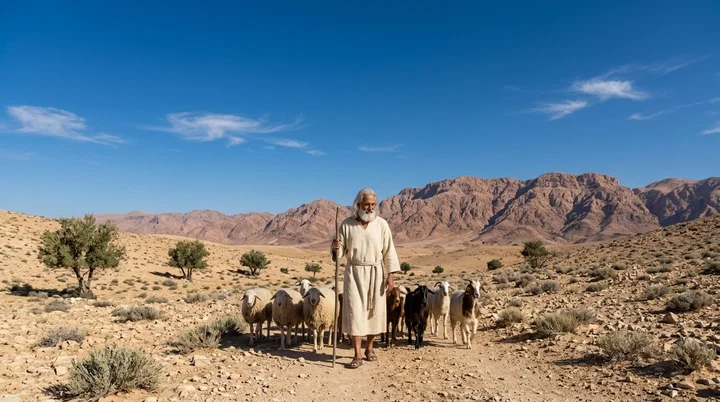
Pictures
Cross-references
- Acts 7:22
And Moses was learned in all the wisdom of the Egyptians, and was mighty in words and in deeds.
mighty in word and deed
- Exodus 3:1-10
Now Moses kept the flock of Jethro his father in law, the priest of Midian: and he led the flock to the backside of the desert, and came to the mountain of God, even to Horeb.
Moses’ years with Jethro precede God’s call from the burning bush.
Commentary
Each commentary is drawn from primary sources: the writings of Ellen G. White and Adventist pioneers and periodicals. Each commentary is separate. Its own words are not a quotation; follow the references to read the source passages.
Ellen G. White
6 sources
Moses had fled from Egypt and come to Midian.SG3 185.1–2PP 247.2 In that flight the Lord directed him to find a home with Jethro.PP 247.2 Jethro was priest and prince of Midian and a worshiper of God.ST Feb 19, 1880PP 247.2 He was Moses' God-fearing father-in-law, whose far-seeing judgment earned him honor among the people and whose influence on Moses was great.1SP 167.2–168.1
Jethro's daughters tended his flocks.1SP 167.1 When they left Moses at the well, Jethro rebuked them for leaving him without inviting him to share a meal and told them to call him back to eat, showing hospitality toward Moses.SG3 185.1–2 That call to eat bread led Moses to remain with him and after a time to marry one of his daughters.ST Feb 19, 18801SP 167.1PP 247.2
Moses then entered Jethro's service as keeper of his flocks.1SP 167.1PP 247.2Ms 14, 1896, par. 11 He stayed there forty years in the service of his father-in-law.PP 247.2 Being called to eat bread and keeping those flocks taught him what it means to be a true shepherd, for his training in Egypt as a mighty statesman and leader of armies had not taught the lessons essential for true greatness, so he needed humble duties to become a caretaker tender toward every living thing.Ms 14, 1896, par. 11 In keeping sheep and lambs his sympathies were called out and he learned to guard God's creatures with the tenderest care, attending to them though their voice could never complain of mistreatment, because God cares for all He has made, and in this lowly work he learned to be a tender shepherd for Israel.Ms 14, 1896, par. 11
Sources
Pioneers and periodicals
18 sources
At a fountain in Midian Reuel reproved his daughters for leaving the stranger without hospitality and bade them call him back to eat bread.ST May 19, 1898 So the fugitive from Egypt found a home with Jethro the priest of Midian, became his shepherd, and married one of his daughters.ST Feb 19, 1880ST Nov 27, 1901 He was forty, turning from Pharaoh's court to share slavery with his Hebrew brethren because his mother's early instruction had rooted him in the divine truth held by Abraham, Isaac and Jacob.ST Oct 11, 1883 His flight came because God's time had not yet come, and the long years of humble shepherd work in the desert curbed his eager spirit and trained him in patient, tender care to fit him for leading Israel.ST Jan 28, 1913RH Feb 4, 1873RH May 2, 1865ST Nov 27, 1901 That welcome also shows true worshipers were not all found in Israel, for God had His witnesses scattered among the nations.ST Apr 2, 1912
Place in Exodus Story
The verse belongs to the opening mainly historical division of Exodus covering chapters 1-18, and specifically to chapters 1-4 relating the birth and upbringing of Moses until he is called to be the deliverer of his people. It is included in the account of Israel's oppression in Egypt and the birth and rearing of Moses.ST Jan 20, 1909 It belongs to God's call to the kingdoms of earth told in Exodus 1 to 12, about three and one-half millenniums ago when Egypt ruled the world as the greatest of all kingdoms.ST Nov 14, 1906 Egypt was then acknowledged for might and power and skill and wisdom in statecraft, deifying her annually overflowing and fertilizing river as a god and worshiping the sun from whom her kings received title as representative of the sun-god upon the throne of men.ST Nov 14, 1906 At that time the few descendants of the nomadic patriarch Abraham sought supplies from her granaries after Joseph, a captive slave of the same people, taught Pharaoh how to store grain in plenteous years to become rich in famine and instituted a good land-law with easy combined rental and taxes.ST Nov 14, 1906 As prime minister he caused Egypt to prosper without oppression, and was honored with flourishing country and prospering people as long as his memory lived among Egypt's rulers.ST Nov 14, 1906
The verse stands in the time of Israel's long sojourn in Egypt, shown in the first five chapters of Exodus as an oppressed state surrounded by polytheism, idolatry, and licentiousness.ST Feb 28, 1906RH May 16, 1854 Israel had then well-nigh lost the knowledge of God and His laws, and Sabbath observance was difficult if not entirely impossible under slavery even if desired, so that while Israel might have kept the other nine commandments they could not have kept the Sabbath in that bondage.ST Feb 28, 1906RH May 16, 1854 Just when the time of the promise which God had sworn to Abraham drew nigh, Moses was qualified and commissioned by Jehovah to make the people know the statutes of God and His laws.ST Feb 28, 1906 For this Pharaoh at once reprimanded him because he made the people rest from their work and enforced stringent measures to crush out Sabbath observance.ST Feb 28, 1906 God wrought deliverance for them and brought them out with a mighty hand to where they could keep the Sabbath, and that deliverance is the reason Deuteronomy 5 assigns for why they were then required to keep it, not the design of its institution.RH May 16, 1854
The verse belongs to events in Moses' life when he was forty, the same period in which he visited his Israelite brethren and chose to identify with God's people rather than remain in Pharaoh's household. He left the court of Pharaoh to unite himself with the Hebrews in slavery because Jochebed had effectually instructed him in his early youth.ST Oct 11, 1883 Thus Moses possessed all the treasures of divine truth held by Abraham, Isaac, Jacob and his other ancestors.ST Oct 11, 1883 The verse belongs to the true early history of Moses, which includes his being hidden three months by his parents, his rescue in infancy and adoption by Pharaoh's daughter, and the experiences that led to his becoming Israel's chosen leader.ST Apr 13, 1904RH Jan 20, 1916 The account is not fabulous or mythological but accurate and reliable history, largely reproduced in the New Testament in Acts 7.ST Apr 13, 1904
At a fountain in Midian where people gathered to draw water, the verse records Reuel rebuking his daughters for leaving Moses without hospitality and telling them to call him back to eat bread.ST May 19, 1898 It belongs to the account of Moses fleeing to Midian and finding a home with Jethro, the priest of Midian.ST Feb 19, 1880ST May 19, 1898 There he became a shepherd for Jethro and later married one of Jethro's daughters.ST Feb 19, 1880ST Nov 27, 1901 It is part of the account of Moses's early life in Midian following his flight from Egypt, placed within the story of God preserving the seed despite attempts to destroy it.
Training and Wider Lessons
Moses fled for his life from the wrath of an offended king because God's time had not yet come, after a premature attempt to deliver Israel in his own strength prompted by his education and position in Egypt.ST Jan 28, 1913RH Feb 4, 1873 He found a home in the desert with the holy priest of Midian and took a shepherd's humble garb to lead Jethro's flocks for forty long years while his suffering people still groaned beneath the oppressor's yoke.ST Jan 28, 1913RH Feb 4, 1873 Those slow, tardy years of weary waiting were God's training to fit His chosen servant for his high and holy mission in preparation for God's call to deliver Israel from Egypt.ST Jan 28, 1913RH Feb 4, 1873 They curbed his eager and disappointed spirit and gave him just the experience needed to lead God's people as a tender, patient shepherd, teaching unwearied labor, patient waiting, and steady, earnest aim.RH Feb 4, 1873
That exile in Midian was endured patiently and prepared him for his work of leading Israel out of Egypt and for his long trial in the wilderness.RH May 2, 1865 The years of humble work as a shepherd developed care and tender concern for others, preparing him to lead Israel with fatherly compassion.ST Nov 27, 1901 Exodus 2:15-22 illustrates how God prepares and appoints a person for a special work, in that Moses' exile trained him in humility and in walking with God before his ministry.RH Nov 18, 1873 Because God chose and instructed Moses, opposition to him was counted as opposition to God, with the people's complaints against His servant being complaints against God.RH Nov 18, 1873
Moses stands as one of the men raised up by the Lord to fill a certain important place in His work and great plan, a man of the hour specially called and fitted by God for that particular occasion.RH Oct 19, 1916 His calling shows that God designates a special earthly place of labor for every faithful child to work in cooperation with Christ for the salvation of souls.RH Oct 19, 1916 His life is presented as an example offering children high ideals to imitate and showing how people accomplished wonderful things for God through faith in Him.RH Dec 14, 1911 True worshipers of God were not all found in Israel, for Jethro the priest of Midian was a worshiper of the true God, and when Moses fled from Egypt he found a place in Jethro's home, proving that God had His witnesses scattered among the nations.ST Apr 2, 1912
Sources