Exodus 2:21
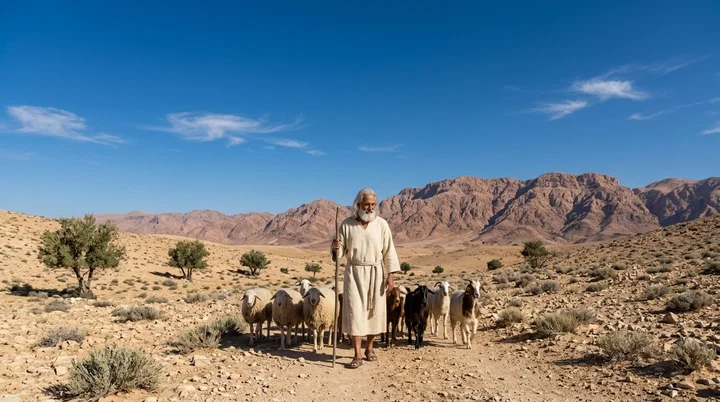
And Moses was content to dwell with the man: and he gave Moses Zipporah his daughter.
Translations
American King James Version, King James Version, KJV Cambridge Paragraph Bible, Webster Bible, Revised Version, American Standard Version
And Moses was content to dwell with the man: and he gave Moses Zipporah his daughter.
And Moses is willing to dwell with the man, and he giveth Zipporah his daughter to Moses,
And Moses consented to remain with the man; and he gave Moses Zipporah his daughter.
And Moses was well-pleased to dwell with the man,—and he gave Zipporah his daughter to Moses.
Berean Standard Bible, Majority Standard Bible
Moses agreed to stay with the man, and he gave his daughter Zipporah to Moses in marriage.
Moses was content to dwell with the man. He gave Moses Zipporah, his daughter.
And Moses was happy to go on living with the man; and he gave his daughter Zipporah to Moses.
And Moses agreed to dwell with the man: who gaue vnto Moses Zipporah his daughter:
Douay-Rheims (Challoner revision)
And Moses swore that he would dwell with him. And he took Sephora his daughter to wife:
Pictures
Cross-references
- Acts 7:29-30
Then fled Moses at this saying, and was a stranger in the land of Madian, where he begat two sons.
Recalls Moses’s sojourn in Midian before God called him.
- Numbers 12:1
And Miriam and Aaron spake against Moses because of the Ethiopian woman whom he had married: for he had married an Ethiopian woman.
Identifies Zipporah as the Cushite woman whose marriage prompted accusations against Moses.
- Exodus 3:1-10
Now Moses kept the flock of Jethro his father in law, the priest of Midian: and he led the flock to the backside of the desert, and came to the mountain of God, even to Horeb.
After settling in Midian, Moses is called to lead Israel out of Egypt.
- Exodus 18:17-24
And Moses’ father in law said unto him, The thing that thou doest is not good.
Jethro’s counsel to Moses led him to share the burden of leadership.
- Exodus 2:11-15
And it came to pass in those days, when Moses was grown, that he went out unto his brethren, and looked on their burdens: and he spied an Egyptian smiting an Hebrew, one of his brethren.
premature rescue attempt that forced flight
Commentary
Each commentary is drawn from primary sources: the writings of Ellen G. White and Adventist pioneers and periodicals. Each commentary is separate. Its own words are not a quotation; follow the references to read the source passages.
Ellen G. White
7 sources
After fleeing Egypt, Moses was content to settle and find a home and refuge with Jethro in Midian.ST Feb 19, 18801SP 167.1SG3 185.1–21SP 167.2–168.1PP 247.2 God directed Moses to Midian to that home with Jethro.PP 247.2 Jethro was the priest of Midian and a worshiper of God, and he was also prince of Midian.ST Feb 19, 18801SP 167.1SG3 185.1–2PP 247.2
Moses married Jethro's daughter Zipporah.ST Feb 19, 18801SP 167.1SG3 185.1–21SP 167.2–168.1PP 383.2–384.1 The marriage took place after Moses had dwelt there for a time, and Zipporah was one of Jethro's daughters.PP 247.2 Moses remained there forty years in the service of his father-in-law as keeper of his flocks.ST Feb 19, 18801SP 167.1SG3 185.1–2PP 247.2
In settling there Moses left the royal court and its privileges, and began a period of preparation through poverty and adversity for the work God had appointed him.1SP 167.2–168.1 Jethro's godly character and respected judgment strongly influenced Moses during this period.1SP 167.2–168.1 Moses exchanged his training in Egypt as a mighty statesman and leader of armies to become a tender of sheep for Jethro.Ms 14, 1896, par. 11
Egypt had not taught him the lessons essential for true greatness, so he needed experience in more humble duties to become a caretaker tender toward every living thing.Ms 14, 1896, par. 11 In keeping the flocks his sympathies were drawn out to the sheep and lambs, and he learned to guard these creatures of God with the tenderest care, though their voice could never complain of mistreatment and only their attitude might show it.Ms 14, 1896, par. 11 God cares for all the creatures He has made.Ms 14, 1896, par. 11 In that lowly station, working for God, Moses unlearned a harsh, overbearing spirit and learned what it means to be a true shepherd, becoming a tender shepherd fitted to care for Israel.Ms 14, 1896, par. 11
Zipporah was a Midianite, a descendant of Abraham and a worshiper of the true God, not a Hebrew, and this marriage offended family and national pride and drew ill-disguised contempt.PP 383.2–384.1 Zipporah was timid, retiring, gentle and affectionate, greatly distressed at suffering, and somewhat darker in complexion than the Hebrews, and she was later called a Cushite woman.PP 383.2–384.1 Moses sent her back to Midian on the way to Egypt to spare her witnessing the judgments on the Egyptians, and when she rejoined him in the wilderness she saw his burdens wearing his strength and told Jethro, who suggested measures of relief.PP 383.2–384.1 Miriam blamed Zipporah's influence for Moses no longer taking Miriam and Aaron into his counsels as before, and this became the chief reason for Miriam's hostility to her.PP 383.2–384.1
Sources
Pioneers and periodicals
18 sources
After fleeing Egypt Moses settled down contentedly with Jethro in Midian, keeping his flocks and taking Jethro's daughter Zipporah as his wife.ST Feb 19, 1880ST May 14, 1894 His flight came at forty years old, after being reared in Pharaoh's house and instructed in all the wisdom of the Egyptians, when his own self-directed attempt to deliver Israel failed.ST Jan 24, 1911RH Jun 6, 1912ST Oct 11, 1883 Those forty years of quiet shepherd life were a providential schooling in the desert to prepare him for God's call to lead Israel out of Egypt.ST Jan 28, 1913RH Feb 4, 1873 That long exile of toil, waiting and care for others taught him humility, meekness, faith, patience and how to walk with God for the wilderness trial ahead.RH May 2, 1865ST Nov 27, 1901RH Nov 18, 1873 Jethro himself was a priest of Midian who worshiped the true God, showing that God had witnesses scattered among the nations outside Israel.ST Apr 2, 1912
Exodus Setting and Flight
The history of Exodus 1 to 12 took place three and one-half millenniums ago, when Egypt was the greatest kingdom on earth, acknowledged for might and power and skill and wisdom in statecraft.ST Nov 14, 1906 Egypt deified its annually overflowing and fertilizing river as a god and worshiped the sun, from whom its kings received title as representative of the sun-god on the throne of men.ST Nov 14, 1906 Israel were then only the few descendants of the nomadic patriarch Abraham, who had sought supplies from Egypt's granaries and lived in Egypt without oppression and prospered.ST Nov 14, 1906 They prospered while Joseph, the captive slave of the same people, was honored as prime minister, taught Pharaoh to store grain in plenteous years to become rich in famine, instituted Egypt's easy rental and tax land-law, and his laws governed.ST Nov 14, 1906
The verse belongs to the first, mainly historical division of Exodus, in the opening section that begins with the oppression of Israel in Egypt and relates the birth and upbringing of Moses till he is called to be the deliverer of his people. It is included in the account of Moses's birth and rearing in Egypt and his later life before God calls him to return to Egypt and deliver Israel.ST Jan 20, 1909 The events of Exodus 1 to 14 would not be expected to obtain direct mention in the historical records of Egypt, because nothing was ever registered on the public monuments except successes and triumphs.RH Apr 23, 1908
It belongs to the true early history of Moses recorded in Exodus 2, which includes his being hid three months by his parents, his adoption by Pharaoh's daughter, and his flight into the land of Midian to dwell there.ST Apr 13, 1904 The same account is largely reproduced in Acts 7, showing these events are no fable or myth but are corroborated in the New Testament.ST Apr 13, 1904 That being brought up in Pharaoh's house means, as Acts 7:20-31 makes clear, that he was instructed in all the wisdom of the Egyptians, whose wide scope is further shown by recent Egyptian explorations.RH Jun 6, 1912
Moses left the court of Pharaoh when forty years old to unite himself with the Hebrews in slavery, because Jochebed, the daughter of Levi and granddaughter of Jacob, had instructed him effectually in his early youth.ST Oct 11, 1883 She gave him all the treasures of divine truth possessed by his ancestors from Abraham, Isaac, Jacob, and Enoch, so that with the highest measure of inspiration ever given to man Moses was well instructed concerning the events of the last day.ST Oct 11, 1883 The verse belongs to the account of his early life, his flight to Midian after his self-directed attempt to deliver Israel failed, and the beginning of his forty years of wilderness schooling while tending sheep.ST Jan 24, 1911 It belongs to his preparation in Midian before God called him to lead Israel out of Egypt, taking place after Moses was forty when he left Egypt and went to Midian, with the verse's details about his life there part of the same period described in the parallel accounts.
Life in Midian
After fleeing Egypt Moses was content to dwell with the man, accepting a home with Jethro the priest of Midian.ST Feb 19, 1880ST May 14, 1894 He settled in Midian and remained there forty years after fleeing Egypt, serving his father-in-law as keeper of flocks and working as a shepherd for his employer.ST Feb 19, 1880ST May 14, 1894 During that time he married Jethro's daughter Zipporah, one of Jethro's daughters, and his life there began a period of humble training.ST Feb 19, 1880ST May 14, 1894 A fountain served as the place of meeting and family connection in the account of his flight to Midian.ST May 19, 1898
Jethro was the priest of Midian and a worshiper of the true God, in whose home Moses found a place when he fled from Egypt.ST Apr 2, 1912 This means not all of God's true people were found in Israel, for God had His witnesses scattered everywhere through the nations.ST Apr 2, 1912
The settling in Midian with Jethro and marrying his daughter Zipporah marks the beginning of Moses's long, quiet life as a shepherd.ST Jan 28, 1913RH Feb 4, 1873 It followed his premature act in trying to deliver Israel in his own strength, trusting his Egyptian education and position.ST Jan 28, 1913 He dwelt there content to keep sheep for forty years as a postgraduate course in the desert in God's providence to prepare him for God's call to deliver Israel from Egypt and to lead Israel out.ST Jan 28, 1913RH Feb 4, 1873 That patient work and waiting prepared him for leading Israel.RH Feb 4, 1873RH May 2, 1865
That long, humble life of toil and hardship in exile taught him humility, faith, patience, self-denial, and tender care for others, and how to walk with God.ST Nov 27, 1901RH Nov 18, 1873 It developed in him meekness needed for the work God had prepared for him and what was needed through work and waiting to lead Israel and to endure the long trial in the wilderness.RH May 2, 1865ST Nov 27, 1901 By patiently enduring his exile in Midian he was prepared for the work of leading Israel out of Egypt and for his ministry.RH May 2, 1865RH Nov 18, 1873
Moses married Zipporah the daughter of Jethro, a Midianite, instead of marrying an Israelite.RH Jun 12, 1913 This marriage was counted as a past failure of Moses that Miriam and Aaron made the basis of present accusation against him at Hazeroth.RH Jun 12, 1913 Their jealousy had been aroused by Jethro's counsel to Moses in the wilderness, which God blessed to the good of Moses and the people, when it burst out.RH Jun 12, 1913 Moses belongs to the men God raises up in the church and in the world to fill certain important places in His work in His great plan, a man of the hour specially called and fitted for the particular occasion.RH Oct 19, 1916 As Moses was truly called so every faithful child is truly called to the special place on earth where God has stationed him to work for God.RH Oct 19, 1916
Sources