Exodus 3:1
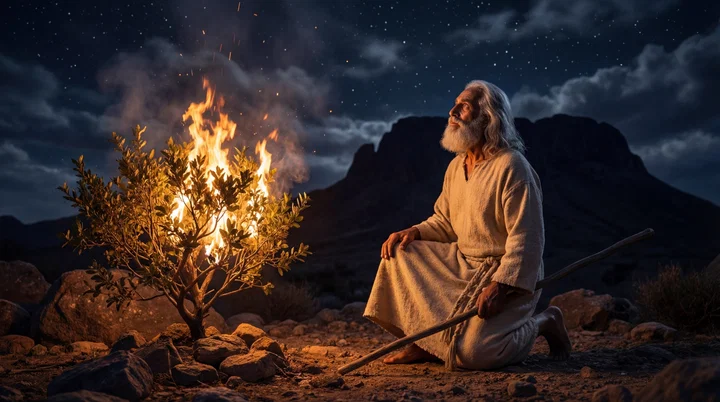
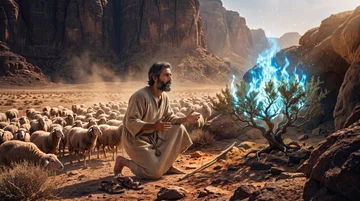
Now Moses kept the flock of Jethro his father in law, the priest of Midian: and he led the flock to the backside of the desert, and came to the mountain of God, even to Horeb.
Translations
American King James Version, King James Version, KJV Cambridge Paragraph Bible
Now Moses kept the flock of Jethro his father in law, the priest of Midian: and he led the flock to the backside of the desert, and came to the mountain of God, even to Horeb.
Now Moses kept the flock of Jethro his father-in-law, the priest of Midian: and he led the flock to the backside of the desert, and came to the mountain of God, even to Horeb.
Now Moses was keeping the flock of Jethro his father in law, the priest of Midian: and he led the flock to the back of the wilderness, and came to the mountain of God, unto Horeb.
Now Moses was keeping the flock of Jethro his father-in-law, the priest of Midian: and he led the flock to the back of the wilderness, and came to the mountain of God, unto Horeb.
And Moses hath been feeding the flock of Jethro his father-in-law, priest of Midian, and he leadeth the flock behind the wilderness, and cometh in unto the mount of God, to Horeb;
And Moses tended the flock of Jethro his father-in-law, the priest of Midian. And he led the flock behind the wilderness, and came to the mountain of God — to Horeb.
Now, Moses, was shepherding the flock of Jethro his father-in-law priest of Midian,—so he led forth the flock behind the desert, and came in unto the mountain of God to Horeb.
Berean Standard Bible, Majority Standard Bible
Meanwhile, Moses was shepherding the flock of his father-in-law Jethro, the priest of Midian. He led the flock to the far side of the wilderness and came to Horeb, the mountain of God.
Now Moses was keeping the flock of Jethro, his father-in-law, the priest of Midian, and he led the flock to the back of the wilderness, and came to God’s mountain, to Horeb.
Now Moses was looking after the flock of Jethro, his father-in-law, the priest of Midian: and he took the flock to the back of the waste land and came to Horeb, the mountain of God.
When Moses kept the sheepe of Iethro his father in lawe, Priest of Midian, and droue the flocke to the backe side of the desert, and came to the Mountaine of God, Horeb,
Douay-Rheims (Challoner revision)
Now Moses fed the sheep of Jethro his father in law, the priest of Madian: and he drove the flock to the inner parts of the desert, and came to the mountain of God, Horeb.
Pictures
Cross-references 20 of 38
- Exodus 3:10
Come now therefore, and I will send thee unto Pharaoh, that thou mayest bring forth my people the children of Israel out of Egypt.
God commissions Moses to bring Israel out of Egypt.
- Exodus 2:11-15
And it came to pass in those days, when Moses was grown, that he went out unto his brethren, and looked on their burdens: and he spied an Egyptian smiting an Hebrew, one of his brethren.
Moses recalls killing the Egyptian and fleeing to Midian.
- Acts 7:29-30
Then fled Moses at this saying, and was a stranger in the land of Madian, where he begat two sons.
Moses fled to Midian, then encountered God in the wilderness after forty years.
- Acts 7:30
And when forty years were expired, there appeared to him in the wilderness of mount Sina an angel of the Lord in a flame of fire in a bush.
Stephen recounts Moses’ call from the burning bush after forty years in Midian.
- 1 Kings 19:8
And he arose, and did eat and drink, and went in the strength of that meat forty days and forty nights unto Horeb the mount of God.
Both texts identify Horeb as the mountain of God reached after a journey.
- Exodus 3:14
And God said unto Moses, I AM THAT I AM: and he said, Thus shalt thou say unto the children of Israel, I AM hath sent me unto you.
God reveals his name as the self-existent I AM at Horeb.
- Exodus 17:6
Behold, I will stand before thee there upon the rock in Horeb; and thou shalt smite the rock, and there shall come water out of it, that the people may drink. And Moses did so in the sight of the elders of Israel.
The rock at Horeb provides water for the thirsty people.
- Hebrews 11:24-27
By faith Moses, when he was come to years, refused to be called the son of Pharaoh’s daughter;
Moses’ faithful choices and endurance preceded his service to God.
- Joshua 5:15
And the captain of the LORD’s host said unto Joshua, Loose thy shoe from off thy foot; for the place whereon thou standest is holy. And Joshua did so.
Both encounters with God’s holy presence occur as the men undertake their duties.
- Exodus 3:12
And he said, Certainly I will be with thee; and this shall be a token unto thee, that I have sent thee: When thou hast brought forth the people out of Egypt, ye shall serve God upon this mountain.
God promises Moses that Israel will worship him on this mountain.
- Exodus 3:5
And he said, Draw not nigh hither: put off thy shoes from off thy feet, for the place whereon thou standest is holy ground.
God’s presence makes the ground holy and calls for reverence.
- Exodus 4:18
And Moses went and returned to Jethro his father in law, and said unto him, Let me go, I pray thee, and return unto my brethren which are in Egypt, and see whether they be yet alive. And Jethro said to Moses, Go in peace.
Another passage naming Moses’ father-in-law.
- Mark 12:26
And as touching the dead, that they rise: have ye not read in the book of Moses, how in the bush God spake unto him, saying, I am the God of Abraham, and the God of Isaac, and the God of Jacob?
God’s words to Moses at the bush affirm that the dead rise.
- Exodus 19:18
And mount Sinai was altogether on a smoke, because the LORD descended upon it in fire: and the smoke thereof ascended as the smoke of a furnace, and the whole mount quaked greatly.
The mountain where God’s glory appeared was also where the law was given.
- Exodus 2:18
And when they came to Reuel their father, he said, How is it that ye are come so soon to day?
Names Reuel as Moses’ father-in-law
- Amos 7:15
And the LORD took me as I followed the flock, and the LORD said unto me, Go, prophesy unto my people Israel.
Both were called while following the flock.
- Exodus 34:28
And he was there with the LORD forty days and forty nights; he did neither eat bread, nor drink water. And he wrote upon the tables the words of the covenant, the ten commandments.
Moses fasted forty days on the mountain in communion with God.
- Joshua 1:1-2
Now after the death of Moses the servant of the LORD it came to pass, that the LORD spake unto Joshua the son of Nun, Moses’ minister, saying,
Joshua is called to lead Israel after Moses.
- Exodus 4:27
And the LORD said to Aaron, Go into the wilderness to meet Moses. And he went, and met him in the mount of God, and kissed him.
Moses and Aaron meet at the same mountain of God.
- Exodus 18:12
And Jethro, Moses’ father in law, took a burnt offering and sacrifices for God: and Aaron came, and all the elders of Israel, to eat bread with Moses’ father in law before God.
Another passage naming Jethro in relation to Moses.
Commentary
Each commentary is drawn from primary sources: the writings of Ellen G. White and Adventist pioneers and periodicals. Each commentary is separate. Its own words are not a quotation; follow the references to read the source passages.
Ellen G. White
28 sources
Moses was keeping the flock of Jethro in Midian, and he led it to the backside of the desert to Horeb, the mountain of God, where God met him at the burning bush to commission him to deliver Israel.PP 251.2–252.1ED 62.3–63.1GW 332.3–333.1ST Mar 31, 1881 Though educated in Egypt as a mighty statesman, general and prospective ruler, he was not ready to lead, for he tried to deliver by his own force when he killed an Egyptian.MH 474.3–475.2CT 406.2Ms 8a, 1891, par. 25–27 God therefore gave him forty years of lowly shepherd work in the solitude of the desert as essential discipline and preparation for his special work.MH 474.3–475.2CT 406.2ED 62.3–63.1 There caring for weak and straying sheep taught him faithfulness, meekness, patience, humility, self-forgetfulness and tender care, while communion with God in the school of nature taught him to know God, trust Him constantly and work as unto Him.MH 474.3–475.2CT 406.24T 442.1ED 62.3–63.1 At the same time the hardship and solitude undid the pride, self-sufficiency and wisdom of Egypt, humbling and purifying him until he was self-distrustful, reverent and meek and ready to exchange his shepherd's crook for the rod of authority.MH 474.3–475.2ED 62.3–63.1Ms 45, 1890, par. 11–13PP 247.3–248.1OEWP 31.1–32.2
Setting and Call at Horeb
Exodus 3:1 finds Moses in Midian as a humble shepherd keeping the flock of Jethro, where he remained for forty years in lowly shepherd work before his great work.PP 251.2–252.1ED 62.3–63.1GW 332.3–333.1Ms 69, 1912, par. 1PP 247.2 Those forty years caring for the flocks of Jethro were his desert experience before his call to deliver Israel, a time that looked like being cut off from his mission but was discipline essential for its fulfillment.ED 62.3–63.1GW 332.3–333.1ST Mar 31, 1881 Only when that faithful shepherd training was complete was he sent to deliver Israel, for he could not be taken straight from the king's court to do his appointed work.ED 62.3–63.1GW 332.3–333.1Ms 69, 1912, par. 1 Together with his learning as a learned man and mighty warrior, that schooling in affliction and adversity trained, qualified and fitted him to lead the vast army of Israel to Canaan and stand at their head.Ms 69, 1912, par. 1
He led the flock to the backside of the desert and came to Horeb, the mountain of God.PP 251.2–252.1ST Mar 31, 1881 That was a place of mountain solitudes and altitudes in the wilderness of Midian and Sinai, among plains and mountains where he was shut in by God's presence and surrounded by evidence of God's power.DA 102.3–4DA 360.1–3DA 290.2–291.2 Away from his usual work among the flocks and apart from busy activity, he could commune with God in the quiet of nature as a place of communion and worship.DA 360.1–3DA 290.2–291.2 His mountain solitude there stands contrasted with John's wilderness home before the heights of Moab.DA 102.3–4
There God met him at the burning bush as the Angel, the I AM, and spoke with him.PP 251.2–252.1Ms 8a, 1891, par. 25–279MR 62.1 At Horeb God called him from the bush and began his commission to deliver Israel and carry God's message to Pharaoh, marking the setting of his divine call and the beginning of his mission.PP 251.2–252.1ST Mar 31, 1881ST Jul 27, 1915 Speaking with the Angel in the bush came before hearing the message for Pharaoh, so communion with God precedes service for God.ST Jul 27, 1915 The encounter shows that God's work would be carried out through a humble servant and that His presence calls for reverence.PP 251.2–252.1
Shepherd Training for Deliverance
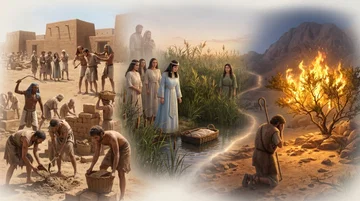
Moses had been raised as the king's grandson and prospective heir and ruler, with thorough training in the highest civil and military wisdom of Egypt as a mighty statesman, leader of armies and general, yet that education had not taught him true greatness and left him unready for his work.MH 474.3–475.2CT 406.2Ms 14, 1896, par. 11FE 342.1 He supposed he could deliver Israel by force and for praise, and in that hasty, impetuous attempt he killed an Egyptian and hid him in the sand.MH 474.3–475.2Ms 8a, 1891, par. 25–279MR 62.1 His Egyptian standing as prospective ruler could not carry him straight from the palace and the court to the deliverance of his people.MH 474.3–475.2GW 332.3–333.1
God therefore appointed him to forty years keeping sheep in the rocks, mountains, wilds and valleys of the desert of Midian, a special preparation for his special work.MH 474.3–475.2ED 62.3–63.1GW 332.3–333.19MR 62.1FE 342.1 That time looked like being cut off forever from his life mission, but it was providential discipline essential to its fulfillment.MH 474.3–475.2ED 62.3–63.1 Only when that humble shepherd training was complete was he met at the bush and sent to deliver Israel.MH 474.3–475.2GW 332.3–333.19MR 62.1
Leading the flocks through mountain wilds and valley pastures was directed to give him experience in caretaking, thoughtfulness and tender solicitude, to make him a faithful shepherd ready to take charge of God's people.MH 474.3–475.24T 442.1ED 62.3–63.1 There he learned faith, meekness, patience, humility, self-forgetfulness, tenderness and long-suffering, with self-mastery that would give him wisdom to govern an ignorant and undisciplined multitude.MH 474.3–475.2ED 62.3–63.1 He cared for the weak, nursed the sick, sought the straying, bore with the unruly, tended lambs and nurtured the old and the feeble, patiently hunting and searching for stray sheep.MH 474.3–475.2Ms 8a, 1891, par. 25–279MR 62.1 He learned to guard creatures whose voice could never complain of mistreatment with the tenderest care, watching their condition and drawing out his sympathies toward every living thing, because God cares for all the creatures He has made.MH 474.3–475.2Ms 14, 1896, par. 11
In the solitude of the mountains, in the school of nature with Christ as teacher, the God of nature taught him the highest and grandest wisdom.MH 474.3–475.2CT 406.2FE 342.1 That schooling drew him nearer to the chief Shepherd and united and bound his soul closer to the Holy One of Israel.MH 474.3–475.2CT 406.2FE 342.1 He learned to do faithfully as unto God the work committed to him, to recognize God's presence in his surroundings while all nature spoke of the unseen One, to know God as a personal God and grasp His presence more fully by meditating on His character, and to find refuge in the everlasting arms.MH 474.3–475.2 In that solitude he contemplated and learned humility, meekness, faith and trust with a humble manner of living, gaining simple, unwavering faith and constant trust in the Lord that all instruction in the king's palace was unable to impart.MH 474.3–475.2CT 406.2FE 342.1 Through years of communing with God in the mountain altitudes and at Horeb he was prepared to see God with a single heart and to learn of God in order to become God's representative, with communion coming before the message to Pharaoh.ED 62.3–63.1Ms 130, 1898, par. 4ST Jul 27, 1915
In the stern simplicity, solitude and hardship of the wilderness he had much to unlearn through long, severe mental and moral discipline.ED 62.3–63.1PP 247.3–248.1Ms 130, 1898, par. 3 The impressions made on his mind and character by Egypt disappeared and were undone and softened little by little, including affection for his foster mother, position as grandson of the king, luxury and vice alluring in ten thousand forms, and the refinement, subtlety and mysticism of a false religion.ED 62.3–63.1PP 247.3–248.1 The effects of Egyptian wisdom, the false theories instilled by training to be a general of armies, and all the idolatrous rubbish of heathen lore from the influences surrounding him and the impressions from what his eyes had looked upon had to be removed and corrected as he learned to obey and to rely on God's power rather than human strength and wisdom.PP 247.3–248.1OEWP 31.1–32.2Lt 47, 1895, par. 75–77Ms 130, 1898, par. 3
That proving, testing and trying in the school of affliction and adversity humbled his soul before God, taught him to understand himself and learn what poverty is, and purged his defects as he did God's will.Ms 45, 1890, par. 11–13Ms 69, 1912, par. 1Lt 77, 1902, par. 7–8 It ended his self-powered plan to deliver by force, sweeping away pride and self-sufficiency.MH 474.3–475.2Ms 11, 1903, par. 9–11 He came forth from the furnace refined and purified with another spirit different from his younger years, self-distrustful yet strengthened as a thinker and doer of God's word, very meek above all men, patient, reverent and humble, ready to exchange his shepherd's crook for the rod of authority.MH 474.3–475.2Ms 45, 1890, par. 11–13Lt 77, 1902, par. 7–8Ms 11, 1903, par. 9–11 Jethro also helped him toward a more correct faith during those years.Ms 45, 1890, par. 11–13
Pattern for Future Service
Usefulness does not come from human learning or confidence in ability, but from humility, trust in God, and obedience to His commands, for God works through a willing, disciplined instrument taught dependence on Him.OEWP 14.1–16.2 Moses had been raised as the prospective ruler of Egypt, yet he could not be taken straight from the king's court to do his appointed work as deliverer, but after forty years as a faithful shepherd with Jethro's flock at Horeb, only when that training was complete was he sent to deliver Israel.GW 332.3–333.1 Useful and honored workers receive their preparation amid faithful labor in the most lowly positions in life, and the account of the call marks the beginning of the commission for which he had been prepared.OEWP 14.1–16.2GW 332.3–333.1 He was appointed to forty years of communing with God in the mountain altitudes before he could be God's instrument, and speaking with the Angel in the burning bush came before hearing God's message to Pharaoh, so communion with God precedes service for God.ST Jul 27, 1915
He was directed to spend time keeping and leading a flock in order to obtain experience in caretaking, thoughtfulness, and tender solicitude, that as a faithful shepherd he might be ready when called to take charge of God's people.4T 442.1 The same shepherd experience is essential for those who preach the truth, who must first drink at the life-giving fountain themselves in order to lead souls to it.4T 442.1 His forty years as a humble shepherd caring for Jethro's flocks in Midian, where he learned what poverty is, was education in the school of affliction and adversity by which God trained, qualified and fitted him, together with his learning as a learned man and mighty warrior skilled in warfare, to lead the vast army of Israel to Canaan and to stand at their head.Ms 69, 1912, par. 1 That keeping of sheep was training under God to fit him to train others, yet he had much to unlearn through the severest mental and moral discipline worked in him over a long time, for his instruction in the Egyptian courts to make him a general of armies had instilled false theories, and the influences surrounding him and the impressions his eyes had looked upon could not be easily shaken off, so all the idolatrous rubbish of heathen lore had to be removed little by little.Ms 130, 1898, par. 3
In his humble sphere as a shepherd he gave himself to God with the whole soul, using his talents to do God's work and listening for His commands that he might obey them.4T 612.2–613.1 Willing obedience gives vital energy and power to the soul and transforms character, so he became great, eloquent, patient, self-reliant, and competent to do the greatest work ever entrusted to mortal man, with increase of talents and a work enduring as the sun done both for himself and for those for whom he labors, however limited his capacity, acceptable to God.4T 612.2–613.1 Long service keeping the flocks taught him true humility, and the burden of God's work laid upon him made him a man of power, yet the call still found him inefficient, hesitating, self-distrustful, and overwhelmed by the command to deliver Israel.4T 611.1–2 In the fear of God he accepted the trust, and he did not bring the work down to his own deficiency but in the strength of God put forth the most earnest efforts to elevate and sanctify himself for his sacred mission.4T 611.1–2 He would never have been prepared had he waited for God to do the work for him, for light from heaven comes to those who feel their need and seek for it as for hidden treasures, who exert to the utmost the powers God has given, who pray much and exercise the mind vigorously, and who pass through severe mental and moral discipline so God can combine divine power with human effort instead of their remaining weak and inefficient in inactivity.4T 611.1–2
Away from his usual work among the flocks in the wilderness of Sinai he could be apart from busy activity and commune with God.DA 360.1–3 The disciples likewise needed to withdraw from their labors to be instructed by Christ and learn that their strength came from God, not themselves.DA 360.1–3 In the wilderness of Midian among the mountains he was shut in by God's presence and surrounded by evidence of God's power, where Christ met and communed with him.DA 102.3–4DA 290.2–291.2 Quiet nature could thus serve as a place of communion and worship, while his mountain solitude is contrasted with John's wilderness home which lay before the heights of Moab.DA 102.3–4DA 290.2–291.2
His experience as a mighty statesman and leader of armies in Egypt did not teach the lessons essential for true greatness, for he needed humble duties as a caretaker to become tender toward every living thing.Ms 14, 1896, par. 11 In caring for the sheep and lambs his sympathies were drawn out and he learned to guard these creatures of God with the tenderest care, watching their condition though their voice could never complain of mistreatment, because God cares for all the creatures He has made.Ms 14, 1896, par. 11 Working for God in this lowly station taught him to be a tender shepherd for Israel, and condemns a harsh, overbearing spirit in dealing with others.Ms 14, 1896, par. 11 Trained as a general, he had thought deliverance would come by force, and when he saw an Egyptian striking an Israelite he killed the Egyptian and fled to Arabia where for forty years he kept sheep, and those years swept away his pride and self-sufficiency and made him patient, reverent, humble, very meek above all men on the face of the earth.Ms 11, 1903, par. 9–11 Self-sufficiency must therefore not be cherished, humility and meekness must be learned, God must be walked humbly before, and imperiled souls must be helped gently and not driven farther from Christ.Ms 11, 1903, par. 9–11
Sources
Pioneers and periodicals
67 sources
Moses, about eighty years old after forty years exiled from Egypt, was tending the flock of Jethro his father-in-law the priest of Midian on the far side of the wilderness in Arabia when he came to Horeb, the mountain of God of which Sinai is a peak.ST Jan 24, 1911ST Nov 27, 1901ST Jan 28, 1913ST Sep 20, 1899 His long shepherding in solitude was God's training to unlearn Egypt's wisdom and to learn humility, patience, dependence, and tender care for the weak, fitting him to shepherd Israel to freedom.RH Mar 23, 1869ST Mar 8, 1910ST Jun 17, 1889 There God met him without human counsel to commission him to return to Egypt, deliver Israel from bondage, and give the law to the world.ST Dec 2, 1880RH May 11, 1869ST Oct 21, 1930 The One who appeared and spoke from the unconsumed burning bush was Christ Himself, the Angel of the Lord and Protector of Israel, whose presence made the ground holy.ST Jul 23, 1912ST Jul 30, 1894ST Mar 18, 1903ST Jul 30, 1894 That bush burning yet not consumed showed God's people preserved in affliction, and His words as the God of Abraham, Isaac, and Jacob prove the dead will rise.ST Dec 2, 1880ST Jul 7, 1887ST Jun 15, 1904
Words Place and Time
The flock Moses kept belonged to Jethro, his father-in-law, the priest of Midian. The man called Reuel in Exodus 2:18 is either another name for this same Jethro, since one man could bear two names, or he was Jethro's father, with father in Exodus 2:18 meaning ancestor.ST May 10, 1910 Jethro was a God-fearing man, one of many outside Israel who had knowledge of the Most High.
To lead the flock to the backside of the desert means to lead it to the far side of the wilderness.ST Nov 27, 1901 That country was a wild and rugged part of Arabia, identified as the Sinaitic Peninsula, the ancient land of Midian.RH Aug 22, 1912 There Moses came to Horeb, called the mountain of God.ST Nov 27, 1901ST May 14, 1894
Horeb bears that name because it was honored by God's presence, and God's presence makes a place holy.RH Feb 5, 1901ST Aug 27, 1896 Sinai is one of its peaks, where God manifested His glory and presence, so that Horeb lies in the shadow of Sinai and in its vicinity.ST Sep 20, 1899ST Jan 30, 1907 It is the mount to which the Lord called His people, where up into the mount God twice called Moses and communed with him forty days and nights, where Moses and Aaron met before meeting Pharaoh, where God revealed His presence in majesty, power, and love in the giving of His law, where Moses communed with his Creator and Redeemer face to face as a man talks with his friend and twice for forty days ate and drank nothing sustained by God's presence, and where more than six centuries later Elijah fled and communed with God forty days without eating or drinking.ST Sep 20, 1899ST Aug 27, 1896 There Israel later spent two years learning the law of the Most High.ST Jan 30, 1907
Horeb was familiar pasture ground where Moses as shepherd many times led the sheep and rested them at the feet of a great rock in its shadow from the heat, indeed the shadow of a great rock in a weary land, which refreshed his weary heart when he returned there with Israel.RH May 29, 1913 It is the place where he heard God's call to deliver Israel, pleaded for God to send some other man, and received the promise that after bringing the people out of Egypt they would serve God upon that mountain.RH May 29, 1913 By seeing and walking but a day at a time through the wonderful events that followed he learned lessons of divine power, resource, and love that fitted him to bear words of encouragement to the Son of God in His time of temptation and trial.RH May 29, 1913 The same time-remembered rock in whose shadow he had rested his sheep is the rock he later smote so that water flowed out not as a feeble trickling stream but as a mighty fountain running down like rivers.RH May 29, 1913
The verse comes after Moses fled Egypt following his failed self-sent attempt to deliver Israel, and then spent forty years in Midian tending sheep in exile and in schooling in the wilderness.ST Jan 24, 1911ST Dec 25, 1901ST Jan 28, 1913 He began those forty years feeling all-sufficient in Egyptian education and knowledge of warfare and met failure, and when God called him here he felt utterly insufficient, yet his mission was successful.ST Jan 24, 1911 After forty years there, discouraged and alone, God called him and sent him back to Egypt to deliver Israel from bondage, humble Egypt, lead the people to freedom, and give the world a code of laws. He was about eighty years old when Jehovah took him up from life as a shepherd in the desert for the great work of becoming the deliverer and leader of Israel, and there the Lord appeared to him in the burning bush.ST Dec 25, 1901 The events are dated to about 1493 B.C. in Usher's chronology.ST May 14, 1894
Midian Training of Moses
Moses came to Midian after a failed, self-sent attempt to deliver Israel in which he killed an Egyptian, running forty years ahead of God.ST Jan 24, 1911RH Dec 30, 1902RH Jun 12, 1913 Affliction drove him out of Egypt, and mere sympathy for his brethren did not qualify him to lead them.RH Aug 11, 1863GSAM 198.3–199.1 His call at Horeb therefore came only after forty years tending sheep, and it supplied a divine commission that would prepare Israel to accept him.ST Jan 24, 1911GSAM 198.3–199.1
Learning in all the wisdom of the Egyptians and being mighty in words and deeds did not fit him to lead Israel from bondage.ST Mar 8, 1910ST Jun 17, 1889ST Sep 24, 1896 Keeping sheep was God's postgraduate and graduating course, given to unlearn worldly book culture and to make knowing God the basis of all knowledge.ST Mar 1, 1899ST Sep 24, 1896 That shepherd schooling taught man's littleness and God's greatness as Egypt never could.ST Jun 17, 1889ST Dec 8, 1898ST Sep 24, 1896ST Oct 9, 1901 Those without book culture in the world's schools need not be discouraged, for they have less to unlearn.ST Mar 1, 1899
The forty years alone with God formed humility, patience, submission, dependence, wisdom, tender solicitude, earnest devotion, constant self-sacrifice, compassion and tenderness, with true knowledge of his own weakness and needs.RH Mar 23, 1869ST Mar 8, 1910ST Jun 17, 1889 He began those years feeling all-sufficient in Egyptian education and knowledge of warfare, but when God called he felt utterly insufficient.ST Jan 24, 1911ST Sep 24, 1896 Only when that humbling was complete, when he no longer trusted his own ability and asked for another to be sent, was he ready and his mission made successful.ST Jan 24, 1911RH Mar 23, 1869ST Jun 15, 1904ST Sep 24, 1896 His years had not been wasted, for Israel's slavery was at the same time purifying the people.ST Jun 15, 1904
Shepherding Jethro's flock night and day fitted him to lead God's flock out toward Canaan and freedom.ST Mar 8, 1910ST Jun 17, 1889 Caring for the feeble and young and wounded trained him to become a tender and patient shepherd of God's people.RH Feb 4, 1873ST Jun 17, 1889ST Dec 8, 1898ST Jan 8, 1902 That long, humble work in exile, while Israel remained oppressed, made the waiting years purposeful through God's timing and discipline.RH Feb 4, 1873 The backside of the desert was God's school apart from the din and bustle of men, where fellowship in the wilderness makes God's voice clearer because no babble of tongues confuses it.RH Dec 7, 1911RH Feb 4, 1904 There in secret communion, mountain solitude, and observation of nature he was taught and equipped for battle, balanced in physical, mental, and spiritual powers, and prepared to face Pharaoh without fear and then step forth publicly as deliverer.RH Dec 7, 1911RH Feb 4, 1904ST Oct 29, 1902 During that time he wrote Job and Genesis.ST Mar 31, 1881RH Jan 25, 1912
Thus prepared, he stands as the one great figure of the ages, second only to the Lord Jesus Christ whom he typified.ST Mar 8, 1910 Through the Book he helped mold under God marvelous civilizations have grown, giving wonderful lessons to the world.ST Mar 8, 1910 God had a deeper and grander thought for Israel and the Hebrews than Moses had, and afterward used him wonderfully in leading His people forward.RH Jun 12, 1913
Call at Burning Bush
At Horeb God met Moses to commission him to leave the flock, return to Egypt, humble Egypt, deliver Israel from oppression and bondage, and lead the people out to freedom.ST Dec 2, 1880RH May 11, 1869ST Oct 21, 1930RH May 13, 1915 That commission included giving the world a code of laws, and it was God's definite program for that moment and for the crisis of Israel's oppression.ST Oct 21, 1930ST Jan 20, 1909RH May 13, 1915 The setting of Exodus 3:1 places Moses with Jethro's flock at Horeb, where this meeting and sending took place.ST Dec 2, 1880RH May 11, 1869ST Oct 21, 1930
The call was direct and impressive, coming without any suggestion or influence from men.GSAM 198.3–199.1 It did not arise from the counsel of Jethro nor from the suffering condition of Israel in Egypt, but from the voice of God speaking from the burning bush with an audible voice and unmistakable evidence.GSAM 198.3–199.1 It laid hold of his conscience with an unyielding grip until he surrendered and promised obedience to the heavenly calling. Everyone chosen to lead in God's work must be especially directed by the Lord, and Moses received full instruction from the Lord at every step with an abundance of the Spirit to guide with wisdom the charge entrusted to him, while the divine commission prepared the Israelites to accept him as their leader.GSAM 198.3–199.1ST Feb 27, 1896
The Angel appeared in a flame of fire out of the midst of a bush that burned yet was not consumed, with not a twig nor a leaf consumed.RH May 11, 1869ST Mar 24, 1887RH Oct 29, 1914 God called to him out of the midst of the bush, forbade nearer approach, and commanded him to remove his shoes because the very spot was holy ground.RH May 11, 1869ST Mar 24, 1887RH Oct 29, 1914 There He declared Himself the God of his father, the God of Abraham, the God of Isaac, and the God of Jacob.ST Mar 24, 1887RH Oct 29, 1914 Moses trembled and hid his face in holy reverence because he was afraid to look upon God.ST Mar 24, 1887RH Oct 29, 1914
The bush enveloped in flame yet unconsumed is an emblem of God's people preserved amid affliction.ST Dec 2, 1880ST May 14, 1894 Israel remained alive in Egypt's furnace of servitude and was not destroyed by affliction, and the church likewise endures fiery trials without being destroyed.ST Dec 2, 1880ST May 14, 1894 Israel's suffering under slavery was purifying the people, and the burning bush showed that Moses' long years in Midian had not been wasted once he had learned his own weakness and God's greatness.ST Jun 15, 1904ST May 14, 1894 The events are dated to about 1493 B.C. in Usher's chronology.ST May 14, 1894
God placed Himself under test to prove His word to Moses, submitting to having His word tested by visible signs in order to satisfy His servant who was slow to accept it without such test.ST May 1, 1901 This shows that God invites men to prove Him and makes reasonable His requirement that human love be thoroughly proved.ST May 1, 1901 Stephen rehearsed this call and burning-bush account, confirming that it is true history and not fictitious.ST Apr 13, 1904 Exodus 3 continues the story of Joseph and God's providential dealings for the preservation of the lives of His people.ST Jan 23, 1912 When the full time had come, after forty years of training amid the mountains of Midian, God had His men and agencies in training oftentimes years before, so that Providence is never surprised by the unforeseen and means come into existence as prophetic prediction reaches the time of fulfilment.RH Feb 2, 1911
Divine Visitor Revealed
The one who appeared to Moses at Horeb while he was keeping Jethro's flock was the Angel of the Lord, Christ Himself, God the Son through whom the Father is revealed.ST Jul 23, 1912ST Mar 18, 1903 He came in a flame of fire in a bush that flamed yet was not consumed, and God called to Moses out of the midst of the bush, at which Moses hid his face because he was afraid to look upon God.ST Jul 23, 1912 This Angel is Michael the Archangel, whose name signifies the one who is like God, the one who is God's Angel, the Commander of the angels and the Protector of Israel.ST Jul 23, 1912 In the mountain solitudes Moses was prepared through communion with God to serve as Israel's deliverer, and at the burning bush he spoke with the Angel before carrying God's message to Pharaoh.
This Angel calls Himself Lord and the God of Abraham, Isaac and Jacob, appearing in a flame of fire out of the midst of a bush that burned with fire and was not consumed. Those who held this distinction taught that the title God is borne here by an angel without making the angel the very and eternal God, so the fact that Christ is called God does not by itself prove that He is Jehovah.
Christ's presence sanctified the mountain at the burning bush and made the place holy ground.ST Jul 30, 1894 His presence within people likewise sanctifies them and keeps them set apart for His service.ST Jul 30, 1894
Doctrine and Prophecy Taught
Moses while keeping the flock of Jethro came to Horeb, where God afterward spoke to him from the bush.ST Jul 7, 1887ST Jul 7, 1887 The words spoken there, that He is the God of Abraham and of Isaac and of Jacob, prove that the dead shall rise.ST Jul 7, 1887ST Jul 7, 1887 The patriarchs are treated in that proof as dead, not as already living elsewhere, and their resurrection is set forth as future.ST Jul 7, 1887ST Jul 7, 1887 Those counted worthy to share in that resurrection will not die again but will be equal unto the angels.ST Jul 7, 1887
Horeb is called the mountain of God because the Lord's presence was there, and God's presence makes a place holy.RH Feb 5, 1901 By the same principle the seventh day is holy, because the Lord's presence is in it.RH Feb 5, 1901 God chose to appear to Moses as flaming fire while Moses was still an alien in Midian, and the great sight drew Moses toward the God who was about to deliver Israel from Egyptian bondage.RH Feb 10, 1910 That drawing foreshadows God's design to attach Himself to a rescued Israel as the type of a proposed eternal union between Himself and the finally redeemed of all ages.RH Feb 10, 1910 The same visible brightness attended the proclamation of the moral law from Sinai as a pledge that those guided by the law would have the brightness of God's glory constantly shining on their pathway.RH Feb 10, 1910 It was also the symbol of the divine presence to be preserved with the law in the sanctuary accompanying Israel toward the promised land, that God might dwell among them.RH Feb 10, 1910
Horeb is the mountain of God where Moses came while keeping the flock, and there in the mount God gave Moses the divine pattern for the sanctuary. That sanctuary after deliverance from Egyptian bondage taught Israel the great plan of salvation. Communion with God at that mountain fitted Moses to lead Israel out of Egypt.ST Sep 10, 1902 Israel was afterward brought to that same mountain to learn what Moses had learned there, that human strength is small and God is strong.ST Sep 10, 1902
Prayer Work and Example
The verse pictures secret, solitary communion with God shut away from the tumult of the world, where the soul alone with God speaks with Him at the fiery bush on the back side of the desert.RH Jul 10, 1860RH Feb 4, 1904ST Apr 24, 1893 Moses alone with God at the burning bush, communing in secret personal prayer and wrestling with God in the closet, draws nearest to Him and receives the richest blessings from on high both for self and for others, fulfilling the promise that the Father who sees in secret rewards openly.RH Jul 10, 1860ST Nov 24, 1887ST Apr 24, 1893 The backside of the desert was a place apart where the voice of God is clearer because there is no babble of tongues to confuse it, and that fellowship of the Arabian wilderness with the flock made him the leader of God's people, not the wisdom of the Egyptians.ST Jul 27, 1915RH Feb 4, 1904 He was appointed to forty years of communing with God in the mountain altitudes before he could be God's instrument in delivering Israel, and speaking with the Angel in the burning bush came before hearing God's message to Pharaoh, so communion with God precedes service for God and gives true power.ST Jul 27, 1915ST Nov 24, 1887RH Sep 23, 1902 Meeting the Lord at the burning bush gave true knowledge of self and needs, exposing weakness and selfishness, and this self-knowledge comes through effectual, fervent prayer, which is limited only by what God can do and is the source of power for work, because faith begets prayer and prayer begets works.ST Jul 27, 1915RH Sep 23, 1902
God called Moses while he was busy tending flocks at Horeb and faithfully occupied, not idle, proving that when God needs men He never goes to the lazy or idle but goes to those already at work and calls a busy man when He wants a great servant.RH Jun 18, 1872RH Sep 5, 1912 His call came while engaged in useful work tending his father-in-law's flock at Mount Horeb, illustrating that God can call active workers from their ordinary occupations to serve Him and that lawful duties performed faithfully can have God's approval.ST Oct 18, 1877RH Jan 28, 1902RH Nov 5, 1872 Faithful attention to everyday duties, diligently performed, may precede a call to greater service, even to be called from ordinary work to confront Pharaoh, free Israel from slavery through signs and wonders, and become the people's leader and lawgiver and a favored servant of God.ST Oct 18, 1877RH Nov 5, 1872
Moses away from Pharaoh's court, keeping Jethro's sheep in Midian and leading them into the wilderness to Horeb the mountain of God, shows that a humble, simple life apart from worldly luxury can bring a person near to God after giving up Egypt's treasures.RH Jun 24, 1873ST Dec 2, 1880 As a refugee and shepherd tending sheep in the Midian desert after fleeing Egypt, he shows that a person called to great work may come from humble circumstances, for God accomplishes great designs by weak means.RH Apr 2, 1861 He was the humble shepherd of Jethro, a feeble and unpromising instrument whom God, together with Aaron in captivity, made an agent in effecting the deliverance of Israel from the house of bondage.ST Dec 2, 1880RH Apr 2, 1861 Keeping Jethro's flock was a humble shepherd's life far more peaceful and happy than leading the vast assembly of turbulent Israel, for he did not choose leadership for himself, and in place of a shepherd's crook God gave him a rod of power and authority which he dared not lay down until God should release him.RH Nov 12, 1903RH Jun 24, 1873
Keeping a flock as a shepherd is an example of God giving man work as a blessing and of the duty to train boys to do something useful and learn a trade, like Jesus learning carpentry and Paul making tents, because an idle brain and idle hands give Satan place for mischief while having a trade keeps from evil.ST Mar 1, 1899ST Mar 20, 1901 Spending forty years in the deserts of Midian caring for the sheep of his father-in-law for his board after being learned in all the wisdom of the Egyptians was a necessary postgraduate course with God to unlearn worldly book culture and to make knowing God the basis of all knowledge.ST Mar 1, 1899ST Mar 20, 1901 Those who have not obtained book culture in the great schools of the world need not be discouraged, for they may have less to unlearn.ST Mar 1, 1899
At Horeb's heights, the mountain of God, the voice of God called from out the burning bush that burned and burned and yet was not consumed, and Moses trembled, hid his face, and hastened in holy reverence to remove his shoes before the voice that identifies itself as the God of Abraham, Isaac, Jacob, and of the hearer.ST May 5, 1909RH Oct 29, 1914 The same voice that startled Horeb still speaks, and the same holy presence that met Moses there passes by fallen men and permits them to gaze for a little moment on His loveliness, calling for the same sudden, silent awe with uncovered heads.RH Oct 29, 1914 The plains and mountains of Arabia where he was placed show God's handwriting discerned in nature, illustrating that people can learn of God by observing the natural world.ST May 5, 1909RH Oct 29, 1914 The Sinaitic Peninsula is the ancient land of Midian where Moses tended his father-in-law's sheep, while its present-day people are described as lacking a spiritual shepherd where he once cared for a flock.ST May 5, 1909RH Aug 22, 1912
Sources