Exodus 22:26
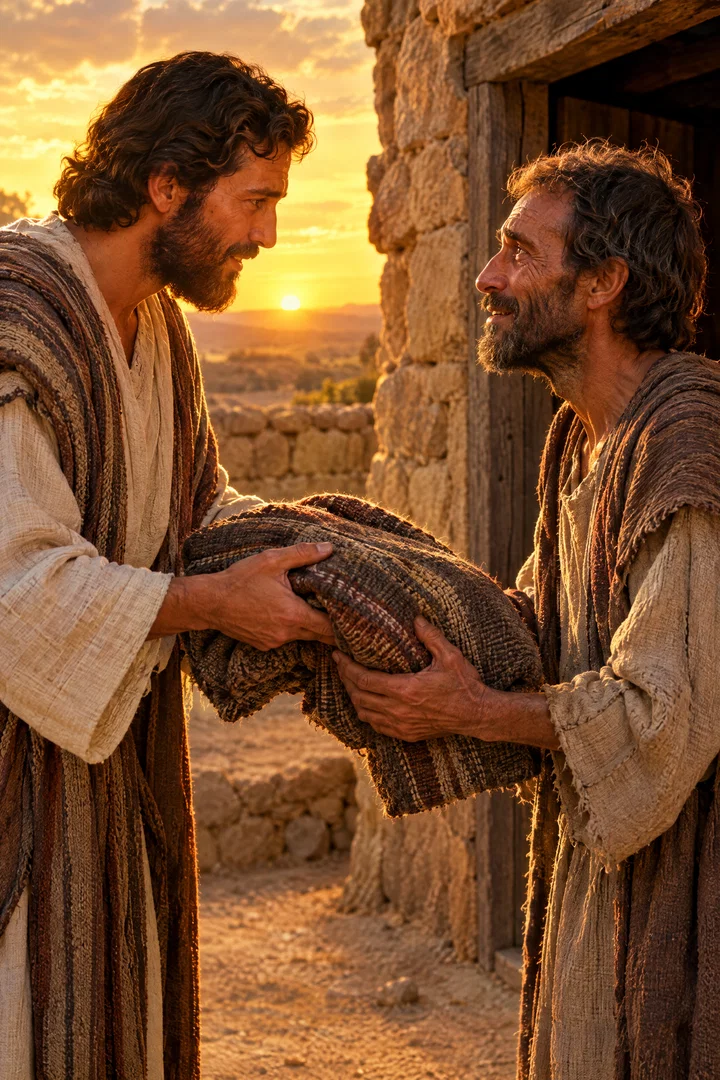
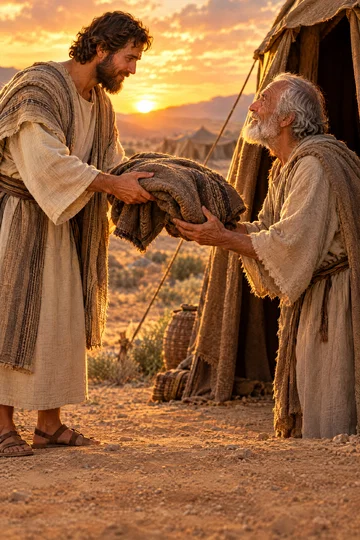
If thou at all take thy neighbour’s raiment to pledge, thou shalt deliver it unto him by that the sun goeth down:
Translations
If you at all take your neighbor’s raiment to pledge, you shall deliver it to him by that the sun goes down:
King James Version, KJV Cambridge Paragraph Bible
If thou at all take thy neighbour’s raiment to pledge, thou shalt deliver it unto him by that the sun goeth down:
If thou shalt at all take thy neighbor's raiment to pledge, thou shalt deliver it to him by the setting of the sun.
If thou at all take thy neighbour’s garment to pledge, thou shalt restore it unto him by that the sun goeth down:
If thou at all take thy neighbor’s garment to pledge, thou shalt restore it unto him before the sun goeth down:
if thou dost at all take in pledge the garment of thy neighbour, during the going in of the sun thou dost return it to him:
— If thou at all take thy neighbour's garment in pledge, thou shalt return it to him before the sun goes down;
If thou, do take in pledge, the mantle of thy neighbour, by the going in of the sun, shalt thou restore it to him;
Berean Standard Bible, Majority Standard Bible
If you take your neighbor’s cloak as collateral, return it to him by sunset,
If you take your neighbor’s garment as collateral, you shall restore it to him before the sun goes down,
If ever you take your neighbour's clothing in exchange for the use of your money, let him have it back before the sun goes down:
If thou take thy neighbours rayment to pledge, thou shalt restore it vnto him before the sunne go downe:
Douay-Rheims (Challoner revision)
If thou take of thy neighbour a garment in pledge, thou shalt give it him again before sunset.
Pictures
Cross-references
- Deuteronomy 24:10-12
When thou dost lend thy brother any thing, thou shalt not go into his house to fetch his pledge.
Both require merciful treatment of borrowers and protection of the poor in pledge laws.
- Deuteronomy 24:17
Thou shalt not pervert the judgment of the stranger, nor of the fatherless; nor take a widow’s raiment to pledge:
Both forbid taking a vulnerable person’s clothing as pledge.
Commentary
Each commentary is drawn from primary sources: the writings of Ellen G. White and Adventist pioneers and periodicals. Each commentary is separate. Its own words are not a quotation; follow the references to read the source passages.
Ellen G. White
10 sources
The direction was given by Christ Himself on Mount Sinai to Moses as part of the instruction in Exodus 19-24, specifically the statutes and judgments recorded in Exodus 21, 22, and 23 and written in a book to guard against injustice and to guide dealing one with another.Lt 160, 1906, par. 3–9Ms 126, 1901, par. 46–47 It does not belong to a Christless dispensation and is not of a lower order than the requirements of the present age, but shows how impartial are the divine ways and how exalted are all the divine requirements, and it was to be strictly obeyed and to be studied and presented now just as verily as by Israel then.Lt 160, 1906, par. 3–9Ms 126, 1901, par. 46–47
When a poor neighbor's garment or blanket is taken as security or pledge for a loan, it must be delivered back to him by sunset, by sundown, by nightfall, so he is not left without it overnight.ST Feb 7, 1884Ms 72, 1898, par. 20–21MH 188.1MH 187.3PP 311.1 The reason is that it is his only covering, needed for sleeping, so the rule protects his basic needs and rights.ST Feb 7, 1884Ms 72, 1898, par. 20–21MH 188.1MH 187.3PP 311.1 Lending must therefore be merciful, just, and compassionate rather than oppressive or using the poor person's need for gain, with dealing that considers the needs of others, ceases contention, and loves as brethren with softened and subdued hearts.ST Feb 7, 1884Lt 160, 1906, par. 3–9MH 188.1MH 188.2MH 187.3 God hears the cry of the afflicted borrower because He is gracious, so keeping the poor's necessities is oppression and a violation of just dealing.Ms 72, 1898, par. 20–21MH 188.1MH 187.3
The requirement belongs to the plan of life given to Israel as an object lesson for all mankind about justice and mercy to the poor, the borrower, the homeless, the suffering and needy, and the outcast, connected with companion principles such as hiding the outcasts, not betraying the fugitive, and covering them from the spoiler.MH 188.2MH 188.5MH 188.3–4 Its principle applies today to practical help for the unemployed and the homeless by giving to him that asks, not turning away from him that would borrow, dealing without oppression or unrighteousness, and providing for homes and for food through work.MH 188.1MH 188.2MH 188.5 If these principles were carried out the world would be a different place, with room within nature and resources sufficient for all who will work.MH 188.5MH 188.3–4
Sources
Pioneers and periodicals
21 sources
If a neighbor's raiment is taken as security for a loan, it must be given back by the time the sun goes down and not kept overnight.ST Feb 7, 1884ST Mar 3, 1914ST Mar 28, 1911 The garment in view is needed clothing, for a poor man often the cloak used as his covering at night, so to keep it would leave him without protection he needs.ST Mar 3, 1914ST Nov 21, 1900RH Jun 16, 1868 The requirement sets a merciful limit on exaction from a debtor, that lending must regard the need and basic rights of the poor with compassion and not take advantage of them for gain.ST Feb 7, 1884ST Mar 28, 1911RH Jun 16, 1868 It belongs to the statutes and judgments spoken through Moses after the Ten Commandments to make their moral principles clearer and apply them, forming civil law for Israel as a nation that is not binding today though its underlying principles remain binding.ST Apr 17, 1907ST May 16, 1878ST Dec 10, 1896RH Oct 22, 1861RH Dec 31, 1861
Place in Covenant Law
Exodus 22:26 stands in the second, chiefly legislative division of Exodus in chapters 19-40, which bound the ransomed people to Jehovah by solemn covenant and gave them a system of legal ordinances for guidance. It belongs to the complete code of laws in Exodus 20-24 given to Israel after deliverance from bitter bondage and oppression in Egypt, when departure from Egypt made them a nation with thorough organization, efficient leadership, a complete code of laws, and an established form of worship.RH Jan 20, 1916 It was given with the Ten Commandments proclaimed at Sinai after the people accepted the covenant condition, to preserve them as a peculiar treasure, a kingdom of priests, and a holy nation, and with them it was ratified over the book of the covenant.
The verse is part of the general laws and precepts in chapters 21-23 that were necessary for community life.ST These statutes and judgments were given to Moses after the people heard the Ten Commandments, and they principally set out principles of justice and duties toward fellow people, while some concern duty toward God and some are ceremonial.ST Feb 6, 1879ST Mar 1, 1883 They are judgments and practical regulations given through Moses that address what people should do toward one another and how wrongs should be corrected or restrained, distinct from the Ten Commandments as the covenant's foundational words.ST Apr 15, 1886
It is one of the laws given through Moses, included among the statutes and judgments regulating conduct between people in the broader body of God's laws that Malachi calls the law of Moses, not only the Ten Commandments. It belongs to the law of ordinances and to the civil laws given through Moses after the Ten Commandments among the judgments taught to the people as part of the old covenant, not to the moral law of the Ten Commandments.ST May 6, 1875 The moral law was written out first and the law of ordinances was written out in full immediately after it, with both set forth together in Exodus 19-30 once the record reached Moses' own time, while Genesis contains only references to the moral law because it records events already past when it was written.ST May 6, 1875 The Ten Commandments were spoken by God to the assembly and written on the stone tablets, while the statutes and judgments the Lord gave Moses to teach the people stand apart from them.RH Jul 9, 1901
These statutes were spoken by God to Moses to make the moral principles of the Ten Commandments clearer and to apply them, and Moses told them to the people and wrote them in the book of the covenant.ST Apr 17, 1907 As precepts growing out of the Ten Commandments given by God to Moses in the mount after God spoke the Ten Commandments in the hearing of all the people and wrote them on two tables of stone, they add no new moral principle beyond the ten words but develop principles already in them for an ignorant and sin-blinded people who could not see them.ST Dec 10, 1896ST Aug 5, 1889 Moses wrote these judgments of Exodus 21-23 in the book of the covenant together with the agreement between God and Israel and the ten words spoken by God, told them to the people, and the book was read to the people and ratified and sealed with sprinkled blood to confirm the old covenant agreement concerning the commandments of God.ST Apr 17, 1907ST Dec 10, 1896ST Aug 5, 1889
Together with the latter part of Exodus 20 and chapters 21-23, the verse forms an epitome of the civil and ceremonial laws and judicial precepts given for Israel's civil and religious life and civil government under the covenant.ST May 16, 1878RH Dec 31, 1861 These judgments formed the basis of national law concerning God's law and the principles of that law in national life.ST Dec 10, 1896 They applied particularly to Israel while living in Canaan, where obedience to them was part of the obedience required for Israel to remain in the land.RH Oct 22, 1861 As civil laws given to the Jews in Exodus 21 and 22 they were limited to Israel as a nation and are not binding today as law, but their great underlying principles remain the same and are still binding in principle.RH Nov 12, 1908 These laws given through Moses at Sinai alongside the Ten Commandments were given in love to draw Israel into close relationship with God and to write His law on their hearts.ST Jan 27, 1909
Mercy to Poor Borrowers
If a neighbor's, and especially a poor neighbor's, garment or raiment is taken as security for a loan, it must be delivered back by the time the sun goes down and may not be kept overnight.ST Feb 7, 1884ST Mar 3, 1914ST Mar 28, 1911RH Jun 22, 1916RH Jun 16, 1868 That is because the garment is needed clothing, for a poor person often the cloak used as a covering at night, so that keeping it overnight would leave the borrower without needed protection.ST Mar 3, 1914ST Nov 21, 1900RH Jun 16, 1868 It must not be kept for the lender's own use while the poor person needs it, for so to use it violates its protection of the poor.RH Jun 16, 1868 The rule thus sets a merciful limit on exaction from a debtor, requiring that lending treat the need and basic rights of the poor with compassion and not take advantage of them for another person's gain.ST Feb 7, 1884ST Mar 28, 1911RH Jun 16, 1868
Even when officers of the law make petty, cruel, often illegal and more exacting demands than this merciful limit, the duty is not to resist or rebel but to bear the loss with patience rather than go to law.ST Mar 28, 1911 The command to return before sunset is also a reminder to put matters right promptly before going to sleep, since no one knows what the next day may bring.RH Jun 22, 1916
A poor person's cloak was normally kept close and not left overnight, so that casting away the garment was unusual for a blind man.ST Nov 21, 1900 Bartimaeus's willingness to do so showed implicit faith that Christ would restore his sight and that he could find the garment afterward, and his immediate response to Christ's call shows the earnestness with which people should seek the Saviour when they recognize their need of healing.ST Nov 21, 1900
Sources