Exodus 27:17
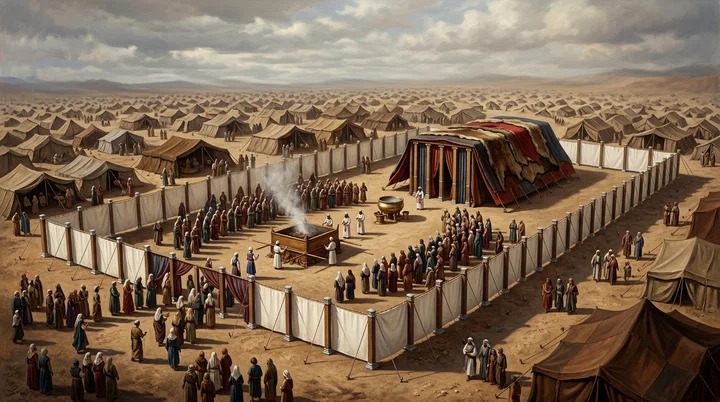
All the pillars round about the court shall be filleted with silver; their hooks shall be of silver, and their sockets of brass.
Translations
American King James Version, King James Version, KJV Cambridge Paragraph Bible
All the pillars round about the court shall be filleted with silver; their hooks shall be of silver, and their sockets of brass.
All the pillars around the court shall be filleted with silver: their hooks shall be of silver, and their sockets of brass.
Revised Version, American Standard Version
All the pillars of the court round about shall be filleted with silver; their hooks of silver, and their sockets of brass.
All the pillars of the court round about [are] filleted [with] silver, their pegs [are] silver, and their sockets brass.
All the pillars of the court round about shall be fastened together with [rods of] silver; their hooks of silver, and their bases of copper.
All the pillars of the court round about, to be joined with cross-rods of silver, and their hooks of silver,—and their sockets of bronze,
Berean Standard Bible, Majority Standard Bible
All the posts around the courtyard shall have silver bands, silver hooks, and bronze bases.
All the pillars of the court around shall be filleted with silver; their hooks of silver, and their sockets of bronze.
All the pillars round the open space are to have silver bands, with hooks of silver and bases of brass.
All the pillars of the court shall haue filets of siluer round about, with their heads of siluer, and their sockets of brasse.
Douay-Rheims (Challoner revision)
All the pillars of the court round about shall be garnished with plates of silver, silver heads and sockets of brass.
Pictures
Cross-references
- Exodus 25:8-9
And let them make me a sanctuary; that I may dwell among them.
The court belongs to the sanctuary God commanded and patterned as his dwelling among Israel.
- Hebrews 8:5
Who serve unto the example and shadow of heavenly things, as Moses was admonished of God when he was about to make the tabernacle: for, See, saith he, that thou make all things according to the pattern shewed to thee in the mount.
The earthly sanctuary was made as a pattern and shadow of heavenly things.
- Acts 7:44
Our fathers had the tabernacle of witness in the wilderness, as he had appointed, speaking unto Moses, that he should make it according to the fashion that he had seen.
The wilderness tabernacle, including its court, was made according to the pattern Moses saw.
- Hebrews 9:24
For Christ is not entered into the holy places made with hands, which are the figures of the true; but into heaven itself, now to appear in the presence of God for us:
Earthly sanctuary features are figures of the true sanctuary in heaven.
- Exodus 25:40
And look that thou make them after their pattern, which was shewed thee in the mount.
The court’s construction follows the pattern shown to Moses on the mount.
- Exodus 25:9
According to all that I shew thee, after the pattern of the tabernacle, and the pattern of all the instruments thereof, even so shall ye make it.
The court’s construction follows the pattern shown to Moses.
- Exodus 38:9-20
And he made the court: on the south side southward the hangings of the court were of fine twined linen, an hundred cubits:
parallel description of the court
- Exodus 38:27
And of the hundred talents of silver were cast the sockets of the sanctuary, and the sockets of the vail; an hundred sockets of the hundred talents, a talent for a socket.
silver sockets weighing a talent each
- Exodus 26:37
And thou shalt make for the hanging five pillars of shittim wood, and overlay them with gold, and their hooks shall be of gold: and thou shalt cast five sockets of brass for them.
both describe entrance pillars, hooks and sockets
- Hebrews 8:1-2
Now of the things which we have spoken this is the sum: We have such an high priest, who is set on the right hand of the throne of the Majesty in the heavens;
The ancient sanctuary typified the heavenly sanctuary where Jesus ministers.
- Hebrews 9:2-5
For there was a tabernacle made; the first, where in was the candlestick, and the table, and the shewbread; which is called the sanctuary.
Describes the sanctuary and its furnishings.
- Exodus 36:1-7
Then wrought Bezaleel and Aholiab, and every wise hearted man, in whom the LORD put wisdom and understanding to know how to work all manner of work for the service of the sanctuary, according to all that the LORD had commanded.
Describes the people carrying out the sanctuary-building work.
Commentary
Each commentary is drawn from primary sources: the writings of Ellen G. White and Adventist pioneers and periodicals. Each commentary is separate. Its own words are not a quotation; follow the references to read the source passages.
Pioneers and periodicals
29 sources
All the pillars around the court were to be joined with silver, with their hooks of silver and their bases of brass, unlike the gold-covered pillars at the entrance of the tabernacle itself.RH Aug 4, 1863ST Jun 26, 1907ST Jun 19, 1907 They upheld an enclosure of fine-twined linen hangings, the pillars standing five cubits high and five cubits apart to form a continuous court fifty by one hundred cubits with its twenty-cubit gate on the east.ST May 1, 1901RH Jan 6, 1853ST Nov 14, 1892 This fitting belonged to the full instructions for the sanctuary and its court given to Moses during his forty days on the mount in Exodus 25-31 and carried out in Exodus 35-40, to be made exactly after the pattern shown him and not left to human fancy.ST Oct 29, 1894ST Mar 25, 1889ST Feb 17, 1890ST May 16, 1878 As part of that earthly sanctuary it served as a type, pattern and shadow of the heavenly sanctuary and of Christ's priestly work, setting forth God's plan for dwelling among His people and dealing with sin.ST Jun 26, 1907ST Jun 19, 1907 Its linen and its gate show the way to God, for the fine linen represents the righteousness of the saints received only through Christ, and coming through the gate by the altar and the laver means coming to the heavenly sanctuary through Christ as the door, the slain sin-offering, and the living Word that cleanses from sin.ST Mar 25, 1897ST May 1, 1901
Court Construction Details
Exodus 27:17 belongs to the detailed instructions for building the sanctuary and its court that God gave to Moses during his forty days and nights stay in the mount, given along with the tables of stone to the ransomed people bound to Jehovah by solemn covenant as a peculiar treasure, a kingdom of priests, and a holy nation, to preserve them and to provide a system of legal ordinances for guidance.ST Mar 25, 1889RH Dec 31, 1861 Those instructions are recorded chiefly in Exodus 25-30 or Exodus 25-31 and carried out in Exodus 35-40, with the very minute description in Exodus 25-40 made exactly according to the pattern shown in the mount, and the sanctuary afterward built and set up with each part made according to God's instructions.ST Oct 29, 1894ST Feb 17, 1890ST Jan 27, 1909ST Apr 15, 1886 Its place among these detailed directions after Israel's covenant was ratified shows God's care for what pertains to worship, including provision for the place where the stone tablets of the law would be kept.ST Mar 25, 1889RH Dec 31, 1861 They included ceremonial requirements and the law of ordinances distinct from the Ten Commandments spoken by God at Sinai.ST Apr 15, 1886
Because of that sacred character the building was not left to man's fancy in size or manner, but God gave explicit instructions and showed the pattern after which it was to be made, and endowed special ones with wisdom to carry it out, and the instructions were not to be disregarded under penalty of death.ST Feb 17, 1890 The object of the building commanded on the mount was that God might dwell among Israel, with His glory remaining there and their worship centering there and the priests ministering in His presence.ST Feb 17, 1890RH Jan 4, 1870 These details of pillars joined with silver fillets, with silver hooks and bronze sockets, belong to the sanctuary and its court made according to the pattern shown to Moses, which is a pattern of the heavenly temple with its two holy places.ST May 16, 1878RH Jan 4, 1870
The verse describes the fittings of the court around the tabernacle as pillars joined or filleted with silver, their hooks of silver, and their sockets or bases of brass or bronze.RH Aug 4, 1863ST Jun 26, 1907ST Jun 19, 1907 These details distinguish the court's fittings from the gold-covered pillars at the tabernacle entrance.RH Aug 4, 1863 The court was enclosed by hangings or canvas screens of fine-twined linen suspended from pillars of brass five cubits in height, standing at regular intervals five cubits apart.ST May 1, 1901ST Nov 14, 1892ST Jun 20, 1911 The linen curtain was about five cubits wide and five cubits or about seven and a half to about nine feet high, fastened to silver hooks, and the enclosure was continuous except on the eastern side.ST May 1, 1901RH Jan 6, 1853ST Nov 14, 1892
The court formed a double square fifty by one hundred cubits, or seventy-five by one hundred and fifty feet, one hundred cubits in length, fifty in breadth, and five cubits in height.ST May 1, 1901RH Jan 6, 1853ST Nov 14, 1892 On the east end was an entrance gate twenty cubits wide, corresponding to the door of the tabernacle on the east in both the sanctuary Moses built and the temple Solomon built, enclosed with curtains of fine-twined linen of the most gorgeous colors.ST Nov 14, 1892ST May 1, 1901 The tabernacle stood nearer the west end, leaving seventy-five feet of open space at the east where the altar of burnt offerings stood and offerings were brought.ST Apr 1, 1889 All the important dimensions of the court and tabernacle were five cubits or some multiple of five cubits, constructed with strict regard to proportion and beauty and of such material as would impress every beholder with the importance of these objects and the purity and sacredness of the worship connected therewith.ST Nov 14, 1892
One description gives the enclosure as one hundred cubits by fifty cubits, surrounded by brass pillars set in sockets of silver, five cubits apart, on which was hung a curtain of fine twined linen five cubits wide, with the gate on the east side twenty cubits wide.ST May 1, 1901 Another description gives the court surrounding the sanctuary as one hundred and fifty feet wide and three hundred feet long, with its entrance facing east.ST Apr 1, 1889
Sanctuary Meaning and Typology
Sanctuary means a sacred or holy place, commanded to be built so that God might dwell among Israel, with His glory remaining there and their worship centering there and the priests ministering in His presence.ST Feb 17, 1890ST Jun 4, 1885ST Jul 8, 1930RH Jan 4, 1870ST Oct 25, 1905 That wilderness tabernacle erected at God's command, and Solomon's temple that took the place of the portable tabernacle, was the center of God's worship on earth, with all worship revolving around the holy of holies where the law rested with the mercy-seat over it, including provision for the place where the stone tablets would be kept.ST Jun 19, 1907 Its place among the detailed directions for the tabernacle and its furniture given during the forty days in the mount, recorded in Exodus 25-30 and carried out in Exodus 35-40 for the ransomed people bound by solemn covenant to be preserved as a peculiar treasure, a kingdom of priests, and a holy nation with a system of legal ordinances for guidance, shows God's care for what pertains to worship.ST Feb 17, 1890
The verse belongs to the law given through Moses, which includes not only the Ten Commandments but also statutes and judgments, civil regulations, and laws about sacrifices, offerings, conduct, health, ceremonies, and morals. Its inclusion places the directions for the tabernacle court among the ceremonial requirements and the law of ordinances written out after the moral law, distinct from the Ten Commandments spoken by God at Sinai and connected with the first covenant and its ordinances of divine service.ST May 6, 1875ST Apr 15, 1886ST Aug 5, 1889 That ancient ministration of the tabernacle built for ministration involving sacrifices and offerings is called a ministration of death, and its sacrificial service ended when Christ came and died once for all.ST Jan 24, 1911ST Aug 5, 1889 Its instructions about offerings, sacrifices, and types help trace the substance of the new dispensation from the shadows of the old.
The exact material and construction instructions, with courtyard pillars joined with silver and fitted with silver hooks and set in brass sockets, formed part of the earthly or worldly sanctuary that served as a type, pattern, and shadow of the heavenly sanctuary and temple with its two holy places and of Christ's priestly work, though earthly things could not represent heavenly things perfectly.ST Jun 26, 1907ST Jun 19, 1907RH Jan 4, 1870 The full description in Exodus 25 through the end of Exodus, part of God's explicit instructions in Exodus 25-31 for building the sanctuary and preparing its services and made according to the pattern shown in the mount, gives the exact pattern of the atoning work taught through Israel's ceremonies for the errors of the people.ST Mar 10, 1898 The sanctuary so commanded is an object-lesson let down upon earth setting forth God's plan of government and how He deals with those who sought to dethrone Him, and the plan devised from eternity for salvation from sin, executed by Christ as priest upon the throne, still King while executing the priest's office in dealing with sinners. It was made known because God's people are so intimately related to the sanctuary that they cooperate with God in His work through Christ in the sanctuary, the divine and the human cooperating at every step, that He may dwell among them.
The court's fine linen represents the righteousness of the saints, which they can receive only through Christ who is their righteousness.ST Mar 25, 1897 The court with its gate on the east end, corresponding to the door of the tabernacle on the east in both the sanctuary Moses built and the temple Solomon built, shows the way the people came to the sanctuary where God dwelt between the cherubim, through the gate of the court and by the altar of burnt offering and the laver.ST May 1, 1901 This means coming to the heavenly sanctuary where God dwells through Christ as the door, as the sin-offering slain at the altar, and as the living Word by which cleansing from sin comes.ST May 1, 1901 In this context the hanging at the court entrance surrounding the tabernacle is identified as one of the sanctuary's veils, called masak in Hebrew and kalumma in the Septuagint.RH Oct 5, 1916 The instruction about God's sanctuary in Exodus 27 to 29 calls for examining what one's attitude of heart toward God's sanctuary is.RH Jan 27, 1916
Sources