Hebrews 9:2
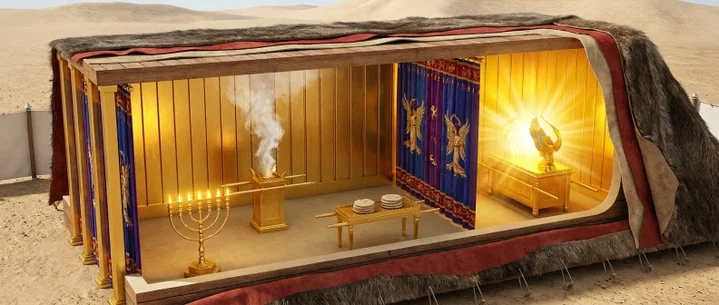
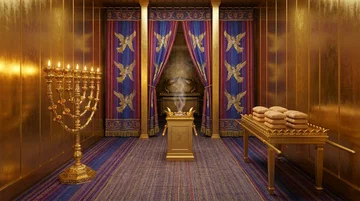
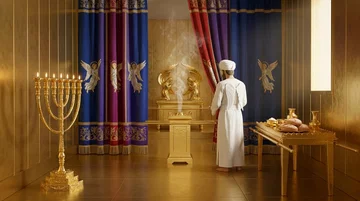
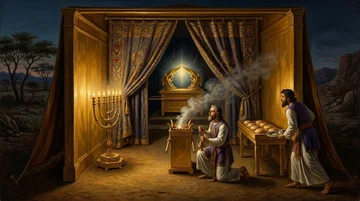
For there was a tabernacle made; the first, where in was the candlestick, and the table, and the shewbread; which is called the sanctuary.
Translations
For there was a tabernacle made; the first, wherein was the candlestick, and the table, and the show bread; which is called the sanctuary.
For there was a tabernacle made; the first, where in was the candlestick, and the table, and the shewbread; which is called the sanctuary.
For there was a tabernacle made; the first, wherein was the candlestick, and the table, and the shewbread; which is called the sanctuary.
For there was a tabernacle made; the first, in which was the candlestick, and the table, and the show-bread; which is called the sanctuary.
For there was a tabernacle prepared, the first, wherein were the candlestick, and the table, and the shewbread; which is called the Holy place.
For there was a tabernacle prepared, the first, wherein were the candlestick, and the table, and the showbread; which is called the Holy place.
for a tabernacle was prepared, the first, in which was both the lamp-stand, and the table, and the bread of the presence — which is called 'Holy;'
For a tabernacle was set up; the first, in which [ were] both the candlestick and the table and the exposition of the loaves, which is called Holy;
For a tent was prepared, the first, in which were both the lampstand and the table and the setting forth of the loaves,—the which is called the Holy place;
Berean Standard Bible, Majority Standard Bible
A tabernacle was prepared. In its first room were the lampstand, the table, and the consecrated bread. This was called the Holy Place.
For a tabernacle was prepared. In the first part were the lamp stand, the table, and the show bread, which is called the Holy Place.
For the first Tent was made ready, having in it the vessels for the lights and the table and the ordering of the bread; and this is named the holy place.
For the first Tabernacle was made, wherein was the candlesticke, and the table, and the shewebread, which Tabernacle is called the Holy places.
Douay-Rheims (Challoner revision)
For there was a tabernacle made the first, wherein were the candlesticks, and the table, and the setting forth of loaves, which is called the holy.
Pictures
Cross-references 20 of 93
- Hebrews 8:1-2
Now of the things which we have spoken this is the sum: We have such an high priest, who is set on the right hand of the throne of the Majesty in the heavens;
Christ ministers as High Priest in the true heavenly tabernacle.
- Hebrews 9:23-24
It was therefore necessary that the patterns of things in the heavens should be purified with these; but the heavenly things themselves with better sacrifices than these.
Contrasts earthly sanctuary figures with the heavenly sanctuary where Christ ministers.
- Exodus 25:31-40
And thou shalt make a candlestick of pure gold: of beaten work shall the candlestick be made: his shaft, and his branches, his bowls, his knops, and his flowers, shall be of the same.
Describes the candlestick in the first tabernacle.
- Daniel 8:14
And he said unto me, Unto two thousand and three hundred days; then shall the sanctuary be cleansed.
The 2,300 days mark the time for the sanctuary’s cleansing.
- Hebrews 8:5
Who serve unto the example and shadow of heavenly things, as Moses was admonished of God when he was about to make the tabernacle: for, See, saith he, that thou make all things according to the pattern shewed to thee in the mount.
Earthly sanctuary service is a copy and shadow of the heavenly pattern.
- Leviticus 16:2-34
And the LORD said unto Moses, Speak unto Aaron thy brother, that he come not at all times into the holy place within the vail before the mercy seat, which is upon the ark; that he die not: for I will appear in the cloud upon the mercy seat.
Describes the Day of Atonement service in the earthly sanctuary.
- Exodus 25:8
And let them make me a sanctuary; that I may dwell among them.
God commands a sanctuary so he may dwell among his people.
- Hebrews 9:11-12
But Christ being come an high priest of good things to come, by a greater and more perfect tabernacle, not made with hands, that is to say, not of this building;
Christ enters the greater heavenly sanctuary as High Priest with his own blood.
- Revelation 11:19
And the temple of God was opened in heaven, and there was seen in his temple the ark of his testament: and there were lightnings, and voices, and thunderings, and an earthquake, and great hail.
The opened heavenly temple reveals the ark of God’s testament.
- Hebrews 10:1
For the law having a shadow of good things to come, and not the very image of the things, can never with those sacrifices which they offered year by year continually make the comers thereunto perfect.
earthly service shadows Christ's ministration
- Exodus 26:33-35
And thou shalt hang up the vail under the taches, that thou mayest bring in thither within the vail the ark of the testimony: and the vail shall divide unto you between the holy place and the most holy.
Distinguishes the Holy Place from the Most Holy Place and locates their furnishings.
- Hebrews 9:6-7
Now when these things were thus ordained, the priests went always into the first tabernacle, accomplishing the service of God.
Contrasts the priests’ service in the first apartment with the high priest’s yearly entry into the second.
- Hebrews 9:8
The Holy Ghost this signifying, that the way into the holiest of all was not yet made manifest, while as the first tabernacle was yet standing:
Uses the same Greek word rendered “holy place.”
- Exodus 40:22-27
And he put the table in the tent of the congregation, upon the side of the tabernacle northward, without the vail.
Lists the table and candlestick and their placement in the tabernacle’s first apartment.
- Revelation 4:5
And out of the throne proceeded lightnings and thunderings and voices: and there were seven lamps of fire burning before the throne, which are the seven Spirits of God.
The seven lamps before the throne correspond to the sanctuary’s candlestick.
- Revelation 8:3
And another angel came and stood at the altar, having a golden censer; and there was given unto him much incense, that he should offer it with the prayers of all saints upon the golden altar which was before the throne.
The golden altar and incense show the heavenly counterpart of the sanctuary’s furnishings.
- Exodus 25:23-30
Thou shalt also make a table of shittim wood: two cubits shall be the length thereof, and a cubit the breadth thereof, and a cubit and a half the height thereof.
Describes the table and shewbread placed in the Holy Place.
- Hebrews 9:24
For Christ is not entered into the holy places made with hands, which are the figures of the true; but into heaven itself, now to appear in the presence of God for us:
Earthly holy places are figures of the true sanctuary in heaven, where Christ appears for his people.
- Exodus 25:21-22
And thou shalt put the mercy seat above upon the ark; and in the ark thou shalt put the testimony that I shall give thee.
God meets and speaks above the mercy seat over the ark.
- Exodus 25:9
According to all that I shew thee, after the pattern of the tabernacle, and the pattern of all the instruments thereof, even so shall ye make it.
The earthly sanctuary was made according to the pattern shown to Moses.
Commentary part 1 of 2
Each commentary is drawn from primary sources: the writings of Ellen G. White and Adventist pioneers and periodicals. Each commentary is separate. Its own words are not a quotation; follow the references to read the source passages.
Ellen G. White
18 sources
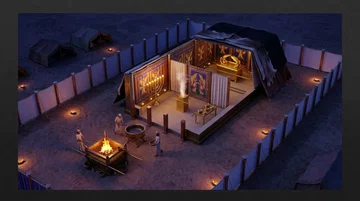
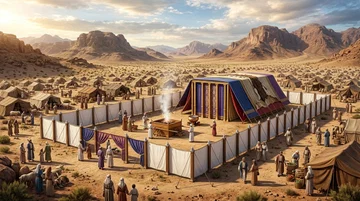
The verse describes the first apartment of the sanctuary, called the holy place, containing the seven-branched candlestick on the south giving light day and night, the table of showbread on the north, and the golden altar of incense before the veil.GC88 411.1–412.3GC 410.3–411.1WLF 18.3–4EW 213.2–214.1RH Nov 8, 1915 It is the portable tabernacle Moses was commanded to build in the mount as God's dwelling among Israel in the wilderness, a magnificent ordered place of worship with gold-plated walls, layered curtains, and an outer court, later reflected in Solomon's Temple and the Jerusalem temple.GC88 411.1–412.3RH Nov 8, 1915GC 411.2–412.3 It also describes the corresponding first apartment of the temple in heaven, reached through a door and raised veil and furnished with the same altar, candlestick, and table in pure gold, of which the earthly apartment was a figure.CET 91.2–3RH Jul 21, 1851SG1 158.1ExVEGW 15.3–17.1EW 213.2–214.1 There Jesus ministered before passing through the veil into the Holy of Holies in 1844, where He now serves as the unseen Mediator before the mercy seat to receive prayers directed to Him by faith and grant the benefits of His mediation.SG1 158.1ExVEGW 15.3–17.1SG4 8.3LS 124.3–125.1 The ministration in that heavenly holy place is present truth and a great pillar of faith given as light from God, to which the Holy Spirit has borne witness for more than half a century against opposing theories that are error.4MR 249.1–2
The Earthly Holy Place
The first apartment named is the holy place, containing the candlestick, the table, and the showbread.GC88 411.1–412.3GC 410.3–411.1WLF 18.3–4SG4 8.3LSEGW 100.1–3 That sanctuary was the tabernacle Moses was commanded to build while with God in the mount as God's dwelling among Israel in the wilderness, made to be portable from place to place and later reflected in Solomon's Temple and the Jerusalem temple.GC88 411.1–412.3RH Nov 8, 1915GC 411.2–412.3
It was of great magnificence, with walls of upright boards heavily plated with gold set in sockets of silver and a roof of layered curtains with outer coverings of skins and an innermost covering of fine linen wrought with cherubim.RH Nov 8, 1915 There was an outer court containing the altar of burnt offering, and the tabernacle itself had two apartments separated by a rich veil, with a similar veil closing the entrance to the first apartment.RH Nov 8, 1915
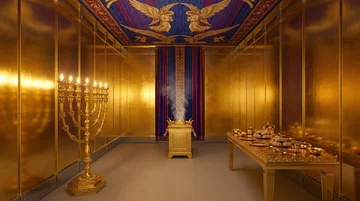
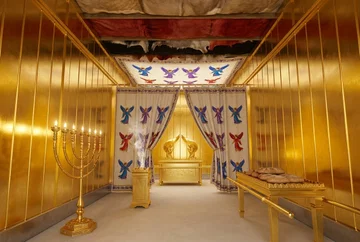
In the first apartment the candlestick stood on the south with its seven lamps giving light to the sanctuary by day and by night, and the table of showbread stood on the north.EW 213.2–214.1RH Nov 8, 1915GC 411.2–412.3 The golden altar of incense with its censer stood before the veil.SG1 158.1EW 213.2–214.1RH Nov 8, 1915 Its seven lamps lit the sanctuary, and from the altar fragrance ascended daily before God with the prayers of Israel.RH Nov 8, 1915GC 411.2–412.3
The sanctuary is a real, ordered place of worship, not the earth, and its furnishings belong before the second veil leading into the Holy of Holies.GC 410.3–411.1WLF 18.3–4EW 25.6 There incense accompanied the worshipers' prayers, animal blood served as a type of Christ's blood, and God revealed His glory above the mercy seat.RH Nov 8, 19154RED 125.2–127.1 The Jerusalem temple was God's dwelling place where priests carried out its services amid symbolic ceremonies.4RED 125.2–127.1
That temple and its worship were to come to an end when Jerusalem was destroyed.4RED 125.2–127.1
The Heavenly Holy Place
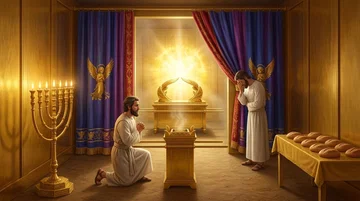
Hebrews 9:2 describes also the first apartment of the temple in the holy city in heaven, a corresponding holy place entered through a door where the first veil is raised.CET 91.2–3RH Jul 21, 1851ExVEGW 15.3–17.1LSEGW 100.1–3 Inside that holy place are the altar of incense, the candlestick with its seven lamps, and the table holding the showbread.CET 91.2–3RH Jul 21, 1851ExVEGW 15.3–17.1LSEGW 100.1–3 After its glory is viewed the second veil is raised to enter into the Holy of Holies.CET 91.2–3RH Jul 21, 1851 In that heavenly apartment the furniture appeared to be of pure gold and reflected the image of the one who entered.EW 213.2–214.1 The first apartment of the earthly sanctuary was a figure of this first apartment in heaven, where Jesus ministered before passing through the veil into the second apartment in 1844.SG1 158.1
The heavenly Holy of Holies is distinct from the holy place, and there Jesus ministers with the ark, the cherubim and glory, the censer, the manna, Aaron's rod, and the tables of stone.ExVEGW 15.3–17.1LS 124.3–125.1 He ministers before the mercy seat, the cover of the ark containing the law of God including the Ten Commandments, whose fourth precept is embraced by the waiting ones as they continue toward the city of God.LS 124.3–125.1Lt 253, 1903, par. 17 Other things connected with the ark and the great day of atonement involve mysteries of heaven that are to remain closed and undescribed.Lt 253, 1903, par. 17 The arrangements of the sanctuary illustrate prayer directed by faith to Christ as the people's unseen Mediator before the mercy seat in the heavenly sanctuary, who receives their prayers and grants the benefits of His mediation.SG4 8.3
The ministration in the heavenly sanctuary, especially that connected with the holy place, is present truth and a great pillar of faith, given as light from God in answer to earnest seeking.4MR 249.1–2 The Holy Spirit bore marked witness to the preaching of this truth over and over for more than half a century, while questioned and opposed new theories are error.4MR 249.1–2 A true understanding of it means much, and anyone presenting theories leading away from that light should not be accepted as a teacher.4MR 249.1–2
Sources
Pioneers and periodicals
253 sources
The sanctuary named here is the first apartment of the tabernacle, the holy place in its proper sense and not the whole building.RH Jan 23, 1855RH Jul 19, 1870RH May 5, 1851RH Jan 1851 It was furnished with the seven-branched candlestick, the table, and the bread of the Presence, standing apart from the second apartment beyond the veil.ST Jan 27, 1890RH Sep 2, 1852RH May 14, 1867RH Feb 11, 1858ST Apr 1, 1886 That earthly tabernacle built by Moses after the pattern shown on the mount was only the figure, copy and shadow of the true tabernacle in heaven which the Lord pitched.ST May 17, 1877LDT 179.2ST Oct 22, 1874ST Aug 15, 1878 Its daily service in the first room and yearly service in the Holiest show the order of Christ's work above, first ministering in the holy place after His ascension and then entering the most holy for the final atonement.RH Sep 21, 1905RH May 14, 1867ST Oct 22, 1874ST Aug 15, 1878RH Mar 10, 1874 That cleansing is done with blood for the removal of sin, and at the end of the 2300 days in 1844 it began in the heavenly sanctuary where Jesus ministers as High Priest.RH Jun 9, 1851ST May 27, 1880RH Oct 30, 1855RH Dec 5, 1854RH Feb 21, 1856
Words and Translation
The word rendered sanctuary comes from the Greek Hagion or hagia, properly meaning the holy place or the holy, in the plural holy places.RH Jan 23, 1855RH Jul 19, 1870RH Oct 5, 1916RH Oct 5, 1916 It names the first tabernacle, the first apartment holding the candlestick and the table and the shewbread, distinct from the Holiest of all and from the other uses of Hagion for the holy place and the holiest.RH Jan 23, 1855RH Jul 19, 1870ST Aug 30, 1877 The form is hagia, nominative plural, properly translated holy place rather than sanctuary, with its first-apartment meaning seen from context.RH Oct 5, 1916RH Sep 30, 1852RH Oct 5, 1916 The same plural word is used elsewhere for the celestial sanctuary, and since Christ ministers in the heavenly sanctuary in a work covering what was done in both apartments of the typical sanctuary, the plural forms should be rendered uniformly as holy places or sanctuary.RH Sep 30, 1852RH Oct 5, 1916
The verse uses sanctuary in its primary and proper sense for the earthly tabernacle and temple, belonging to the vast majority of Bible uses where sanctuary means that house, sometimes a part and sometimes the whole.RH May 5, 1851RH Aug 4, 1863 While the earthly house stood the appropriate application of the term was to that house, and after its day to the heavenly reality it represented.RH May 5, 1851 More particularly it uses sanctuary for a particular part of the temple, the first apartment which contained the candlestick and the table and the shewbread.RH Jan 1851RH Jan 1851 It does not there mean the whole temple, the land of Canaan or promised land, or the heavenly sanctuary itself, but directly defines this building as the sanctuary of the first covenant, as Old Testament use of sanctuary refers almost always to this building.RH Jan 1851RH Jan 1851RH Aug 4, 1863
The margin reads holy, and the singular feminine Hagia names the holy place of the first apartment, distinct from the plural neuter Hagia meaning holy things.RH Sep 30, 1852RH Oct 5, 1916 That plural neuter is used for the holy things Christ entered by His own blood, while the first-apartment form names the Holy Place patterned in the heavenly sanctuary where Christ ministers as High Priest.RH Sep 30, 1852RH Oct 5, 1916 Together with the reference to a second veil and the holiest apartment beyond it, the verse shows the typical sanctuary had a first apartment and more than one veil, with the first room as the holy place distinguished by the veil from the most holy place.ST Mar 11, 1886 Hebrews is the only New Testament book using the word sanctuary.RH Oct 5, 1916
First Apartment Named Sanctuary
Hebrews 9:2 describes the first tabernacle that was made, the first apartment of the earthly tabernacle called the sanctuary or holy place.ST Jan 27, 1890RH Sep 2, 1852RH May 14, 1867RH Feb 11, 1858RH Aug 4, 1863 That first compartment contained the candlestick and the table with the shewbread, also called the showbread or bread of the Presence.ST Jan 27, 1890RH Sep 2, 1852RH May 14, 1867RH Feb 11, 1858ST Dec 8, 1881 This tabernacle had two apartments, and its furnishings and services belonged to the worldly sanctuary of the first covenant, distinct from the real sanctuary in heaven.ST Jan 27, 1890RH Sep 2, 1852RH Feb 11, 1858RH Aug 4, 1863ST Dec 8, 1881 The broader sanctuary includes the tabernacle's two apartments together with the court and the vessels used in its ministry, serving as a figure of the present time.RH Sep 2, 1852RH Aug 4, 1863 Its earthly furnishings and services pointed to the heavenly sanctuary, where Christ ministers as High Priest under the new covenant.RH Sep 2, 1852RH May 27, 1852 Together with the inner compartment described next, this tabernacle constituted the Lord's sanctuary for the time of the Mosaic or first-covenant period, the sanctuary of Israel's earthly worship.RH May 14, 1867RH Aug 4, 1863ST Dec 8, 1881
Common priests entered that first apartment daily through the year to perform the service of God.RH May 14, 1867 The first apartment called the sanctuary is distinct from the tabernacle after the second veil called the Holiest of all or Most Holy Place.RH Feb 11, 1858ST Apr 1, 1886RH May 27, 1852 That second compartment had the golden censer and the ark of the covenant overlaid round about with gold.RH Feb 11, 1858ST Apr 1, 1886 Inside the ark were the golden pot that had manna and Aaron's rod that budded and the tables of the covenant, with the cherubim of glory shadowing the mercy seat.RH Feb 11, 1858ST Apr 1, 1886
The ark and the mercy seat were placed together in the Most Holy Place, with the mercy seat resting upon the ark.ST Oct 22, 1874RH May 27, 1852 The ark held God's commandments as the rule of human life, while the mercy seat was where mercy and pardon for breaking that law are found through Christ's blood sprinkled there.ST Oct 22, 1874RH May 27, 1852 This arrangement shows the close connection between the law kept in the ark and the pardon offered for its transgression.ST Oct 22, 1874RH May 27, 1852 The heavenly sanctuary where Christ ministers likewise has both the ark and the mercy seat, with its realities typified by the earthly furniture: the seven lamps of fire burning before the throne answering to the candlestick, the golden altar before the throne with golden censer, and the ark of the testament seen when the temple was opened.ST Apr 1, 1886RH May 27, 1852
Earthly Tabernacle Described
The tabernacle was a small portable building about fifty-five feet long and eighteen feet broad and high, made to be taken apart and borne with Israel in all their journeyings yet of extraordinary magnificence.ST Mar 21, 1911RH Nov 8, 1915ST Jun 20, 1911 Elsewhere it is given as thirty cubits long and ten cubits wide, divided into two rooms by a beautiful curtain or veil suspended from gold-plated pillars, with a similar veil closing the entrance of the first apartment.ST Mar 21, 1911RH Nov 8, 1915ST Jun 20, 1911RH Jan 24, 1856ST May 8, 1901 The first apartment was twice the size of the second, the Holy of holies being half its area, and in the temple strictly so called there were three parts, the portico, the outer sanctuary, and the holy place, with the sanctuary or holy place separated from the holy of holies by a double veil and the holy of holies twenty cubits square.ST May 8, 1901RH Nov 10, 1863 Those who held a different reckoning taught that earth is the antitype of this first room or sanctuary and heaven beyond the veil is the antitype of the holy of holies, so that Christ offered Himself once for all on earth and then passed through the veil into heaven itself to present His blood before the mercy seat.RH Jan 24, 1856
Its walls were upright boards set in silver sockets and held firm by pillars and connecting bars and overlaid with gold so as to appear solid gold, heavily plated with purest gold.ST Mar 21, 1911RH Nov 8, 1915ST Jun 20, 1911 The roof was of layered curtains with outer coverings of skins and an innermost covering of fine linen wrought with cherubim in various colors most beautifully arranged and inwrought with threads of gold and silver to represent the angelic host connected with the heavenly sanctuary as ministering angels to the saints upon the earth.ST Mar 21, 1911RH Nov 8, 1915ST Jun 20, 1911 It was enclosed in a court surrounded by hangings of fine linen suspended from pillars of brass with its entrance at the east end.ST Jun 20, 1911 Near the entrance stood the brazen altar of burnt offerings, with the laver between the altar and the door where priests washed hands and feet before entering, and the outer court contained the altar of burnt offering.RH Nov 8, 1915ST Jun 20, 1911
Inside the door of the first apartment the table of showbread stood on the north side and the seven-branched golden candlestick with its seven lamps stood opposite on the south side, with the golden altar of incense just before the veil separating the holy from the most holy.ST Jun 20, 1911RH Mar 1, 1870ST Aug 8, 1878RH Mar 10, 1874 The table was about three and a half feet in length, two and a half in height, and two in width, overlaid with pure gold, placed without the veil with showbread always kept upon it set in order before the Lord.ST Jun 20, 1911RH Mar 1, 1870 The candlestick was one solid work of beaten gold about the weight of a talent, made after the express pattern shown to Moses, with its lamps lighted before the Lord.ST Jun 20, 1911RH Mar 1, 1870 Its seven lamps gave light to the sanctuary both by day and by night because the tabernacle had no windows, and the first apartment also held the golden altar of incense with its three articles of furniture, the table meaning the bread of His presence, teaching practical duties that keep step with Christ's work in heaven.RH Nov 8, 1915ST Aug 8, 1878ST Jan 18, 1883
The larger stationary altar of incense stood in the first apartment, distinct from the portable golden censer associated with the second apartment, which explains why the two biblical descriptions do not conflict, since incense offered there was placed on that altar.RH Jun 18, 1901 The golden altar of incense was set before the veil, from which fragrance ascended daily before God with the prayers of Israel, burned morning and evening and symbolizing Christ's continual intercession.RH Nov 8, 1915RH Jan 6, 1916
Common priests entered the first room daily through the entire year offering sacrifices and ministrations in behalf of sinners, performing the official duties and service of God including the offering of blood for themselves and for the errors or ignorance of the people.RH Sep 21, 1905RH May 14, 1867RH Aug 31, 1916RH Sep 21, 1905ST Oct 21, 1880 The sanctuary where they ministered consisted of two apartments, the first containing the golden candlestick with seven branches, the table for the showbread, and the altar of incense, distinct from the second holding the ark of the covenant.RH Sep 21, 1905RH Jan 20, 1874 The high priest went alone once each year into the second or inner apartment on the tenth day of the seventh month on the day of atonement, offering blood for himself and for the errors of the people, taking up the sins brought into the sanctuary during the year into the second apartment before the ark and mercy seat to so far complete atonement as to permit carrying sins out to confess upon the scapegoat borne into an uninhabited wilderness, which closed the yearly round and was the cleansing of the sanctuary.RH Aug 31, 1916RH Sep 21, 1905ST Oct 21, 1880RH Jan 20, 1874
First Covenant Sanctuary Identified
The sanctuary of the first covenant was the definite tabernacle built by Moses in the wilderness of Sinai at the express command of God in exact accordance with the pattern shown him on the mount.ST Aug 30, 1877RH Jan 9, 1855 Its construction is described from Exodus 25 onward, with the first apartment holding the candlestick and the table and the shewbread which is called the sanctuary or holy, distinct from the most holy place beyond the second veil.ST May 17, 1877ST Aug 30, 1877RH Jan 9, 1855 That same sanctuary was afterward embodied in the temples of Solomon, Zerubbabel and Herod, which shared its general arrangement and furnishings.ST May 17, 1877RH Dec 24, 1908 It remained the sanctuary from the days of Moses to Christ's first Advent, until the new covenant was introduced by the Messiah, until the death of Christ when the veil was rent.ST May 17, 1877RH Jan 9, 1855
It belonged to Israel's worship as the habitation of God and dwelling place in Israel's camp, built so He might dwell among them.ST Oct 25, 1905RH Mar 1, 1870RH Oct 15, 1901 In its broader sense it includes the tabernacle's two apartments with the court and the vessels used in its ministry, with ordinances of divine service, a worldly sanctuary belonging to the former law dispensation.RH Sep 2, 1852RH Oct 8, 1857RH Oct 15, 1901 It was the setting for the law, priesthood and sacrifices, where penitents confessed sins and through the victim's blood and the priest's ministry sins were represented as entering the sanctuary and being put away in figure, serving as a figure for the time then present and a pattern of the true tabernacle in heaven where Christ ministers.RH Sep 2, 1852RH Jan 9, 1855RH Oct 15, 1901 As God's house it was the center linking earth and heaven and pointing forward to the heavenly Canaan, with the altar of incense also belonging to its first apartment distinct from the most holy place behind the second veil.RH Dec 24, 1908ST Mar 20, 1879ST Oct 25, 1905
That specific tabernacle was the sanctuary of that dispensation, not the land of Canaan, not the earth, not Zion, Jerusalem, a tribe or mountain, not the church or host, nor the people of God.RH Jan 6, 1853RH Mar 1, 1870 Places were called holy only because God's temple stood there, and the earth is never called the sanctuary in the Bible and has nothing to do with its cleansing by fire.RH Jan 9, 1855RH Oct 30, 1855 Joined with the sanctuary of the better covenant, the true tabernacle which the Lord pitched and not man, this covers all the ground and settles that the sanctuary is the tabernacle of the Lord, that it is cleansed with blood and not with fire, and that its cleansing is the concluding work of the High Priest before leaving the tabernacle and therefore precedes His revelation.RH Mar 2, 1852RH Jan 9, 1855RH Oct 30, 1855
Pattern of Heavenly Sanctuary
The earthly tabernacle with its furnishings and services was made only as the pattern, figure, copy, example and shadow of the true tabernacle in heaven which the Lord pitched and not man, built by the Lord himself.LDT 179.2ST Aug 15, 1878RH Jan 13, 1859RH Apr 28, 1853RH Aug 28, 1853 Hebrews 9:2 describes the first room of that earthly tabernacle, containing the candlestick and the table and the shewbread or bread of the Presence, belonging only to the first covenant.LDT 179.2ST Oct 22, 1874ST Aug 15, 1878RH Jan 13, 1859RH Aug 28, 1853 While that first tabernacle stood it signified that the way into the holy places of the heavenly temple was not yet opened.ST Aug 15, 1878 Its arrangement of two apartments indicates the order of Christ's mediatorial work in the two apartments above as traced in the New Testament.ST Oct 22, 1874ST Aug 15, 1878
The relation is type and antitype, figure and true, the earthly erected after the pattern shown in the mount and the true sanctuary being that pattern from which the earthly was made.RH Jun 9, 1851ST May 27, 1880RH Feb 21, 1856 Naming a first covenant with such a sanctuary and ordinances of divine service necessarily implies a second or new covenant, and joining a sanctuary and divine service to the first shows the second covenant also has a sanctuary with divine service.ST May 27, 1880RH Feb 18, 1858 That second-covenant sanctuary is the true sanctuary in heaven where Jesus as merciful great High Priest now intercedes for those who come to God through Him, distinct from earthly meeting-houses or places where men claim to absolve sins.RH Sep 20, 1864RH Jun 9, 1851RH Feb 21, 1856 The earthly was the typical sanctuary pitched by human hands, temporary, serving its appointed role until Christ became High Priest and ministered in the greater and more perfect heavenly tabernacle, which at the close of the typical dispensation and at the time of reformation took the place of the pattern and shadow and gave place not to the earth itself.RH Jan 13, 1859RH Apr 28, 1853RH Jun 9, 1851RH Feb 21, 1856RH Feb 15, 1870
The heavenly sanctuary likewise has two holy places with corresponding furniture and vessels, and Christ ministers in those heavenly places in a way patterned on the Levitical priests' service.RH Aug 28, 1853ST Apr 1, 1886ST Nov 20, 1879 The seven lamps of fire burning before the throne are the counterpart of the earthly candlestick, and their place in the Holy Place identifies where John saw Jesus ministering as mediator for the world.RH Jan 1851ST Apr 1, 1886ST Nov 20, 1879RH May 11, 1869ST Jul 2, 1896 The golden altar before the throne with a golden censer corresponds to the incense altar, and the ark of the testament seen when the temple was opened corresponds to the ark of the covenant with its mercy seat.ST Apr 1, 1886ST Nov 20, 1879 God's glory continually manifested where He met His people in the earthly holy place points to Christ beginning His ministry in the holy place of the heavenly counterpart after ascending, placing the throne where He ministered at the beginning of the gospel dispensation.ST Nov 20, 1879RH May 11, 1869RH May 11, 1869
The earthly services ended when Jesus the true Sacrifice died on the cross, the veil was torn and the type reached its antitype, so that afterward forgiveness of sins is ministered through Christ's service in heaven.RH Aug 28, 1853RH Jul 7, 1853 That typical ministry with two holy places and ministry in each continued only until Christ's death, which divides the period of the shadow from the gospel dispensation and ended the shadow to begin the reality of His sacrifice and better ministry in the true tabernacle.RH Aug 28, 1853RH Jul 7, 1853RH Mar 1, 1870 The first apartment's daily ministry therefore had its fulfillment after the type ended, not alongside it, and belonged to Christ's ministry after that dividing point.RH Aug 28, 1853RH Jul 7, 1853 The offerings of the past served for their own time and pointed forward to His once-for-all effective offering, so that renewing animal sacrifices would make that offering ineffective and return from reality to shadow, and the crucifixion began the new dispensation ending the Aaronic priesthood and typical sacrifices.ST Oct 1, 1896ST Sep 20, 1899
Christ's Priestly Ministry Order
The service in the two apartments of the earthly tabernacle shows the order of ministration in the two apartments of the temple above.ST Oct 22, 1874ST Aug 15, 1878RH Mar 10, 1874ST Nov 20, 1879RH Nov 10, 1910 The earthly sanctuary with its candlestick and table and bread of the Presence belonged only to the first covenant and was made only as the pattern of the sanctuary in heaven, and while that first tabernacle stood it signified that the way into the holy places of the heavenly temple was not yet opened.ST Oct 22, 1874ST Aug 15, 1878ST Nov 20, 1879 With the new covenant came the real sanctuary of God, the tabernacle which the Lord pitched and not man, where upon ascending Christ became great High Priest and by His own blood entered the temple of God to begin His work in its first apartment.ST Aug 15, 1878RH Mar 10, 1874ST Nov 20, 1879 He ministers there as Mediator from Pentecost in A.D. 31, seen among the seven candlesticks, for the seven lamps of fire burning before the throne and the golden altar of incense before God identify that heavenly apartment with the first apartment of the earthly sanctuary.ST Nov 20, 1879RH May 11, 1869 Priests ministered in the holy place daily until the Day of Atonement with God's glory continually manifested there as He met His people, and in the heavenly counterpart Christ began in the holy place after ascending and later entered the most holy to do the work corresponding to the Day of Atonement.ST Oct 22, 1874RH May 11, 1869RH Nov 10, 1910
Being within the veil does not by itself prove presence in the second apartment, since the typical sanctuary had more than one veil with a first apartment and a second veil and a holiest beyond it. He could enter within the veil only after ascension to do in the heavenly sanctuary what Moses and Aaron did in the earthly pattern made by human hands.RH May 8, 1856 As Aaron entered the most holy with the blood of a slain sacrifice and not with the blood in his veins, so He entered heaven as High Priest by presenting the blood He shed as a sacrifice on the cross.RH Aug 25, 1874 The anointing of the heavenly sanctuary and its vessels prepared and marked the beginning of that priestly work as antitype of the Aaronic priesthood.RH Jan 20, 1853ST Mar 26, 1912
The first-apartment ministry had its antitype after the type ended and occupied a long period of more than 1,800 years until the end of the 2300 days.RH Apr 28, 1853 The year-for-a-day rule applies to prophetic periods and not to the timing of sanctuary types, otherwise the first-apartment ministry would have lasted only 364 years.RH Apr 28, 1853 At the end of the 2300 years, in October 1844, the outer daily phase ended and He entered the holiest where the Ten Commandments are seen, as the substance corresponding to Aaron's yearly service.RH Jan 1, 1867RH Nov 1850 At the judgment He leaves the first apartment and enters the second to begin the work of judgment, and the cleansing is not limited to one prophetic day, for several prophetic days may be required for the ministry in the holiest.RH Jan 1, 1867RH Apr 28, 1853 That ministry in the most holy is a brief unspecified period that ends human probation and leads to the seven last plagues, a definite special work in this generation in which He is no longer ministering in the holy-place ministry in the general sense, and knowing that definite place keeps faith anchored in the third angel's message instead of spiritualizing the truth away.RH Apr 28, 1853RH Dec 3, 1903
The heavenly sanctuary with its two holy places and services in both has its antitype in heaven alone, in the sanctuary which the Lord pitched and not man as the sanctuary of the new covenant.RH Jan 24, 1856 It does not make earth and heaven the antitypical tabernacle with earth as the pattern of the first apartment where He offered Himself once for all and then passed through the veil into the second room in heaven to present His blood before the mercy seat, for on that view the candlestick and table and altar would have nothing they could typify.RH Jan 24, 1856RH Jan 24, 1856RH Sep 25, 1856 Those who held that earthly-first-room view taught that the tabernacle was longer than wide and divided by the veil, that the high priest went into the first room every day, and that earth is the antitype of that sanctuary and heaven beyond the veil the antitype of the holy of holies.RH Jan 24, 1856 The correspondence of the first compartment to the human body or flesh, with lamp as consecration and incense as godly life and bread as His presence making the flesh a sacred place where God ministers, is rejected.RH Jul 21, 1904 The claim that those furnishings correspond to an earthly place where He and His people minister is rejected, for His sanctuary ministry is not performed on earth and Christians take no part in the antitypical priestly service but seek pardon through His mediation.RH Feb 25, 1858
Cleansing and Final Atonement
The sanctuary is the tabernacle of the Lord, first the pattern erected by Moses with its first apartment holding the candlestick and the table and the shewbread, then the true tabernacle which the Lord pitched and not man, and it is cleansed with blood and not with fire.RH Oct 30, 1855RH Dec 5, 1854RH Dec 15, 1868 That cleansing is the concluding work of the High Priest in the tabernacle before He leaves it, and therefore it precedes His revelation and the Second Advent.RH Oct 30, 1855RH Dec 5, 1854RH Apr 30, 1857RH Dec 15, 1868 It is not the removing of physical uncleanness but the removing of sin and iniquity, the justified cleansing foretold in Daniel 8:14, which proves the earth is never called the sanctuary and its burning by fire has nothing to do with this work.RH Oct 30, 1855RH Feb 21, 1856RH Dec 15, 1868 Until that blood-cleansing is complete His intercession stays wrath, and its closing place is at the conclusion and not the commencement of His ministration in fulfillment of Daniel 8:14.RH Apr 30, 1857
At the end of each ceremonial year, on the tenth day of the seventh month, the high priest alone took up the work the common priests had carried on daily through the year in the first apartment without closing the work for the sinner, and carried all the sins brought into the sanctuary during the year into the second apartment before the ark of the ten commandments where God's presence was met above the mercy seat.RH Sep 21, 1905RH Feb 26, 1867RH May 18, 1869ST Oct 25, 1883RH Jan 20, 1874 There the final work of atonement was so far completed as to permit carrying the sins out to the door and confessing them upon the head of the prepared scapegoat, which then bore them out of the assembly into an uninhabited wilderness.RH Sep 21, 1905RH Jan 20, 1874 The tabernacle and all the vessels of the ministry were sprinkled with blood, because almost all things are purged with blood and without shedding of blood is no remission, and that yearly cleansing for the uncleanness of Israel typifies Christ's atoning work in heaven as minister of the true tabernacle.RH Feb 26, 1867ST Oct 25, 1883 When that heavenly work is finished the sins are placed upon Satan, represented by the scapegoat and Azazel as originator of sin, and he is cast into the bottomless pit.RH May 9, 1871
This cleansing is the antitype of the atonement with the slain goat, the final blotting out of confessed sins that had been placed upon the sanctuary and its atoning blood by confession, repentance and faith by those who maintain confidence steadfast unto the end.ST Dec 12, 1916 The patterns of things in the heavens were purified by the blood of calves and goats, but the heavenly things themselves are purified with better sacrifices, meaning Christ who appeared once in the end of the world to put away sin by the sacrifice of Himself and thus cleanse the heavenly sanctuary by His own blood.ST Dec 12, 1916ST May 1, 1879 Animal sacrifices could not remove sin, while His blood both cleanses from sin and purifies the worshipers, bringing the sanctuary ministry to an end and completing the plan of salvation.RH Apr 5, 1864ST May 20, 1875ST May 1, 1879 It is the full atonement identified with the investigative judgment, the close of mediatorial work that acquits His people before He leaves priesthood to come as king.RH Feb 26, 1867RH May 18, 1869
Its cleansing began at the end of the 2300 days in 1844 and is the concluding work for sinners that terminates the ministration in the heavenly temple where Christ ministers as great High Priest.RH May 13, 1875 It is a period of indefinite duration that from its nature cannot be long, proving the end is at the very doors.RH May 13, 1875 To accomplish that part of His priesthood Christ must pass within the second veil into the tabernacle of the testimony containing the ten commandments, shown by the first earthly tabernacle with its second veil as the pattern for the new-covenant sanctuary.RH Dec 23, 1851 Only after that heavenly tabernacle of testimony is opened are the seven angels commanded to go and pour out the vials of wrath.RH Dec 23, 1851
Prophecy of Twenty-Three Hundred Days
The sanctuary to be cleansed at the termination of the 2300 days in the autumn of 1844 is in heaven where Jesus ministers as high priest.RH Jun 9, 1851ST May 27, 1880RH Sep 2, 1851 Hebrews 9:2 shows the first apartment of the earthly tabernacle, called the sanctuary, where were the candlestick and the table and the shewbread, belonging to the worldly sanctuary of the first covenant with its ordinances of divine service.RH Jun 9, 1851ST May 27, 1880RH Sep 2, 1851 That earthly tabernacle was made according to the pattern shown to Moses in the mount, which pattern was the true tabernacle or sanctuary in heaven, the earthly being the example and shadow of heavenly things and the type a perfect guide to the substance.RH Jun 9, 1851ST May 27, 1880 In the gospel dispensation the true sanctuary in heaven has taken the place of the earthly and is the only thing that can properly be called God's sanctuary.RH Jun 9, 1851ST May 27, 1880 Its cleansing proves the present time is the antitypical Day of Atonement and the time of the third angel following with the last warning against worshiping the beast and his image and receiving his mark and proclaiming the commandments of God.RH Sep 2, 1851
When Paul speaks of a first covenant with such a sanctuary he necessarily implies a second covenant, and when he connects a sanctuary and divine service with the first he shows the second covenant also has a sanctuary with divine service, the relation between them being type and antitype, figure and true.ST May 27, 1880RH Feb 18, 1858 Only 490 years of the 2300 years were allotted to the first covenant, its worldly sanctuary, and the Jewish church.ST May 27, 1880RH Feb 18, 1858 That period ended when the confirmation of the covenant was finished, the old covenant passed away, the services of the worldly sanctuary forever ceased, and the Jewish church no longer had pre-eminence above other peoples.ST May 27, 1880RH Feb 18, 1858 Because 1810 years still remained before the sanctuary was to be cleansed, that cleansing belongs to the sanctuary of the second covenant.ST May 27, 1880RH Feb 18, 1858 Only the first 490 days of the 2300 days belonged to the earthly sanctuary erected by Moses as the pattern of the true, and about the time of the anointing of the heavenly sanctuary as the last event of the seventy weeks that earthly sanctuary was superseded by the heavenly sanctuary, the true tabernacle which the Lord pitched and not man, even as the Levitical priesthood gave place to the priesthood of the order of Melchisedec.ST Aug 15, 1878ST Oct 22, 1874
Hebrews 9:1-5 describes the earthly sanctuary as the temple of God in old Jerusalem, with its first apartment containing the candlestick, the table, and the shewbread.ST Aug 15, 1878RH Mar 10, 1874 Daniel understood the sanctuary in exactly the same way as that temple.ST Aug 15, 1878ST Oct 22, 1874 This agreement helps distinguish the earthly temple from the heavenly sanctuary of the new covenant that took its place.RH Mar 10, 1874ST Oct 22, 1874 Only the 490 days cut off upon Daniel's people and holy city belong to the earthly sanctuary thus described, while the full 2300 days embrace the closing period of that earthly sanctuary and the entire history of ministration in the heavenly sanctuary, the transition taking place in close proximity to the end of the 490 days.ST Aug 15, 1878ST Oct 22, 1874
Law Covenants and Gospel
The ark and the mercy seat were joined together in the Most Holy Place, the mercy seat resting upon the ark.ST Oct 22, 1874RH May 27, 1852 The ark held God's commandments, including the fourth precept, as the rule of human life and the foundation of His government, while the mercy seat covering the broken law was the place where mercy and pardon for breaking that law are found through Christ's blood sprinkled there.ST Oct 22, 1874RH May 27, 1852ST Aug 10, 1882 Hebrews 9:1-5 shows the Ten Commandments kept in the ark of the earthly sanctuary, which as pattern points to the heavenly sanctuary where Jesus entered to make atonement for those who obey God and keep His commandments.RH Feb 5, 1867RH Mar 4, 1862 The earthly system centered on that ark and its law taught how atonement could be made, pointing to Christ's real atonement above and foreshadowing the restoration of the pardoned and the destruction of the impenitent.ST Aug 10, 1882
The agreement made with Israel at Sinai was the people's promise to obey what God had spoken, with the Ten Commandments stated as the condition of the covenant.RH Aug 13, 1857 The tables of the covenant held in the first tabernacle belonged to the covenant of the Lord yet were distinct from the first covenant itself.ST Dec 23, 1897 That old arrangement associated with the ark and the law written on stone served its purpose and would no longer be visited under the new dispensation, when the ten commandments are to be written on the heart by the Spirit.RH Feb 14, 1854
The ministration of the first covenant set out in Hebrews 7 through 10 is the Levitical priesthood's ordinances of divine service, not the words written on stone.RH Oct 8, 1857RH Oct 15, 1901 Its tabernacle in Israel's camp was God's dwelling place and the setting for law, priesthood and sacrifices, where penitents confessed sins and through the victim's blood and the priest's ministry sins were represented as entering the sanctuary and being put away in figure.RH Oct 15, 1901 Its sacrifices and gifts were type and shadow of heavenly things pointing forward to Christ, and they could not in themselves remove sin, grant remission, perfect the conscience, make anyone perfect, or provide salvation.RH Jul 18, 1854ST Jan 13, 1914ST May 1, 1879ST Oct 10, 1906 What is abolished at the cross is that typical service of condemnation with its veil, not God's law, whose obligation remains and whose pardon is pleaded by Christ's blood as High Priest cleansing from sin in the heavenly sanctuary.RH Jul 18, 1854ST May 1, 1879
The heavenly sanctuary is where Jesus now intercedes as merciful High Priest for those who come to God through Him, the true sanctuary of the Christian dispensation of which the Jewish tabernacle was type and shadow.RH Sep 20, 1864 It is distinct from earthly meeting-houses or places where men claim to absolve sins.RH Sep 20, 1864 Its teaching is the antidote to the claim that Christ is physically contained in a priest-controlled tabernacle.RH May 21, 1908
Sources