Exodus 27:20
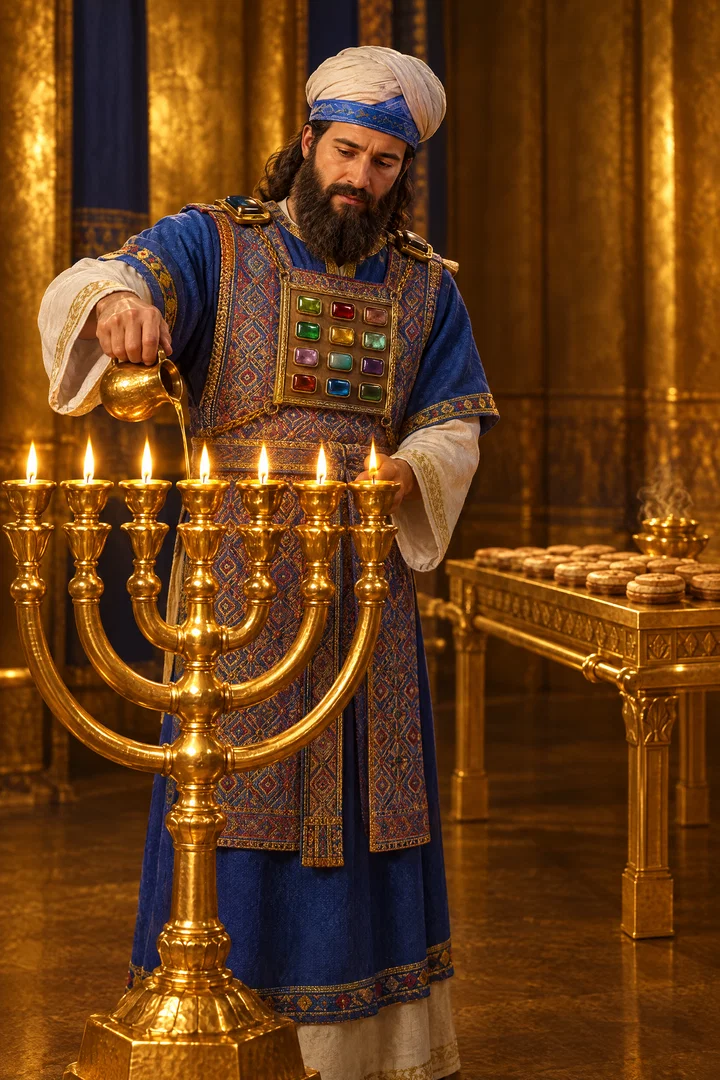
And thou shalt command the children of Israel, that they bring thee pure oil olive beaten for the light, to cause the lamp to burn always.
Translations
And you shall command the children of Israel, that they bring you pure oil olive beaten for the light, to cause the lamp to burn always.
King James Version, KJV Cambridge Paragraph Bible
And thou shalt command the children of Israel, that they bring thee pure oil olive beaten for the light, to cause the lamp to burn always.
And thou shalt command the children of Israel, that they bring the pure olive-oil beaten for the light, to cause the lamp to burn always.
Revised Version, American Standard Version
And thou shalt command the children of Israel, that they bring unto thee pure olive oil beaten for the light, to cause a lamp to burn continually.
'And thou — thou dost command the sons of Israel, and they bring unto thee pure beaten olive oil for the light, to cause the lamp to go up continually;
And thou shalt command the children of Israel, that they bring thee olive oil, pure, beaten, for the light, to light the lamp continually.
Thou thyself, therefore, shalt command the sons of Israel that they bring unto thee—pure, beaten olive-oil, for giving light,—that the lamp may lift up its flame continually.
Berean Standard Bible, Majority Standard Bible
And you are to command the Israelites to bring you pure oil of pressed olives for the light, to keep the lamps burning continually.
“ You shall command the children of Israel, that they bring to you pure olive oil beaten for the light, to cause a lamp to burn continually.
Give orders to the children of Israel to give you clear olive oil for the lights, so that a light may be burning there at all times.
And thou shalt commande the children of Israel, that they bring vnto thee pure oyle oliue beaten, for the light, that the lampes may alway burne.
Douay-Rheims (Challoner revision)
Command the children of Israel that they bring thee the purest oil of the olives, and beaten with a pestle: that a lamp may burn always,
Pictures
Cross-references
- Leviticus 24:2
Command the children of Israel, that they bring unto thee pure oil olive beaten for the light, to cause the lamps to burn continually.
Both command Israel to provide pure olive oil for the lamps to burn continually.
- Exodus 25:31-37
And thou shalt make a candlestick of pure gold: of beaten work shall the candlestick be made: his shaft, and his branches, his bowls, his knops, and his flowers, shall be of the same.
Describes the lampstand and lamps that give light.
- Hebrews 9:2
For there was a tabernacle made; the first, where in was the candlestick, and the table, and the shewbread; which is called the sanctuary.
Describes the sanctuary and its lampstand.
- Exodus 30:8
And when Aaron lighteth the lamps at even, he shall burn incense upon it, a perpetual incense before the LORD throughout your generations.
The evening lamp lighting and perpetual incense show the lamps were not extinguished overnight.
- Revelation 4:5
And out of the throne proceeded lightnings and thunderings and voices: and there were seven lamps of fire burning before the throne, which are the seven Spirits of God.
Sanctuary lamps symbolize the sevenfold Spirit of God.
- Exodus 40:25
And he lighted the lamps before the LORD; as the LORD commanded Moses.
Moses lights the lamps before the Lord as commanded.
- Zechariah 4:2-6
And said unto me, What seest thou? And I said, I have looked, and behold a candlestick all of gold, with a bowl upon the top of it, and his seven lamps thereon, and seven pipes to the seven lamps, which are upon the top thereof:
The lamp’s oil supply is pictured through two olive trees.
- Exodus 40:4
And thou shalt bring in the table, and set in order the things that are to be set in order upon it; and thou shalt bring in the candlestick, and light the lamps thereof.
Moses is instructed to set up the lampstand and light its lamps.
- Zechariah 4:12
And I answered again, and said unto him, What be these two olive branches which through the two golden pipes empty the golden oil out of themselves?
The olive branches pour golden oil through pipes to supply the lamp.
- John 8:12
Then spake Jesus again unto them, saying, I am the light of the world: he that followeth me shall not walk in darkness, but shall have the light of life.
Christ is identified as the Light represented by the lamps.
- Leviticus 6:13
The fire shall ever be burning upon the altar; it shall never go out.
The altar fire was to be kept burning continually.
- Matthew 5:14
Ye are the light of the world. A city that is set on an hill cannot be hid.
Christ’s followers are also called lights.
- Exodus 25:38
And the tongs thereof, and the snuffdishes thereof, shall be of pure gold.
Names the tools for tending the lamps.
- Hebrews 9:23-24
It was therefore necessary that the patterns of things in the heavens should be purified with these; but the heavenly things themselves with better sacrifices than these.
earthly sanctuary a pattern of heavenly
Commentary
Each commentary is drawn from primary sources: the writings of Ellen G. White and Adventist pioneers and periodicals. Each commentary is separate. Its own words are not a quotation; follow the references to read the source passages.
Ellen G. White
8 sources
The command was for Israel to bring pure olive oil, beaten for the light, to cause the sanctuary lamp to burn always.9T 248.2GW 226.1Ms 82, 1904, par. 1–2Ms 33, 1907, par. 127MR 135.1–2 The oil was to be supplied continually so the lamp would keep burning and the house of God would have what its service required.9T 248.2GW 226.1Ms 82, 1904, par. 1–2Ms 33, 1907, par. 127MR 135.1–2 That supply was a regular, continual offering meant to keep God's house furnished with what was needed for its service.9T 248.2GW 226.1Ms 82, 1904, par. 1–2Ms 33, 1907, par. 127MR 135.1–2
The instruction stands among the tabernacle-building specifications that Paul repeated to his fellow workers, showing that the skill, wisdom, and ability employed in that construction came from God and were to honor Him.Ms 97, 1899, par. 3–4 The continually burning lamp represented God's church shining as a light to the world, with Israel to represent God's great light, a light that was never to become extinct.Ms 112, 1897, par. 35–36 When Ahaz closed the temple doors and left the lamp unlit, it marked the interruption of the sacred services.RH Apr 8, 1915
The requirement continues as a present duty to properly supply, care for, and carefully maintain houses of worship, which belong to the Lord.9T 248.2GW 226.1Ms 82, 1904, par. 1–2Ms 33, 1907, par. 127MR 135.1–2 Funds for that upkeep are to be provided by offerings separate from the tithe and must not be taken from the tithe.9T 248.2GW 226.1Ms 82, 1904, par. 1–2Ms 33, 1907, par. 127MR 135.1–2 The tithe is reserved to support the ministers appointed to serve the people.Ms 82, 1904, par. 1–2
Sources
Pioneers and periodicals
38 sources
God commanded Israel to bring pure olive oil made by beating the olives for the sanctuary light so the lamps would burn continually without going out.ST Apr 29, 1897RH Aug 4, 1863ST May 8, 1901ST Dec 2, 1889ST May 10, 1883 The seven lamps on the golden candlestick supplied all the light in the windowless holy place, tended morning and evening by Aaron and his sons as a perpetual priestly ministry.ST May 20, 1880RH Aug 4, 1863ST May 8, 1901RH Jun 21, 1864ST Nov 21, 1892 The oil is the Holy Spirit and the lamps represent Christ the Light of the world and His followers who are to shine, kept bright as Christ trims away what hinders and supplies more of the Spirit, with grace coming through the Old and New Testaments.ST May 8, 1901RH Aug 13, 1908ST Nov 21, 1892 The tabernacle and its continual service were a pattern and shadow of the heavenly sanctuary where Christ now ministers as Priest, devised from eternity for salvation from sin through the cooperation of the divine with the human.ST Jan 24, 1911ST Jun 26, 1907ST Jun 19, 1907 God accepts only pure beaten oil in His service, with no human wisdom or pride mingled like unbeaten oil or strange fire, which calls for careful preparation and thorough work that costs labor.RH Jan 27, 1916ST Jan 19, 1882RH Apr 12, 1906ST Jan 27, 1881
Tabernacle Instructions Context
Exodus 27:20 belongs to the detailed instructions for the construction of the tabernacle and its furnishings which God gave to Moses on the mountain during the forty days and nights he spent there.ST Mar 25, 1889RH Dec 31, 1861ST Jan 31, 1911 This giving took place after Israel's covenant was made and ratified, and it showed God's care for the details of worship through ordinances for the sanctuary and its service and its instruments of service.ST Mar 25, 1889RH Dec 31, 1861ST Jan 31, 1911 Though the full meaning of such a text and every reason for its exact details may not be grasped, it offers instructive lessons and spiritual nourishment.ST Jun 10, 1908
It is part of the explicit instruction concerning the building of the sanctuary and the making of its furniture and the preparation for its services, principally found in Exodus 25 to 30 and in Exodus 25 to 31.ST Feb 17, 1890ST Jun 19, 1907ST Dec 10, 1896 The making of what was thus commanded is recorded in Exodus 35 to 40 and in Exodus 36 to 39, and the erection in Exodus 40.ST Feb 17, 1890ST Jun 19, 1907 In chronological order this instruction comes after the events of Exodus 19 to 32 and before the building and setting up of the sanctuary in Exodus 33 to 40.ST Dec 10, 1896
The building so commanded was the wilderness tabernacle, the inner tabernacle erected by Israel in the wilderness as the sanctuary or temple of God that He might dwell among Israel delivered from Egypt.ST Jun 19, 1907ST Nov 14, 1892ST Jul 8, 1930RH Jan 4, 1870 There their worship was to center and His glory was to remain, with priests ministering in His presence, and the tabernacle with its court was the center of worship adapted to be taken down and set up as Israel journeyed to the promised land.ST Feb 17, 1890ST Nov 14, 1892RH Jan 4, 1870 It was forty-five feet long by fifteen feet wide, divided into the holy place and the most holy place, surrounded by a court fifty by one hundred cubits enclosed by linen hangings.ST Nov 14, 1892 That building was afterward replaced as the center of God's worship on earth by Solomon's temple, and in both buildings all earthly worship and service centered and revolved around the holy of holies where the law of God rested with the mercy-seat over it.ST Jun 19, 1907 The command for the children of Israel to bring pure beaten olive oil to cause the lamp to burn always was one of the provisions for furnishing and operating that sanctuary of two holy places with its ark and sacred vessels.RH Jan 4, 1870
Sanctuary means a sacred or holy place, built not to man's fancy but by explicit instruction after the pattern shown on the mount.ST Feb 17, 1890ST May 16, 1878 The tabernacle and its sacred vessels were made like that pattern as a pattern of the heavenly temple.ST May 16, 1878RH Jan 4, 1870 The pure olive oil for the light was among the materials and offerings Israel brought willingly with the heart for God's dwelling place among them, with gold, silver, brass, precious stones, blue, purple, fine linen, skins and spices.ST Feb 17, 1890ST Jun 4, 1885
Its sides and one end were upright boards closely joined with lower ends set in silver sockets fixed in the ground and held in position by outside bars passing through rings in the boards.ST Mar 10, 1898 It was roofed with curtains reaching to the ground on both sides, with the east end closed by hangings of fine-twined linen brushed aside for passage.ST Mar 10, 1898 Another curtain divided it into two apartments, with the outer twice as much space as the inner.ST Mar 10, 1898 Its inner walls were overlaid with fine gold shining with the greatest brilliancy, representing the reflected light of God's glory in the New Jerusalem.ST Mar 10, 1898 The ceiling part of the curtains was finest and purest linen wrought with many angels in beautiful needlework, representing the angels of heaven waiting upon the bidding of Jehovah.ST Mar 10, 1898
Lamp Oil and Service
The children of Israel were to bring pure olive oil for the light, obtained by beating the olives fine so the sanctuary lamps would keep burning.RH Aug 4, 1863ST May 10, 1883 The golden candlestick that held that oil stood at the left of the door on the south side of the holy place, the first apartment of the tabernacle.ST Nov 21, 1892 It was beaten out of one solid piece of pure gold weighing a talent, nearly twelve pounds Troy weight.ST May 8, 1901ST Nov 21, 1892 It had a main stock with six branches extending outward from two sides and rounding upward to the same height as the main stem, all similarly ornamented, each crowned with a bowl for the reception of the olive oil which was to be kept burning perpetually.ST May 8, 1901
The first apartment had no window, so its seven lamps supplied its light by day and by night.ST May 20, 1880RH Aug 4, 1863 Moses set the candlestick in place and lit its lamps before the Lord when the tabernacle was erected, and the candlestick with its seven lamps belonged to the ordered worship of the earthly sanctuary and its furnishings in the holy place.ST May 20, 1880RH Jun 21, 1864 To cause the lamp to burn always means a continuous, perpetual light: once lit the lamps were never to go out and were never all extinguished at one time.ST Apr 29, 1897ST May 8, 1901 They were ordered by Aaron and his sons from evening to morning before the Lord as a perpetual statute, as part of the priests' daily ministry in the holy place every day in the year.ST May 8, 1901ST Dec 2, 1889 The priests trimmed the lamps and replenished them with oil every morning and evening, with some of the seven kept burning night and day.ST Apr 29, 1897RH Feb 2, 1911 This tending was done with tongs and snuff-dishes of pure gold, with no extinguisher mentioned.ST May 8, 1901
The Hebrew tahmeed, rendered continual or perpetual, means what is constant and ongoing rather than only a daily ceremony.ST Mar 12, 1912 The lamp's ongoing service was part of what was permanently maintained in worship together with the showbread, incense, altar fire and daily offerings.ST Mar 12, 1912ST Mar 12, 1912 Its lighting was therefore a permanent service of worship, not merely a temporary act.ST Mar 12, 1912 The directions assign the priesthood to Aaron and his sons, and priestly rites were not for others to perform unless the Lord specially directed.ST Mar 3, 1914 When Ahaz closed the temple doors the lamp left unlit marked the interruption of the sacred services.RH Apr 8, 1915
Symbolism of Oil and Light
The pure beaten olive oil commanded to keep the sanctuary lamp burning continually is the Holy Spirit.ST May 8, 1901 Because the tabernacle had no windows, its lamps gave light by day and by night, ordered by Aaron and his sons from evening to morning before the Lord as a perpetual statute, and they were never all extinguished at one time.ST May 8, 1901 They were tended with tongs and snuff-dishes of pure gold, with no extinguisher mentioned.ST May 8, 1901 The trimming signifies that Christ as High Priest walks among the candlesticks and cuts away whatever hinders His people from sending forth light, and when He removes something loved He gives more of the Holy Spirit so that they become brighter and better Christians.ST May 8, 1901
The lamps represent Christ the Light of the world and His followers who are also to be lights, and the oil represents the grace needed to keep their light shining.RH Aug 13, 1908 That grace comes through the Old and New Testaments, pictured as the two olive trees.RH Aug 13, 1908 The bread of the presence is closely linked to the lamps because Christ's life-giving word is also light.RH Aug 13, 1908 The seven-branched candlestick with its constantly burning lamps symbolizes the sevenfold Spirit of God.RH Aug 13, 1908 The seven lamps kept continually burning in the first apartment or holy place stood at the left of the door on the south side, formed as a standard with seven branches beaten out of one solid piece of gold weighing about a talent, and they symbolize the seven lamps of fire burning before the throne of God in heaven.ST Nov 21, 1892
By contrast with oil prepared by beating the olives fine for the sanctuary lamps, Zechariah's vision shows the two olive trees producing oil directly without human preparation and pouring it into the lampstand's bowl.ST May 10, 1883 The sanctuary and its service as set forth in the tabernacle among Israel and later in the temple is an object-lesson let down upon earth setting forth God's plan of government and how He deals with those who sought to dethrone Him by sin. It sets forth the plan devised from eternity for salvation from sin through Christ's work in the sanctuary as priest upon the throne, still king while executing the priest's office in dealing with sinners. God's people are so intimately related to this sanctuary question that they cooperate with God in His work through Christ in the sanctuary, so that at every step the divine and the human cooperate.
The earthly sanctuary commanded in Exodus 25 to 31, made as recorded in Exodus 36 to 39 and erected as recorded in Exodus 40, with its directions for construction and furnishing including provision for a dwelling place for God among Israel, was a figure, pattern, shadow and type of the heavenly sanctuary and of Christ's priestly service therein as High Priest and Minister in heaven.ST Jun 26, 1907ST Jun 19, 1907 Its rites pointed to Christ and His work of forgiving sin and transforming character.ST Jun 26, 1907 These scriptures were not written in vain or without purpose but are profitable for doctrine, for reproof, for correction, for instruction in righteousness that the man of God may be perfect, and were written for learning that through patience and comfort of the Scriptures men might have hope.ST Jun 19, 1907 Study of this provision therefore helps to understand God's temple in heaven and Christ's work in behalf of men and reveals God's way, power and glory.ST Jun 19, 1907
Covenant Prophecy and Fulfillment
Exodus 27:20 belongs to the instructions given through Moses in Exodus 25-30 for the sanctuary service, ceremonial requirements distinct from the Ten Commandments spoken by God at Sinai and written on the stone tablets, and not part of the enduring moral law.ST Apr 15, 1886 It is part of the laws given through Moses which Malachi's call to remember the law of Moses includes, comprising ceremonial instructions as well as moral laws. Those laws helped reveal the meaning of the new dispensation through the types and offerings of the old.
It belongs to the description of the worldly sanctuary connected with the first covenant and its ordinances of divine service.ST Aug 5, 1889 Together with that sanctuary system it shows why the ministration of the first covenant was called a ministration of death.ST Aug 5, 1889 That ancient tabernacle was built for ministry involving sacrifices and offerings.ST Jan 24, 1911 Its sacrificial services passed away when Christ died once for all, and it typified the heavenly temple where Jesus now ministers.ST Jan 24, 1911
The constantly burning lamps symbolize the perpetual life union and service between God and His people.ST Mar 12, 1912 They are the continual channel of life, light, and power from the Prince to His children.ST Mar 12, 1912 The little horn's taking away the continual means disrupting that union and service.ST Mar 12, 1912 It does so by putting another ruler in Christ's place in the church and in the hearts of His professed people.ST Mar 12, 1912
Practical Lessons for Believers
The command to supply pure olive oil beaten for the light so that the lamp burns always belongs to God's sanctuary instruction and calls for examination of the attitude of heart toward God's sanctuary.RH Jan 27, 1916 The sanctuary lamp is held before the young only with beaten oil, which is truth made familiar by careful preparation and by gathered material fitted to the youthful mind.ST Jan 19, 1882 General knowledge and fluency of speech are not enough for that work.ST Jan 19, 1882 Teaching the young is service to God that must cost labor and study rather than what costs nothing.ST Jan 19, 1882
God requires only pure beaten oil for His service, with no strange fire kindled and no unbeaten oil mingled in sacrifice.RH Apr 12, 1906 Unbeaten oil is human wisdom and human pride added to God's appointed service.RH Apr 12, 1906 Such presumption God in jealousy rejects with zealous righteous wrath.RH Apr 12, 1906 Beaten oil is thus the image of thorough work yielding a brilliant flame, since pure olive oil beaten for the light was to be brought so the lamp could burn continually.ST Jan 27, 1881
Sources