Exodus 27:21
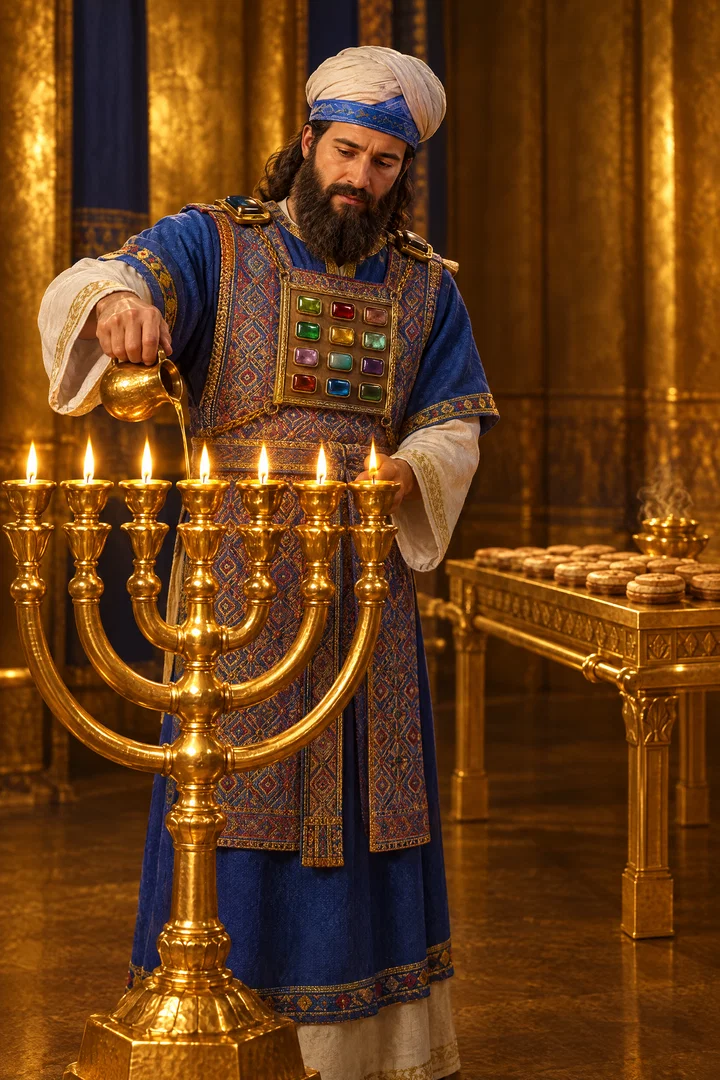
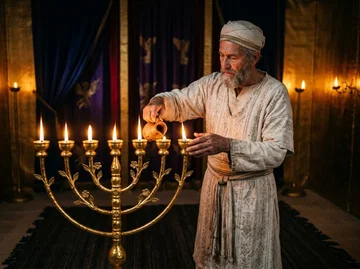
In the tabernacle of the congregation without the vail, which is before the testimony, Aaron and his sons shall order it from evening to morning before the LORD: it shall be a statute for ever unto their generations on the behalf of the children of Israel.
Translations
In the tabernacle of the congregation without the veil, which is before the testimony, Aaron and his sons shall order it from evening to morning before the LORD: it shall be a statute for ever to their generations on the behalf of the children of Israel.
In the tabernacle of the congregation without the vail, which is before the testimony, Aaron and his sons shall order it from evening to morning before the LORD: it shall be a statute for ever unto their generations on the behalf of the children of Israel.
In the tabernacle of the congregation without the vail, which is before the Testimony, Aaron and his sons shall order it from evening to morning before the Lord: it shall be a statute for ever unto their generations on the behalf of the children of Israel.
In the tabernacle of the congregation without the vail, which is before the testimony, Aaron and his sons shall order it from evening to morning before the LORD: It shall be a statute for ever to their generations on the behalf of the children of Israel.
In the tent of meeting, without the veil which is before the testimony, Aaron and his sons shall order it from evening to morning before the LORD: it shall be a statute for ever throughout their generations on the behalf of the children of Israel.
In the tent of meeting, without the veil which is before the testimony, Aaron and his sons shall keep it in order from evening to morning before Jehovah: it shall be a statute for ever throughout their generations on the behalf of the children of Israel.
in the tent of meeting, at the outside of the vail, which [is] over the testimony, doth Aaron — his sons also — arrange it from evening till morning before Jehovah — a statute age-during to their generations, from the sons of Israel.
In the tent of meeting outside the veil, which is before the testimony, Aaron and his sons shall dress them from evening to morning before Jehovah: [ it is] an everlasting statute, for their generations, on the part of the children of Israel.
In the tent of meeting, outside the veil which is by the testimony, shall Aaron and his sons order it from evening until morning, before Yahweh,—a statute age-abiding, to their generations, from the sons of Israel.
Berean Standard Bible, Majority Standard Bible
In the Tent of Meeting, outside the veil that is in front of the Testimony, Aaron and his sons are to tend the lamps before the LORD from evening until morning. This is to be a permanent statute for the Israelites for the generations to come.
In the Tent of Meeting, outside the veil which is before the covenant, Aaron and his sons shall keep it in order from evening to morning before the LORD: it shall be a statute forever throughout their generations on the behalf of the children of Israel.
Let Aaron and his sons put this in order, evening and morning, before the Lord, inside the Tent of meeting, outside the veil which is before the ark; this is to be an order for ever, from generation to generation, to be kept by the children of Israel.
In the Tabernacle of the Congregation without the vaile, which is before the Testimony, shall Aaron and his sonnes dresse them from euening to morning before the Lord, for a statute for euer vnto their generations, to be obserued by the children of Israel.
Douay-Rheims (Challoner revision)
In the tabernacle of the testimony without the veil that hangs before the testimony. And Aaron and his sons shall order it, that it may give light before the Lord until the morning. It shall be a perpetual observance throughout their successions among the children of Israel.
Pictures
Cross-references 20 of 51
- Exodus 25:8
And let them make me a sanctuary; that I may dwell among them.
Commands a sanctuary so God may dwell among Israel.
- Hebrews 9:24
For Christ is not entered into the holy places made with hands, which are the figures of the true; but into heaven itself, now to appear in the presence of God for us:
The earthly sanctuary is a figure of the true sanctuary in heaven.
- Exodus 26:31-33
And thou shalt make a vail of blue, and purple, and scarlet, and fine twined linen of cunning work: with cherubims shall it be made:
The veil separates the holy place from the Most Holy Place, where the testimony is placed.
- Hebrews 8:5
Who serve unto the example and shadow of heavenly things, as Moses was admonished of God when he was about to make the tabernacle: for, See, saith he, that thou make all things according to the pattern shewed to thee in the mount.
The tabernacle’s earthly service is an example and shadow of heavenly things.
- Acts 7:44
Our fathers had the tabernacle of witness in the wilderness, as he had appointed, speaking unto Moses, that he should make it according to the fashion that he had seen.
Both describe the tabernacle as made according to the pattern God showed Moses.
- Exodus 25:16
And thou shalt put into the ark the testimony which I shall give thee.
The ark in the sanctuary held the testimony, God’s law.
- Hebrews 8:1-2
Now of the things which we have spoken this is the sum: We have such an high priest, who is set on the right hand of the throne of the Majesty in the heavens;
The earthly sanctuary service points to Christ’s ministry as High Priest in the true heavenly sanctuary.
- Exodus 31:18
And he gave unto Moses, when he had made an end of communing with him upon mount Sinai, two tables of testimony, tables of stone, written with the finger of God.
The testimony is identified as the commandments written on stone tablets.
- Exodus 30:7-8
And Aaron shall burn thereon sweet incense every morning: when he dresseth the lamps, he shall burn incense upon it.
Both prescribe the priests’ daily tending of the lamps morning and evening.
- Leviticus 24:3
Without the vail of the testimony, in the tabernacle of the congregation, shall Aaron order it from the evening unto the morning before the LORD continually: it shall be a statute for ever in your generations.
Repeats the command to keep the lamps burning continually.
- Hebrews 9:3
And after the second veil, the tabernacle which is called the Holiest of all;
Calls the inner curtain the second veil.
- Exodus 25:31-40
And thou shalt make a candlestick of pure gold: of beaten work shall the candlestick be made: his shaft, and his branches, his bowls, his knops, and his flowers, shall be of the same.
Describes the golden candlestick and its lamps.
- Revelation 15:5
And after that I looked, and, behold, the temple of the tabernacle of the testimony in heaven was opened:
Names the heavenly temple as the tabernacle of the testimony.
- Exodus 26:30
And thou shalt rear up the tabernacle according to the fashion thereof which was shewed thee in the mount.
The tabernacle was erected according to the pattern shown to Moses.
- Hebrews 9:11-12
But Christ being come an high priest of good things to come, by a greater and more perfect tabernacle, not made with hands, that is to say, not of this building;
Contrasts the earthly sanctuary service with Christ’s ministry in the greater sanctuary.
- Exodus 32:15
And Moses turned, and went down from the mount, and the two tables of the testimony were in his hand: the tables were written on both their sides; on the one side and on the other were they written.
Calls the stone tablets the tables of the testimony.
- Exodus 40:21
And he brought the ark into the tabernacle, and set up the vail of the covering, and covered the ark of the testimony; as the LORD commanded Moses.
The testimony is placed in the ark behind the veil.
- Exodus 16:34
As the LORD commanded Moses, so Aaron laid it up before the Testimony, to be kept.
“Testimony” names the commandments before which the manna was kept.
- Exodus 40:3
And thou shalt put therein the ark of the testimony, and cover the ark with the vail.
The veil covers the ark before the Most Holy Place.
- Exodus 28:1
And take thou unto thee Aaron thy brother, and his sons with him, from among the children of Israel, that he may minister unto me in the priest’s office, even Aaron, Nadab and Abihu, Eleazar and Ithamar, Aaron’s sons.
Aaron and his sons are appointed for priestly ministry in the sanctuary.
Commentary
Each commentary is drawn from primary sources: the writings of Ellen G. White and Adventist pioneers and periodicals. Each commentary is separate. Its own words are not a quotation; follow the references to read the source passages.
Ellen G. White
2 sources
Aaron and his sons were given charge of the lamp in the tabernacle of the congregation before the Lord, to order and tend it through every night from evening until morning.RH Apr 8, 1915Ms 112, 1897, par. 35–36 Its burning was to be continual and unbroken, never permitted to grow dim or to go out.Ms 112, 1897, par. 35–36 That light was not furnished to illuminate the heavenly sanctuary, but stood for God's church giving light to the world, with Israel appointed to uphold and represent that great light so that it would never become extinct.Ms 112, 1897, par. 35–36
When the temple services were interrupted under Ahaz, the candlesticks were left unlit, in direct violation of this requirement to keep them burning.RH Apr 8, 1915
Sources
Pioneers and periodicals
38 sources
Aaron and his sons were to keep the seven lamps burning continually in the holy place outside the veil before the testimony, ordering them from evening until morning as a perpetual statute for Israel so the light never went out.ST May 20, 1880ST Apr 29, 1897ST May 8, 1901ST Dec 2, 1889 The command was part of the detailed pattern for the tabernacle and its furnishings given to Moses during his forty days with God on Mount Sinai, with nothing left to human fancy in form or size.ST Mar 25, 1889ST Feb 17, 1890RH Dec 31, 1861ST Dec 10, 1896 That earthly sanctuary and its service was a pattern, shadow and type of heavenly things, teaching about God's heavenly temple and the work of Christ as High Priest and Minister of the sanctuary, which passed away as a typical system when He suffered and died once for all.ST Oct 29, 1894ST Jan 24, 1911ST Jun 26, 1907ST Jun 19, 1907 The constantly burning lamps symbolized the sevenfold Spirit of God burning before His throne, and their trimming pictures Christ walking among the candlesticks to cut away what hinders His people from giving light and to give more of the oil of the Holy Spirit.ST May 8, 1901ST Nov 21, 1892 Like all Scripture it was not written in vain but is profitable for doctrine and instruction, giving clearer views of the Saviour and His work and revealing God's way, power and glory.ST Jun 19, 1907
Verse Wording and Placement
The lamps ordered here stood in the tent of meeting outside the veil before the testimony, in the first apartment or holy place, where Aaron and his sons were to keep them burning from evening until morning before the Lord.ST May 20, 1880ST Dec 2, 1889 That holy place had no window, so the golden candlestick provided its light, and every day in the year the priests ministered there.ST May 20, 1880ST Dec 2, 1889 The candlestick stood on the south side at the left of the door.ST Nov 21, 1892
It was made as a standard with seven branches beaten out of one solid piece of gold weighing about a talent, supporting seven lamps that were kept continually burning.RH Jun 21, 1864ST Nov 21, 1892 It is identified as one of the furnishings of the holy place, belonging to the daily priestly service as distinct from the yearly atonement service connected with the law kept in the ark in the most holy place.RH Jun 21, 1864 The seven burning lamps represent the seven lamps of fire burning before the throne of God in heaven.ST Nov 21, 1892
The testimony before which the lamp burned is the Ten Commandments behind the veil where the ark of the testimony was located.RH Nov 22, 1864ST Jun 24, 1880ST May 23, 1878 This setting distinguishes the testimony, the commandments kept in the ark, from the inner, most holy place where the ark itself was located, while the earthly arrangement served as a pattern of the heavenly sanctuary.RH Nov 22, 1864ST Jun 24, 1880 The term testimony is definitely used here to mean the ten commandments.RH Jan 4, 1870ST May 23, 1878
Those commandments give their name to the tables on which they were written, to the ark in which the tables were placed, to the veil that hides the ark, and to the tabernacle itself, especially to its second apartment where the ark was placed.RH Jan 4, 1870 The veil named here is thus the veil before the ten commandments in the ark.RH Jan 4, 1870
The curtain named here uses the Hebrew masak, rendered katapetasma in the Septuagint.RH Apr 8, 1873RH Oct 5, 1916 The Septuagint uses the same Greek word for it as for the curtain before the Most Holy Place, though the English translation calls the former a hanging and the latter a veil.RH Apr 8, 1873 The Hebrew terms used for the two curtains are different, but both mean a veil or curtain.RH Apr 8, 1873
The verse stands in the account of the court around the tabernacle, which was a double square fifty by one hundred cubits, or seventy-five by one hundred and fifty feet.ST Nov 14, 1892 It was enclosed by hangings of fine-twined linen suspended from brass pillars five cubits high set five cubits apart with sockets of brass and hooks and fillets of silver.ST Nov 14, 1892 The entrance twenty cubits wide on the east was closed with curtains of fine-twined linen of gorgeous colors.ST Nov 14, 1892 All the important dimensions were five cubits or some multiple of five cubits, constructed with strict proportion and beauty of material to impress every beholder with the importance, purity and sacredness of the worship connected therewith.ST Nov 14, 1892
Sinai Instructions History
Exodus belongs in two great parts, with chapters 19 to 40 forming the chiefly legislative division, and this command stands within the detailed instructions for building the tabernacle and its furniture given to Moses during his forty days and nights with God on Mount Sinai.ST Mar 25, 1889RH Dec 31, 1861ST Jan 31, 1911 Those forty days came after the covenant with Israel was ratified, after the Ten Commandments and other statutes were proclaimed and ratified over the book of the covenant.ST Mar 25, 1889 During that time on the mountain God ordained the priesthood to minister in the sanctuary before the ark, and gave particular care to all that pertained to worship.ST Mar 25, 1889RH Dec 31, 1861 What Moses received then concerned the sanctuary and its instruments of service, before the worship of the golden calf and before the preparation and setting up of the tabernacle.ST Jan 31, 1911
It is part of the explicit instructions in Exodus 25 to 31 for building the sanctuary and preparing its services, with the structure and arrangement of the sanctuary and its furnishings set out in chapters 25, 26, 27 and 30 and continuing to the end of Exodus.ST Jun 19, 1907ST Mar 10, 1898 That full description gives the place in which the two kinds of atoning service for the errors of the people were performed.ST Mar 10, 1898 The sanctuary and its service in the tabernacle among Israel and later in the temple was God's object-lesson let down to earth to set forth His plan of government and how He deals with sin. It sets forth the plan devised from eternity for salvation, carried out by Christ as priest upon the throne, still King while executing the priest's office, in which the divine and the human cooperate because God's people are intimately related to the sanctuary.
The directions for building the sanctuary and making its furniture were afterward carried out as recorded in Exodus 35 to 40, when the sanctuary was built and set up.ST Feb 17, 1890ST Dec 10, 1896 Nothing was left to human fancy as to form or size or how large it should be, for God gave explicit instructions and even the pattern to be followed.ST Feb 17, 1890 Special men were endowed with sufficient wisdom to carry out the directions, showing the meaning of sanctuary as a sacred or holy place made so that He might dwell among them.ST Feb 17, 1890 The verse is thus included among the detailed instructions for constructing and serving Israel's sanctuary as God's dwelling place among them, where His glory was to remain and where their worship was to center.ST Feb 17, 1890ST Jul 8, 1930
Perpetual Lamp Service
Aaron and his sons were charged to order the lamps in the tent of meeting outside the veil before the testimony from evening until morning before the Lord, as a perpetual statute for Israel through their generations.ST May 20, 1880ST May 8, 1901ST Mar 11, 1886RH Jun 28, 1864RH Feb 2, 1911 The light was to be continuous and perpetual, never to go out, so that the lamps were never all extinguished at one time but shed light by day and by night.ST Apr 29, 1897ST May 8, 1901RH Feb 2, 1911 The lamps stood in the first apartment or holy place, which had no window, so the golden candlestick supplied its light.ST May 20, 1880ST May 8, 1901 This tending belonged to the regulations of the first-covenant sanctuary service.RH Jun 28, 1864
Every day in the year the priests ministered in the holy place, the first room of the sanctuary.ST Dec 2, 1889 They trimmed the lamps and replenished their oil each morning and evening to keep them burning.ST Apr 29, 1897ST May 8, 1901 That care required tongs and snuff-dishes of pure gold, and no extinguisher was provided.ST May 8, 1901
The priestly rites were committed to Aaron and his sons, and no one else was to perform them unless the Lord specially directed it.ST Mar 3, 1914 The seven-lamped candlestick was one of the furnishings of the holy place where this daily priestly service was performed, standing alongside the yearly atonement service, with the law kept in the ark in the most holy place.RH Jun 21, 1864 When the temple services were interrupted under Ahaz, the candlesticks were no longer kept burning as this command required.RH Apr 8, 1915
Type and Fulfillment
The instruction belongs to the scriptural description of the worldly sanctuary and its service, which was designed to teach about God's heavenly temple and the work of Christ as High Priest and Minister of the sanctuary.ST Oct 29, 1894ST Jun 26, 1907ST Jun 19, 1907 That sanctuary and its service were a pattern, shadow, and type of heavenly things, and its rites pointed to Christ and His power to forgive sin and transform character.ST Jun 26, 1907ST Jun 19, 1907 Study of it gives clearer views of the Saviour and His work and reveals God's way, power, and glory, for it was written for learning to give patience, comfort, and hope and is profitable for doctrine, reproof, correction, and instruction in righteousness.ST Jun 19, 1907
The sanctuary let down to earth is God's object-lesson setting forth His plan of government and how He deals with those who have sought to dethrone Him by sin. It sets forth the plan devised from eternity for salvation from sin, carried out by Christ as priest upon the throne, still King while executing the priest's office in dealing with sinners. God made His purpose known to His people because they are so intimately related to the sanctuary that they co-operate with God in His work through Christ in the sanctuary, so that in every step the divine and the human co-operate.
The earthly sanctuary was built for the ministry of sacrifices and offerings, and that typical system passed away when Christ suffered and died once for all.ST Jan 24, 1911ST Jun 26, 1907 The sanctuary it foreshadowed is in heaven, where Jesus now ministers.ST Jan 24, 1911 Its ceremonial ordinances and sacrifices found their fulfillment in Christ.ST Jun 26, 1907ST Jun 19, 1907ST Jul 8, 1886 As part of the description of the worldly sanctuary connected with the first covenant and its ordinances of divine service, its ministration was called a ministration of death.ST Aug 5, 1889 The continual tending of the tabernacle lamp by Aaron and his sons from evening until morning before the Lord as a lasting ordinance for Israel is an example of the regulations belonging to that first-covenant sanctuary service.ST Aug 5, 1889RH Jun 28, 1864
The command belongs to the ordinances written out in full after the moral law and recorded in Exodus 19-30, especially Exodus 25-30, distinct from the Ten Commandments written on the stone tablets.ST May 6, 1875ST Apr 15, 1886 It was given through Moses after the people asked him to receive God's further commands, and stands among the moral, ceremonial, sacrificial, and other statutes and judgments that Israel was to remember.ST Apr 15, 1886 As part of the ceremonial, sacrificial, and other statutes, including the regulations concerning offerings and sacrifices, it reveals the old dispensation's types and helps trace their fulfillment in the new dispensation.ST May 6, 1875ST Apr 15, 1886
The sanctuary God commanded Israel to build in the wilderness was the center of Israel's worship, which centered on the holy of holies where God's law rested beneath the mercy seat in the ark of the covenant.ST Jun 19, 1907ST Jan 27, 1909 It was God's dwelling place among the people, and that role continued from the wilderness sanctuary through the temple built by Solomon, where the Lord's glory filled the house.ST Jun 19, 1907ST Jun 4, 1885 God gave the builders His Spirit so they could carry out the sanctuary work properly.ST Jan 27, 1909 The sanctuary ordered on the mount, made so God might dwell among Israel and priests might minister in His presence, consisted of two holy places with its sacred vessels made exactly like the pattern shown in the mount.RH Jan 4, 1870 The tabernacle thus built is a pattern of the heavenly temple, proving the heavenly temple consists of two holy places.RH Jan 4, 1870
The lamps in the holy place outside the veil before the testimony were kept constantly burning and symbolized the sevenfold Spirit of God. The seven burning lamps represent the seven lamps of fire burning before the throne of God in heaven.ST Nov 21, 1892 They were to burn continually and were never all extinguished at one time, shedding light by day and by night.ST May 8, 1901 Their care required pure gold tongs and snuff-dishes for trimming, with no extinguisher provided.ST May 8, 1901 The trimming pictures Christ as High Priest walking among the golden candlesticks to cut away whatever hinders His people from sending forth light, and when He removes something loved He gives more of the oil of the Holy Spirit to make them brighter and better Christians.ST May 8, 1901
Study Value and Warning
The instructions for the sanctuary in Exodus 25, 26, 27, and 30 were not written in vain but are profitable for doctrine, reproof, correction, and instruction in righteousness, and were written for learning to give patience, comfort, and hope.ST Jun 19, 1907 With the rest of the earthly sanctuary and its service they are a pattern, shadow, and type of the heavenly sanctuary, an object-lesson teaching about the temple of God in heaven and Christ's priestly service there as High Priest and Minister of the sanctuary.ST Jun 19, 1907 Studying them gives clearer views of the Saviour and His work and reveals God's way, power, and glory.ST Jun 19, 1907
As part of God's instruction about His sanctuary, the command calls for examining one's attitude of heart toward God's sanctuary.RH Jan 27, 1916 Those instructions were given to Moses during the forty days and nights he was on the mountain after the covenant with Israel was ratified, and they show God's particular care for what pertains to worship.ST Mar 25, 1889 They belong to the directions for building the sanctuary and making its furniture, afterward carried out as recorded in Exodus 35-40.ST Feb 17, 1890 The directions show the meaning of sanctuary as a sacred or holy place.ST Feb 17, 1890
The object of the building shows its sacred character, for the command was to make a sanctuary that He might dwell among them, where His glory was to remain and where their worship was to center.ST Feb 17, 1890 The building was not left to man's fancy as to how it should be built or how large it should be, for God gave explicit instructions, even the pattern after which it was to be made, and endowed special men with sufficient wisdom to carry out the directions.ST Feb 17, 1890 To quote the wilderness account to argue that the Sabbath was first instituted in the wilderness gives the words a sense they were not intended to convey.
Sources