Leviticus 6:13
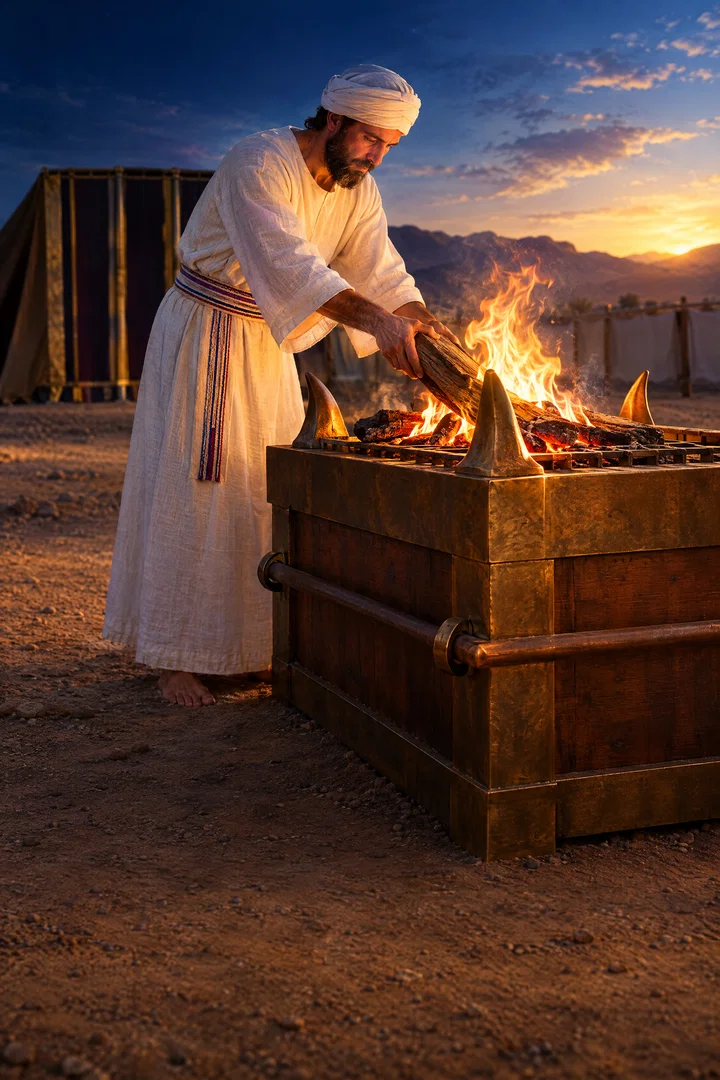
The fire shall ever be burning upon the altar; it shall never go out.
Translations
The fire shall ever be burning on the altar; it shall never go out.
King James Version, KJV Cambridge Paragraph Bible, Webster Bible
The fire shall ever be burning upon the altar; it shall never go out.
Revised Version, American Standard Version
Fire shall be kept burning upon the altar continually; it shall not go out.
fire is continually burning on the altar, it is not quenched.
A continual fire shall be kept burning on the altar: it shall never go out.
fire, shall continually be kept burning on the altar, it shall not be suffered to go out.
Berean Standard Bible, Majority Standard Bible
The fire shall be kept burning on the altar continually; it must not be extinguished.
Fire shall be kept burning on the altar continually; it shall not go out.
Let the fire be kept burning on the altar at all times; it is never to go out.
The fire shall euer burne vpon the altar, and neuer go out.
Douay-Rheims (Challoner revision)
This is the perpetual fire which shall never go out on the altar.
Pictures
Cross-references
- Leviticus 10:1-2
And Nadab and Abihu, the sons of Aaron, took either of them his censer, and put fire therein, and put incense thereon, and offered strange fire before the LORD, which he commanded them not.
Nadab and Abihu are consumed for offering fire God had not commanded.
- Leviticus 9:24
And there came a fire out from before the LORD, and consumed upon the altar the burnt offering and the fat: which when all the people saw, they shouted, and fell on their faces.
The Lord kindled the altar fire that was to be kept burning.
- Exodus 29:38-42
Now this is that which thou shalt offer upon the altar; two lambs of the first year day by day continually.
Prescribes the daily lamb offerings morning and evening as a continual burnt offering.
- Numbers 28:3-8
And thou shalt say unto them, This is the offering made by fire which ye shall offer unto the LORD; two lambs of the first year without spot day by day, for a continual burnt offering.
Prescribes the continual morning and evening offerings.
- Exodus 27:20
And thou shalt command the children of Israel, that they bring thee pure oil olive beaten for the light, to cause the lamp to burn always.
Both describe a sanctuary light kept burning continually.
- Exodus 29:42
This shall be a continual burnt offering throughout your generations at the door of the tabernacle of the congregation before the LORD: where I will meet you, to speak there unto thee.
The morning and evening lambs are included in the continual service.
- Leviticus 16:12
And he shall take a censer full of burning coals of fire from off the altar before the LORD, and his hands full of sweet incense beaten small, and bring it within the vail:
The incense coals were taken from the sacred fire.
- Numbers 16:46
And Moses said unto Aaron, Take a censer, and put fire therein from off the altar, and put on incense, and go quickly unto the congregation, and make an atonement for them: for there is wrath gone out from the LORD; the plague is begun.
Coals from the altar fire were used with incense.
- Hebrews 10:11-14
And every priest standeth daily ministering and offering oftentimes the same sacrifices, which can never take away sins:
The repeated altar sacrifices find their fulfillment in Christ’s one lasting offering.
- 1 Kings 18:38
Then the fire of the LORD fell, and consumed the burnt sacrifice, and the wood, and the stones, and the dust, and licked up the water that was in the trench.
God sends fire to consume Elijah’s sacrifice on Mount Carmel.
- Leviticus 24:2
Command the children of Israel, that they bring unto thee pure oil olive beaten for the light, to cause the lamps to burn continually.
The lamps and altar fire are both maintained continually as part of worship.
- Malachi 3:2-3
But who may abide the day of his coming? and who shall stand when he appeareth? for he is like a refiner’s fire, and like fullers’ soap:
God-kindled fire signifies the Spirit’s refining work.
- Mark 9:49
For every one shall be salted with fire, and every sacrifice shall be salted with salt.
The passage connects this fire with sin’s final consumption.
- Daniel 8:11
Yea, he magnified himself even to the prince of the host, and by him the daily sacrifice was taken away, and the place of his sanctuary was cast down.
The perpetual altar fire illustrates the continual that the little horn takes away.
Commentary
Each commentary is drawn from primary sources: the writings of Ellen G. White and Adventist pioneers and periodicals. Each commentary is separate. Its own words are not a quotation; follow the references to read the source passages.
Ellen G. White
13 sources
God Himself kindled the fire on the altar and commanded that it burn continually day and night and never go out.2RED 82.1–21SP 276.2–277.1LC1 186.1 It was the only fire to be used in sacred service, especially to kindle the incense on the censer, and all common fire was forbidden for that use under penalty of death.2RED 82.1–21SP 276.2–277.1LC1 186.1Ms 122, 1897, par. 25–26 Nadab and Abihu dishonored God by offering common fire in disregard of His direction, and He consumed them so that they died.Ms 122, 1897, par. 25–263MR 324.3Ms 109, 1899, par. 5–6 The divine fire represents God and the communion with Him opened through Jesus Christ alone, so that the perpetually burning fire kindled the incense that rose mingled with the prayers of the people as an emblem of His mediation, without whom no sacrifice is acceptable.2RED 82.1–2LC1 186.13MR 324.3Ms 109, 1899, par. 5–6RH Mar 25, 1875 That altar is still where people receive divine fire, and the truth must burn as a purifying fire in the hearts of ministers to shape their lives and bring light to those in darkness.GW 255.12T 336.2
Sacred Fire Commanded
The fire on the altar was kindled by God Himself, and He commanded that it be kept burning continually, day and night, without ever going out.2RED 82.1–21SP 276.2–277.1LC1 186.13MR 324.3RH Mar 25, 1875 It was never to be extinguished, but was to remain perpetually burning as the sacred fire He provided for the priests' service.2RED 82.1–2LC1 186.1Ms 122, 1897, par. 25–263MR 324.3SG4 11.2–3 That sacred, God-kindled fire was the only fire to be used for sacred service, and it was used in all the sanctuary service.Ms 122, 1897, par. 25–263MR 324.3Ms 109, 1899, par. 5–6 Especially it was the required source for burning incense, to be put on the censer for the priests' offerings of incense before the Lord.2RED 82.1–21SP 276.2–277.1LC1 186.1RH Mar 25, 1875SG4 11.2–3
Common or unauthorized fire was forbidden for that use and was distinct from the sacred fire.2RED 82.1–21SP 276.2–277.1SG4 11.2–3 Explicit directions were given that all sacred worship must agree with His holy character, with any deviation punishable by death.RH Mar 25, 1875 Nadab and Abihu violated this command by bringing and offering common fire instead of the sacred fire.2RED 82.1–2Ms 122, 1897, par. 25–263MR 324.3Ms 109, 1899, par. 5–6RH Mar 25, 1875 In doing so they showed positive disregard for God's directions and dishonored Him, so God consumed them and they died.3MR 324.3RH Mar 25, 1875
Their discernment was lost because wine confused their senses and beclouded and debased their intellect.Ms 122, 1897, par. 25–26RH Mar 25, 1875 Having gratified appetite by wine, they could no longer distinguish sacred fire from common fire.Ms 122, 1897, par. 25–26RH Mar 25, 1875
What the Fire Signified
The fire on the altar represented God Himself, which is why only the fire He commanded could be used and its use was governed by His command.3MR 324.3Ms 109, 1899, par. 5–6 That divine fire represents the communication between God and humanity opened through Jesus Christ alone.2RED 82.1–2LC1 186.1RH Mar 25, 1875 It was kept burning perpetually so it could be placed on the censer, and while the people prayed without, the incense kindled by it rose mingled with their prayers as an emblem of Christ's mediation.2RED 82.1–2LC1 186.1RH Mar 25, 1875Ms 18, 1895, par. 15–16
No sacrifice was acceptable unless salted and seasoned with this divine fire.RH Mar 25, 1875 To leave out the divine Saviour by using other fire insulted God and made the work like the offering of Cain.RH Mar 25, 1875 Like the spiritual water Christ gives, the continually burning fire pictures a continuing provision from God, not a gift that fails or is available only once.Ms 18, 1895, par. 15–16
Enduring Spiritual Application
The altar of God is the place where people receive divine fire to kindle their spiritual light, for the fire was to remain continually burning and never go out.GW 255.1 The truth must keep burning in ministers’ hearts as a purifying fire that shapes their lives and enables them to bring light to people in darkness.2T 336.2 Consecrated workers are to kindle a fire of sacrificial service in the South and keep it burning until their work is done, never allowing it to go out.SBAWP 47.3–48.4 The continually burning altar fire signifies humanity’s endless obligation to God, expressed through gratitude and giving.4T 477.1 The portion God claims from income is to be set aside before personal wants are met, to support the poor and God’s cause, and what remains is blessed for personal use.4T 477.1
Sources
Pioneers and periodicals
41 sources
The fire on the altar was kindled by God himself and was to be kept burning continually day and night and never allowed to go out.RH Sep 19, 1912ST Apr 22, 1889ST Feb 17, 1890 The priests maintained it by laying wood upon it every morning and keeping the burnt offering and the fat of the offerings ever consuming upon it.RH Nov 27, 1913RH Aug 15, 1865RH Mar 8, 1870 As part of the sanctuary service it shadows the continual priestly ministry of Jesus Christ in the heavenly temple for his people.ST Feb 7, 1911ST Jun 19, 1907ST Nov 28, 1895 Only that consecrated fire could be used in worship, so that common fire brought into sacred service, as with Nadab and Abihu, was a serious sin that insulted God by leaving out the divine mediation.ST Mar 4, 1875ST Apr 22, 1889ST Sep 12, 1900RH Sep 11, 1913 It signifies the continuing union between God and his people, and calls for the fire of love and prayer to be kept ever burning on the altar of the heart and in private devotion, in the home, and in the church.RH Apr 21, 1859ST Mar 12, 1912ST Mar 29, 1883ST Mar 29, 1883ST Mar 12, 1912
Altar Fire Described
The fire on the altar of burnt offering, the brazen altar, was kindled by the Lord himself and was to be kept burning continually day and night and never allowed to go out.RH Sep 19, 1912ST Apr 22, 1889ST Feb 17, 1890ST Apr 1, 1913RH Feb 2, 1911 That unquenched burning was without interruption.RH Sep 19, 1912ST Apr 22, 1889RH Aug 15, 1865ST Feb 17, 1890ST Apr 1, 1913
The priests maintained it by burning wood on it every morning, laying the burnt offering in order upon it, and burning thereon the fat of the peace offerings.RH Nov 27, 1913ST May 29, 1901 The carefully separated fat of peace offerings and nearly every other offering of the penitent was burned by the priest to keep the required continual fire.RH Nov 27, 1913ST May 29, 1901 The daily ministration included the regular morning and evening burnt offerings, with the morning lamb burning through the day and the evening lamb burning through the night.RH Aug 15, 1865RH Mar 8, 1870ST May 29, 1901 In this way the continual burnt offering remained in progress even while the high priest served in the second apartment on the Day of Atonement.RH Aug 15, 1865RH Mar 8, 1870
The perpetually burning fire was one part of the permanent continual service rather than a temporary rite.ST Mar 12, 1912ST Mar 12, 1912ST Apr 2, 1912 That continual service included more than the daily morning and evening sacrifice.ST Mar 12, 1912ST Mar 12, 1912 It also included such lasting duties as offering incense, presenting the showbread, lighting the lamps, and keeping the altar fire, with the daily worship and offerings continuing throughout the year.ST Mar 12, 1912ST Apr 2, 1912
The language of keeping the fire burning and never letting it go out can describe a duration that ends when its subject ceases.RH Mar 22, 1864 Its context concerns the meat offerings presented by Aaron's sons, with the related requirement that his male descendants eat those offerings forever through their generations.RH Mar 22, 1864 Those offerings later ceased, showing that forever can describe a duration ending when the thing it concerns ceases.RH Mar 22, 1864
Shadow of Christ's Ministry
The command stands within the laws concerning sacrifices and offerings in Leviticus 1-7, 16 and 23, which set out the main features of the service of the sanctuary built by Moses for God to dwell among His people.ST Feb 7, 1911ST Jun 19, 1907ST Feb 13, 1912 The details of those laws have meaning, and their fuller meaning is found in the sacrifice, life, and work of Jesus Christ, with each different kind of sacrifice presenting something in type concerning His work.ST Feb 7, 1911ST Feb 13, 1912 As part of the instructions for Israel's offerings and priesthood, it shows that sin demands a penalty and that the offerings are types pointing to Jesus Christ.ST Feb 3, 1909 The earthly sanctuary and its service were a pattern, shadow, and type and impressive object-lesson of the temple of God in heaven and Christ's priestly service therein as High Priest and Minister of the heavenly sanctuary, revealing God's way, power, and glory.ST Jun 19, 1907 That service is profitable for doctrine, reproof, correction, and instruction in righteousness to make the man of God perfect, and was written for learning that through patience and comfort of the Scriptures hope may be had, so that study of this verse enables understanding of Christ and His work in behalf of men.ST Jun 19, 1907
The instruction is part of the ceremonial law contained in Leviticus 3-7, which was instituted in consequence of sin and stands distinct from and contrasted with the moral law.RH Jan 10, 1916 Every offering presented in faith transferred in figure the sins of the penitent through the blood of the sacrifice or the person of the priest to the sanctuary, where the sprinkled blood left those forgiven sins resting upon the altar before the ark.RH Nov 27, 1913ST This transfer went on daily through the year until the cleansing on the tenth day of the seventh month.ST As a type of the gospel shadowing the offering on Calvary, the service was also the divine channel making all gospel blessings real, so that every faith-prompted offering gave full possession of what it symbolized rather than only a typical pardon.RH Nov 27, 1913
The verse belongs to the complete round of service performed every year in the sanctuary built by Moses in the wilderness, later giving way to the temple, which in its building, appointments, priesthood, and service was typical of Christ and His priesthood in the heavenly sanctuary begun when He ascended on high.ST Nov 28, 1895 Each yearly round typified the service of Christ which was once for all.ST Nov 28, 1895 Its daily worship and offerings continued throughout the year and pointed forward to Christ.ST Apr 2, 1912
Fire Consuming Sin
The unquenched fire on the brazen altar was to be kept burning continually and never allowed to go out, and it represents the fire from God that will destroy sin from the earth, burning as long as any sin remains to be consumed.RH Sep 19, 1912 Fire means a destroying agent that consumes what it preys upon, and fat always means sin.RH Nov 27, 1913 God required this continual altar fire to be maintained by the priest burning the carefully separated fat of peace offerings and nearly every other offering of the penitent Jew.RH Nov 27, 1913 The careful separating of the fat and its burning by the priest means the divine process of separating sin from the sinner for its final and eternal destruction by fire.RH Nov 27, 1913
This ceremony brought the devout believing Jew through faith into the divine reality of the saving power of the gospel of Jesus Christ, because the earthly sanctuary service was a type of the gospel shadowing the offering on Calvary yet was also the divine channel making all gospel blessings real, so that every faith-prompted offering gave full possession of what it symbolized rather than only a typical pardon.RH Nov 27, 1913 The fire once kindled by the Lord on the altar must be kept burning continually and never go out, with the priest burning wood on it every morning and laying the burnt offering in order upon it and burning the fat of the peace offerings thereon.ST May 29, 1901 The fire represents one phase of the work of the Holy Spirit and must never be allowed to go out.ST May 29, 1901 The command means not to quench the Holy Spirit but to keep it burning with the fat of sin offerings and whole burnt offerings.ST May 29, 1901
The altar is every human heart fully surrendered to God, where through the work of the Holy Spirit a fire is kindled that never goes out unless quenched.RH Nov 27, 1913 There it burns until all the dross of sin and all the base metal in the character is burned out.RH Nov 27, 1913 This calls for constant surrender of everything in life the Holy Spirit reveals as not right.RH Nov 27, 1913
Holy Fire Kept Pure
The fire that was to burn continually was not any fire, but fire kindled by God himself, carefully maintained and kept perpetually burning, and only this consecrated fire could be used to burn the offering.ST Apr 22, 1889ST Sep 12, 1900 The coals for burning the sacred incense were to be taken from this altar fire, so the prescribed worship excluded ordinary fire.ST Mar 4, 1875ST Apr 22, 1889 On special occasions God himself kindled a sacrifice directly, as at Elijah's altar on Mount Carmel.ST Sep 12, 1900
No sacrifice was acceptable unless salted and seasoned with this divine fire, which is the communication between God and man opened through Jesus Christ alone.ST Mar 4, 1875RH Mar 25, 1875 The holy fire was kept burning perpetually to be put on the censer, so that while God's people prayed without, the incense kindled by it rose before God mingled with their prayers as an emblem of Christ's mediation.ST Mar 4, 1875RH Mar 25, 1875 Priests were required to use only that holy fire, especially for burning incense, for God gave explicit directions that all sacred worship agree with his holy character, and any deviation from his express directions in sacred service was punishable with death.ST Mar 4, 1875RH Mar 25, 1875
Nadab and Abihu used common fire with the holy spices, and together the improper fire and incense made their offering strange and unacceptable.ST Mar 4, 1875ST Apr 22, 1889 To use common fire was to offer strange fire, an insult to the infinite God because it left out the divine Saviour, making their works like the offering of Cain, with no divine Saviour represented.ST Mar 4, 1875RH Mar 25, 1875 God consumed them for positive disregard of his directions, a discernment they had lost because gratification of appetite by wine had debased and beclouded their intellect.RH Mar 25, 1875ST Sep 12, 1900
Sacred fire provided and made sacred by God for sanctuary service is different from common fire kindled by men, and all fire is not alike.RH Sep 11, 1913 To bring common fire into sanctuary service in place of God's sacred fire was failure to distinguish between the common and the sacred.ST Sep 12, 1900RH Sep 11, 1913 It was not a slight offense but a serious sin, because God is particular about what he has sanctified, the same sin as treating the Sabbath day and the tithe of increase as common.RH Sep 11, 1913 The punishment of Nadab and Abihu for that act reveals the nature of the offense and the final fate of those who treat as common what God has made sacred.RH Sep 11, 1913
Continual Union Signified
The fire on the altar was to stay burning continually as part of the permanent worship of the temple.ST Mar 12, 1912 That continual service was broader than the morning and evening sacrifice alone, embracing also the offering of incense, the presenting of the showbread, the lighting of the lamps, and the keeping of the altar fire.ST Mar 12, 1912 Together these continuing ordinances illustrate a permanent worship that expresses the continuing union between God and his people.ST Mar 12, 1912ST Mar 12, 1912 In that union the perpetual fire stands for the life, light, power, and service that flow from connection with God.ST Mar 12, 1912
When prophecy speaks of taking away the continual, it means the loss of this channel between Christ and his people.ST Mar 12, 1912 The continual burning of the fire and the continual offering of gratitude show humanity's unending obligation to God.ST Mar 12, 1912RH Feb 6, 1913
Keeping the Fire Today
The continually burning fire on the altar is the fire of love in human hearts, which is to keep burning without going out and to send holy prayer upward to God, and its flame is a light guiding believers on the heavenly road to the Lamb.RH Apr 21, 1859 The altar of the heart is a golden altar that God delights to see glowing toward himself, and hearts are to be given to him all blazing with love while his grace is sought so that the fire is never quenched.ST Mar 29, 1883 That fire will not keep burning unless the Lord himself keeps it burning, for many foes seek to extinguish it, yet when the unseen hand pours sacred oil upon it, it blazes higher.ST Mar 29, 1883 Texts of Scripture are fuel for the fire of the heart and are live coals, and attending sermons and prayer meetings feeds it, but above all being much alone with Jesus keeps it burning.ST Mar 29, 1883
The altar of private prayer must be kept alight at all times, for secret devotion is the very life of all piety and the essence, evidence, and barometer of vital religion, from which both sanctuary worship and the family altar borrow their fires.ST Mar 29, 1883 Keeping it burning means offering the fat of sacrifices in regular, frequent, and undisturbed closet seasons of prayer for the church, the ministry, the soul, children, neighbors, relatives, country, and the cause of God throughout the world.ST Mar 29, 1883 Lukewarmness in private devotion, dimness of the fire in the heart, and heavy dragging are signs of decay that call for alarm, self-examination, weeping, asking for the spirit of grace and of supplications, and setting apart special seasons for extraordinary prayer.ST Mar 29, 1883 If the fire is smothered beneath the ashes of worldly conformity, the fire on the family altar dims and influence in the church and in the world lessens, since effectual fervent prayer avails much.ST Mar 29, 1883RH May 5, 1859 The command shows that devotion of heart to God must be kept steady and constant and nourished through God's love, rather than allowed to swing between periods of fervor and spiritual coldness.RH Feb 12, 1861 Holy fire must be applied to the daily sacrifice, for prayer must be fervent to be effective, and looking after the altar fires means maintaining spiritual strength amid discouragement and difficult circumstances.RH Mar 15, 1906RH May 5, 1859
The image of fire kept continually burning applies to keeping the fires of religious devotion burning in every heart through daily family worship and through continued prayer and devotion at the family altar.RH Nov 12, 1914RH Jun 4, 1867 The sacred fire is love kept alive in the home, where it sustains service and care for others, and prayer in the inner sanctuary renews that love when the heart grows numb and the hands grow cold.RH Mar 14, 1912 The flame in the holy temple that was never allowed to go out is what love between husband and wife should be like, a continual affection kept alive and cared for and never left to die through thoughtlessness and neglect.RH Aug 19, 1902ST Dec 18, 1901 That means not giving courtesy and affection to others while leaving the marriage partner lonely.RH Aug 19, 1902
Applied to the church, the holy fire is spiritual vitality, without which sound doctrine, impressive buildings, crowded worship, music, learning, and ceremonies cannot keep it spiritually alive.ST May 12, 1881 In the Christian church that sacred flame flamed anew in thousands of hearts.ST Apr 30, 1894 The verse likewise shows that missionary zeal must remain continually alive, with the missionary fire kept burning on the altar of the heart by the Spirit, sustained by experience and meditation and fanned by prayer.RH Jul 22, 1915
Sources