Exodus 28:11
With the work of an engraver in stone, like the engravings of a signet, shalt thou engrave the two stones with the names of the children of Israel: thou shalt make them to be set in ouches of gold.
Translations
With the work of an engraver in stone, like the engravings of a signet, shall you engrave the two stones with the names of the children of Israel: you shall make them to be set in ouches of gold.
King James Version, KJV Cambridge Paragraph Bible, Webster Bible
With the work of an engraver in stone, like the engravings of a signet, shalt thou engrave the two stones with the names of the children of Israel: thou shalt make them to be set in ouches of gold.
With the work of an engraver in stone, like the engravings of a signet, shalt thou engrave the two stones, according to the names of the children of Israel: thou shalt make them to be enclosed in ouches of gold.
With the work of an engraver in stone, like the engravings of a signet, shalt thou engrave the two stones, according to the names of the children of Israel: thou shalt make them to be inclosed in settings of gold.
the work of an engraver in stone, openings of a signet, thou dost open the two stones by the names of the sons of Israel; turned round, embroidered [with] gold, thou dost make them.
According to the work of an engraver in stone, as the engravings of a seal, shalt thou engrave the two stones with the names of the sons of Israel; surrounded by enclosures of gold shalt thou make them.
with the work of a stone engraver, like seal-ring engravings, shalt thou engrave the two stones, after the names of the sons of Israel,—to be encircled with settings of gold, shalt thou make them.
Berean Standard Bible, Majority Standard Bible
Engrave the names of the sons of Israel on the two stones the way a gem cutter engraves a seal. Then mount the stones in gold filigree settings.
With the work of an engraver in stone, like the engravings of a signet, you shall engrave the two stones, according to the names of the children of Israel. You shall make them to be enclosed in settings of gold.
With the work of a jeweller, like the cutting of a stamp, the names of the children of Israel are to be cut on them, and they are to be fixed in twisted frames of gold.
Thou shalt cause to graue the two stones according to the names of the children of Israel by a grauer of signets, that worketh and graueth in stone, and shalt make them to be set and embossed in golde.
Douay-Rheims (Challoner revision)
With the work of an engraver and the graving of a jeweller, thou shalt engrave them with the names of the children of Israel, set in gold and compassed about:
Pictures
Cross-references
- Hebrews 8:5
Who serve unto the example and shadow of heavenly things, as Moses was admonished of God when he was about to make the tabernacle: for, See, saith he, that thou make all things according to the pattern shewed to thee in the mount.
The earthly sanctuary’s pattern is an example and shadow of heavenly things.
- Exodus 28:29
And Aaron shall bear the names of the children of Israel in the breastplate of judgment upon his heart, when he goeth in unto the holy place, for a memorial before the LORD continually.
The high priest bears Israel’s names before the Lord.
- Exodus 28:2-4
And thou shalt make holy garments for Aaron thy brother for glory and for beauty.
The priestly garments and their service form the setting for the engraved stones.
- Exodus 28:21
And the stones shall be with the names of the children of Israel, twelve, according to their names, like the engravings of a signet; every one with his name shall they be according to the twelve tribes.
The stones bear Israel’s tribal names engraved like signets.
- Revelation 3:5
He that overcometh, the same shall be clothed in white raiment; and I will not blot out his name out of the book of life, but I will confess his name before my Father, and before his angels.
engraved names typify names Christ will confess
- Leviticus 16:4
He shall put on the holy linen coat, and he shall have the linen breeches upon his flesh, and shall be girded with a linen girdle, and with the linen mitre shall he be attired: these are holy garments; therefore shall he wash his flesh in water, and so put them on.
It describes the holy garments worn for the atonement service.
Commentary
Each commentary is drawn from primary sources: the writings of Ellen G. White and Adventist pioneers and periodicals. Each commentary is separate. Its own words are not a quotation; follow the references to read the source passages.
Ellen G. White
6 sources
Exodus 28:11 belongs to God's specific, detailed directions to Moses for the dress of those ministering as priests in tabernacle service, with garments specified to suit their work in the holy place.GW92 161.1GW92 162.22T 610.3–612.1Ms 56, 1900, par. 11–12 It directs that two onyx stones be engraved in the manner of a seal with the names of the twelve tribes of Israel and be set in gold on the gold-embroidered shoulder pieces of the ephod.EW 213.1PP 350.3 The ephod was a sleeveless, shorter outer garment worn over the blue robe, made of gold, blue, purple, scarlet and white and held by a beautifully wrought girdle of the same colors, with costly material and beautiful workmanship befitting the high priest's exalted station.PP 350.3
In the heavenly sanctuary Jesus is seen wearing a breastplate whose glittering letters appear as names engraved upon it.EW 213.1 The attention to such details as the engraved stones set in gold shows that God requires order in everything and especially cleanliness, and that He is honored or dishonored by the apparel of those who officiate before Him.GW92 161.1 God gave special directions about everything connected with His service, including the dress of ministers and even the arrangement of houses, for He is the God of heaven who moves the world and sustains life and health.GW92 161.1
Order and care in appearance were part of reverent service before God and helped the people recognize the holiness of God and His work.2T 610.3–612.1 Aaron's garments were symbolic, showing that dress can convey meaning, and the dress of Christ's followers should likewise be symbolic and represent Him.Ms 56, 1900, par. 11–12
Sources
Pioneers and periodicals
32 sources
God commanded Moses on Sinai to have two onyx stones engraved like a signet with the names of Israel and set in gold on the shoulder pieces of the high priest's ephod.ST Oct 29, 1894RH Jul 26, 1864RH Sep 16, 1852 Six tribal names were placed on each stone so the priest carried the whole nation on his shoulders as a memorial, with the breastplate bearing the tribes in four rows over his heart.RH Dec 15, 1910ST Dec 17, 1912 This bearing of Israel typifies Christ, the sinless High Priest who carries every repentant believer with their burdens upon His shoulder and heart.RH Sep 16, 1852RH Dec 15, 1910ST Dec 17, 1912 The earthly sanctuary and its service were a pattern of the heavenly tabernacle where Jesus now ministers, and the engraved names point to the judgment and to the names of overcomers confessed before the Father, enduring as stone yet more enduring in the Book of Life.ST Jan 24, 1911ST Jun 19, 1907ST Jun 26, 1907ST Dec 17, 1912 God's care for even the smallest detail of this work shows His holiness and calls for reverence, consecrated effort, and no carelessness.RH Oct 30, 1913ST Mar 15, 1883
Sinai Instruction and Setting
Exodus 28:11 belongs to the minute, explicit directions God gave Moses during his forty-day stay on Mount Sinai for building and furnishing the tabernacle exactly according to the pattern shown him in the mount.ST Oct 29, 1894ST Jan 27, 1909ST May 16, 1878ST Dec 10, 1896 It is part of the very minute description in Exodus 25 to 40, with the full account in Exodus 25 through the end of Exodus setting forth the sanctuary and its furnishings and the exact form of service carried on in its two separate apartments.ST Oct 29, 1894ST May 16, 1878ST Mar 10, 1898 The building and setting up of the sanctuary followed those mountain instructions for making the sanctuary and its sacred vessels and items.ST May 16, 1878ST Dec 10, 1896
It stands within the narrative of Exodus 19, 20, and 24-34 recording God's personal descent upon Mount Sinai with His angels.RH Dec 24, 1861 It was given during the forty days on the mountain for the priesthood and sanctuary while God was preparing to entrust Moses with the stone tablets of the law.RH Dec 31, 1861
It belongs to the account of the appointment of the Levitical priesthood and its garments, which came after the Ten Commandments had been received.ST Mar 22, 1883ST Feb 20, 1879 It is separate from the Ten Commandments which God spoke directly from heaven to the assembled people and wrote Himself on the two tables of stone with nothing added, belonging instead with the precepts, statutes, and laws delivered by the hand of Moses during the forty days in the mount, recorded chiefly in Exodus 25-30 and Leviticus.ST Mar 22, 1883ST Apr 15, 1886ST Feb 20, 1879 Those laws delivered through Moses include burdensome ceremonies, diverse washings, and carnal ordinances imposed until the time of reformation, a yoke which neither the fathers nor their children were able to bear.ST Apr 15, 1886
It is part of the law of Moses commanded in Horeb to be remembered, included under the statutes and judgments with the Ten Commandments and with all civil regulations, sacrifices, offerings, conduct, health, ceremonial and moral laws. It belongs with the laws revealing offerings, sacrifices and types whose shadows trace the substance of the new dispensation, among the law especially set forth in Exodus 20 to 40 and Leviticus to which God calls His people to give attention in the last days.
The sanctuary it serves was to be God's dwelling among Israel, made as God's dwelling place among them that He might dwell among them.ST Jun 4, 1885 It was given as a divine pattern in the mount after deliverance from Egyptian bondage, a marvelously beautiful sanctuary and a manifold object-lesson by various forms and rites teaching the great plan of salvation, God's plan of government and how He deals with those who sought to dethrone Him, and the character He required, because hundreds of years of slavery had unfitted Israel to comprehend them. That plan devised from eternity for salvation from sin is carried out as priest upon the throne, still King while executing the office of priest in dealing with sinners. The work was to be made from free-will offerings of the children of Israel, including onyx stones and stones to be set in the ephod and breastplate, and to be carried out by workmen specially endowed by God for the building.ST Jun 4, 1885 God's people were so intimately related to the sanctuary that they cooperate with God in His work through Christ in the sanctuary, the divine and the human cooperating at every step, God making known His purpose, Let them make me a sanctuary that I may dwell among them, to Moses for the people because the people had a part to act in the work.
Priestly Garments and Stones
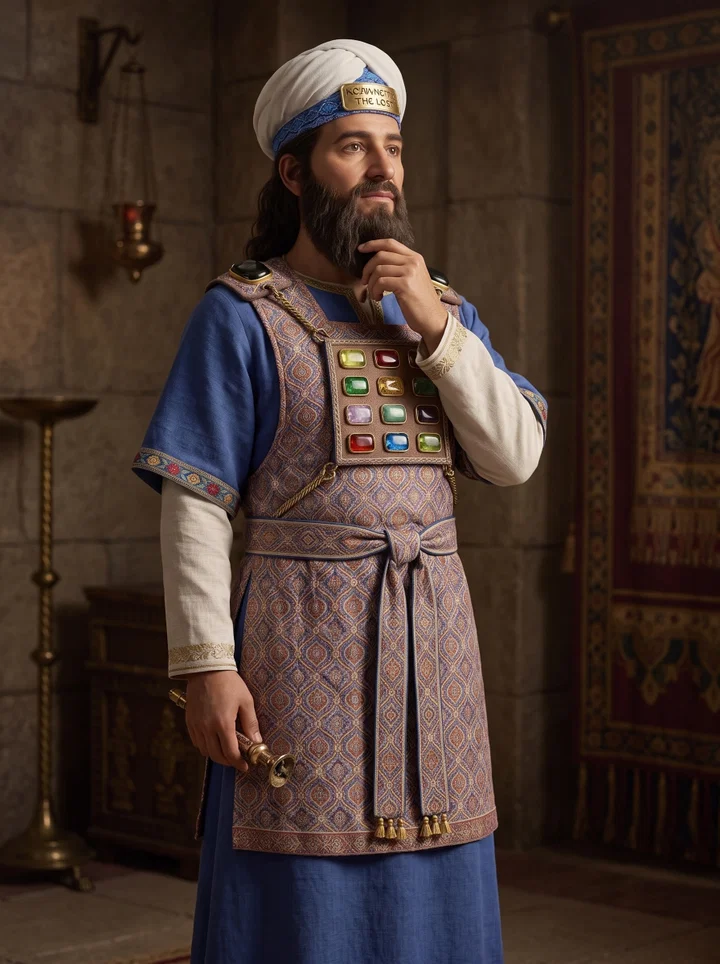
The verse belongs to the special dress appointed for priests according to office, and the high priest's garments were of costly material and beautiful workmanship befitting his exalted station.ST Nov 12, 1894ST Nov 12, 1894RH Dec 8, 1910 The robe of the common priest was of white linen woven in one piece, extending nearly to the feet and confined about the waist by a white linen girdle embroidered in blue, purple and red, with a linen turban completing the outward costume.ST Nov 12, 1894 In addition to that linen dress the high priest wore a one-piece blue robe ornamented around the skirt with golden bells and pomegranates of blue, purple and scarlet, and outside this the ephod, a shorter sleeveless garment of gold, blue, purple, scarlet and white confined by a beautifully wrought girdle of the same colors.ST Nov 12, 1894 Aaron's distinctive attire including the breastplate and other items set it apart from the white linen garments worn by all the priests, and from the plain dress worn for ordinary service, and the many-colored robe recalls this description.RH Dec 8, 1910ST Oct 4, 1899
The two stones were onyx stones engraved with the work of an engraver like a signet with the names of the children of Israel, the twelve tribes, and set in ouches or settings of gold.RH Jul 26, 1864RH Sep 16, 1852ST Nov 12, 1894RH Jul 5, 1864 They were placed on the gold-embroidered shoulder pieces of the ephod as part of the high priest's holy garments marking his calling and purpose.RH Sep 16, 1852ST Nov 12, 1894 The gold settings held chains that suspended the breastplate before his chest, where the names of the twelve tribes were arranged in four rows. As part of the priests' sacred service these stones were set apart for religious use, and the names borne by the high priest represent Israel as he ministers before the Lord.RH Jul 26, 1864RH Sep 16, 1852
The twelve tribal names were divided between the stones, six names on each shoulder, signifying that the priest bore the whole nation on his shoulders with responsibility for the welfare of the whole nation.RH Dec 15, 1910ST Dec 17, 1912 While the shoulder stones were so borne, the breastplate stones bore the tribes' names over his heart.RH Feb 2, 1911 These garments picture the Mighty One who bears the perplexities and burdens of His people upon His shoulder, and the great High Priest bearing every repentant, believing soul on His heart.ST Dec 17, 1912RH Feb 2, 1911
The engraved stones were mementos or memorials of the tribes of Israel, and beyond that memorial purpose their symbolism is not specified.
The splendid dress prescribed to be worn on other occasions, to which the two engraved stones set in gold belong, was laid aside when on the tenth day of the seventh month the high priest entered the most holy place in the plainest and humblest dress on the Day of Atonement.RH Jan 11, 1870ST Jun 6, 1878 Those who held the other teaching held that these sacred stones of the tribes engraved on two onyx stones and set in gold were worn on the high priest's shoulders as he entered the inner sanctuary on the Day of Atonement.RH Oct 10, 1912
Typology Doctrine and Application
The earthly sanctuary with its furnishings and service was made according to God's directions as a pattern pointing to the heavenly sanctuary and true tabernacle, where Jesus now ministers in a more excellent ministry.ST Jan 24, 1911ST Jun 26, 1907RH Mar 8, 1870 That earthly worship centered on the holy of holies, where the law of God rested beneath the mercy seat.ST Jun 19, 1907 It was constructed for ministration in sacrifices and offerings, and it has no likeness to modern churches, for all those sacrifices and offerings passed away when Christ came and suffered and died once for all.ST Jan 24, 1911 The Levitical order ministered in the two holy places as the example and shadow of that heavenly work, and its service before the ark in the typical sanctuary could show sinners their guilt but could not itself provide pardon, pointing forward to Christ's sacrifice.RH Mar 8, 1870RH Dec 12, 1854
The two onyx stones engraved like a signet with the names of the tribes of Israel and set in gold belonged to the high priest's holy garments, with six names on each stone upon the embroidered shoulder-pieces of the ephod while chains suspended the breastplate bearing the tribes over his heart.RH Sep 16, 1852RH Dec 15, 1910ST Dec 17, 1912RH Feb 2, 1911 As the priest thus bore the whole nation on his shoulders he bore responsibility for the welfare of all Israel as he ministered before the Lord.RH Sep 16, 1852RH Dec 15, 1910 These garments picture Christ, the sinless and mighty High Priest who lives forever, the great High Priest bearing every repentant, believing soul upon His heart and bearing the perplexities and burdens of His people upon His shoulder.ST Dec 17, 1912RH Feb 2, 1911RH Jul 5, 1864
The sanctuary work performed with those names on the shoulders and over the heart typified the judgment when the cases of everyone will come up in review before God.ST Dec 17, 1912 The engraved names are a type of the names of the overcomers which Christ will confess before the Father and the angels, and though stone is an enduring substance, far more enduring is the Book of Life where the confessed names are written to remain forever.ST Dec 17, 1912 God's direction of the sanctuary service even to the smallest detail, telling what the priests should wear and how they should appear before Him in the holy place, taught reverence and showed that He is holy and His work sacred, with nothing too trifling to escape His notice.RH Oct 30, 1913ST Mar 15, 1883 He is the same now as then, and He will not countenance negligence or carelessness now any more than then, but requires consecrated energy and ability and only best efforts.ST Mar 15, 1883
Sources