Exodus 28:12
And thou shalt put the two stones upon the shoulders of the ephod for stones of memorial unto the children of Israel: and Aaron shall bear their names before the LORD upon his two shoulders for a memorial.
Translations
And you shall put the two stones on the shoulders of the ephod for stones of memorial to the children of Israel: and Aaron shall bear their names before the LORD on his two shoulders for a memorial.
And thou shalt put the two stones upon the shoulders of the ephod for stones of memorial unto the children of Israel: and Aaron shall bear their names before the LORD upon his two shoulders for a memorial.
And thou shalt put the two stones upon the shoulders of the ephod for stones of memorial unto the children of Israel: and Aaron shall bear their names before the Lord upon his two shoulders for a memorial.
And thou shalt put the two stones upon the shoulders of the ephod for stones of memorial to the children of Israel: and Aaron shall bear their names before the LORD upon his two shoulders for a memorial.
And thou shalt put the two stones upon the shoulderpieces of the ephod, to be stones of memorial for the children of Israel: and Aaron shall bear their names before the LORD upon his two shoulders for a memorial.
And thou shalt put the two stones upon the shoulder-pieces of the ephod, to be stones of memorial for the children of Israel: and Aaron shall bear their names before Jehovah upon his two shoulders for a memorial.
'And thou hast set the two stones on the shoulders of the ephod — stones of memorial to the sons of Israel — and Aaron hath borne their names before Jehovah, on his two shoulders, for a memorial.
And thou shalt put the two stones upon the shoulder-pieces of the ephod [ as] stones of memorial for the children of Israel; and Aaron shall bear their names before Jehovah upon his two shoulders for a memorial.
And thou shalt put the two stones upon the shoulderpieces of the ephod, as stones of memorial for the sons of Israel,—so shall Aaron bear their names before Yahweh upon his two shoulders, for a memorial.
Berean Standard Bible, Majority Standard Bible
Fasten both stones on the shoulder pieces of the ephod as memorial stones for the sons of Israel. Aaron is to bear their names on his two shoulders as a memorial before the LORD.
You shall put the two stones on the shoulder straps of the ephod, to be stones of memorial for the children of Israel. Aaron shall bear their names before the LORD on his two shoulders for a memorial.
And the two stones are to be placed on the ephod, over the arm-holes, to be stones of memory for the children of Israel: Aaron will have their names on his arms when he goes in before the Lord, to keep the Lord in mind of them.
And thou shalt put the two stones vpon the shoulders of the Ephod, as stones of remebrance of the children of Israel: for Aaron shall beare their names before the Lord vpon his two shoulders for a remembrance.
Douay-Rheims (Challoner revision)
And thou shalt put them in both sides of the ephod, a memorial for the children of Israel. And Aaron shall bear their names before the Lord upon both shoulders, for a remembrance.
Pictures
Cross-references
- Hebrews 8:5
Who serve unto the example and shadow of heavenly things, as Moses was admonished of God when he was about to make the tabernacle: for, See, saith he, that thou make all things according to the pattern shewed to thee in the mount.
The earthly priestly sanctuary serves as a shadow of the heavenly things, made according to God’s pattern.
- Exodus 29:1-9
And this is the thing that thou shalt do unto them to hallow them, to minister unto me in the priest’s office: Take one young bullock, and two rams without blemish,
Instructions for consecrating Aaron and his sons to serve as priests.
- Exodus 28:29
And Aaron shall bear the names of the children of Israel in the breastplate of judgment upon his heart, when he goeth in unto the holy place, for a memorial before the LORD continually.
The breastplate bears Israel’s names before the Lord over the high priest’s heart.
- Leviticus 16:4
He shall put on the holy linen coat, and he shall have the linen breeches upon his flesh, and shall be girded with a linen girdle, and with the linen mitre shall he be attired: these are holy garments; therefore shall he wash his flesh in water, and so put them on.
Plain linen garments contrast with the high priest’s splendid dress.
- Hebrews 7:24-26
But this man, because he continueth ever, hath an unchangeable priesthood.
Christ’s enduring, sinless priesthood enables him to save and intercede for those who come to God.
- Hebrews 8:1-2
Now of the things which we have spoken this is the sum: We have such an high priest, who is set on the right hand of the throne of the Majesty in the heavens;
Christ serves as high priest in the heavenly sanctuary, fulfilling the sanctuary’s priestly pattern.
- Leviticus 8
And the LORD spake unto Moses, saying,
Describes the setting apart and service of the priests.
- Exodus 28:1-3
And take thou unto thee Aaron thy brother, and his sons with him, from among the children of Israel, that he may minister unto me in the priest’s office, even Aaron, Nadab and Abihu, Eleazar and Ithamar, Aaron’s sons.
Aaron and his sons are set apart for sacred service.
- Exodus 28:30
And thou shalt put in the breastplate of judgment the Urim and the Thummim; and they shall be upon Aaron’s heart, when he goeth in before the LORD: and Aaron shall bear the judgment of the children of Israel upon his heart before the LORD continually.
The high priest bears Israel’s names and judgment before the Lord.
- 1 Samuel 23:9-12
And David knew that Saul secretly practised mischief against him; and he said to Abiathar the priest, Bring hither the ephod.
David uses the priestly ephod while seeking direction from God.
- Hebrews 4:14-16
Seeing then that we have a great high priest, that is passed into the heavens, Jesus the Son of God, let us hold fast our profession.
Christ is identified as the great High Priest.
- Revelation 3:5
He that overcometh, the same shall be clothed in white raiment; and I will not blot out his name out of the book of life, but I will confess his name before my Father, and before his angels.
Engraved names typify overcomers confessed and kept forever.
- Hebrews 9:11
But Christ being come an high priest of good things to come, by a greater and more perfect tabernacle, not made with hands, that is to say, not of this building;
The earthly sanctuary typified the heavenly sanctuary where Christ ministers.
- Revelation 21:11
Having the glory of God: and her light was like unto a stone most precious, even like a jasper stone, clear as crystal;
The city shines with the glory of God.
- Isaiah 9:6
For unto us a child is born, unto us a son is given: and the government shall be upon his shoulder: and his name shall be called Wonderful, Counsellor, The mighty God, The everlasting Father, The Prince of Peace.
The shoulder signifies Christ bearing burdens.
Commentary
Each commentary is drawn from primary sources: the writings of Ellen G. White and Adventist pioneers and periodicals. Each commentary is separate. Its own words are not a quotation; follow the references to read the source passages.
Ellen G. White
6 sources
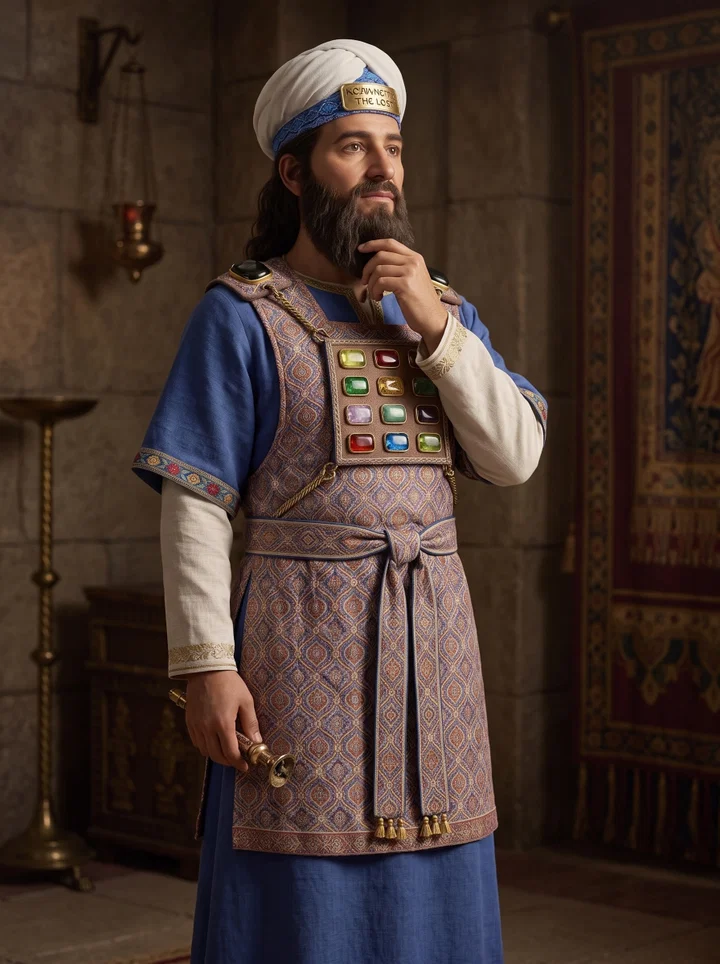
The ephod had gold-embroidered shoulder pieces bearing two onyx stones engraved with the names of Israel's twelve tribes.PP 350.3 Placed on Aaron's shoulders as part of his robes for service, the stones meant he carried Israel's names before the Lord as a memorial.EW 213.1PP 350.3Ms 56, 1900, par. 11–12 The heavenly sanctuary scene recalls this clothing, with Jesus wearing priestly garments with names engraved on a breastplate suspended from his shoulders.EW 213.1
The verse belongs to God's specific, detailed directions for the clothing of those who minister before Him.GW92 162.2GW92 161.12T 610.3–612.1Ms 56, 1900, par. 11–12 Those directions covered everything connected with His service in a particular style suited to the work of service in the holy place and the priest's office, down to the two shoulder stones.GW92 162.2GW92 161.1
The tabernacle garments were symbolic, so Aaron's dress had meaning and the appearance of those who serve God is to represent Him.Ms 56, 1900, par. 11–12 God may be honored or dishonored by the apparel of those who officiate before Him, and He requires order in everything and especially cleanliness.GW92 161.1 Care in ministers' appearance helped teach the people reverence for God and the holiness of His work.2T 610.3–612.1 In application, Christ's followers should be neat, modest, and pure in appearance, without dressing for fashion or display.Ms 56, 1900, par. 11–12
Sources
Pioneers and periodicals
31 sources
The two onyx stones set in gold on the shoulder-pieces of the ephod, the distinctive costly outer garment of the high priest, were engraved with the names of the twelve tribes, six on each shoulder, to be borne by Aaron before the Lord as a memorial.ST Nov 12, 1894ST Jan 31, 1911RH Dec 8, 1910 In wearing them as he performed the national atonement he represented the whole people and carried concern for their present and eternal welfare into God's presence.ST Jan 31, 1911RH Jul 26, 1864 The command belongs to the minute instructions for the sanctuary given to Moses in forty days on the mount exactly according to the pattern shown him, showing how particular God was about what pertained to His worship and dress of His priests.ST Oct 29, 1894ST May 20, 1880ST Mar 25, 1889RH Oct 30, 1913ST Mar 15, 1883 The earthly tabernacle and its Levitical ministry were worldly and typical, a shadow of the true tabernacle which the Lord pitched where Jesus now ministers as the great High Priest bearing the perplexities and burdens of His people.ST Jan 24, 1911ST Jun 26, 1907 With the names over the heart on the breastplate of judgment the shoulder stones typified the judgment when every case comes in review, pointing to Christ confessing the names of repentant believing overcomers before the Father, while the laying aside of the splendid ephod for the plainest dress on the Day of Atonement admonished that the Levitical high priest was high priest only in a typical sense in contrast with Christ's sinless everlasting priesthood.RH Jan 11, 1870ST Jun 6, 1878RH Jul 5, 1864RH Feb 2, 1911ST Dec 17, 1912
Sanctuary Setting and Ephod
The verse belongs to the minute instructions for the sanctuary given to Moses during his forty days and nights on the mount, recorded in Exodus 25-31 and on through Exodus 40 with Leviticus.ST Oct 29, 1894ST Mar 25, 1889RH Dec 31, 1861ST Jan 31, 1911 It was part of the very minute description of the sanctuary built in the days of Moses, made exactly according to the pattern shown to Moses in the mount for the sanctuary, its furnishings, dimensions, materials, and priestly ministry in God's presence.ST Oct 29, 1894ST May 20, 1880 These instructions established the sanctuary and priesthood that would minister before the ark containing the law.RH Dec 31, 1861 They were given by the hand of Moses as mediator after the people stood afar off and asked Moses to hear God for them, not what God spoke directly to the people at Sinai and wrote on the two tables of stone.ST Apr 15, 1886 They belong with the additional precepts, statutes and laws recorded chiefly in Exodus 25-30 and Leviticus, counted with that body of Mosaic instruction which included many burdensome ceremonies, diverse washings and carnal ordinances imposed as a yoke.ST Apr 15, 1886 Their minuteness shows how particular God was about what pertained to His worship.ST Mar 25, 1889
The tabernacle Moses erected after Israel's deliverance from Egyptian bondage was a marvelously beautiful and magnificent structure built from free-will offerings by specially endowed workmen so God could dwell among them.ST May 20, 1880 It was formed of upright gold-overlaid boards with a pillared entrance, four coverings of embroidered linen, goats' hair, red-dyed rams' skins and badgers' skins, and a linen-curtained court before the door.ST May 20, 1880 A vail divided the holy place, holding the golden candlestick, table of showbread and altar of incense, from the most holy place, holding the ark, mercy-seat and cherubim where God manifested His presence and communicated with His people, with brazen laver and altar of burnt offering outside.ST May 20, 1880 It was made according to the divine pattern shown to Moses in the mount, so that the temple of God was with men and their Divine Deliverer might dwell among them.ST Jun 26, 1907 It served as a great multiple object-lesson by forms and rites to teach a people unfitted by slavery to comprehend God's great salvation and required character.
The ephod was the distinctive, costly and beautifully worked outer garment of the high priest, appointed according to his office and befitting his exalted station, with features not found on his sons' garments.ST Nov 12, 1894RH Dec 8, 1910 It was a shorter sleeveless cape, of linen, worn over the blue robe, made of gold, blue, purple, scarlet and white linen and confined by a beautifully wrought girdle of the same colors.ST Nov 12, 1894 It had gold-embroidered shoulder pieces with gold settings holding chains that supported the breastpiece.ST Nov 12, 1894 The names of the twelve tribes were inscribed there in four rows on the breastpiece. The priest's garments signified his calling, office, purpose and exalted station.ST Nov 12, 1894
The two stones to be put upon the shoulders of the ephod were onyx memorial stones engraved with the names of the twelve tribes of the children of Israel.ST Nov 12, 1894RH Feb 3, 1853RH Dec 15, 1910 Six names were on each shoulder stone, borne before the Lord upon Aaron's two shoulders for a memorial.ST Jan 31, 1911RH Dec 15, 1910 Aaron thus bore the names of the children of Israel before the Lord on his shoulders, and in the sanctuary service the high priest thus represented Israel before God.ST Jan 31, 1911RH Feb 3, 1853 Their placement signified that the priest carried concern for the present and eternal welfare of the whole nation.RH Dec 15, 1910 The shoulder stones are ranked with the two positions nearest God's throne, as the anointed covering cherub.ST Aug 8, 1900
Priestly Representation and Type
Aaron in his sacred garments bore the names of the children of Israel before the Lord upon his shoulders for a memorial, the two onyx stones on the ephod being engraved with the names of the twelve tribes, six on each shoulder.ST Jan 31, 1911RH Jul 26, 1864ST Jan 9, 1893RH Feb 3, 1853 As he performed the national atonement he thus represented the people before God, bearing them and their judgment in his priestly service.RH Sep 16, 1852ST Jan 9, 1893RH Feb 3, 1853 Their placement on his shoulders signified his carrying of concern for the present and eternal welfare of the whole nation.RH Sep 16, 1852 The ephod itself was a linen cape whose gold settings held chains supporting the breastpiece, with the tribal names also arranged there in four rows, and the priestly garments signified his calling, office, purpose and exalted station while marking priests set apart for sacred use.RH Jul 26, 1864
The earthly sanctuary first pitched in the wilderness was worldly and typical, foreshadowing and serving unto the shadow of the true tabernacle which the Lord pitched and not man and the great temple on high where Jesus now ministers.ST Jan 24, 1911ST Jun 26, 1907RH Mar 8, 1870 Its explicit directions for dimensions, materials, furnishings and priestly ministration made known upon earth the object-lesson of God's plan of government and salvation from sin, that God and His people might co-operate together in His work through Christ in the sanctuary at every step.ST Jun 26, 1907 All its rites and ceremonies in its two holy places were object-lessons pointing to the Lamb of God that takes away sin and to the coming Messiah and His power to forgive sin, transform character and deliver from burdens, the Levitical order ministering there as the example and shadow of Christ's more excellent ministry.ST Jun 26, 1907RH Mar 8, 1870 The two engraved shoulder stones typified the Mighty One who bears the perplexities and burdens of His people upon His shoulder.ST Dec 17, 1912 True worship centered in that worldly sanctuary until Christ came and suffered and died once for all and His sacrifice at Calvary rent the veil, when the typical and shadowy passed away entirely and forever and left no likeness to modern churches.ST Jan 24, 1911ST Jun 26, 1907
The law required the splendid high-priestly dress with the ephod for ordinary occasions, yet on the Day of Atonement when entering the most holy place and second apartment he had to lay that splendid dress aside and put on the plainest and humblest dress.RH Jan 11, 1870ST Jun 6, 1878RH Oct 10, 1912 The change was a solemn admonition that the Levitical high priest was high priest only in a typical sense and not in reality, designed to impress his infirmity and sinfulness.RH Jan 11, 1870ST Jun 6, 1878 In this his earthly priesthood stands contrasted with Christ's heavenly, sinless and everlasting priesthood.RH Jul 5, 1864 Even so, wearing the two onyx stones engraved with the tribes' names on the ephod shoulders as a memorial, Aaron bore those names before the Lord as he served, including when he entered the second apartment.RH Oct 10, 1912
The high priest's bearing of all Israel's names on his shoulders, together with the names worn over his heart on the breastplate of judgment, typified the judgment when the cases of everyone come up in review before God.ST Dec 17, 1912 The priestly garments thus point to Christ the great High Priest, who bears the names of repentant, believing souls.RH Feb 2, 1911 The names engraved on the enduring stones are a type of the names of the overcomers which Christ will confess before the Father and the angels, though stone is less enduring than the Book of Life where those confessed names are written to remain forever.ST Dec 17, 1912 The shoulder memorial stones further illustrate nearness to God's throne, ranked with the two positions nearest God as the anointed covering cherub.ST Aug 8, 1900
Law and Reverent Worship
The shoulder stones belong to the law of Moses commanded through Moses in Horeb with statutes and judgments, covering moral, ceremonial, sacrificial, civil and health laws including the Ten Commandments and the laws of offerings, sacrifices and types in which the substance of the new dispensation is traced from the shadows of the old. It stands within the body of instruction set forth in Exodus 20 to 40 and Leviticus which God calls His people to remember and give attention to in the last days. It was given by the hand of Moses as mediator during the forty days in the mount, after the people stood afar off and asked Moses to hear God for them and speak to them, and not as part of what God spoke directly to the people at Sinai and wrote on the two tables of stone.ST Apr 15, 1886 It is counted with that additional body of Mosaic precepts, statutes and laws recorded chiefly in Exodus 25-30 and Leviticus, which included many burdensome ceremonies, diverse washings and carnal ordinances imposed as a yoke.ST Apr 15, 1886
The chapter appointing the Levitical priesthood came after the Ten Commandments in Exodus 20, proving the commandments were received before that priesthood existed.ST Mar 22, 1883ST Mar 22, 1883ST Feb 20, 1879 The ephod and its priestly service were therefore established after the Ten Commandments, and the commandments are distinct from the Levitical law, the priestly law, and the first covenant declared not faultless.ST Mar 22, 1883ST Mar 22, 1883ST Feb 20, 1879 The ancient tabernacle, sanctuary, priests, sacrifices and offerings so described have no likeness to modern churches.ST Jan 24, 1911 They were constructed for ministration in sacrifices and offerings that passed away when Christ came and suffered and died once for all, typifying the great temple on high where Jesus now ministers.ST Jan 24, 1911
True worship centered in that worldly sanctuary first pitched in the wilderness until His sacrifice at Calvary rent the temple veil, when the typical and shadowy passed away entirely and forever.ST Jun 26, 1907 God committed the priesthood to Aaron and his sons and appointed the Levitical order to perform the ministration in the two holy places of the typical earthly sanctuary, which was the example and shadow of Christ's more excellent ministry in the true tabernacle.ST Mar 3, 1914RH Mar 8, 1870 After that appointment no one else was to perform a priest's rites unless God specially directed otherwise.ST Mar 3, 1914 They were set apart for sacred use to minister before the ark containing the law while that sanctuary continued.RH Jul 26, 1864RH Dec 12, 1854
The instructions given to Moses during his forty days and nights on the mountain, down to the two memorial stones, show how particular God was about what pertained to His worship.ST Mar 25, 1889ST Mar 15, 1883 He specified how priests should dress and appear when serving in the holy place, telling what they should wear and how they should appear before Him.RH Oct 30, 1913ST Mar 15, 1883 Their care and reverence in appearing before Him taught the people that God is holy and His work sacred.RH Oct 30, 1913 Nothing was too trifling to escape His notice, and because God is the same now He will not countenance negligence now any more than then, so His sacred and important work must be done carefully with all energy and ability and not negligently or carelessly.ST Mar 15, 1883
Sources