Translations
American King James Version, King James Version
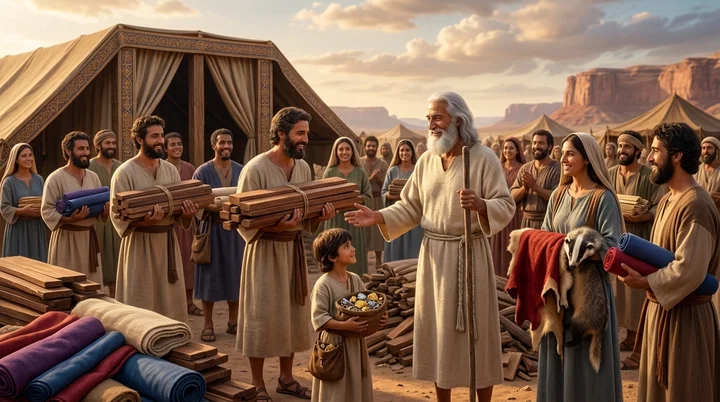
And rams’ skins dyed red, and badgers’ skins, and shittim wood,
and rams’ skins dyed red, and badgers’ skins, and shittim wood,
And rams' skins dyed red, and badgers' skins, and shittim wood,
and rams’ skins dyed red, and sealskins, and acacia wood;
and rams’ skins dyed red, and sealskins, and acacia wood,
and rams' skins made red, and badgers' skins, and shittim wood,
and rams' skins dyed red, and badgers' skins, and acacia-wood,
and rams’ skins dyed red, and badgers’ skins, and acacia wood;
Berean Standard Bible, Majority Standard Bible
ram skins dyed red and fine leather;
acacia wood;rams’ skins dyed red, sea cow hides, acacia wood,
And sheepskins coloured red, and leather, and hard wood,
And rams skins died red, and badgers skins with Shittim wood:
Douay-Rheims (Challoner revision)
And rams’ skins dyed red, and violet coloured skins, setim wood,
Pictures
Cross-references
- Exodus 36:5-7
And they spake unto Moses, saying, The people bring much more than enough for the service of the work, which the LORD commanded to make.
The people bring more than enough materials for the sanctuary, so their giving is restrained.
- Exodus 25:2-8
Speak unto the children of Israel, that they bring me an offering: of every man that giveth it willingly with his heart ye shall take my offering.
Gives the sanctuary materials and their purpose.
- Hebrews 8:5
Who serve unto the example and shadow of heavenly things, as Moses was admonished of God when he was about to make the tabernacle: for, See, saith he, that thou make all things according to the pattern shewed to thee in the mount.
The sanctuary’s materials belong to the earthly tabernacle made according to the heavenly pattern.
- Exodus 36:19
And he made a covering for the tent of rams’ skins dyed red, and a covering of badgers’ skins above that.
Records the making of the tent coverings from these skins.
- Exodus 35:21-29
And they came, every one whose heart stirred him up, and every one whom his spirit made willing, and they brought the LORD’s offering to the work of the tabernacle of the congregation, and for all his service, and for the holy garments.
Willing people brought offerings and materials for the tabernacle.
- Hebrews 9:1-5
Then verily the first covenant had also ordinances of divine service, and a worldly sanctuary.
Summarizes the sanctuary and its furnishings.
- Exodus 26:14
And thou shalt make a covering for the tent of rams’ skins dyed red, and a covering above of badgers’ skins.
Both describe the tabernacle’s ram-skin and outer-skin coverings.
- Exodus 36:20-34
And he made boards for the tabernacle of shittim wood, standing up.
Describes the shittim-wood boards of the tabernacle.
- Exodus 26:15
And thou shalt make boards for the tabernacle of shittim wood standing up.
Both specify shittim wood for the tabernacle’s construction.
- Exodus 25:9
According to all that I shew thee, after the pattern of the tabernacle, and the pattern of all the instruments thereof, even so shall ye make it.
The sanctuary was made according to the pattern shown to Moses.
Commentary
Each commentary is drawn from primary sources: the writings of Ellen G. White and Adventist pioneers and periodicals. Each commentary is separate. Its own words are not a quotation; follow the references to read the source passages.
Ellen G. White
7 sources
The verse names rams' skins dyed red, badgers' skins, and shittim wood among the materials offered for building the tabernacle.ST Sep 11, 1884ST Aug 5, 1875LC1 175.3RH Oct 13, 1874 The offering was commanded just after Israel left Egypt, when they were but a step back from freedom to slavery, means were scanty and their own tents were small, yet God's house was to be built first according to the design God gave.ST Aug 5, 1875 These materials were free-will, willing gifts for God's house, brought gladly and willingly from the heart, with each soul anxious to have an interest in the tabernacle and with no urging needed.ST Sep 11, 1884ST Aug 5, 1875LC1 175.3RH Oct 13, 1874
The skins and wood were brought together with gold, silver, brass, jewelry, ornaments and ornamental work, costing in all more than a million dollars.ST Aug 5, 1875 They were given in such cheerful abundance that there was more than could be used, so Moses had to proclaim that they had enough and that labor and offerings must cease.ST Aug 5, 1875LC1 175.3RH Oct 13, 1874 The verse shows that beyond systematic and regular donations there were special needs calling for free-will offerings, and God made these calls both for the people's own good and to sustain His service.4T 467.1–2
The verse belongs among the directions showing the exactitude, skill, wisdom, and perfection God required in building the earthly tabernacle, and this standard is to guide every kind of work done in His service.Ms 109, 1899, par. 1–4 The listed materials are part of the pattern that things pertaining to worship and God's service were to be provided and arranged with care, with the people giving their best and keeping what pertained to His service pure, clean, and tasteful.Ms 23, 1889, par. 1–3
Sources
Pioneers and periodicals
25 sources
The verse names three of the materials brought for building the sanctuary, the reddened rams' skins and sea-animal skins and the durable acacia wood.ST Oct 29, 1894ST Feb 17, 1890ST Jun 4, 1885 It stands in the account of preparing and setting up the tabernacle at Sinai in the second year after the Exodus, exactly carrying out the heavenly pattern shown to Moses on the mount.ST Jan 27, 1909ST Dec 10, 1896ST Jun 10, 1908 The skins formed the outer coverings of its tent roof, while the wood formed its upright boards and framework, set in silver sockets and overlaid with gold.ST Oct 29, 1894ST Feb 17, 1890ST Mar 10, 1898 They were gathered as free-will gifts from every willing heart, given gladly and in such abundance that the giving had to be stopped because more than enough had been brought.ST Sep 11, 1884ST Aug 5, 1875ST Sep 17, 1874RH May 27, 1902RH Feb 3, 1903 So made, the sanctuary was God's dwelling place among His people and the center of their worship, a type of the heavenly sanctuary whose rites pointed to Christ.ST Jun 19, 1907ST Jun 4, 1885ST Jul 8, 1930ST Jun 26, 1907
Tabernacle Setting and Materials
Exodus 35:7 belongs to the account of preparing, fitting, building and setting up the tabernacle recorded in Exodus 33-40.ST Dec 10, 1896 That account stands in chronological order after the events of Exodus 19-32 and immediately follows the sanctuary instruction God gave to Moses in the mount in Exodus 25-31.ST Dec 10, 1896ST Feb 13, 1912 The following chapters record that those directions were carried out, with the ark and its furnishings made as God directed.ST Jan 27, 1909ST Feb 13, 1912 Blessing and glory came upon the congregation and the completed building.ST Jan 27, 1909
The tabernacle was set up on the first day of the first month of the second year after the Exodus. It was the wonderful building at Sinai in the year after Israel's release from Egypt.ST Jun 10, 1908 Israel came in the third month out of the wilderness of Sin between Elim and Sinai and encamped at Sinai.ST Jun 10, 1908 That mountain became a schoolhouse of flame where God spoke momentous lessons of life if received and obeyed and death if disobeyed.ST Jun 10, 1908 There Moses was given the definite, careful heavenly pattern for that most singular of all earthly buildings, with rigid instruction not to deviate from it.ST Jun 10, 1908
The verse lists rams' skins dyed red, badgers' skins, and shittim wood among the materials offered and brought for building the sanctuary and its service.ST Feb 17, 1890ST Jun 4, 1885RH Aug 21, 1856ST Jun 26, 1907 Shittim wood is acacia wood.ST Oct 29, 1894ST Feb 17, 1890 The badger skins are understood as seal or porpoise skins.ST Feb 17, 1890 The skins were used for the tabernacle's outer coverings as part of its tent roof.ST Feb 17, 1890RH Aug 21, 1856 The shittim or acacia wood was used for its structure.ST Oct 29, 1894ST Feb 17, 1890RH Aug 21, 1856 Its sides and west end were made of upright acacia boards set in silver sockets and held by bars, overlaid with gold.ST Oct 29, 1894ST Mar 10, 1898 Its inner walls were overlaid with gold, representing the reflected light of God's glory in the New Jerusalem.ST Mar 10, 1898 It was roofed with curtains.ST Mar 10, 1898
The sanctuary was God's dwelling place among His people, first in the wilderness and later through Israel's history.ST Jun 4, 1885 It was a dwelling place God asked Israel to make so that He could dwell among them and reveal His love.ST Jul 8, 1930 It was built by the children of Israel. It was the center of earthly worship, revolving around the holy of holies where the law rested beneath the mercy seat.ST Jun 19, 1907
The verse is part of the law of Moses commanded in Horeb, especially set forth in Exodus 20 to 40 and Leviticus, to be remembered in the last days. It belongs with the statutes and judgments that include the Ten Commandments together with all the other precepts, civil, sacrificial, moral, and ceremonial. It is one of the laws in which offerings, sacrifices, and types were revealed, given so the substance of the new dispensation may be traced from the shadows of the old. That law is the rule of conduct God calls His people to remember. The earthly sanctuary served as a type of the heavenly sanctuary, and its rites and ceremonies pointed to Christ and His power to forgive sin and transform character.ST Jun 26, 1907 Its story of building the tabernacle and establishing its services comes after the giving of the law as part of the simple, connected story of the whole Bible from Genesis to Revelation.RH May 12, 1904
Willing Offerings and Example
The verse names part of the free-will, typical offering to be brought for God's sanctuary and tabernacle just after Israel left Egypt.ST Aug 5, 1875RH Jan 27, 1916RH May 16, 1871 At that time there was but a step back from freedom to slavery, means were scanty and their own tents were small, yet God's house must be built first according to the design God gave and showed to Moses.ST Aug 5, 1875RH Feb 3, 1903 The costly materials of red-dyed ram skins, badger skins, and shittim wood were gathered as part of that work to make the sanctuary according to the pattern, with abundant, willing gifts in response to God's command for its construction.ST Sep 17, 1874RH Feb 3, 1903
The materials were gathered through gifts from every man that gave willingly from his heart, with willing hearts and spirits.ST Sep 17, 1874RH Oct 13, 1874RH May 27, 1902 Each soul was anxious to have an interest in the tabernacle for God, giving according to what each person had available, so that God provided the means for the work through their offerings.ST Sep 11, 1884ST Aug 5, 1875RH Feb 3, 1903RH Dec 30, 1915 The people joined the work of building the tabernacle in that willing spirit, bringing ram skins dyed red, badger skins, and shittim wood among their willing gifts for God's house.ST Sep 11, 1884RH May 27, 1902RH Feb 3, 1903
The gifts came gladly and in abundance with gold, silver, brass, jewelry, ornaments and ornamental work, costing in all more than a million dollars.ST Aug 5, 1875 They were brought with such cheerful willingness that no urging or compulsion was needed, with no grand feast, no scenes of gaiety, dancing and general amusement, and no lotteries or anything profane.ST Aug 5, 1875ST Sep 17, 1874 The free-will offerings came in so great abundance that Moses had to proclaim that they had enough and that labor and offerings must cease, because they had given abundantly, more than could be used.ST Aug 5, 1875ST Sep 17, 1874RH Oct 13, 1874
That generous, abundant giving shows how consecration makes giving a willing privilege rather than a stern duty.RH Mar 16, 1911 It calls for real heart communion with God by being a willing giver for His sanctuary, and connects the call for contributions with giving willingly and liberally and self-sacrificingly to support God's work.RH Jan 27, 1916RH Jan 29, 1914 The account serves as a model for asking people to bring an offering to build a house for God and for providing means for institutional work through such offerings.RH May 16, 1871RH Dec 30, 1915 It is also a parallel for constructing college buildings as sacred building work for God rather than as an opportunity to pursue wages.RH May 27, 1902
Sources