Translations
American King James Version, King James Version
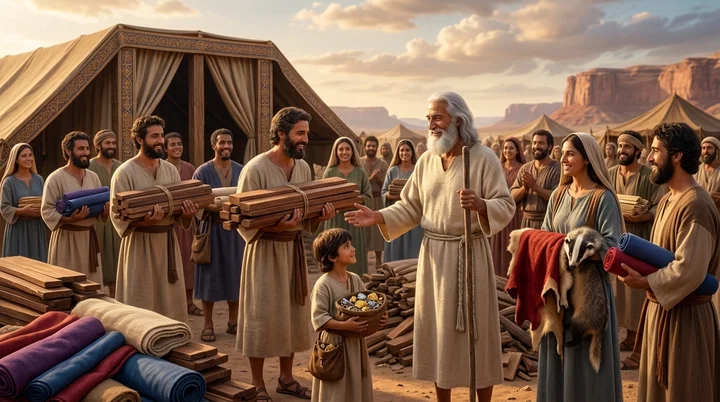
And blue, and purple, and scarlet, and fine linen, and goats’ hair,
KJV Cambridge Paragraph Bible, American Standard Version
and blue, and purple, and scarlet, and fine linen, and goats’ hair,
And blue, and purple, and scarlet, and fine linen, and goats' hair,
and blue, and purple, and scarlet, and fine linen, and goats’ hair;
and blue, and purple, and scarlet, and linen, and goats' [hair],
and blue, and purple, and scarlet, and byssus, and goats' [hair],
and blue and purple and crimson and fine linen and goat’s-hair;
Berean Standard Bible, Majority Standard Bible
blue, purple, and scarlet yarn;
fine linen and goat hair;blue, purple, scarlet, fine linen, goats’ hair,
And blue and purple and red and the best linen and goats' hair,
Also blewe silke, and purple, and skarlet, and fine linen, and goates heare,
Douay-Rheims (Challoner revision)
Violet and purple, and scarlet twice dyed, and fine linen, goats’ hair,
Pictures
Cross-references
- Exodus 36:5-7
And they spake unto Moses, saying, The people bring much more than enough for the service of the work, which the LORD commanded to make.
The offerings exceeded what the work required, so the people were told to stop giving.
- Exodus 25:1-8
And the LORD spake unto Moses, saying,
God asks Israel for willing gifts to build His dwelling place.
- Exodus 26:1-14
Moreover thou shalt make the tabernacle with ten curtains of fine twined linen, and blue, and purple, and scarlet: with cherubims of cunning work shalt thou make them.
Describes the curtains and coverings made from these materials.
- Exodus 35:23
And every man, with whom was found blue, and purple, and scarlet, and fine linen, and goats’ hair, and red skins of rams, and badgers’ skins, brought them.
The Israelites bring the listed materials for the tabernacle.
- Hebrews 8:5
Who serve unto the example and shadow of heavenly things, as Moses was admonished of God when he was about to make the tabernacle: for, See, saith he, that thou make all things according to the pattern shewed to thee in the mount.
The earthly sanctuary was made according to a heavenly pattern.
- Hebrews 9:1-5
Then verily the first covenant had also ordinances of divine service, and a worldly sanctuary.
Describes the sanctuary whose construction materials include those named here.
- 1 Chronicles 29:6-9
Then the chief of the fathers and princes of the tribes of Israel, and the captains of thousands and of hundreds, with the rulers of the king’s work, offered willingly,
Both describe willing gifts for building the sanctuary.
- Exodus 26:31-33
And thou shalt make a vail of blue, and purple, and scarlet, and fine twined linen of cunning work: with cherubims shall it be made:
Describes the curtain dividing the sanctuary into two apartments.
- Exodus 36:8-19
And every wise hearted man among them that wrought the work of the tabernacle made ten curtains of fine twined linen, and blue, and purple, and scarlet: with cherubims of cunning work made he them.
Records the making of the tabernacle curtains and roof coverings.
- Exodus 25:2
Speak unto the children of Israel, that they bring me an offering: of every man that giveth it willingly with his heart ye shall take my offering.
God asks the people to give willingly for the sanctuary.
- Exodus 28
And take thou unto thee Aaron thy brother, and his sons with him, from among the children of Israel, that he may minister unto me in the priest’s office, even Aaron, Nadab and Abihu, Eleazar and Ithamar, Aaron’s sons.
Instructions for the priests’ garments precede the tabernacle’s construction.
- Exodus 31:7-11
The tabernacle of the congregation, and the ark of the testimony, and the mercy seat that is thereupon, and all the furniture of the tabernacle,
Instructions on the mount specify the tabernacle’s materials and furnishings before construction.
- Exodus 25:9
According to all that I shew thee, after the pattern of the tabernacle, and the pattern of all the instruments thereof, even so shall ye make it.
The sanctuary’s materials are part of the divinely shown pattern Moses was told to follow.
Commentary
Each commentary is drawn from primary sources: the writings of Ellen G. White and Adventist pioneers and periodicals. Each commentary is separate. Its own words are not a quotation; follow the references to read the source passages.
Ellen G. White
8 sources
Exodus 35:6 belongs to the list of blue and purple and scarlet materials, fine linen, and goats' hair that the Israelites gave from their own possessions for building the tabernacle.ST Sep 11, 1884ST Aug 5, 1875RH Oct 13, 1874LC1 175.3 These named things were among the free gifts willingly brought from what the people had for God's house.ST Sep 11, 1884ST Aug 5, 1875RH Oct 13, 1874LC1 175.3 The gifts included ornaments and other materials, and they came in such abundance that there was more than enough for the work.ST Aug 5, 1875RH Oct 13, 1874LC1 175.31MR 337.2–338.2 At last Moses and the leaders said it was enough and that no more gifts should be brought.RH Oct 13, 1874LC1 175.31MR 337.2–338.2
The call was a special freewill offering to build the tabernacle in the wilderness, distinct from regular systematic donations such as the tithe.4T 467.1–2 The offering was required of all in proportion to the amount possessed, with more required where more capital was entrusted.4T 467.1–2 God made this claim both to sustain His service and for the people's own good.4T 467.1–2
The Lord could have created an abundance of means to carry forward His work without asking His people for any sacrifice, for the gold and silver are His and all that is possessed, even bodies and souls, are His, but He has never worked that way.1MR 337.2–338.2 He called on all the people to make their freewill offerings so they would all want a part in the blessing.1MR 337.2–338.2 The building of the earthly tabernacle required exactitude, skill, wisdom, and perfection according to the pattern shown to Moses, and His servants are to bring the same care to every part of His service.Ms 109, 1899, par. 1–4 God's directions for these offerings show that what is provided for worship should be the best people can give, pure, orderly, and tasteful rather than coarse or common.Ms 23, 1889, par. 1–3
The same pattern applies to purchasing property for a school: everyone should take an interest and make freewill offerings so that every soul has a share in the blessing that comes from returning to the Lord what is His own.1MR 337.2–338.2 Then when the time for settlement comes the money is ready for the deed.1MR 337.2–338.2
Sources
Pioneers and periodicals
22 sources
Exodus 35:6 stands in Moses' call at Sinai for free offerings to build the tabernacle where God would dwell among His people, made exactly after the heavenly pattern as a type of Christ and the heavenly sanctuary.RH May 27, 1902ST Oct 29, 1894ST Feb 17, 1890 It names blue and purple and scarlet material with fine linen and goats' hair among the gifts to be brought, which became the beautiful embroidered inner curtain and the goats' hair tent covering over the sanctuary.ST Feb 17, 1890ST Jun 4, 1885ST Jan 27, 1909 Those gifts were to come only from willing hearts, from what the people had, both men and women giving goods and service without pay, and they were brought so liberally that there was more than enough and the people had to be restrained.ST Aug 5, 1875ST Sep 17, 1874RH May 27, 1902RH May 16, 1871RH Jun 11, 1914 It teaches that giving for God's house must be willing and from the heart, with no compulsion and no profane methods of raising means, and that same plan of voluntary offerings still provides places set apart for His work and worship and brings His blessing.RH Oct 13, 1874RH May 27, 1902RH Feb 16, 1905RH Jan 27, 1916
Setting and Sanctuary Materials
Exodus 35:6 belongs to Moses' call in the wilderness at Sinai for offerings to build the tabernacle after the law was proclaimed from the mount and after he received on the mount the pattern of the heavenly sanctuary.RH May 27, 1902ST Oct 29, 1894 In the order of Exodus it stands in chapters 33-40 on building and setting up the sanctuary, following the mount instructions in chapters 25-31 and the events of chapters 19-32.ST Oct 29, 1894ST Dec 10, 1896 The preparing and fitting it records led to the tabernacle being set up on the first day of the first month of the second year after the Exodus. Israel had come there after leaving the wilderness of Sin between Elim and Sinai, making Sinai their encampment in the third month of the year of their release, not merely as a destitute company just out of Egypt with unbaked bread on their shoulders.ST Jun 10, 1908 Sinai thus became the most celebrated of earth's mountains for the majestic scenes it witnessed and the words of power to which it listened, a schoolhouse of flame from whose lofty, burning doorway spoke the Teacher of the universe with momentous lessons of life if received and obeyed and of death if disobeyed.ST Jun 10, 1908
The verse names blue and purple and scarlet material, and fine linen, and goats' hair, among the materials to be brought as offerings for the sanctuary.ST Feb 17, 1890ST Jun 4, 1885 They were contributions for building the sacred place where God's glory would dwell and Israel's worship would center, the dwelling place God asked Israel to make so He could dwell among His people.ST Feb 17, 1890ST Jun 4, 1885ST Jul 8, 1930 The passage does not explain the listed materials individually.ST Jul 8, 1930 Its list stands as part of the instructions for making the wilderness sanctuary, whose materials and design followed the directions God gave Moses.ST Jul 8, 1930ST Jun 26, 1907
Those materials were used in the curtains and coverings made exactly according to God's directions and instructions, whose carrying out the following chapters record.ST Jan 27, 1909RH Aug 21, 1856ST Feb 13, 1912 Fine linen formed the beautiful inner curtain and ceiling portion, embroidered in blue and purple and scarlet.ST Feb 17, 1890RH Aug 21, 1856 That ceiling portion of fine, pure linen was embroidered with angels, representing the angels of heaven waiting on God's command.ST Mar 10, 1898 Goats' hair formed the next covering over the sanctuary as part of its tent roof, covering the structure and reaching the ground on both sides.ST Feb 17, 1890ST Mar 10, 1898RH Aug 21, 1856
The sanctuary so provided was the sacred dwelling place where God's glory would dwell and Israel's worship would center, and its completion according to God's directions was accompanied by God's blessing and glory.ST Feb 17, 1890ST Jan 27, 1909 Made according to the pattern shown on the mountain, the earthly sanctuary and its services were types pointing to Christ and the heavenly sanctuary.ST Oct 29, 1894ST Jun 26, 1907 The verse stands among the statutes and judgments of the law of Moses commanded in Horeb, belonging to the law especially set forth in Exodus 20 to 40 and Leviticus to be remembered in the last days. It belongs among those laws in which offerings, sacrifices, and types were revealed, whose shadows trace the substance of the new dispensation.
Willing Giving and Present Pattern
The blue and purple and scarlet, the fine linen and goats' hair, were to be brought as free-will, voluntary gifts, given willingly from the heart and from what the people had.ST Sep 11, 1884RH Jun 11, 1914 They were brought by every one whom his heart stirred up and whose spirit made willing, both men and women, as many as were willing-hearted, who are called wise-hearted men.RH May 27, 1902RH Mar 18, 1902 They offered their goods and services without asking what pay they would receive, and came in such numbers that the builders did not lack workmen and did not need to hire help from among the heathen.RH May 27, 1902 They were brought in obedience to Moses' command and as the Lord's offering for the work God commanded, when God directed the work and opened hearts to provide the needed materials and means.RH May 16, 1871RH Mar 18, 1902
The giving was abundant and liberal, from what they had, including ornaments and other materials, until there was more than enough for the work.ST Aug 5, 1875ST Sep 17, 1874 The willing offerings came in such great abundance that more than could be used was given, and Moses said there was enough.ST Sep 17, 1874RH Oct 13, 1874 The people had to be restrained and stopped from bringing more, so freely did they give for the construction of the sanctuary.ST Sep 17, 1874RH Mar 16, 1911 Gifts were to be accepted from every man that gave willingly from his heart, with no compulsion and with no feasts, dancing, gaiety, amusement, lotteries, or other profane methods to raise means.ST Sep 17, 1874
Giving for God's sanctuary must be willing and from the heart.RH Jan 27, 1916 Each person is called to come into real heart communion with God and to examine willingness in giving for His sanctuary.RH Jan 27, 1916 The willingness that would have given a young man a part in that wilderness work marks the willing-hearted today.RH May 27, 1902
God's plan of calling for voluntary offerings of materials and means to provide a place set apart for His work and worship still applies.RH Feb 16, 1905 It moves interested believers to bring offerings and donations sufficient to buy a house and lot for holding services, and brings the Lord's blessing and direction on the work.RH Feb 16, 1905 That willing giving, given willingly and liberally for God's work, is the pattern for consecrating a portion of soil and seed and giving its proceeds to provide a holy house for training workers.RH Mar 18, 1902 From that house will come missionaries whose special work is to teach men how to preserve God-given health and to bring those stricken by disease back to fullness of life.RH Mar 18, 1902
Sources