Exodus 40:32
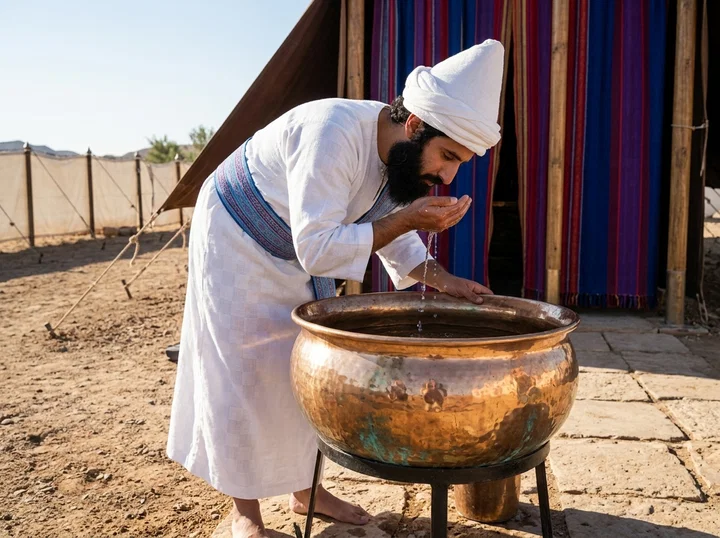
When they went into the tent of the congregation, and when they came near unto the altar, they washed; as the LORD commanded Moses.
Translations
American King James Version, Webster Bible
When they went into the tent of the congregation, and when they came near to the altar, they washed; as the LORD commanded Moses.
When they went into the tent of the congregation, and when they came near unto the altar, they washed; as the LORD commanded Moses.
when they went into the tent of the congregation, and when they came near unto the altar, they washed; as the Lord commanded Moses.
when they went into the tent of meeting, and when they came near unto the altar, they washed: as the LORD commanded Moses.
when they went into the tent of meeting, and when they came near unto the altar, they washed; as Jehovah commanded Moses.
in their going in unto the tent of meeting, and in their drawing near unto the altar, they wash, as Jehovah hath commanded Moses.
when they went into the tent of meeting, and when they drew near to the altar, they washed; as Jehovah had commanded Moses.
when they were entering into the tent of meeting, and when they were drawing near unto the altar, then used they to bathe,—As Yahweh commanded Moses.
Berean Standard Bible, Majority Standard Bible
They washed whenever they entered the Tent of Meeting or approached the altar, just as the LORD had commanded Moses.
When they went into the Tent of Meeting, and when they came near to the altar, they washed, as the LORD commanded Moses.
Whenever they went into the Tent of meeting, and when they came near the altar, as the Lord had given orders to Moses.
When they went into the Tabernacle of the Congregation, and when they approched to the Altar, they washed, as the Lord had commanded Moses.
Douay-Rheims (Challoner revision)
When they went into the tabernacle of the covenant, and went to the altar, as the Lord had commanded Moses.
Pictures
Cross-references
- Exodus 30:18-21
Thou shalt also make a laver of brass, and his foot also of brass, to wash withal: and thou shalt put it between the tabernacle of the congregation and the altar, and thou shalt put water therein.
Priests wash at the laver before entering the tent or approaching the altar.
- Hebrews 9:1-5
Then verily the first covenant had also ordinances of divine service, and a worldly sanctuary.
Describes the earthly sanctuary and its furnishings, corresponding to the tabernacle’s two apartments.
- Exodus 27:9-16
And thou shalt make the court of the tabernacle: for the south side southward there shall be hangings for the court of fine twined linen of an hundred cubits long for one side:
Describes the court surrounding the sanctuary where they approached the altar.
- Exodus 40:9-11
And thou shalt take the anointing oil, and anoint the tabernacle, and all that is therein, and shalt hallow it, and all the vessels thereof: and it shall be holy.
The tabernacle, altar, and laver are consecrated as holy.
- Exodus 29
And this is the thing that thou shalt do unto them to hallow them, to minister unto me in the priest’s office: Take one young bullock, and two rams without blemish,
Both concern regulations for worship and priestly service.
- Exodus 38
And he made the altar of burnt offering of shittim wood: five cubits was the length thereof, and five cubits the breadth thereof; it was foursquare; and three cubits the height thereof.
Gives instructions for making and setting up the sanctuary.
- Hebrews 8:5
Who serve unto the example and shadow of heavenly things, as Moses was admonished of God when he was about to make the tabernacle: for, See, saith he, that thou make all things according to the pattern shewed to thee in the mount.
The earthly tabernacle ministry follows a pattern of heavenly things.
- Leviticus 9:23-24
And Moses and Aaron went into the tabernacle of the congregation, and came out, and blessed the people: and the glory of the LORD appeared unto all the people.
God’s glory appears as the priests minister at the tabernacle.
- Exodus 26:31-35
And thou shalt make a vail of blue, and purple, and scarlet, and fine twined linen of cunning work: with cherubims shall it be made:
describes its rooms and veil
- Hebrews 9:21-24
Moreover he sprinkled with blood both the tabernacle, and all the vessels of the ministry.
Contrasts the earthly tabernacle with the true one in heaven.
- Exodus 39
And of the blue, and purple, and scarlet, they made cloths of service, to do service in the holy place, and made the holy garments for Aaron; as the LORD commanded Moses.
Gives instructions for making and setting up the sanctuary.
- Hebrews 8:1-2
Now of the things which we have spoken this is the sum: We have such an high priest, who is set on the right hand of the throne of the Majesty in the heavens;
contrasts typical sanctuary with heavenly
Commentary
Each commentary is drawn from primary sources: the writings of Ellen G. White and Adventist pioneers and periodicals. Each commentary is separate. Its own words are not a quotation; follow the references to read the source passages.
Ellen G. White
3 sources
As the Lord commanded Moses, the priests washed whenever they went into the tent of meeting and whenever they came near to the altar.GW92 308.21SP 348.3GW92 162.2 They washed their hands and feet at the laver.1SP 348.3GW92 162.2 The laver stood between the altar and the congregation.GW92 162.2 That washing removed impurity, teaching that every particle of dust had to be put away before coming into God's presence.1SP 348.3GW92 162.2
The washing belonged to the tabernacle's sacred order and was the special preparation required before serving where God's glory was revealed.GW92 308.21SP 348.3 Meeting this requirement was necessary so they would not die, because God is holy.1SP 348.3GW92 162.2 The requirement taught that those who serve God must be pure.GW92 308.2 The tabernacle's arrangements displayed God's holiness and were meant to reveal His character to the surrounding nations.GW92 308.2
Sources
Pioneers and periodicals
22 sources
The verse records that the priests washed whenever they entered the tent of the congregation and whenever they came near to the altar, exactly as the Lord commanded Moses in the ordered service of the sanctuary.RH Feb 3, 1916RH Aug 21, 1856 It belongs to the completing and erecting of the tabernacle in the second year after Israel left Egypt, on the first day of the first month, when the laver was set between the tabernacle and the altar, the court was set up around all, and the cloud covered the tent and the glory of the Lord filled the tabernacle so that Moses could not enter.RH Aug 21, 1856ST Jan 27, 1909 That tabernacle was built by specially endowed workmen from free-will offerings exactly according to the pattern shown on the mount, that God might dwell among His delivered people and be the center of their worship.ST Oct 29, 1894RH Aug 4, 1863 The whole movable sanctuary with its rites was typical, serving unto the shadow of heavenly things and pointing to the Lamb of God and the true tabernacle which the Lord pitched and not man, and its earthly typical service centered worship until Christ's sacrifice at Calvary when the veil was rent and it passed away forever.ST Jun 26, 1907 Its law of worship, with the moral law beneath the mercy-seat where the breaker of the law found pardon by the sprinkled blood of atonement, stands apart from civil law, and its washing marked the sanctuary as holy and not for common use, illustrating the obedience and readiness needed to go forward to Canaan and to the heavenly Canaan.ST Jun 19, 1907ST Aug 10, 1882ST Jan 31, 1911RH Jul 16, 1861
Tabernacle Context and Washing
The washing was done whenever they went into the tent of the congregation and whenever they came near unto the altar, as the Lord commanded Moses, as part of the detailed service of the sanctuary.RH Feb 3, 1916RH Aug 21, 1856ST Jan 27, 1909ST Jun 19, 1907ST Jan 31, 1911 It was the carrying out of God's directions for the sanctuary and the command about washing before entering the tent of meeting or approaching the altar, belonging to the laws God gave through Moses including ceremonial laws as well as moral and other laws.ST Jan 27, 1909ST Jan 31, 1911 The sanctuary's inauguration and its services were accompanied by God's glory, showing His acceptance of the people's repentance, and bringing blessing and glory upon the congregation and the building.ST Jan 27, 1909ST Jan 31, 1911
The verse belongs to the preparing, fitting, completing and erecting of the tabernacle, which was reared up in the second year after Israel departed from Egypt on the first day of the first month.RH Aug 21, 1856 Moses completed the erection by setting up the hanging for the door, placing the altar of burnt offering at the entrance, setting the laver holding water for the priests' use between the tabernacle and the altar, and setting up the court around the whole.RH Mar 1, 1870 This finished the sanctuary erected as the habitation of Jehovah, making it ready to receive the eternal King, after which a cloud covered the tent of the congregation and the glory of the Lord filled the tabernacle so that Moses was not able to enter.RH Aug 21, 1856RH Mar 1, 1870ST Jun 26, 1907
The tabernacle was built according to the pattern shown to Moses on the mount, from free-will offerings after deliverance from Egyptian bondage by workmen God specially endowed, exactly according to directions.ST Oct 29, 1894ST Jun 26, 1907 God told Israel to build it so He might dwell among them and reveal His love, as a great multiple object-lesson by various forms and rites comprehending the great plan of salvation.ST Jul 8, 1930ST Oct 25, 1905 It was set up as God's dwelling and habitation among Israel and the dwelling place of God among His people in the wilderness and in later periods, the center of earthly worship centering on the holy of holies.ST Jun 19, 1907RH Aug 4, 1863ST Jun 4, 1885
In that setting the brazen laver and the altar of burnt offering stood before the door of the tabernacle inside the court with its curtains of fine twined linen.RH Aug 21, 1856 With them were the testimony in the ark and the mercy seat upon it behind the vail, and the table of shewbread and golden candlestick with lighted lamps and golden altar of incense with sweet incense in the holy place, and the burnt offering and meat offering offered on the altar before the door.RH Aug 21, 1856 The structure had sides and one end of upright boards closely joined and set in silver sockets in the ground and held by outer bars passing through rings, roofed with curtains reaching to the ground on both sides, closed at the east end by hangings of fine-twined linen brushed aside for passage.ST Mar 10, 1898 It was divided by another curtain into two apartments with the outer apartment twice as large as the inner, with inner walls overlaid with fine gold shining with great brilliancy and ceiling of finest and purest linen worked with many angels, where the ark was placed for the Levitical priesthood's ministry before it.ST Mar 10, 1898RH Jul 8, 1852
The verse stands in the worship part of Exodus, chapters 25 to 40, giving Israel's established form of worship after going out from Egypt and great deliverance from bondage as they became a nation with thorough organization, efficient leadership, a complete code of laws, and an established worship.RH Jan 20, 1916 It belongs to the building and setting up of the sanctuary in Exodus 33-40, which came in chronological order immediately after the events of Exodus 19 to 32 and after the instruction concerning the sanctuary in Exodus 25 to 31 and that God gave to Moses in the mount.ST Dec 10, 1896 The full description of the sanctuary and its furnishings is given from Exodus 25 to the end of Exodus.ST Mar 10, 1898
Doctrine, Type and Application
Exodus 40:32 belongs to the laws God gave through Moses, which included ceremonial laws as well as moral and other laws, and it records the command about washing before entering the tent of meeting or approaching the altar.ST Sep 3, 1896 It belongs with Exodus 29-31 to the set of laws given to regulate the worship of Israel, standing apart from the set given for civil government in Exodus 21-23.ST Sep 3, 1896 That separation shows that civil government and religion have essentially different purposes and entirely separate lines of operation that must go side by side without commingling.ST Sep 3, 1896 Civil government is a temporary arrangement of force made necessary by sin to control men and regulate their relations toward each other in this life only, while worship and true Gospel religion are to persuade men and bring them back to God.ST Sep 3, 1896
The tabernacle God commanded Israel to build in the wilderness was the center of earthly worship, which centered on the holy of holies, where the law rested beneath the mercy seat.ST Jun 19, 1907ST Aug 10, 1882 The ark containing the law of God was placed in the second apartment of the earthly sanctuary, the most holy place.ST Jun 19, 1907ST Aug 10, 1882 The two tables of the moral law spoken by God at Mount Sinai were kept inside that ark, which was made on purpose to receive them.ST Aug 10, 1882 The top of the ark was called the mercy-seat because the breaker of the law beneath it could find pardon by the sprinkling of the blood of atonement upon it.ST Aug 10, 1882 The whole system of ceremonial law was ordained to enable man to approach the broken law again and to typify the restitution of the pardoned to their inheritance and the destruction of the impenitent.ST Aug 10, 1882
The sanctuary so established was a worldly, movable dwelling first pitched in the wilderness after the deliverance from Egypt so God might dwell among His people, with dimensions, material, furnishings, and all exactly according to the directions given to Moses in the mount.ST Jun 26, 1907 Its completion was marked by the cloud covering the tent of the congregation and the glory of the Lord filling the tabernacle so that Moses was not able to enter.ST Jun 26, 1907 The washing of the priests when going into the tent of the congregation and when coming near the altar, as the Lord commanded Moses, was part of that worldly sanctuary and its service.ST Jan 31, 1911RH Jul 16, 1861ST Jun 26, 1907 That sanctuary answered every purpose for which it was constructed, yet was always typical and foreshadowed the better temple, the true tabernacle which the Lord pitched and not man, its priests serving unto the shadow of heavenly things.ST Jun 26, 1907 All its rites and ceremonies pointed as object lessons to the Lamb of God that takes away the sins of the world and His power to forgive sin, transform character, and deliver from burdens.ST Jun 26, 1907 First pitched in the wilderness and afterward succeeded by the temple of Solomon in Jerusalem, it centered true worship until the sacrifice of Christ at Calvary, when the veil was rent and the earthly typical and shadowy sanctuary passed away entirely and forever.ST Jun 26, 1907
The washing required when entering the tent of meeting or approaching the altar, in obedience to the Lord's command to Moses, marked the sanctuary and its service as holy, not for ordinary use like a private house.ST Jan 31, 1911RH Jul 16, 1861RH Dec 31, 1857 The sanctuary's inauguration and its services were accompanied by God's glory, showing His acceptance of the people's repentance.ST Jan 31, 1911 The tabernacle's ordered setup and service formed part of Israel's preparation to go forward and possess Canaan, and served as a type of the heavenly Canaan.RH Dec 31, 1857 It thus illustrates the need for obedience and readiness before entering it.RH Dec 31, 1857 The setting up of the tabernacle in Exodus 40 came before the later ceremonial command requiring the showbread to be set out every Sabbath, so that later command cannot prove that the day the tabernacle was set up was a Sabbath.ST Jul 17, 1879
Sources