Exodus 26:31
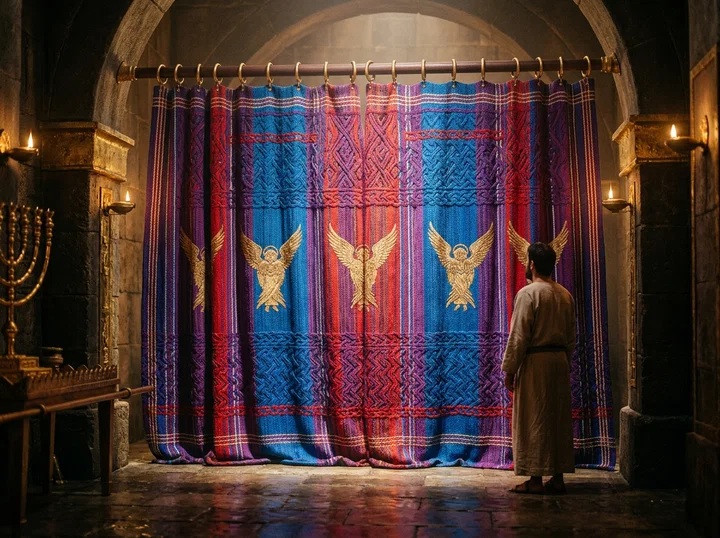
And thou shalt make a vail of blue, and purple, and scarlet, and fine twined linen of cunning work: with cherubims shall it be made:
Translations
And you shall make a veil of blue, and purple, and scarlet, and fine twined linen of cunning work: with cherubim shall it be made:
King James Version, KJV Cambridge Paragraph Bible
And thou shalt make a vail of blue, and purple, and scarlet, and fine twined linen of cunning work: with cherubims shall it be made:
And thou shalt make a vail of blue, and purple, and scarlet, and fine twined linen of curious work: with cherubim shall it be made.
And thou shalt make a veil of blue, and purple, and scarlet, and fine twined linen: with cherubim the work of the cunning workman shall it be made:
And thou shalt make a veil of blue, and purple, and scarlet, and fine twined linen: with cherubim the work of the skilful workman shall it be made:
'And thou hast made a vail of blue, and purple, and scarlet, and twined linen, work of a designer; he maketh it [with] cherubs;
And thou shalt make a veil of blue, and purple, and scarlet, and twined byssus; of artistic work shall it be made, with cherubim.
And thou shalt make a veil, of blue and purple, and crimson and fine-twined linen,—of the work of a skilful weaver, shall it be made, with cherubim;
Berean Standard Bible, Majority Standard Bible
Make a veil of blue, purple, and scarlet yarn, and finely spun linen, with cherubim skillfully worked into it.
“ You shall make a veil of blue, and purple, and scarlet, and fine twined linen, with cherubim. It shall be the work of a skillful workman.
And you are to make a veil of the best linen, blue and purple and red, worked with designs of winged ones by a good workman:
Moreouer, thou shalt make a vaile of blewe silke, and purple, and skarlet, and fine twined linen: thou shalt make it of broydred worke with Cherubims.
Douay-Rheims (Challoner revision)
Thou shalt make also a veil of violet and purple, and scarlet twice dyed, and fine twisted linen, wrought with embroidered work, and goodly variety:
Pictures
Cross-references 20 of 49
- Hebrews 9:3
And after the second veil, the tabernacle which is called the Holiest of all;
Identifies the second veil before the most holy place.
- Exodus 25:8-9
And let them make me a sanctuary; that I may dwell among them.
Commands the sanctuary’s construction according to the pattern shown to Moses, so God may dwell among Israel.
- Hebrews 8:5
Who serve unto the example and shadow of heavenly things, as Moses was admonished of God when he was about to make the tabernacle: for, See, saith he, that thou make all things according to the pattern shewed to thee in the mount.
The earthly tabernacle is an example and shadow of heavenly things.
- Hebrews 9:24
For Christ is not entered into the holy places made with hands, which are the figures of the true; but into heaven itself, now to appear in the presence of God for us:
The earthly veil belongs to a sanctuary that figures the true heavenly sanctuary.
- Exodus 26:36
And thou shalt make an hanging for the door of the tent, of blue, and purple, and scarlet, and fine twined linen, wrought with needlework.
Contrasts the sanctuary entrance hanging with the inner veil.
- Hebrews 6:19
Which hope we have as an anchor of the soul, both sure and stedfast, and which entereth into that within the veil;
Hope enters within the sanctuary veil, where Christ has gone as high priest.
- Exodus 36:35
And he made a vail of blue, and purple, and scarlet, and fine twined linen: with cherubims made he it of cunning work.
Records the making of the veil and its cherubim.
- Exodus 25:40
And look that thou make them after their pattern, which was shewed thee in the mount.
The earthly sanctuary is made according to the pattern shown on the mount.
- Leviticus 16:2
And the LORD said unto Moses, Speak unto Aaron thy brother, that he come not at all times into the holy place within the vail before the mercy seat, which is upon the ark; that he die not: for I will appear in the cloud upon the mercy seat.
The veil marks the restricted entrance to the most holy place for appointed priestly service.
- Acts 7:44
Our fathers had the tabernacle of witness in the wilderness, as he had appointed, speaking unto Moses, that he should make it according to the fashion that he had seen.
Moses made the tabernacle according to the pattern shown to him.
- Exodus 25:18-20
And thou shalt make two cherubims of gold, of beaten work shalt thou make them, in the two ends of the mercy seat.
Both texts command cherubim to be made for the sanctuary.
- Hebrews 8:2
A minister of the sanctuary, and of the true tabernacle, which the Lord pitched, and not man.
Christ ministers as priest in the true heavenly sanctuary.
- Exodus 40:3
And thou shalt put therein the ark of the testimony, and cover the ark with the vail.
Identifies the veil that covered the ark in the sanctuary.
- Exodus 26:1
Moreover thou shalt make the tabernacle with ten curtains of fine twined linen, and blue, and purple, and scarlet: with cherubims of cunning work shalt thou make them.
Describes matching colored linen and cherubim on the inner curtains.
- Hebrews 10:20
By a new and living way, which he hath consecrated for us, through the veil, that is to say, his flesh;
The veil signifies Christ’s flesh and the way to God.
- Hebrews 9:11
But Christ being come an high priest of good things to come, by a greater and more perfect tabernacle, not made with hands, that is to say, not of this building;
The earthly sanctuary points to Christ’s ministry in the greater heavenly sanctuary.
- Exodus 27:21
In the tabernacle of the congregation without the vail, which is before the testimony, Aaron and his sons shall order it from evening to morning before the LORD: it shall be a statute for ever unto their generations on the behalf of the children of Israel.
Uses the same term for the sanctuary veil.
- Hebrews 9:7
But into the second went the high priest alone once every year, not without blood, which he offered for himself, and for the errors of the people:
The high priest enters the inner sanctuary beyond the veil once yearly with blood.
- Exodus 39:32-43
Thus was all the work of the tabernacle of the tent of the congregation finished: and the children of Israel did according to all that the LORD commanded Moses, so did they.
The completed sanctuary follows the Lord’s commands and the earlier instructions.
- Exodus 40:5
And thou shalt set the altar of gold for the incense before the ark of the testimony, and put the hanging of the door to the tabernacle.
Both refer to the tabernacle entrance curtain as a veil.
Commentary
Each commentary is drawn from primary sources: the writings of Ellen G. White and Adventist pioneers and periodicals. Each commentary is separate. Its own words are not a quotation; follow the references to read the source passages.
Ellen G. White
7 sources
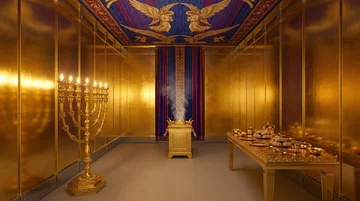
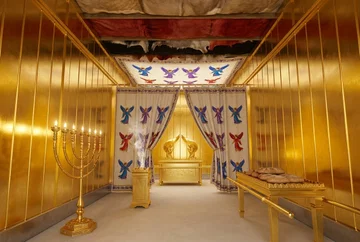
The inner veil is that of the tabernacle built by Moses as God's earthly dwelling place in the wilderness sanctuary and temple, which had two apartments, the holy place and the most holy place, with this curtain separating the holy from the most holy while a similar veil closed the entrance to the first apartment.MH 437.1GC88 411.1–412.3 It was a rich and beautiful curtain of different colors and material, embroidered and woven with cherubim in gold and silver threads, with a beautiful border and figures of gold representing angels.MH 437.18T 284.3–285.1SG1 158.1ST Mar 4, 1903GC88 411.1–412.3 Those cherubim worked into the veils and ceiling curtain represent the angelic host connected with the heavenly sanctuary and the ministering angels who serve God's people on earth.SG1 158.1ST Mar 4, 1903
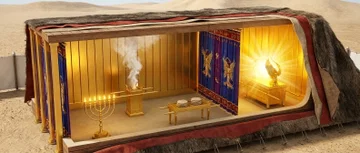
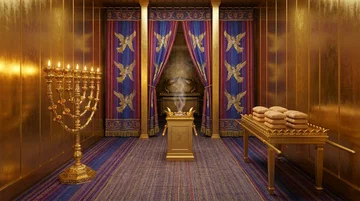
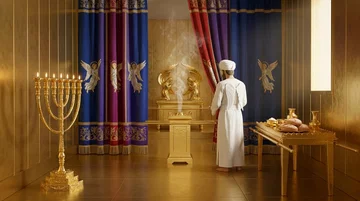
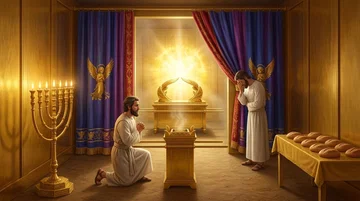
The heavenly sanctuary likewise has two veils as a curtain or door, the first veil opening into the holy place containing the altar of incense, the candlestick with seven lamps, and the table with the showbread, and the second veil, called the second veil, opening into the holy of holies containing the ark with the ten commandments, and the veil can be raised and lifted to give entrance and to show what is inside.CET 91.2–3SG1 158.1 The veil marked the boundary of the place sacred to God's presence, where His glory dwelt above the mercy seat, which no person could look upon and live.MH 437.18T 284.3–285.1 No one could lift it or enter unbidden without facing death, and only the high priest entered the most holy place once a year on the appointed day, with trembling, while incense concealed the glory from his sight.MH 437.18T 284.3–285.1
In 1844, when the ministration in the holy place ended, Jesus passed in a flaming chariot within this second veil into the most holy place to cleanse the sanctuary.SG1 158.1 At Jesus' death this richly worked veil separating the sacred inner place was torn from top to bottom, exposing the most holy place to everyone's view.DA 774.1 Its tearing showed that the temple's sacrificial service had met its fulfillment in Christ's sacrifice for the sins of the world, and the place where God had met the high priest was no longer recognized as His sacred audience chamber.DA 774.1
Sources
Pioneers and periodicals
62 sources
The verse commands the making of the inner dividing curtain of blue and purple and scarlet with fine twined linen, worked with cherubim in cunning needlework.ST Apr 1, 1889ST Nov 14, 1892ST Mar 11, 1886 Hung on four gold-overlaid pillars, it divided the tabernacle into the holy place without and the most holy place within.RH Jan 20, 1859ST Oct 29, 1894ST Apr 1, 1889 It barred all entrance except to the high priest alone once in the year, when he passed beyond it with blood to make atonement before the ark.ST Oct 25, 1905RH Jun 21, 1864ST May 13, 1897 Made exactly after the pattern of the heavenly temple shown to Moses in the mount, the earthly sanctuary with its two apartments typified the heavenly where Christ now ministers.ST May 16, 1878RH Jan 4, 1870RH Aug 28, 1853 The curtain itself represents Christ, through whose flesh the way to the Father is opened, while its woven cherubim picture the angels surrounding God's throne.ST Jun 19, 1907ST Apr 1, 1889ST Oct 29, 1894RH Aug 13, 1908
Materials and Craftsmanship
The command is to make a veil of blue and purple and scarlet yarn with fine twined linen, of cunning work with cherubim worked into it.ST Apr 1, 1889ST Nov 14, 1892ST Mar 11, 1886RH Mar 28, 1854ST Dec 2, 1889 It is the inner veil of the tabernacle, the second veil, to be hung under the taches upon four pillars to bring the ark of the testimony within it, dividing between the holy place and the most holy, the holiest of all.ST Apr 1, 1889ST Nov 14, 1892ST Mar 11, 1886RH Mar 28, 1854ST Dec 2, 1889 It is distinct from the hanging for the door of the tent, though of like materials, and the embroidered cherubim represent the angels who minister in the heavenly sanctuary.ST Dec 2, 1889ST Jun 19, 1907
The veil was richly made and embroidered, costly and heavy, forming with the ceiling covering part of the gorgeous beauty of the sanctuary interior.ST Mar 21, 1911ST Mar 4, 1903ST Nov 21, 1892 Its linen was richly embroidered with cherubim and flowers in gold and silver threads, against a background of three gorgeous colors beautifully arranged.ST Mar 21, 1911ST Mar 4, 1903RH Nov 27, 1913 Beyond it stood the ark, with God's law and the mercy seat beneath the sign of God's presence, amid walls having all the appearance of massive solid gold reflecting in a thousand directions the light of the seven lamps, with the table of showbread and the altar of incense overlaid with burnished gold.ST Nov 21, 1892
It hung from four pillars of shittim or acacia wood overlaid with gold and set in sockets of silver, made of the same materials, colors, and style as the first veil, with its distinguishing construction details given in the following verses.RH Jan 20, 1859RH Aug 4, 1863ST Nov 14, 1892 The inner veils were more costly than the court hangings, one hung at the east entrance of the holy place closing the entrance to the first apartment, and another separated the holy place from the most holy place.ST Jun 24, 1880 The exact proportion of the division is not stated in the verse itself, but it is the same as afterward observed in the temple, with two-thirds of the space allotted to the first apartment and the remaining one-third to the second.RH Aug 4, 1863
The sanctuary building was thirty cubits long, ten cubits wide, and ten cubits high, about forty-five feet long by eighteen feet wide, elsewhere reckoned as a tent about eighteen by fifty-four feet, made of upright acacia boards overlaid with gold set in sockets of silver so it looked like a building of gold.ST Feb 17, 1890ST Jun 4, 1885RH Aug 3, 1916 Overhead was a surpassingly beautiful curtain of fine-twined linen wrought with cunning needlework figures of cherubim forming a lovely ceiling, with an outer tent roof of goats' hair, red-dyed rams' skins, and sealskins, joined in strips with gold clasps.ST Feb 17, 1890 The holy place stood outside the veil and held the lampstand on the south side, the table of showbread on the north side, and the altar of incense on the west side close to the veil, while the most holy place stood within the veil as a perfect cube of ten cubits, about eighteen feet square, holding the ark of the covenant containing the tables of stone with the Ten Commandments, with the mercy seat on top and a cherub on each end stretching wings over it, where God met and communed with Israel from between the cherubim.ST Feb 17, 1890ST Jun 4, 1885 The pattern was the same as the temple proper, which was twenty cubits wide and sixty cubits long with the oracle a perfect cube twenty cubits on a side, the holy place occupying two-thirds and being about twice as large as the inner room, the most holy only half as large, about eighteen by thirty-six feet to eighteen feet square.ST Feb 17, 1890ST May 8, 1901RH Aug 3, 1916 There were two curtains made of the same material and of nearly the same pattern, one serving as the outer door of the sanctuary and the other as the partition, which is the second veil of Hebrews 9:3, implying the outer door curtain is the first veil, the names by which both curtains were known among the Jews, and the entrance to the first apartment faced east so the ministering priest stood with his back to the entrance and his face to the west, unlike sun worship.ST Feb 17, 1890RH Aug 3, 1916
The verse has also been described as the richly embroidered inner curtain of fine linen in blue, purple, and scarlet, with cherubim, which formed the magnificent ceiling of the tabernacle.ST May 20, 1880RH Feb 11, 1858 In that reckoning a separate veil divided the tent into the holy place and the most holy place.ST May 20, 1880
Placement Within Tabernacle
The curtain commanded here is the inner or second veil hung inside the tabernacle to divide it into two apartments, the holy place without and the most holy place or holiest of all within.RH Jan 20, 1859ST Oct 29, 1894ST Apr 1, 1889RH Jan 6, 1853ST Nov 14, 1892 It was made of the same materials, colors and style as the first veil, of blue and purple and scarlet yarn and fine twined linen of cunning work with cherubim wrought into it.RH Jan 20, 1859ST Apr 1, 1889ST Nov 14, 1892 Its construction was to hang under the taches from four gold-covered pillars of shittim or acacia wood set in sockets of silver, bringing the ark of the testimony within it.RH Jan 20, 1859ST Nov 14, 1892ST Dec 2, 1889 The tabernacle so divided had two holy places made after the pattern shown to Moses on the mount as a pattern of the heavenly temple.RH Jan 6, 1853ST May 16, 1878
It is distinct from the hanging at the east end that closed the sanctuary, called the door of the tent or tabernacle.RH Jan 6, 1853ST Dec 2, 1889 The entrance curtain and the dividing veil were two curtains of like beautifully worked linen, of the same material and nearly the same pattern, one serving as the outer door of the sanctuary and the other as the partition between the first and second apartments.ST Dec 2, 1889ST Oct 29, 1894ST Apr 1, 1889RH Aug 3, 1916ST Jun 20, 1911 The partition curtain is the second veil of Hebrews 9:3, which implies the outer door curtain is the first veil, the names by which both were known among the Jews.RH Aug 3, 1916 A similar veil closed the entrance to the first apartment, hung from gold-plated pillars like the inner veil.ST Apr 1, 1889ST Jun 20, 1911
The division allotted about two-thirds of the space to the first apartment and the remaining one-third to the second, the outer apartment being twice the size of the inner.RH Aug 4, 1863ST Mar 10, 1898ST May 8, 1901 The sacred tent or building itself was about thirty cubits long, ten cubits wide and ten cubits high, about forty-five feet by eighteen feet, a tent about eighteen by fifty-four feet.ST Feb 17, 1890ST Jun 4, 1885RH Aug 3, 1916 The holy place stood outside the veil at about eighteen by thirty-six feet, and the most holy stood within as a perfect cube of ten cubits, about eighteen feet square.ST Feb 17, 1890ST May 8, 1901RH Aug 3, 1916 The exact proportion is not stated in the verse itself but is the same as afterward observed in the temple proper, which was twenty cubits wide and sixty cubits long with the oracle a perfect cube of twenty cubits on a side.RH Aug 4, 1863ST May 8, 1901
The holy place outside the veil held the table of showbread on the north side, the seven-branched candlestick or lampstand on the south side, and the altar of incense on the west side close to the veil, with the front eastern two-thirds forming that apartment.RH Jul 27, 1916ST Jun 4, 1885 The most holy place within the veil held the ark of the covenant or ark of the testimony, containing the tables of stone with the Ten Commandments, with the mercy seat on top and a cherub on each end stretching wings over it.RH Jul 27, 1916ST Jun 4, 1885 There between the cherubim God met and communed with Israel, manifesting His presence over the law beneath the mercy seat.RH Jul 27, 1916ST Jun 4, 1885 The entrance to the first apartment faced east, so the ministering priest stood with his back to the entrance and his face to the west, unlike sun worship.ST Feb 17, 1890
That inner tabernacle erected by Israel in the wilderness at God's command, described in Exodus 25 to 40, was later replaced by Solomon's temple, and both buildings were the center of God's worship on earth.ST Jun 19, 1907 All earthly worship and service revolved around the holy of holies where the ark of the covenant holding God's holy law written on tables of stone was placed with the mercy seat over it.ST Jun 19, 1907ST Jan 27, 1909 The veil belongs to those explicit directions for the sanctuary given in every part in detail, afterward carried out exactly as directed until blessing and glory came upon the congregation and the building when completed.ST Jan 27, 1909
Names for the Hangings
The word veil is not confined to the inner curtain, for the same word in Hebrew and Greek also describes the outer curtain hung at the entrance of the holy place.ST May 17, 1877RH Apr 8, 1873 Passing through a veil therefore happens in entering the holy place just as much as in entering the most holy.ST May 17, 1877 Paul distinguishes the curtain of this verse by calling it the second veil, which proves there is a first veil.ST May 17, 1877 This inner veil of blue and purple and scarlet and fine-twined linen of cunning work with cherubim was to be hung under the taches upon four pillars to bring the ark of the testimony within it, dividing between the holy place and the most holy, and it is distinct from the hanging for the door of the tent though of like materials, being the veil that encloses the holiest of all.ST Dec 2, 1889 There were two curtains made of the same material and of nearly the same pattern, one serving as the outer door of the sanctuary and the other as the partition between the first and second apartments, and the partition is the second veil of Hebrews 9:3, which implies the outer door curtain is the first veil, the names by which both were known among the Jews.RH Aug 3, 1916 Since the sanctuary had several hangings called veils, the word veil alone does not necessarily identify the curtain between the holy and most holy places, and Hebrews calls that curtain the second veil to distinguish it.RH Oct 28, 1909
In Hebrew paroketh was the term used for this inner veil, while masak and in Greek kalumma or katapetasma could refer to several sanctuary hangings.RH Oct 5, 1916 In the Septuagint the word for this veil before the holy of holies separating it from the outer sanctuary is katapetasma, meaning a covering veil or curtain that hangs down.RH Apr 8, 1873 The same word is used for the curtain at the entrance of the outer sanctuary, so both curtains are veils and both should be rendered veil.RH Apr 8, 1873 The English distinction that calls the first curtain a hanging and this one a veil is not in the Greek, while the Hebrew uses two different words for the two curtains, though both mean veil or curtain.RH Apr 8, 1873
Because several hangings were called veils, being within the veil does not necessarily mean being in the most holy place.ST May 17, 1877 The entrance curtain was also a woven hanging like the inner one, so it too could be called a veil, and the sanctuary had a veil at its entrance as well as the inner veil between its two apartments.RH Apr 8, 1873ST Mar 18, 1897 That entrance veil is described as like the inner veil of blue and purple and scarlet yarn and fine linen with cherubim woven into it in size, material, and color, so both hangings can be called veils.RH Apr 8, 1873
Heavenly Pattern and History
The vail belongs to the detailed instructions for the construction of the tabernacle and its furniture given to Moses during his forty days in the mount, together with the tables of stone, as the pattern shown to him there.ST May 16, 1878RH Dec 31, 1861RH Jan 4, 1870RH Aug 28, 1853 Those instructions provided for a tabernacle of two holy places divided by the vail of blue and purple and scarlet and fine twined linen with cherubim, and the sanctuary with its furnishings was made as a correct pattern or model of the heavenly building.ST May 16, 1878RH Dec 31, 1861RH Jan 4, 1870RH Aug 28, 1853RH Feb 3, 1853 Moses erected it after forty days inspecting the heavenly one, and the sanctuary was set up immediately afterward.RH Feb 3, 1853ST Dec 10, 1896 It belongs to the Exodus 19-26 portion giving the account of the giving of the law of Ten Commandments upon Mount Sinai.ST Mar 3, 1914 It belongs also to the worship part of Exodus laying out Israel's established form of worship after deliverance from Egypt as they became a nation with organization, leadership, and laws, and to God's personal presence with Israel at Sinai where He gave His law and where the ark containing the law was to be placed.RH Dec 31, 1861RH Dec 24, 1861RH Jan 20, 1916
The tabernacle was made exactly according to the pattern of the heavenly temple, with two holy places marked by the dividing vail.ST May 16, 1878RH Jan 4, 1870RH Aug 28, 1853RH Feb 3, 1853RH Mar 8, 1870 Since the earthly copy has two compartments, the heavenly original from which it was copied must also have two, for if the heavenly had only one there would be perfect dissimilarity instead of likeness, and its two apartments represented corresponding holy places in the heavenly sanctuary.ST May 16, 1878RH Jan 4, 1870RH Aug 28, 1853RH Feb 3, 1853RH Mar 8, 1870 The finely worked vail with its materials and cherubim formed part of the arrangement used to illustrate those two holy places in the heavenly sanctuary.RH Mar 8, 1870 That portable tabernacle erected in the wilderness at God's command, described in Exodus 25 to 40, was God's dwelling-place among Israel so He might dwell among them.ST Jun 19, 1907ST Jun 4, 1885ST Jul 8, 1930 It remained so through the time of the judges, of Samuel, of Saul, and of David, until Solomon built the temple after the same pattern, which from its dedication when the glory of the Lord filled the house was God's dwelling-place among Israel.ST Jun 19, 1907ST Jun 4, 1885 Both buildings were the center of God's worship on earth, and all earthly worship and service revolved around the holy of holies where the law rested with the mercy seat over it.ST Jun 19, 1907
The sanctuary was built for the ministry of sacrifices and offerings, as an earthly object lesson of God's government and His plan for salvation from sin through Christ.ST Jan 24, 1911ST Jun 26, 1907 Through it God would dwell among His people and reveal His love, and they would cooperate with Him in His work; its dimensions, materials, furnishings, ceremonies and services pointed to Christ and His power to forgive sin and transform character, directing people to the coming Messiah.ST Jun 26, 1907ST Jun 4, 1885ST Jul 8, 1930 The vail is part of the law of Moses commanded through Moses in Horeb with the statutes and judgments, set forth in Exodus 20 to 40 and Leviticus.ST Apr 15, 1886 It is not the Ten-Commandment moral law alone spoken by God at Sinai and written on the stone tablets, but one of the ceremonial laws and ordinances given through Moses after the Ten Commandments, revealing offerings, sacrifices and types, a shadow of the old dispensation from which the substance of the new dispensation is traced, which God calls His people to remember and give attention to in the last days.ST Apr 15, 1886 As part of the worldly sanctuary that belonged to the first covenant with its ordinances of divine service, this connection explains why that ministration was a ministration of death.ST Aug 5, 1889
God placed His Spirit upon the builders Bezalel and Oholiab with other devoted men and women so the building might be properly erected and the work properly done, showing He blesses consecrated workers in material things as in spiritual things.ST Jan 27, 1909 The direction was afterward carried out exactly as directed, with the vail among the sacred objects entrusted to the sons of Kohath, and blessing and glory came down upon the congregation and the building when it was completed.ST Jan 27, 1909RH May 5, 1851 That ancient tabernacle with its sacrificial services typified the heavenly temple where Jesus now ministers, and its sacrificial services passed away when Christ died once for all.ST Jan 24, 1911
Symbols in the Veil
The cherubim worked into the veil and the inner curtains pictured the angels who surround God's throne in the heavenly sanctuary.ST Mar 21, 1911ST Jun 19, 1907ST Apr 1, 1889ST Oct 29, 1894ST Apr 1, 1889 Those embroidered cherubim, woven in fine twined linen of blue, purple and scarlet and richly arranged, represented the angelic host connected with the work of the heavenly sanctuary.ST Jun 24, 1880ST Mar 21, 1911ST Jun 19, 1907ST Apr 1, 1889 They minister in the heavenly sanctuary and minister to God's people on earth.ST Jun 24, 1880ST Mar 21, 1911ST Jun 19, 1907 The entrance curtain and the dividing veil were alike made of linen beautifully worked with cherubim, and a similar veil closed the entrance to the first apartment as well as separating the two apartments.ST Jun 24, 1880ST Mar 21, 1911ST Oct 29, 1894ST Apr 1, 1889 The curtains' colors were beautifully arranged, with cherubim woven in gold and silver threads.ST Mar 21, 1911
The veil represents Christ, for the way to the Father is through Him.RH Aug 13, 1908 The veil signifies His flesh.RH Aug 13, 1908 Its materials of fine twined linen, blue, purple and scarlet, shared with the sanctuary door and court hangings, also picture the experiences of His triumphal passage from the cross to the throne.RH Aug 13, 1908 The colors and cherubim make the veil-folds a place of beauty within God's dwelling where His presence abides.RH Nov 27, 1913
Figures of cherubim were made for the sanctuary as ornament and as part of its legitimate worship setting, and making and carrying them did not break the second commandment because they were not made to be worshiped.RH Mar 9, 1916RH Aug 9, 1864 God commanded cherubim to be embroidered on the veil and golden cherubim to be placed over the ark, which proves the second commandment does not forbid making every image or likeness but only making an image with intent of worship.RH Aug 9, 1864 Moses did not transgress the law by ordering these veil cherubim and ark cherubim, nor by making the brazen serpent, because they were not made to be worshiped and the ancient Jews paid them no adoration.RH Aug 9, 1864 When worship of the serpent began, a pious king rightly destroyed it.RH Aug 9, 1864
The instructions for the sanctuary to which this veil belongs show how particular God was about what pertained to His worship.ST Mar 25, 1889 That place in those instructions connects sanctuary worship and its services with the purpose of bringing people into harmony with God's holy law.ST Mar 25, 1889 The veil belongs to the sanctuary's detailed construction, but its measurements, materials and furnishings are not the sanctuary's full meaning.RH May 25, 1905 The heavenly truth represented by the earthly sanctuary must not be reduced to its physical structure or treated as a mere theory.RH May 25, 1905
Ministry Beyond the Veil
The veil described in Exodus 26:31-34 separated the holy place from the most holy place in the tabernacle.ST Oct 25, 1905RH Jun 21, 1864ST May 13, 1897 It marked the boundary before which the priests daily carried and sprinkled the blood of the offering.RH Jun 21, 1864 It barred entrance to everyone except the high priest, and to him only at one special time in the year.ST May 13, 1897 Once each year, on the Day of Atonement, the high priest passed beyond it into the most holy place, unlike his ordinary daily service.ST Oct 25, 1905RH Jun 21, 1864 He brought blood before the ark and sprinkled it on and before the mercy seat to make atonement and cleanse the sanctuary.RH Jun 21, 1864
The second veil bore mystic figures of cherubim in blue and purple and scarlet as part of the gorgeous beauty of the sanctuary interior.ST Nov 21, 1892 Its walls had all the appearance of massive and solid gold reflecting in a thousand directions the light of the seven lamps of the golden candlestick, with the table of showbread and the altar of incense overlaid with burnished gold.ST Nov 21, 1892 Beyond that second veil was the golden ark, and above it the glorious shekinah, the visible manifestation of God's glory.ST Nov 21, 1892 It was an awful presence into which no man could venture and live, except the high priest alone entering once every year.ST Nov 21, 1892
The earthly sanctuary had an inner veil at the inner door dividing the holy place from the most holy place, with another veil at the outer door.RH Nov 10, 1904 Christ has gone within the veil in heaven.RH Nov 10, 1904 The hope of believers as an anchor enters within the veil to Him, and knowing and believing the interceding work He does there at the right hand of the Father for the human family gives steadfast Christian experience.RH Nov 10, 1904
The curtain and the apartment it enclosed contain precious gospel truths.ST May 13, 1897 They were preached to the Israelites in the wilderness as well as to Christians.ST May 13, 1897
Sources