Exodus 40:33
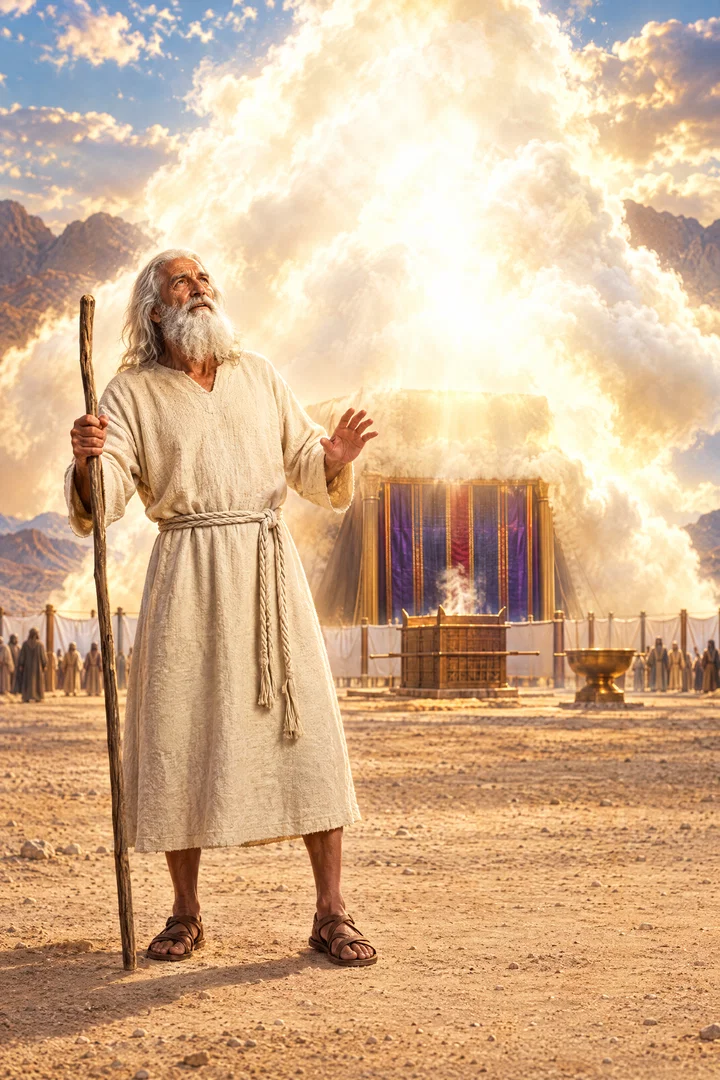
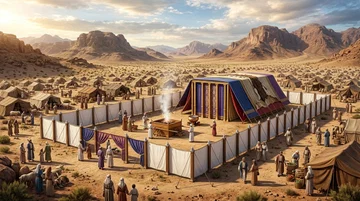
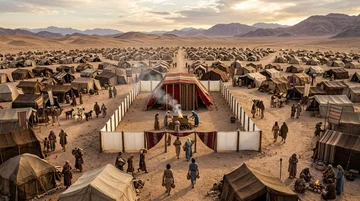
And he reared up the court round about the tabernacle and the altar, and set up the hanging of the court gate. So Moses finished the work.
Translations
American King James Version, King James Version, KJV Cambridge Paragraph Bible
And he reared up the court round about the tabernacle and the altar, and set up the hanging of the court gate. So Moses finished the work.
And he reared up the court round about the tabernacle and the altar, and set up the hanging of the court-gate: so Moses finished the work.
Revised Version, American Standard Version
And he reared up the court round about the tabernacle and the altar, and set up the screen of the gate of the court. So Moses finished the work.
And he raiseth up the court round about the tabernacle, and about the altar, and placeth the covering of the gate of the court; and Moses completeth the work.
And he set up the court round about the tabernacle and the altar, and hung up the curtain of the gate of the court. And so Moses finished the work.
And he reared the court round about to the habitation and to the altar, and put up the screen of the gate of the court,—and Moses finished the work.
Berean Standard Bible, Majority Standard Bible
And Moses set up the courtyard around the tabernacle and the altar, and he hung the curtain for the entrance to the courtyard. So Moses finished the work.
He raised up the court around the tabernacle and the altar, and set up the screen of the gate of the court. So Moses finished the work.
And he put up the hangings forming the open space round the House and the altar, and put the curtain over the doorway. So Moses made the work complete.
Finally, he reared vp the court rounde about the Tabernacle and the Altar, and hanged vp the vaile at the court gate: so Moses finished the worke.
Douay-Rheims (Challoner revision)
He set up also the court round about the tabernacle and the altar, drawing the hanging in the entry thereof. After all things were perfected,
Pictures
Cross-references
- Hebrews 8:5
Who serve unto the example and shadow of heavenly things, as Moses was admonished of God when he was about to make the tabernacle: for, See, saith he, that thou make all things according to the pattern shewed to thee in the mount.
The earthly tabernacle was built as a pattern of heavenly things.
- Exodus 25:8
And let them make me a sanctuary; that I may dwell among them.
both concern building sanctuary for God to dwell
- Hebrews 9:1-5
Then verily the first covenant had also ordinances of divine service, and a worldly sanctuary.
Describes the earthly tabernacle, its furnishings, and the ark in the most holy place.
- Numbers 9:15-16
And on the day that the tabernacle was reared up the cloud covered the tabernacle, namely, the tent of the testimony: and at even there was upon the tabernacle as it were the appearance of fire, until the morning.
The cloud covered the tabernacle from its erection, marking God’s presence during Israel’s wilderness journey.
- Exodus 25:40
And look that thou make them after their pattern, which was shewed thee in the mount.
Moses completed the work according to the pattern shown on the mountain.
- Hebrews 8:2
A minister of the sanctuary, and of the true tabernacle, which the Lord pitched, and not man.
The completed earthly tabernacle contrasts with the true tabernacle pitched by the Lord.
- Hebrews 9:23-24
It was therefore necessary that the patterns of things in the heavens should be purified with these; but the heavenly things themselves with better sacrifices than these.
Contrasts the earthly sanctuary with the heavenly.
- Exodus 39:32
Thus was all the work of the tabernacle of the tent of the congregation finished: and the children of Israel did according to all that the LORD commanded Moses, so did they.
Cited as another example of the word used for completing the tabernacle.
- Exodus 40:1-2
And the LORD spake unto Moses, saying,
Dates the command to set up the tabernacle.
- Exodus 40:17
And it came to pass in the first month in the second year, on the first day of the month, that the tabernacle was reared up.
Dates the tabernacle’s setup to the first day of the first month.
- Exodus 25:9
According to all that I shew thee, after the pattern of the tabernacle, and the pattern of all the instruments thereof, even so shall ye make it.
The tabernacle was made according to the pattern and directions shown on the mount.
- Hebrews 9:9
Which was a figure for the time then present, in which were offered both gifts and sacrifices, that could not make him that did the service perfect, as pertaining to the conscience;
The earthly sanctuary and its service were a teaching symbol.
- Numbers 7:1
And it came to pass on the day that Moses had fully set up the tabernacle, and had anointed it, and sanctified it, and all the instruments thereof, both the altar and all the vessels thereof, and had anointed them, and sanctified them;
Cited as an example of the word used for completing the tabernacle.
- Exodus 26:30
And thou shalt rear up the tabernacle according to the fashion thereof which was shewed thee in the mount.
tabernacle built according to mount pattern
- Leviticus 9:23
And Moses and Aaron went into the tabernacle of the congregation, and came out, and blessed the people: and the glory of the LORD appeared unto all the people.
God’s glory appeared as the priests began their ministry.
- 1 Kings 6:14
So Solomon built the house, and finished it.
Solomon likewise built and finished the temple within his generation.
- 1 Kings 8:10-11
And it came to pass, when the priests were come out of the holy place, that the cloud filled the house of the LORD,
The Lord’s glory fills the temple built after the sanctuary’s pattern.
- Exodus 31:1-6
And the LORD spake unto Moses, saying,
God equips the builders for the sanctuary work.
- Hebrews 10:1
For the law having a shadow of good things to come, and not the very image of the things, can never with those sacrifices which they offered year by year continually make the comers thereunto perfect.
The earthly arrangements are a shadow, not the full reality.
- Matthew 27:51
And, behold, the veil of the temple was rent in twain from the top to the bottom; and the earth did quake, and the rocks rent;
The torn veil marked the transfer from the earthly sanctuary.
Commentary
Each commentary is drawn from primary sources: the writings of Ellen G. White and Adventist pioneers and periodicals. Each commentary is separate. Its own words are not a quotation; follow the references to read the source passages.
Ellen G. White
2 sources
The closing work was the raising of the courtyard enclosure around the dwelling and the altar, with the screen hung at the entrance to the courtyard, and with that the task was complete.ST Mar 4, 1903GW92 308.2 Before that completion the finished construction had been inspected to see that it matched the model revealed on the mountain and the instructions given by God.ST Mar 4, 1903 Once finished, a cloud came down upon the dwelling and the visible glory made known that God received it as the place where He would dwell.ST Mar 4, 1903
The precise order of the dwelling and its court was designed to stamp upon Israel a sense of divine greatness and sacredness and of the cleanness of life demanded of those who minister.GW92 308.2 It was also designed to display to the peoples round about what God is like and what kind of people He wants His own to become.GW92 308.2 The same law of order and harmonious arrangement is to govern the planning of work done for God.GW92 308.2
Sources
Pioneers and periodicals
31 sources
The verse records the final act in erecting the wilderness sanctuary, when the court was reared around the tabernacle and the altar and its gate hanging was set up, and so the work of setting it up was brought to an end.RH Apr 13, 1876RH Feb 11, 1858 This took place on the first day of the first month in the second year after Israel left Egypt.RH Apr 13, 1876RH Feb 11, 1858 The work was done exactly according to the pattern shown on the mount and God's explicit directions, which proves the commission was faithfully performed.ST Feb 17, 1890ST Jan 27, 1909 As soon as it was finished the cloud covered the tent and the glory of the Lord filled the tabernacle so that Moses could not enter, showing that God had taken possession and dwelling among His people and had accepted the work.RH Apr 13, 1876RH Jan 6, 1853RH Aug 21, 1856 The completed sanctuary was erected for the habitation of Jehovah among His people as the earthly center of worship, built as a great object-lesson comprehending the plan of salvation and as a pattern of the heavenly sanctuary which the Lord pitched and not man.ST Jun 19, 1907ST Jun 4, 1885ST Mar 10, 1898 Its innermost ark held the moral law with the mercy-seat above where atoning blood was sprinkled, so that the whole ceremonial ministration before it pointed penitent breakers of the law forward to pardon through the great Sacrifice to come in Christ.ST Aug 10, 1882RH Dec 12, 1854
Erection and Completion
The verse records the final act in erecting the wilderness sanctuary, when the court was reared up round about the tabernacle and the altar and the hanging of the court gate was set up, and so Moses finished the work of setting up the sanctuary with its court, furnishings and offerings arranged as commanded.RH Apr 13, 1876RH Feb 11, 1858RH Jan 6, 1853ST Feb 17, 1890 The completed tabernacle was then ready to receive the Lord's presence as the earthly center of worship focused on the holy of holies where God's law rested beneath the mercy seat.RH Jan 6, 1853ST Jun 19, 1907 This took place in the first month of the second year after Israel left Egypt, on the first day of the first month.RH Apr 13, 1876RH Feb 11, 1858RH Aug 21, 1856ST Jul 17, 1879 The tabernacle was erected at Sinai in that second year, with its furnishings and services arranged as God commanded.RH Aug 21, 1856RH Aug 4, 1863
The finishing included putting the testimony of the ten commandments into the ark with the mercy-seat upon it and bringing it inside, setting up the vail, placing the table of shewbread and the golden candlestick and lighting the lamps before the Lord, putting the golden altar of incense before the vail and burning sweet incense upon it, and placing the altar of burnt offering and the brazen laver between the tabernacle and the altar before the door.RH Aug 21, 1856 It included hanging the door of the sanctuary, placing the altar of burnt offering at the door, setting the laver between the tabernacle and the altar, and setting up the court of the tabernacle around the whole, with the burnt offering and meat offering offered on the outer altar as commanded.RH Aug 21, 1856RH Mar 1, 1870 The finished work was the sanctuary erected for the habitation of Jehovah, now ready to receive the King eternal.RH Mar 1, 1870 The court itself had curtains of fine twined linen with its gate hanging.RH Aug 21, 1856
The tabernacle itself had upright boards closely joined set in silver sockets in the ground and held by bars passing through rings in the boards, roofed with curtains reaching to the ground, closed at the east end by hangings of fine-twined linen for entrance, and divided by another curtain into two apartments with the outer apartment twice as large as the inner.ST Mar 10, 1898 Its inner walls were overlaid with fine gold and its ceiling was of finest pure linen wrought with many angels.ST Mar 10, 1898 The work was done exactly according to the pattern shown to Moses in the mount and God's explicit directions and instructions for building the sanctuary, which Moses examined the completed work against while the assembled Israelites saw the furnishings in place.ST Feb 17, 1890RH Feb 9, 1911ST Dec 10, 1896ST Oct 25, 1905ST Jun 26, 1907 The pattern was divine and God specially endowed His workmen to build it from free-will offerings, and the Lord's acceptance of the completed work proves Moses performed his commission faithfully.RH Feb 9, 1911
The word translated finished means brought to an end or completed, especially in descriptions of completing the tabernacle or temple.ST Apr 16, 1912ST Jan 28, 1903ST Jun 23, 1909 The specified work was completed in six short months through the earnest labor of men, women, and children who had a mind to work, nobly meeting the test God had revealed to Israel.RH Feb 3, 1903 As soon as the work was finished the cloud covered the tent of the congregation and the glory of the Lord filled the tabernacle so that Moses was not able to enter.RH Apr 13, 1876RH Aug 21, 1856ST Jun 26, 1907 This showed God had taken possession of His dwelling among His people and taken up His dwelling among them, accepted the work and the people's repentance, and brought blessing, keen joy and satisfaction.RH Apr 13, 1876RH Aug 4, 1863ST Jan 27, 1909ST Jan 31, 1911RH Feb 3, 1903
Sanctuary Meaning and Typology
The finished sanctuary was erected for the habitation of Jehovah, a movable dwelling in the wilderness far from enemies after deliverance across the Red Sea, so that God might dwell among His people and reveal more fully His great love.RH Mar 1, 1870ST Jul 8, 1930ST Oct 25, 1905ST Jun 26, 1907 It was the earthly center of worship, focused on the holy of holies where God's law rested beneath the mercy seat, with its holy and most holy places and their furnishings made from the pattern shown to Moses.ST Jun 19, 1907ST Jun 4, 1885ST Oct 25, 1905 That same pattern was followed later in Solomon's temple, first in the wilderness and then in the settled kingdom as God's dwelling place among His people.ST Jun 4, 1885 The building was raised from the free-will offerings of the children of Israel by workmen whom God specially endowed, according to the divine pattern given in the mount.
It was a great multiple object-lesson which by various forms and rites comprehended in its teaching the great plan of salvation. Such teaching was given because hundreds of years of slavery had unfitted Israel to comprehend God's great salvation and the character He required. The ark containing the moral law spoken at Sinai was placed in the second apartment, the most holy place, with its top as the mercy-seat where the blood of atonement was sprinkled so the breaker of the law beneath could find pardon.ST Aug 10, 1882RH Dec 12, 1854 The whole ceremonial system connected with that sanctuary, with the Levitical priesthood set apart to minister before that ark while the typical sanctuary should continue, was ordained to bring man back to that broken law, providing a way for sinners to approach the law they had broken through atonement.ST Aug 10, 1882RH Dec 12, 1854RH Jul 8, 1852
That ministration carried forward through the entire Old Testament period what began when Moses brought the law down.RH Dec 12, 1854 To that sinful, rebellious people it was only condemnation and death, for it could only show guilt and exposure to its just penalty and contained in itself no promise of pardon.RH Dec 12, 1854 It cited penitent sinners forward to the great Sacrifice to be offered for sins.RH Dec 12, 1854 The sanctuary and its ceremonies served as a pattern of the heavenly sanctuary and as the worldly sanctuary of the first covenant, typical of and foreshadowing the true tabernacle which the Lord pitched and not man.ST Jun 26, 1907 All its rites pointed to Christ and passed away at His death.ST Jun 26, 1907
The inner walls overlaid with fine gold reflect the light of God's glory in the New Jerusalem, and the ceiling of finest pure linen wrought with many angels in needlework represents the angels of heaven waiting upon Jehovah's bidding.ST Mar 10, 1898 The account belongs to the law given through Moses, which comprises God's commandments, statutes, and judgments — not only the Ten Commandments but also civil, health, ceremonial, and moral laws. Its tabernacle types are shadows from which the substance of the new dispensation is traced. With the instructions in Exodus 29-31 and 40 it completes the setting up of the worship system for God's peculiar people as a nation, distinct from the laws for civil government in Exodus 21-23.ST Sep 3, 1896
Civil government and religion have essentially different purposes and entirely separate lines of operation.ST Sep 3, 1896 Civil government is a temporary government of force to control men and regulate their relations to each other in this life only, while religion is to persuade men and bring them back to God.ST Sep 3, 1896 Any commingling of them produces discordant clashing detrimental to both.ST Sep 3, 1896 The sanctuary itself was set apart as holy, so the priests could not use it as they would their own houses.RH Jul 16, 1861 This shows that sanctification marks a real distinction between what is holy and what is ordinary.RH Jul 16, 1861
Sabbath Argument and Application
The tabernacle with its court reared round about and its gate hanging set up was completed on the first day of the first month, with the showbread also set in place on that day.ST Jul 17, 1879ST Jul 17, 1879 That setting out does not prove the day was a weekly Sabbath, because the setting up came before the command to set out the showbread every Sabbath was given.ST Jul 17, 1879ST Jul 17, 1879 The finishing shows the Exodus movement reached completion within the generation in which it began.ST Dec 21, 1915
The necessary waiting at Sinai before advancing to subdue enemies and possess the goodly land required the commandments to be given, the tabernacle to be erected, and all the people to be marshalled in perfect order, because God was particular to have all things just right.RH Dec 31, 1857 That earthly preparation and advance to Canaan was merely a type of entering the heavenly Canaan now, which requires still greater particularity.RH Dec 31, 1857 This means obeying God in all things, heeding His strait testimony, moving just right, seeking wisdom from above, and reaching the place of not counting even life dear in striving to overcome and advance in the divine life.RH Dec 31, 1857
The specified work was completed in six short months through the earnest labor of men, women, and children who had a mind to work, nobly meeting the test God had revealed to Israel.RH Feb 3, 1903 Only when the work was finished, and not before, the glory of God filled the tabernacle as the token of His presence, bringing keen joy and satisfaction, for finished work brings the glory.RH Feb 3, 1903 Completion, not partial progress, is therefore the measure of a task faithfully carried through, and the same standard applies to the work of the church, which is not finished until the whole task is done.RH Feb 3, 1903
Sources