Exodus 40:8
And thou shalt set up the court round about, and hang up the hanging at the court gate.
Translations
And you shall set up the court round about, and hang up the hanging at the court gate.
King James Version, KJV Cambridge Paragraph Bible
And thou shalt set up the court round about, and hang up the hanging at the court gate.
And thou shalt set up the court round about, and hang up the hanging at the court-gate.
Revised Version, American Standard Version
And thou shalt set up the court round about, and hang up the screen of the gate of the court.
'And thou hast set the court round about, and hast placed the covering of the gate of the court,
And thou shalt fix the court round about, and hang up the curtain at the gate of the court.
And thou shalt put up the court round about, and hang up the screen of the gate of the court.
Berean Standard Bible, Majority Standard Bible
Set up the surrounding courtyard and hang the curtain for the entrance to the courtyard.
You shall set up the court around it, and hang up the screen of the gate of the court.
And put up the hangings forming the open space all round it, with the curtain over its doorway.
Then thou shalt appoynt the courte round about, and hang vp the hanging at the courte gate.
Douay-Rheims (Challoner revision)
And thou shalt encompass the court with hangings, and the entry thereof.
Pictures
Cross-references
- Hebrews 8:5
Who serve unto the example and shadow of heavenly things, as Moses was admonished of God when he was about to make the tabernacle: for, See, saith he, that thou make all things according to the pattern shewed to thee in the mount.
The earthly sanctuary followed the pattern shown to Moses of heavenly things.
- Hebrews 9:1-5
Then verily the first covenant had also ordinances of divine service, and a worldly sanctuary.
Describes the earthly sanctuary, its divisions, and its furnishings.
- Exodus 40:33
And he reared up the court round about the tabernacle and the altar, and set up the hanging of the court gate. So Moses finished the work.
Moses finishes setting up the court around the tabernacle.
- Exodus 27:9-19
And thou shalt make the court of the tabernacle: for the south side southward there shall be hangings for the court of fine twined linen of an hundred cubits long for one side:
Gives the court’s dimensions and its hangings and gate.
- Exodus 38:9-20
And he made the court: on the south side southward the hangings of the court were of fine twined linen, an hundred cubits:
Describes the construction of the court and its gate hanging.
- Exodus 40:1-2
And the LORD spake unto Moses, saying,
same rearing up that includes setting the court
- Acts 7:44
Our fathers had the tabernacle of witness in the wilderness, as he had appointed, speaking unto Moses, that he should make it according to the fashion that he had seen.
Refers to the sanctuary made according to God’s pattern.
- Hebrews 9:23-24
It was therefore necessary that the patterns of things in the heavens should be purified with these; but the heavenly things themselves with better sacrifices than these.
The earthly sanctuary points to the heavenly sanctuary and Christ's work there.
- Hebrews 9:8-9
The Holy Ghost this signifying, that the way into the holiest of all was not yet made manifest, while as the first tabernacle was yet standing:
The earthly sanctuary and its service are a shadow and lesson.
- Exodus 40:34-35
Then a cloud covered the tent of the congregation, and the glory of the LORD filled the tabernacle.
The glory filled the tabernacle after the court gate curtain was hung.
Commentary
Each commentary is drawn from primary sources: the writings of Ellen G. White and Adventist pioneers and periodicals. Each commentary is separate. Its own words are not a quotation; follow the references to read the source passages.
Pioneers and periodicals
20 sources
The command was to erect the court around the whole tabernacle and hang the screen at the court gate as the finishing act that completed the court, the outer part of the sanctuary enclosed with curtains of fine twined linen around the laver and the altar of burnt offering before the entrance.RH Feb 11, 1858ST Sep 17, 1902RH Aug 21, 1856ST May 20, 1880
It was carried out when the movable wilderness tabernacle was reared up on Abib 1 in the second year after Israel left Egypt, its parts put in order and its furniture placed, after which the cloud covered the tent and the glory of the Lord filled the tabernacle so that Moses could not enter.RH Aug 21, 1856ST Jul 17, 1879
It belongs to the worship division of Exodus, chapters 25 to 40, for the sanctuary built at God's command from free-will offerings by divinely endowed workmen exactly after the pattern shown to Moses in the mount, that God might dwell among His people with His law beneath the mercy seat as the center of their worship.RH Apr 13, 1876ST Jun 19, 1907ST Jun 4, 1885
So erected, the tabernacle taught salvation by its structure and services as an object-lesson and type and pattern of the heavenly sanctuary where Christ ministers.ST Sep 17, 1902RH Jul 8, 1852
It is part of the law of Moses commanded in Horeb, with the Ten Commandments, statutes, judgments, and ceremonial laws of sacrifices and offerings whose shadows point to the new dispensation, belonging to the religious system distinct from the civil laws for governing the people.ST Sep 3, 1896
Once so set up the sanctuary was sanctified for God's service and was not to be used as a common house, while its ministration before the ark containing the law could only expose the guilt and just condemnation of sinners with in itself no promise of pardon.RH Dec 12, 1854RH Jul 16, 1861
Erection and Arrangement
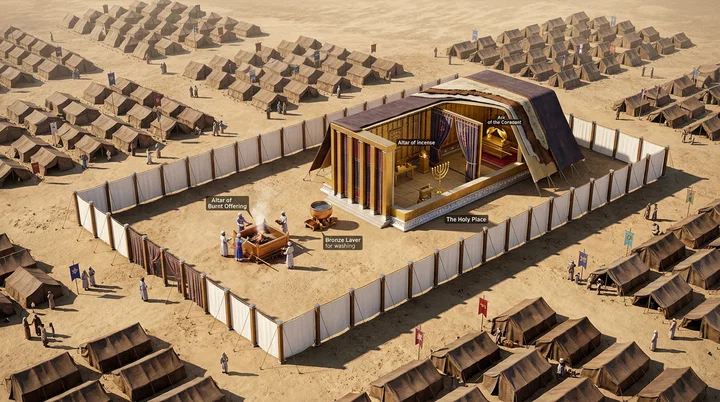
Exodus 40:8 commands setting up the court round about the tabernacle and hanging the hanging or screen at the court gate.ST Sep 17, 1902ST May 20, 1880ST Feb 17, 1890 It belongs both to the directions for erecting the tabernacle and to the record of carrying them out as the finishing act of completing the court.ST Sep 17, 1902ST Feb 17, 1890ST Jan 27, 1909 The court was set up around the sanctuary and its gate was hung as directed, with its furnishings and equipment made according to God's directions.RH Aug 4, 1863ST Jan 27, 1909
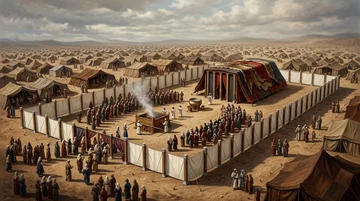
The court was the outer part of the sanctuary arrangement, erected around the whole tabernacle.RH Feb 11, 1858RH Aug 21, 1856RH Aug 4, 1863 It was enclosed with curtains of fine twined linen, and its gate had a hanging.RH Feb 11, 1858RH Aug 21, 1856ST May 20, 1880RH Aug 4, 1863 Enclosed within it were the brazen laver and the altar of burnt offering that stood before the door or entrance of the tabernacle.RH Feb 11, 1858RH Aug 21, 1856
The setting is the rearing up of the movable wilderness tabernacle on the first day of the first month, Abib 1, in the second year after Israel departed from Egypt.RH Aug 21, 1856ST Jul 17, 1879 This followed deliverance from Pharaoh and the crossing of the Red Sea, when Moses hung the last curtain upon the court gate.ST Jun 26, 1907 Its parts were put in order and the furniture was placed in the holy and most holy places, with offering made on the outer altar.RH Aug 21, 1856 As soon as that court-gate hanging was in place, the cloud covered the tent of the congregation and the glory of the Lord filled the tabernacle, so that Moses was not able to enter into the tent.RH Aug 21, 1856ST Jun 26, 1907 The completed sanctuary was followed by a manifestation of God's blessing and glory upon the congregation and the building, showing that He accepted the people's repentance.ST Jan 27, 1909ST Jan 31, 1911
The verse belongs to the worship division of Exodus, chapters 25 to 40, in the book named from the Greek meaning going out.RH Jan 20, 1916 It concerns Israel's departure from Egypt and deliverance from bitter bondage into a nation with organization, leadership, laws, and established worship.RH Jan 20, 1916 The marvelously beautiful sanctuary structure described in Exodus 25-40 was built at God's command from the free-will offerings of the children of Israel by workmen specially endowed by God. It was made exactly according to the divine pattern given to Moses in the mount, in its dimensions, material, furnishings and all, so that the temple of God was with men.ST Jun 26, 1907 This was given after Egyptian bondage had unfitted Israel to comprehend the plan of salvation and the character God required, as a great, multiple object-lesson to teach them. The tabernacle erected in the wilderness became God's dwelling place among Israel and the center of Israel's worship, which focused on the holy of holies where God's law rested beneath the mercy seat.RH Apr 13, 1876ST Jun 19, 1907ST Jun 4, 1885 The same pattern continued in the temple built by Solomon, where the Lord's glory filled the house.ST Jun 4, 1885
Doctrine and Lessons
The tabernacle was built so that God could dwell among His people, and its structure and services taught spiritual truths.ST Sep 17, 1902 It was a marvelously beautiful sanctuary set forth in Exodus 25 to 40, built from the free-will offerings of the children of Israel by workmen specially endowed by God, exactly according to the divine pattern given to Moses in the mount. It was given after deliverance from Egyptian bondage as a great, multiple object-lesson to teach the plan of salvation and the character God required, because slavery had unfitted Israel to comprehend them. It was a type and pattern of the heavenly sanctuary where Christ ministers, and its service continued for generations with the Levitical priests ministering before the ark containing the law.ST Sep 17, 1902RH Jul 8, 1852
The instruction belongs to the law of Moses commanded in Horeb, set forth in Exodus 20 to 40 and Leviticus with the Ten Commandments, statutes and judgments, civil regulations, laws of conduct, health laws, ceremonial laws, moral laws, sacrifices and offerings. It belongs to the laws in which offerings, sacrifices, and types were revealed, whose shadows trace the substance of the new dispensation, and to the great laws of conduct together with the typical laws that God calls His people to remember in the last days, not the Ten-Commandment law alone. As a regulation of worship it belongs to the religious system, distinct from the civil laws given for governing the people.ST Sep 3, 1896 The purpose of that religious system differs from the role of civil government in controlling people and regulating their relations with one another.ST Sep 3, 1896
The setting up of the tabernacle on Abib 1, when the table and showbread were also put in place with the court set up round about and its gate screen hung, does not prove that Abib 1 was the weekly Sabbath.ST Jul 17, 1879ST Jul 17, 1879 Moses set it up before the later command to set out the showbread every Sabbath was given, so the tabernacle's setup and the showbread placed there do not prove that the day was a Sabbath.ST Jul 17, 1879ST Jul 17, 1879 The instruction stands among commands for observances described as lasting forever or as a perpetual covenant, showing that such wording does not by itself prove an observance must continue without end.RH Jun 10, 1862
The chapter shows Moses placing the two tables of the law in the ark and placing the ark in the Most Holy Place of the typical sanctuary.RH Dec 12, 1854 This act carried forward through the entire Old Testament period the ministration Moses began when he brought the law down from God, with the Levitical priesthood set apart to minister before that ark while the typical sanctuary continued.RH Dec 12, 1854 That ministration could only exhibit guilt and just condemnation and death to the sinful, rebellious people, showing them exposed to the just penalty of the law and containing in itself no promise of pardon.RH Dec 12, 1854 The sanctuary thus set up was sanctified for God's service and was not to be used like an ordinary house, for what God sets apart as holy is distinct from what is common.RH Jul 16, 1861
Sources