Exodus 5:11
Go ye, get you straw where ye can find it: yet not ought of your work shall be diminished.
Translations
Go you, get you straw where you can find it: yet not any of your work shall be diminished.
Go ye, get you straw where ye can find it: yet not ought of your work shall be diminished.
Go ye, get you straw where you can find it: yet not ought of your work shall be diminished.
Go ye, get you straw where ye can find it: yet not aught of your work shall be diminished.
Revised Version, American Standard Version
Go yourselves, get you straw where ye can find it: for nought of your work shall be diminished.
ye — go ye, take for yourselves straw where ye find [it], for there is nothing of your service diminished.'
go ye, get yourselves straw where ye may find it; but none of your work shall be diminished.
Ye yourselves go fetch you straw, of any ye can find,—yet hath there not been diminished from your service a single thing.
Berean Standard Bible, Majority Standard Bible
Go and get your own straw wherever you can find it; but your workload will in no way be reduced.’”
Go yourselves, get straw where you can find it, for nothing of your work shall be diminished.’”
Go yourselves and get dry stems wherever you are able; for your work is not to be any less.
Goe your selues, get you strawe where yee can finde it, yet shall nothing of your labour bee diminished.
Douay-Rheims (Challoner revision)
Go, and gather it where you can find it: neither shall any thing of your work be diminished.
Pictures
Cross-references
- Exodus 1:13-14
And the Egyptians made the children of Israel to serve with rigour:
Describes the Israelites’ harsh forced labor and brickmaking in Egypt.
- Exodus 5:1-3
And afterward Moses and Aaron went in, and told Pharaoh, Thus saith the LORD God of Israel, Let my people go, that they may hold a feast unto me in the wilderness.
Israel’s request to worship God prompts Pharaoh’s refusal and harsher demands.
- Exodus 5:5
And Pharaoh said, Behold, the people of the land now are many, and ye make them rest from their burdens.
Pharaoh accuses Moses of making Israel rest from its burdens.
Commentary
Each commentary is drawn from primary sources: the writings of Ellen G. White and Adventist pioneers and periodicals. Each commentary is separate. Its own words are not a quotation; follow the references to read the source passages.
Ellen G. White
12 sources
The command to get straw wherever it could be found while letting none of the work be diminished was Pharaoh's answer when the Hebrew officers appealed the increased labor after Moses and Aaron had asked only for a three days' journey to hold a feast and sacrifice to God in the wilderness.1SP 177.1–180.1 Pharaoh claimed not to know God, called Israel idle, and ordered that no straw be given while the same daily tale of bricks must still be delivered.1SP 177.1–180.1ST Mar 4, 1880Lt 92, 1902, par. 14–15Lt 23, 1905, par. 5Lt 2, 1899, par. 14–15 The same order is an unjust demand that withholds the means while keeping the quota unchanged.18MR 67.2–3
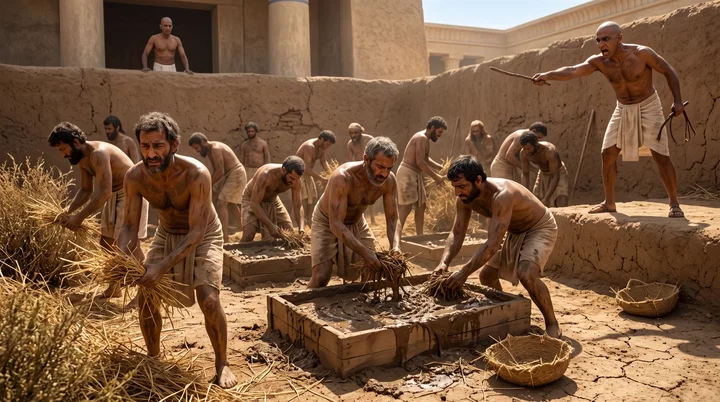
Straw was mixed into sun-dried bricks to bind the earth, and the order forced the people to scatter throughout all Egypt to gather straw and stubble from the fields for themselves.1SP 177.1–180.1ST Mar 4, 1880 Searching for stubble left them unable to perform their usual amount of labor or meet the quota.1SP 177.1–180.1ST Mar 4, 1880 Egyptian taskmasters set over Hebrew officers beat the officers for the shortfall.1SP 177.1–180.1ST Mar 4, 1880 When the officers appealed thinking the oppression came from the taskmasters, Pharaoh hardened his heart, mocked their complaints, repeated the demand with hatred, and sent them back to work with no reduction.1SP 177.1–180.1ST Mar 4, 1880
The harsher burden turned the officers and people against Moses and Aaron for making them abhorred in Pharaoh's sight and putting a sword in his hand to slay them, and it drove Moses to ask God why the people were evil entreated and not yet delivered.1SP 177.1–180.1 Deliverance would not come without a trial of faith and suffering, for Israel expected immediate release, had little faith, and was not yet prepared to patiently suffer and perseveringly endure affliction until God worked a glorious deliverance.1SP 177.1–180.1 The command illustrates the injustice of demanding work without providing what is needed to do it, a burden made harder by withholding necessary resources without reducing the demand and requiring labor to continue even when the means are withheld.Lt 140, 1898, par. 16Lt 140, 1898, par. 8Lt 262, 1899, par. 2–5
Sending missionaries to new fields without the facilities and means their work requires is like requiring bricks to be made without straw.Lt 92, 1902, par. 14–15 Having much work to do with too little money is making bricks without straw.Lt 23, 1905, par. 5 The same principle applies to God's work when people are expected to begin and expand it without adequate means.Lt 2, 1899, par. 14–15 Shortsighted ambition expects work from people without providing the means or fair conditions to do it.18MR 67.2–3 Leaders who tell workers to go forward but provide them with no facilities or help leave them to make bricks without straw.Ms 3, 1897, par. 22 The missionary work in Melbourne was burdened by a lack of resources caused by others' actions, being required to keep producing bricks while denied the straw needed to make them.21MR 359.6–360.1 Being made to carry on with demanding new missionary work despite being deprived of the means to do it when funds were withheld is the same burden.21MR 359.4–5
Sources
Pioneers and periodicals
38 sources
Pharaoh ordered the Israelites to gather straw for themselves wherever they could find it while still demanding the same full daily quota of bricks, withholding a necessary material without reducing the work and thereby making their forced labor harder and more severe.ST Mar 4, 1880ST Jan 25, 1910ST Jan 20, 1909RH Jan 25, 1906ST Nov 27, 1879 This heavier demand was his move to stop the restoration of Sabbath observance, for Moses and Aaron were turning the people from work to rest, and by refusing straw and leaving the fixed quota undiminished he left them no time for idleness or for keeping a day.ST Aug 1, 1911RH Mar 25, 1909ST Apr 28, 1909RH Feb 3, 1852RH Oct 29, 1914 Under such unceasing labor Sabbath-keeping became practically impossible even if desired, and God afterward delivered them with a mighty hand to bring them where they could keep the Sabbath and obey His law in liberty.ST Oct 11, 1883RH Feb 3, 1852RH Oct 29, 1914RH May 16, 1854 Chopped straw found mixed in Egyptian bricks accords with the account, especially at Pithom in Goshen, a treasure city built by Israel where lower courses contain straw and upper courses were made without it, exactly matching the change commanded here.RH Apr 23, 1908RH Nov 27, 1866ST Aug 12, 1913ST Oct 21, 1930RH Jun 25, 1901 By contrast with Pharaoh as a hard master who demands the full tale of bricks without supply, work for God as Father is perfect freedom, for He guarantees strength, supplies all materials, fellowships with His workers, and lays no grievous burden.RH May 17, 1860ST Sep 22, 1881RH Mar 26, 1861 Those who held otherwise taught that the order to get straw with none of the work diminished gives no hint of any trouble over a sacred rest-day.ST Oct 21, 1889
Wording and Historical Setting
The order was to go and get straw wherever it could be found, yet with none of the required work diminished.ST Jan 25, 1910ST Jan 20, 1909ST Nov 27, 1879 By withholding a necessary material without reducing the quota, the demand made the labor harder, and it stands as a severe burden of cruel tasks in Egypt.ST Jan 25, 1910ST Jan 20, 1909ST Nov 27, 1879 The straw was chopped material mixed into sun-dried bricks to bind the earth.ST Mar 4, 1880 Forced to search for stubble while still owing the same fixed daily number of bricks, the workers and their Hebrew officers could not meet the quota, suffered beatings, and the officers were sent back to work with no reduction in the demand.ST Mar 4, 1880
The command did not order brickmaking with no material at all.RH Jan 25, 1906 It only added to the labor by requiring them to gather the straw themselves where they could find it instead of having it brought to hand, while the full quota of work remained undiminished.RH Jan 25, 1906 The verse belongs to the account of forced labor in Egypt and to the first appearance before Pharaoh in Exodus 5 to 8, which resulted in severer oppression of the children of Israel.RH Apr 23, 1908ST Apr 22, 1913 There Moses and Aaron made the reasonable appeal that Israel be released to serve God, which Pharaoh resisted and hardened his own heart.ST Apr 22, 1913 The verse stands before God's repetition of His promises and the plagues of waters turned to blood, frogs, lice, and flies, by which God showed that the gods of Egypt were vanity and that the God of Israel was the true God.
The verse belongs to the history part of Exodus, chapters 1 to 18.RH Jan 20, 1916 That part tells how the family of Israel, comfortable and prosperous in Egypt at the close of Genesis and grown more and mightier than the Egyptians, came into bitter bondage and oppression and relates in detail their great deliverance as they became a nation with thorough organization, efficient leadership, a complete code of laws, and an established form of worship.RH Jan 20, 1916 The book's name means going out, referring to the departure of Israel from Egypt, with the life of Moses from his rescue from Egyptian malice in infancy through his work as chosen leader as its human center.RH Jan 20, 1916 The verse belongs to the opening of Israel in oppression and bondage with the whole power of Egypt set against them, standing opposite the song of triumph beyond the Red Sea with the host of Egypt overthrown.ST Jan 30, 1912 God's saving of Israel out of that bondage was a mighty work of creative power shown over again such as was never done in saving any other nation.ST Jan 30, 1912 After brief prosperity came long and terrible oppression and bitter servitude as the iron furnace foreshadowed to Abraham by horror of great darkness and the smoking furnace in vision, when the children of Joseph, who had been Egypt's saviour and deliverer, were set to brick-kilns after Egypt quickly forgot him and their infants were murdered.RH Dec 17, 1861
Sabbath Conflict in Egypt
The increased burden was Pharaoh's move to stop Israel from keeping the Sabbath, for Moses and Aaron were turning the people away from their work to rest and teaching them to observe the Sabbath.ST Aug 1, 1911RH Mar 25, 1909RH Jun 20, 1912 In contempt for God and His law he refused to furnish straw as before and ordered them to get straw and gather stubble where they could find it, while none of the required work was to be diminished.ST Aug 1, 1911RH Mar 25, 1909ST Apr 28, 1909RH Jun 20, 1912 Joined to the demand to deliver the fixed daily tale of bricks, this left no room to keep a day, so as servants in Egypt they were not allowed to keep the Sabbath.ST Aug 1, 1911ST Apr 28, 1909RH Jun 20, 1912 The added labor was meant to leave them no time for what he regarded as idleness and to stop their efforts to restore Sabbath observance, tightening their bondage after Moses sought their release.ST Aug 1, 1911ST Apr 28, 1909RH Jun 20, 1912
This rigorous servitude with increased labor and full quota kept them in great measure from practically observing God's law, because acceptable worship includes obeying His law.ST Oct 11, 1883 Under the added hardship heaped on them for their attempt at Sabbath observance they murmured and complained most bitterly.ST Oct 11, 1883ST Mar 7, 1906 Their bitter suffering under toil so heavy they could not keep the Sabbath brought their cry to heaven.ST Oct 11, 1883ST Mar 7, 1906RH May 27, 1852
The order to gather their own straw while the required output remained unchanged illustrates a bondage in which Sabbath-keeping was impossible even if desired.RH Feb 3, 1852RH May 16, 1854RH May 27, 1852 Pharaoh required the same full amount of work while forcing the bondmen to find straw for themselves, proving their cruel bondage under unceasing labor.RH Feb 3, 1852RH May 16, 1854RH May 27, 1852 While the other nine commandments might have been kept, the Sabbath could not be kept under such conditions.RH May 16, 1854 God afterward delivered them with a mighty hand and brought them out where they could keep the Sabbath.ST Aug 1, 1911RH May 16, 1854 The time when they had become lax in keeping the Sabbath through hard bondage, with Moses' request for release to serve God and Pharaoh's answer of heavier labor without straw yet with undiminished work, marks the preparation for deliverance from Egypt as a signal for Israel to return to observance of the Sabbath of the Lord.RH Oct 29, 1914RH May 16, 1854
The conflict with Pharaoh over work arose because the Israelites attempted to keep the seventh-day Sabbath and were probably prevented from keeping it while enslaved in Egypt.ST Oct 21, 1889ST Oct 21, 1889 That dispute was not about keeping the first day.ST Oct 21, 1889ST Oct 21, 1889 By contrast, those who held otherwise taught that the record of irritation between Pharaoh and the officers and the Hebrew slaves, ordering them to get straw where they could find it with none of the work diminished, gives no hint or statement of any trouble over a sacred rest-day, which shows Israel did not keep one day and Egypt another.ST Oct 21, 1889
Bondage and Deliverance Meaning
When Israel asked leave to worship God their labor was greatly increased, for they were forced to find their own straw while the full quota of work remained unchanged.ST Oct 11, 1883 This rigorous servitude kept them in great measure from practically observing God's law, because acceptable worship includes obeying His law.ST Oct 11, 1883 Their condition in Egypt was the house of bondage, not liberty, even though they were left without obedience to the law.ST Oct 11, 1883 God brought them out to give them the privilege of obeying and serving Him in a land flowing with milk and honey, speaking the law aloud to the whole multitude and giving it in lasting form to help them enjoy liberty.ST Oct 11, 1883
It was the idolatrous Egyptians persecuting the Hebrews who worshiped the true God, proving that he who is born after the flesh persecutes him who is born after the Spirit and that the wicked persecute the righteous.RH Jun 8, 1916 Israel lay in Egyptian bondage from which God redeemed them with a mighty hand. Their hundreds of years of slavery had unfitted them to comprehend God's great salvation and the character He required. Therefore God gave them a great multiple object-lesson by various forms and rites comprehending the great plan of salvation, instructing Moses to ask free-will offerings of the children of Israel for building and to make Him a sanctuary that He might dwell among them. The withheld straw and doubled labor with unchanged quota are part of the unpaid debt Egypt owed them for their service.ST Mar 18, 1880
Egyptian Bricks Confirm Account
The order to find straw wherever it could be found while the required amount of work remained unchanged is confirmed by the way Israelite bricks were made with straw.RH Apr 23, 1908RH Nov 27, 1866RH Jun 25, 1901 Chopped straw found in Egyptian bricks accords with that account of their manufacture.RH Apr 23, 1908RH Nov 27, 1866 The ruins of Pithom in the land of Goshen confirm it, for Pithom was a square treasure or storage city built by Israel for Pharaoh Rameses II.RH Jun 25, 1901 It was enclosed by walls twenty-two feet thick and filled with vast storage chambers built of brick laid with mortar, with some tiers of brick made with straw and some without straw, exactly matching the commanded change in brick-making.RH Apr 23, 1908RH Jun 25, 1901
Egyptian discoveries include storehouses built by Hebrew slaves in which some lower brickwork contained straw while most bricks were made without it, fitting the bondage account.ST Aug 12, 1913 The command belongs to the historical account of Israelite slaves building the city of Raamses, when Rameses II collected Semites and made them build the city of Raamses-Mera-Amen on the eastern delta of the Nile.ST Oct 21, 1930 Bricks stamped with the name Raamses are found in ancient houses in Pithom, palace pictures show slaves mixing straw and mud, and houses in Pithom are made with strawless bricks.ST Oct 21, 1930
Egyptian pictures and accounts show slaves with Hebrew features making bricks in the same way the Hebrews worked.ST Nov 20, 1884 That brick work went into store cities such as Pithom, built by the children of Israel, whose chief buildings were great brick storehouses without windows or doors for preserving grain for war or famine.ST Nov 20, 1884 Egyptian monuments contain no record of the miracles, because kings do not report their disasters.ST Nov 20, 1884
Moral and Gospel Applications
The verse means hard, close-fisted oppression that lays onerous burdens by demanding the full tale of bricks in haste while forcing the makers to get straw where they can find it, leaving them no time to read or pray, and the same sin appears in modern Pharaohs.RH May 17, 1860 A hard master who makes rapacious demands for more work with cutting reproaches makes a bad servant, stirring up all his evil passions and sinking him lower than he imagined possible, until his strength fails, his arm trembles and his knees grow weak, because discouragement of mind afflicts the body.RH May 17, 1860 To such oppressors Sabbath-keeping doctrines will only be a millstone to sink them in an ocean deep as eternity, while God will speedily pity the oppressed and deliver them from their burdens.RH May 17, 1860 By contrast a kind, good master like Cornelius makes a good servant, with a loving bond in which servants love him and become his solace, his good fortune and his recommendation.RH May 17, 1860
The verse means oppressive exaction of full labor under impossible conditions, demanding the full amount of brick while giving no straw except stubble from the field.RH Sep 23, 1862 The great men of the American republic do the same through slavery, and the people of the North share the guilt by forgetting their brother in bonds and by voting for ambitious men who embrace slavery.RH Sep 23, 1862 For this oppression an awful day of national punishment will surely come, with no mercy except in repentance toward God by withdrawing all aid from slavery, being humbled in sackcloth, having loins girded and God as pavilion and battlement against the hosts of hell.RH Sep 23, 1862 That repentance includes praying for a little respite until the servants of God are sealed to enter the everlasting kingdom of the Lord and His Christ.RH Sep 23, 1862
Even Pharaoh as an embodiment of cruelty and oppression never denied his slaves all means of labor, for his command only added to their labor by requiring them to gather the straw for themselves where they could find it instead of having it brought to their hand, while the full quota of work remained undiminished, rather than commanding labor without the necessary means as the condition of life and welfare.RH Jan 25, 1906 This proves that the infinitely just and benevolent God who commands and necessitates men to labor necessarily grants all men a right to the necessary means and opportunity to labor.RH Jan 25, 1906 Making bricks without straw is work attempted without the needed material, and prospective ministers must not try to do their work in that way.ST Jan 30, 1912 The straw-gathering task also illustrates that people who cannot do the main work can still support those who do it.RH Jan 9, 1872
Being forced to make bricks without straw supplied while the full quota was still demanded, with sighing and crying under the lash of the taskmaster, is the opposite of working for God as Father.ST Sep 22, 1881 He guarantees strength, supplies all materials, fellowships with workers while they work, forgives blunders, and accepts work in quick love, making His service perfect freedom and sheer joy even apart from heaven, a future crown, or final commendation, so His workers should serve cheerfully.ST Sep 22, 1881 To say Christ's commandments are most grievous, His yoke too heavy to be borne, His service beyond the possibility of obedience by any grace received in this life, and His spiritual supply so sparing as to leave famine and starvation, is to make Christ like Pharaoh in this verse as a hard master and cruel slave-holder keeping workers on short allowance, demanding brick without straw and requiring the full tale of work while withholding supply.RH Mar 26, 1861 Christ's true religion is opposite to that, with perfect will, perfect liberty, and a yoke as easy as possible, requiring nothing that love cannot well afford to do.RH Mar 26, 1861
Sources