Translations
American King James Version, American Standard Version
And the Egyptians made the children of Israel to serve with rigor:
King James Version, KJV Cambridge Paragraph Bible, Revised Version
And the Egyptians made the children of Israel to serve with rigour:
And the Egyptians made the children of Israel to serve with rigor.
and the Egyptians cause the sons of Israel to serve with rigour,
And the Egyptians made the children of Israel serve with harshness;
And the Egyptians rigorously made the sons of Israel serve;
Berean Standard Bible, Majority Standard Bible
They worked the Israelites ruthlessly
The Egyptians ruthlessly made the children of Israel serve,
And they gave the children of Israel even harder work to do:
Wherefore the Egyptians by crueltie caused the children of Israel to serue.
Douay-Rheims (Challoner revision)
And the Egyptians hated the children of Israel, and afflicted them and mocked them:
Pictures
Cross-references 20 of 32
- Exodus 3:7
And the LORD said, I have surely seen the affliction of my people which are in Egypt, and have heard their cry by reason of their taskmasters; for I know their sorrows;
God sees and hears Israel’s affliction under Egyptian oppression.
- Genesis 15:13-14
And he said unto Abram, Know of a surety that thy seed shall be a stranger in a land that is not theirs, and shall serve them; and they shall afflict them four hundred years;
Foretells Israel’s oppression in a foreign land and their eventual deliverance.
- Exodus 5:6-19
And Pharaoh commanded the same day the taskmasters of the people, and their officers, saying,
Pharaoh intensifies Israel’s forced labor by withholding straw while keeping the brick quota unchanged.
- Exodus 2:24
And God heard their groaning, and God remembered his covenant with Abraham, with Isaac, and with Jacob.
God hears the Israelites’ groaning under oppression and remembers his covenant.
- Deuteronomy 4:20
But the LORD hath taken you, and brought you forth out of the iron furnace, even out of Egypt, to be unto him a people of inheritance, as ye are this day.
Egypt is called an iron furnace from which God brought Israel.
- Exodus 1:7
And the children of Israel were fruitful, and increased abundantly, and multiplied, and waxed exceeding mighty; and the land was filled with them.
Israel multiplied in Egypt before their growth provoked oppression.
- Exodus 12:31-33
And he called for Moses and Aaron by night, and said, Rise up, and get you forth from among my people, both ye and the children of Israel; and go, serve the LORD, as ye have said.
After the final plague, Pharaoh urges Israel to leave Egypt.
- 1 Kings 8:51
For they be thy people, and thine inheritance, which thou broughtest forth out of Egypt, from the midst of the furnace of iron:
Israel was brought out of Egypt, described as an iron furnace.
- Exodus 1:22
And Pharaoh charged all his people, saying, Every son that is born ye shall cast into the river, and every daughter ye shall save alive.
Both describe Pharaoh’s tyranny against Israel at Moses’ birth.
- Deuteronomy 5:15
And remember that thou wast a servant in the land of Egypt, and that the LORD thy God brought thee out thence through a mighty hand and by a stretched out arm: therefore the LORD thy God commanded thee to keep the sabbath day.
Deliverance from Egyptian bondage is given as a reason for Sabbath observance.
- Jeremiah 11:4
Which I commanded your fathers in the day that I brought them forth out of the land of Egypt, from the iron furnace, saying, Obey my voice, and do them, according to all which I command you: so shall ye be my people, and I will be your God:
Calls Egypt an iron furnace in the account of Israel’s deliverance.
- Genesis 46:6
And they took their cattle, and their goods, which they had gotten in the land of Canaan, and came into Egypt, Jacob, and all his seed with him:
Jacob’s family enters Egypt, beginning the period of Israelite service there.
- Exodus 2:23
And it came to pass in process of time, that the king of Egypt died: and the children of Israel sighed by reason of the bondage, and they cried, and their cry came up unto God by reason of the bondage.
Israel cries to God because of its bondage.
- Exodus 14:21-31
And Moses stretched out his hand over the sea; and the LORD caused the sea to go back by a strong east wind all that night, and made the sea dry land, and the waters were divided.
Israel escapes Egyptian bondage through the Red Sea.
- Acts 7:34
I have seen, I have seen the affliction of my people which is in Egypt, and I have heard their groaning, and am come down to deliver them. And now come, I will send thee into Egypt.
God hears Israel’s groaning in Egypt and comes to deliver them.
- Exodus 1:8
Now there arose up a new king over Egypt, which knew not Joseph.
new king began the rigor
- Acts 7:19
The same dealt subtilly with our kindred, and evil entreated our fathers, so that they cast out their young children, to the end they might not live.
Both describe Egypt’s harsh oppression of Israel.
- Exodus 6:6
Wherefore say unto the children of Israel, I am the LORD, and I will bring you out from under the burdens of the Egyptians, and I will rid you out of their bondage, and I will redeem you with a stretched out arm, and with great judgments:
Promises to free Israel from Egyptian bondage.
- Exodus 6:9
And Moses spake so unto the children of Israel: but they hearkened not unto Moses for anguish of spirit, and for cruel bondage.
Israel’s anguish under cruel bondage reflects their harsh Egyptian oppression.
- Exodus 12:51
And it came to pass the selfsame day, that the LORD did bring the children of Israel out of the land of Egypt by their armies.
Records God bringing Israel out of bondage.
Commentary
Each commentary is drawn from primary sources: the writings of Ellen G. White and Adventist pioneers and periodicals. Each commentary is separate. Its own words are not a quotation; follow the references to read the source passages.
Ellen G. White
7 sources
After Joseph and all his generation died, a new king came to power over Egypt who did not know Joseph.1SP 160.2–162.1 Learning that the children of Israel were able and understanding workmen of great service, he was unwilling to lose their labor and feared that because they were more and mightier they might join his enemies in war.1SP 160.2–162.1 He therefore ranked the free Israelites with the class of slaves who had sold their flocks, their lands, and themselves to the kingdom.1SP 160.2–162.1
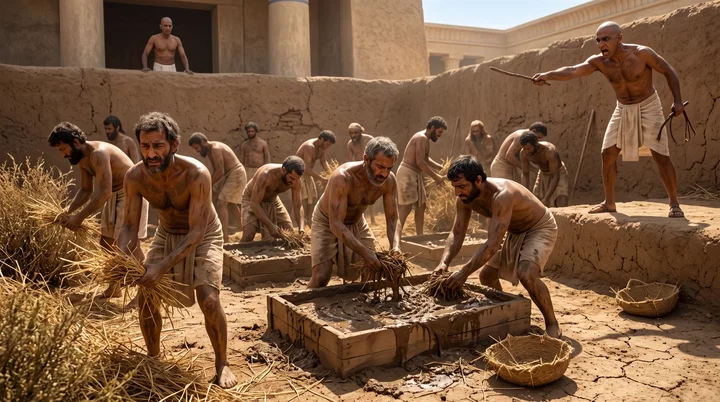
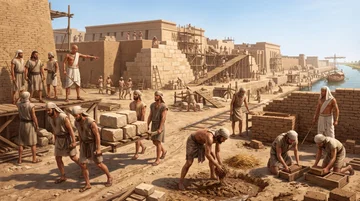
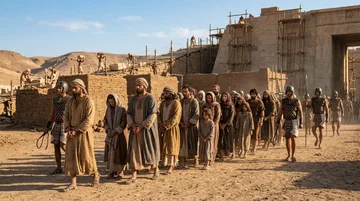
To serve with rigor meant the Egyptians unjustly forced the free Israelites, though they were not slaves, into harsh and complete slave labor.SG3 178.3PP 241.3–41SP 160.2–162.1SG3 191.1–2Ms 83, 1903, par. 9 Taskmasters were set over them to afflict them with burdens and heavy labor.SG3 178.3PP 241.3–41SP 160.2–162.1 Their lives were made bitter with hard bondage in brickmaking, in mortar, and in all manner of service in the field.PP 241.3–41SP 160.2–162.1 They built for Pharaoh the treasure-cities Pithom and Raamses, even their women were compelled to work in the fields as slaves, and daily quotas were imposed upon them.1SP 160.2–162.1 Only enough sustenance was provided to keep them working, while the Egyptians enriched themselves from their extorted labor.SG3 191.1–2
The oppression was intended to subdue the Israelites with hard labor, to crush out their independent spirit, to reduce their numbers, and to destroy them.SG3 178.3PP 241.3–41SP 160.2–162.1SG3 216.2–217.11SP 193.2–194.1 Despite the affliction, the more they were oppressed the more they multiplied and grew.SG3 178.3PP 241.3–41SP 160.2–162.1 The Egyptians were grieved and angry because they could not decrease their numbers.1SP 160.2–162.1
Because harsh labor failed, the Egyptians hardened their hearts to go further, moved by Satan to destroy the male children at birth in order to defeat God's purpose to raise up a deliverer among the Hebrews.1SP 160.2–162.1 The women who feared God saved the male children alive, and the Lord prospered them.1SP 160.2–162.1 Until at last Pharaoh in anger charged all his people to cast every newborn son into the river.1SP 160.2–162.1
The Egyptians oppressed Israel with heavy burdens until God intervened, and the goods Israel received when leaving Egypt were only small compensation for their hard work.SG3 191.1–2 That prior attempt to destroy Israel through forced labor exposes as false Pharaoh's later profession of special interest in Israel's welfare and tender care for their little ones when he would let only the men go.SG3 216.2–217.11SP 193.2–194.1 That claim was pretense to serve his own purpose and keep Israel in bondage, while he charged that God in requiring wives and children to go into the wilderness would only lead them out to destroy them.1SP 193.2–194.1
Sources
Pioneers and periodicals
83 sources
After Joseph and his service were forgotten a new king who feared Israel's fruitfulness set taskmasters over them to afflict them with burdens and made them to serve with rigor.ST Apr 30, 1894RH Mar 9, 1869RH May 14, 1901ST Apr 13, 1904ST Jul 21, 1881 That rigor was a crushing policy meant to use their labor and break their spirit, making their lives bitter with hard service in mortar and brick and field work, chiefly brickmaking for the store cities Pithom and Raamses.RH Jun 25, 1901ST Nov 6, 1901RH Apr 23, 1908ST Apr 30, 1894ST Nov 6, 1901 God allowed idolatrous masters to oppress them because after Joseph's death they had departed to worship Egyptian gods, that distress might turn them back to Him, yet the more they were afflicted the more they multiplied and spread abroad.ST Jun 10, 1880ST Jun 25, 1902ST Jun 11, 1894ST Mar 3, 1898 The bitter toil in the iron furnace left them unable to keep the Sabbath, which had almost fallen into disuse and had to be set forth anew after deliverance made observance possible.RH Feb 3, 1852RH Feb 3, 1852RH May 6, 1852RH May 16, 1854 That rigorous bondage is the bondage of sin, and the deliverance teaches salvation from sin by God's mighty power through faith, for He did not sanction the oppression but demanded release, judged Egypt, and brought Israel out to serve Him in freedom.RH Jun 8, 1916RH Oct 1, 1861ST Nov 23, 1904RH Mar 4, 1902RH May 21, 1908
Egypt's Turn Against Israel
The verse belongs to the account of Abraham's descendants dwelling in Egypt, where during Joseph's time as prime minister and Pharaoh's chief officer they knew no oppression, but after Joseph and his service were forgotten their prosperity ended and harsh cruelty was added to ingratitude in severe servitude.ST Nov 14, 1906RH Mar 9, 1869ST Jul 21, 1881
A new king and dynasty arose over Egypt which knew not Joseph, and seeing Israel fruitful and increased abundantly and multiplied and waxing exceeding mighty till the land was filled with them, he looked with a jealous eye and feared they would become more powerful and would join his enemies in war and go up out of the land.ST Feb 12, 1880ST Apr 30, 1894RH May 14, 1901 Saying come let us deal wisely with them, he set taskmasters over them to afflict them with burdens and to build the store cities Pithom and Raamses, and then made them to serve with rigor and made their lives bitter, while also charging all his people that every newborn son be cast into the river and every daughter saved alive.ST Apr 30, 1894RH May 14, 1901 This conduct of the king who knew not Joseph, also recorded through Stephen in the New Testament, brought Israel under a new dynasty as despised slaves in complete slavery under taskmasters, valued yet feared for numbers and usefulness as skilled workers in mortar and brick and all manner of field service.ST Feb 12, 1880ST Apr 13, 1904 The more they were afflicted the more they multiplied and spread abroad, so that the Egyptians were grieved because of them, yet the persecuting hand of man could not stop the prospering hand of God upon them.ST Feb 12, 1880ST Apr 30, 1894
The reversal was gradual from favor and nourishment with a possession in the best of the land during the seven-year famine, when the Egyptians themselves were left enslaved to Pharaoh, to despised slavery, ignorance and degradation.RH May 14, 1901RH Oct 21, 1862 The policy intending both to use their labor and to break their spirit was carried out during a long period of peace when Pharaoh could repress without fear of their joining an enemy.ST Apr 14, 1887 After Khu-n-Aten a new Nineteenth Dynasty rose on the cry of Egypt for the Egyptians, when Asiatic and Canaanite foreigners who had held high office were driven out or massacred and those who remained in Goshen were reduced to the condition of public slaves, with Israel's rigorous service part of that nationalist subjugation accompanied by decimation through destruction of male offspring.
The bondage is placed as beginning in 1573 B.C., with Moses born two years later and leading Israel out in 1491 B.C., making eighty-two years of slavery.RH May 14, 1901 The Pharaoh of the oppression is identified as Rameses II, who reigned sixty-seven years from 1564 to 1497 B.C. to within six years of the exodus and built the treasure cities Pithom and Raamses, one named for himself, with Seti I also sharing in the work, and who was the king from whose presence Moses fled into Midian.ST Aug 9, 1910RH Aug 24, 1905 Notwithstanding hardships, afflictions, burdens and fearful pressure, the people multiplied and grew from seventy-five souls entering Egypt to about three million departing at the exodus.ST Aug 9, 1910
The affliction had been foretold to Abraham and foreshadowed by the horror of great darkness and the smoking furnace seen in vision, and it had to occur because his descendants could not yet possess the promised land until the iniquity of the Amorites was full and the time came for God to bring them out by His power.RH Aug 11, 1863RH Dec 17, 1861ST Dec 28, 1876 Cruel taskmasters almost daily increased burdens, refusing necessary straw yet requiring the full tale of bricks, with decrees putting the male children to death, and this rigor continued until God saw the affliction and heard the cry by reason of the taskmasters.RH Aug 11, 1863 The policy was shrewd and wicked but not wise because it fought against God, for He made the hard service strengthen them physically and used it to increase their numbers and work out salvation.ST Apr 30, 1894 The hatred went so far as to destroy all the male children in a Satanic plan to destroy Israel as the promised seed, to keep them enslaved or destroy them and thus thwart the promise and defer the plan of salvation, but God was with His people.ST Apr 30, 1894ST Nov 7, 1906 The affliction accomplished what ease and worldly prosperity could not, for Israel never would have left Egypt had they lived in ease, and the decrees against their sons left them no alternative but to flee toward Canaan.RH Aug 11, 1863
Meaning of Rigorous Service
The word rendered rigor is rare, rooted in a term meaning to break in pieces or crush, and it denotes crushing labor imposed to use Israel's strength while breaking their spirit.ST Apr 14, 1887ST Nov 6, 1901ST Nov 6, 1901 It expressed hatred that appeared after affliction only multiplied Israel, so that the Egyptians were grieved because of them.ST Apr 30, 1894 That policy was carried out during a long period of peace, when Pharaoh could repress them without fear that they would join an enemy.ST Apr 14, 1887 It meant heavy burdens, savage whips, exposed and beaten backs, poor food, and suffering too great to be borne.ST Nov 6, 1901ST Nov 6, 1901
The rigorous service made their lives bitter with hard service in mortar and in brick and in all manner of service in the field, principally brick-making for the store cities.RH Jun 25, 1901ST Nov 6, 1901 It followed the setting of taskmasters over them to afflict them with burdens and to build Pithom and Raamses.ST Nov 6, 1901 The work included building the storage city of Pithom with brick and mortar, whose ruins and names correspond to the account, with some bricks made with straw and others without.RH Jun 25, 1901 When they sought relief to worship God, Pharaoh made the bondage worse by requiring them to gather their own straw while still producing the same tale of bricks, in order to crush their desire for liberty.RH Apr 23, 1908
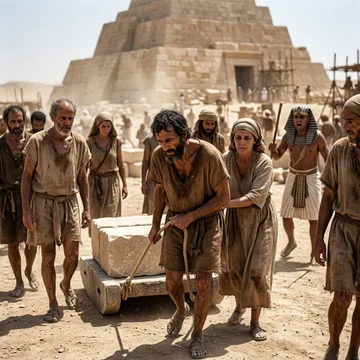
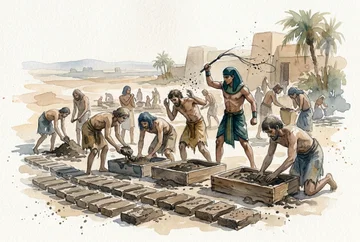
The toil embraced every kind of work required by the building plans, including quarrying huge blocks of granite and limestone, dragging them overland to their destinations, loading rafts and piloting them down the Nile, digging canals, mixing mortar, making bricks, erecting countless buildings always in progress, and all manner of field service besides, including painfully lifting Nile water into canals and up to the fields through long days under the burning sun.RH Apr 23, 1908ST Apr 14, 1887 They dragged huge stone masses and blocks ten by six cubits for a month at a time over soft yielding garden soil with no machinery and little mechanical help, wearing out the arms of the workmen.ST Apr 14, 1887 They labored as forced gangs like beasts of burden under overseers armed with sticks who beat their naked backs and shoulders and exacted a fixed daily task from each laborer, with food supplied by the government but a mixture of all things vile, washing allowed only once in a season, and driving by pitiless taskmasters until thousands fell worn out and died.RH Apr 23, 1908ST Apr 14, 1887ST Apr 14, 1887 This system bore especially hard under Seti I and Rameses II because of great building works, as shown by tomb pictures of Asiatic captives making bricks under the rod, and the same cruelty marking Egypt in all ages was seen in this century when thirty thousand men died digging the Mahmoudieh Canal by hand without picks or spades or wheelbarrows, leaving the Hebrews groaning under starvation and beating while looking above for punishment of their oppressors.RH Apr 23, 1908ST Apr 14, 1887 After the Syrian wars ended prisoners of war were too few to supply labor for works more numerous than those of all the other kings of Egypt for two thousand years, so all the population that could be ventured to be enslaved were driven off as forced laborers, the Hebrews among the other Semitic foreign tribes settled in the Delta, to toil in brickfield, quarry, and temple precincts under blows and privations too great for human endurance.ST Apr 14, 1887
Their long service enriched Egypt while they received no just return, and the later request for Egyptian valuables was partial repayment of wages owed.RH Mar 17, 1874 Their toil and suffering supplied the labor used to build the great monuments of Pharaoh Ramses and to serve his ambition for personal glory.ST Aug 27, 1902 They were made to work in brickyards on the enlargement of the treasure cities Pithom and Rameses, where taskmasters beat them, and the oppression became so severe that the Israelites rebelled.ST Aug 11, 1909 Thus the Egyptians subjected Israel to complete, degrading, grievous slavery under cruel taskmasters, forcing harsh labor to an almost intolerable degree marked by severe cruelty and injustice, including tyranny already in force when Moses was born, from which he was preserved as a special object of providential care through loving, God-fearing parents.RH Jan 20, 1916ST Jan 28, 1913RH Dec 30, 1858 The oppression did not stop them from multiplying and growing, and it continued until God intervened to deliver them.ST Jan 28, 1913ST Dec 14, 1915RH Dec 30, 1858
Labor Cities and Archaeology
The rigorous service was principally brick-making for the store-cities Pithom and Raamses.RH Apr 23, 1908ST Nov 6, 1901 Those cities stood in Goshen near Egypt's eastern frontier and held grain and weapons.ST Nov 6, 1901 They were square, thick-walled store-cities of brick, with solid chambers laid with mortar in regular tiers and entered by trap-door for storage.RH Apr 23, 1908
Pithom, called Pa-Tum and Pi Tum, also called Succoth, lies uncovered at Tel-el-Maskoutah as a square about 650 feet to a side with 22-foot outer walls and 8 to 10-foot chamber walls.RH Apr 23, 1908ST Nov 6, 1901 Its ruins and the names of Pithom and its builder Rameses II correspond to the biblical account.RH Jun 25, 1901 That identification is linked by inscriptions showing that he built Pithom.RH Apr 23, 1908RH Aug 24, 1905 The labor there was work in mortar for Pharaoh, making lives bitter through hard bondage.RH Jun 25, 1901RH Apr 23, 1908
The chambers contain bricks generally mixed with straw but in some instances destitute of it, with straw becoming scarce and eventually replaced by rushes and water plants, showing changing materials when straw was withheld.RH Apr 23, 1908ST Nov 6, 1901 This fits depictions of slaves making bricks from straw and mud, and tomb pictures of Asiatic captives making bricks under the rod.ST Oct 21, 1930ST Nov 6, 1901 It fits archaeological evidence of Semites being made to build the city of Raamses for Rameses II, and bricks made without straw at Pithom.ST Oct 21, 1930
Direct mention of the events of the first fourteen chapters of Exodus is not found in the historical records on public monuments because nothing was ever registered there except successes and triumphs.RH Apr 23, 1908 King and court historians would not record the terrible plagues suffered during a whole year or the disaster of the Red Sea.RH Apr 23, 1908 But forced labor, including the employment of the Hebrews among the forced laborers and the method of its employment, is a point of the narrative that admits comparison with the records of the time.RH Apr 23, 1908 Egyptian inscriptions corroborate and help illuminate the Pentateuch account of Joseph and the exodus as part of Egyptian history.ST Jul 30, 1885 An Egyptian stele mentioning Israel in Egypt confirms that account, and physical evidence of that forced work still exists.RH Jan 20, 1916RH May 13, 1909 Their brickmaking has been compared with forced labor used in Egypt under the Khedive.RH May 1, 1879
The oppression begins the first, mainly historical division of Exodus in chapters 1-18, which opens with the birth and upbringing of Moses until he is called to be the deliverer. More specifically chapters 1 to 4 give Israel in bondage, the chosen deliverer, waiting, the call, and Aaron.RH Jan 20, 1916 Israel's slavery in Egypt was a literal historical event, as were the plagues on Egypt and the deliverance through the Red Sea, and this real early history in the five books of Moses is not done away.ST Jan 3, 1884RH Nov 26, 1861 It places forced labor under Pharaoh in Egypt, not under Herod, for Pharaoh lived nearly fifteen centuries before Herod, who ruled in Syria. It belongs to the history of bondage and great deliverance that Jesus learned from the Old Testament as a child.ST Aug 13, 1912 In that history Moses saved in infancy from the decree against the Hebrew children is likened to a later infant deliverance from Herod's sword.ST Aug 13, 1912
God's Purpose in Affliction
After Joseph's death his descendants departed from the God of their fathers to worship Egyptian gods, seduced into idolatry, forgetting the meaning of the early offerings and largely losing knowledge of God and Christ.ST Jun 10, 1880ST Jun 25, 1902ST Mar 3, 1898 God allowed idolatrous masters to oppress them in harsh service so that in distress they would recognize the folly of their course, turn to Him, and choose His righteous and merciful rule and obey His requirements.ST Jun 10, 1880ST Jun 25, 1902 The life of bondage was never part of God's covenant of promise with Abraham but came because they did not keep the covenant of which circumcision was a sign and did not keep God's law in mind.RH Jan 16, 1900 Had they kept the covenant and kept God's law in mind they would never have suffered that slavery, and there would have been no need for the law to be proclaimed from Sinai or engraved on tables of stone.RH Jan 16, 1900
The oppression marked the end of their prosperity in Egypt after Joseph and his service were forgotten, when ingratitude was joined to harsh cruelty and severe servitude.RH Mar 9, 1869RH Aug 11, 1863RH Mar 9, 1869 The affliction accomplished what ease and worldly prosperity could not, for Israel never would have left Egypt had they lived in ease, but the degrading slavery stirred them to leave Egypt's prosperity and undertake the wilderness journey to Canaan whose return they expected.RH Mar 9, 1869RH Aug 11, 1863RH Mar 9, 1869 God used the king's cruelty to advance that purpose, seeking to keep them from leaving, and the decrees putting their male children to death left them no alternative but to flee.RH Aug 11, 1863RH Mar 9, 1869 The rigor continued with cruel taskmasters almost daily increasing burdens, refusing necessary straw yet requiring the full tale of bricks, until God saw their affliction and heard their cry by reason of their taskmasters.RH Aug 11, 1863
When they seemed forgotten by God His providence over them was especially manifested in increase of number and preservation of life under great trial as part of the making of a nation.ST Jun 11, 1894ST Jan 28, 1913 Passing under a new dynasty they were treated as despised slaves and forced into harsh service, yet the persecuting hand of man could not stop the prospering hand of God upon them, and oppression did not stop them from multiplying and growing and spreading abroad.ST Feb 12, 1880ST Jan 28, 1913 The policy was shrewd and wicked but not wise because it fought against God, reaching even to hatred that sought to destroy all the male children in Satan's plan to destroy Israel as the promised seed and defer salvation, yet God was with His people and made tribulation work out salvation for them.ST Apr 30, 1894 He made the hard service strengthen them physically and used it as a means of increasing their numbers, from seventy-five souls entering Egypt to about three million departing at the exodus, fulfilling His promise to bring them out and using permitted trials for character development.ST Feb 12, 1880ST Aug 9, 1910ST Apr 30, 1894
Their grievous bondage under severe cruelty and injustice reached an almost intolerable degree before God intervened to deliver them.RH Dec 30, 1858 God had seen their affliction for a long time, with harsh labor under cruel taskmasters driving with the lash already before Moses was born, but deliverance waited for the right time when a leader had been prepared and the people were ready to leave Egypt in God's way.RH Aug 11, 1863ST Nov 27, 1901 The events humbled them and prepared them to receive the law and build the sanctuary, though after mighty deliverance with a mighty hand they soon rebelled, murmured, and worshiped the golden calf.RH Oct 17, 1854 God allowed the condition for a time but did not sanction it and did not present it as a divinely protected institution: He demanded release, judged the Egyptians when they refused, led Israel out, and drowned the pursuers in the Red Sea.RH Oct 1, 1861RH Oct 13, 1859 The cruel oppression of Hebrews who worshiped the true God, despite the wisdom, goodness, and power shown to Egypt, illustrates that the wicked persecute the righteous, a spirit still found among those with even greater light.ST Dec 25, 1901RH Jun 8, 1916
Sabbath Covenant and Worship
The cruel bondage in the iron furnace of Egyptian servitude forced harsh labor upon Israel and left them unable to keep the Sabbath while enslaved.RH Feb 3, 1852RH Feb 3, 1852RH May 6, 1852RH May 27, 1852RH May 27, 1852 Even if they had wished to observe it, their harsh bondage prevented them, and deliverance alone made observance possible again.RH May 16, 1854RH May 27, 1852RH May 27, 1852 In such bitter suffering and severe forced labor they were not in a situation to observe the Lord's rest day, and keeping it was difficult if not impossible.RH Feb 3, 1852RH Feb 3, 1852RH May 6, 1852RH May 27, 1852
After a century of abject servitude the Sabbath, like other divine ordinances, had almost or entirely fallen into disuse.RH Feb 3, 1852RH May 6, 1852RH Dec 11, 1856 As circumcision fell into total disuse during forty years in the wilderness, so Sabbath keeping could likewise lapse under Egyptian oppression.RH Feb 3, 1852 Prolonged oppression therefore made it necessary for God to set the Sabbath forth solemnly and enforce it again.RH Feb 3, 1852RH May 6, 1852 That no permission is recorded for setting aside the Sabbath during the captivity does not mean God repealed the ordinance or formally suspended it.RH Dec 11, 1856
The rigor deprived Israel of the rest of the holy Sabbath unto the Lord as a result of their own apostasy.ST Jun 25, 1902 When God broke the Egyptian yoke from their necks He brought them out of darkness into His marvelous light to serve Him, setting them free to obey His law instead of Egyptian law, and Christ Himself liberated them so they would be free indeed.ST Jun 25, 1902 The Sabbath then restored in the wilderness was not a new day but the same seventh day blessed and sanctified at creation and rehearsed a few weeks later at Sinai.ST Jun 25, 1902 Hundreds of years of slavery had left them unable to understand God's salvation and the character He required, yet God preserved His truth through that enslaved nation made to serve harshly.ST Feb 20, 1907
Prophecy Types and Deliverance
The rigorous bondage in Egypt is the bondage of sin, and the deliverance from it teaches salvation from sin through faith in the saving power of God, which is the power of righteousness.RH May 21, 1908 Human power cannot deliver from the power of sin, but salvation comes only by the mighty power of God.RH May 21, 1908 The faith shown by Moses and his people makes known salvation by faith, the gospel of righteousness by faith, which is the same vital truth in the threefold gospel message proclaimed in this generation as the only sufficient means of deliverance from the bondage of sin.RH May 21, 1908
The history of bondage and deliverance has a double fulfillment, for its primary fulfillment was in God's ancient people but its emphatic meaning reaches events to transpire either under the gospel or at the close of this dispensation.RH Sep 17, 1872 There is a sudden transition from type to antitype that must be carefully distinguished, lest what belongs to the antitype be applied to the type.RH Sep 17, 1872 Those living in the Christian dispensation therefore have a special interest in what applied primarily and typically to the Jews.RH Sep 17, 1872
Israel's labor troubles in Egypt, as dependence on land owned by others descended into tyrannical slavery under harsh forced labor, are a type of the modern conflict between capital and labor.RH Nov 24, 1904ST Nov 23, 1904 The oppression of God's people there foreshadows persecution of commandment keepers in the closing conflict.RH Nov 24, 1904 The harsh treatment of the Israelites by the Egyptians was also an enforcement of law.
God delivered Israel from rigor under a hard master that made their lives bitter with hard bondage, not for idleness but to serve still, under a different Master and in a different kind of service.RH Mar 4, 1902 Israel is His son, His firstborn, let go that he may serve Him.RH Mar 4, 1902 The service of the Lord is opposite to the service of Egypt, for the Lord is good to all, gracious and full of compassion, to be served with gladness and singing by His own whom He made.RH Mar 4, 1902 That deliverance defended their right to leave that labor and return to the land God had given them, where they could unite their own work with their own land and be free.ST Nov 23, 1904
Egypt's attempt to keep Israel enslaved or destroy them, joining oppression in Egypt with the king's order to kill the Israelite boys, sought to thwart the promise carried through that people and to prevent the promised restoration of the Lord's usurped territory in Palestine.ST Dec 22, 1898ST Nov 7, 1906 God preserved the people so the promised Seed, Jesus Christ, could be born in the land promised to Abraham.ST Dec 22, 1898 Moses resisted Pharaoh's despotism in forcing harsh service and maintained his integrity before God, and God upheld his cause and delivered Moses and the people from Egypt.
Warnings for Later Oppression
The harsh forced labor laid on Israel exposes the selfishness and cruelty at the heart of slavery.RH May 1, 1866RH May 10, 1864STST Mar 11, 1880 Slaveholders in the South who resisted emancipation hardened their hearts and clung to power over the enslaved just as Pharaoh did, and only God could break such relentless oppression and set the captives free.RH May 1, 1866 That bondage under hard taskmasters is a picture of the bondage of enslaved Black people in the United States, with Moses raised up as deliverer for Israel and Abraham Lincoln raised up as deliverer for the slaves.RH May 10, 1864 Oppression begun in hard service brings plagues and woes upon the oppressing land until deliverance comes.RH May 10, 1864
Pharaoh's rigor stands as a measure of despotism, raising the question whether the Union army was shielding the country from a military despotism even worse than his.RH Sep 23, 1862 The Hebrews entered Egypt in great favor with its rulers and were brought only step by step into rigorous bondage and into the ignorance and degradation in which deliverance found them, not by a knowing choice to disobey God.RH Oct 21, 1862 A Sabbath-keeper with clear light that war violates God's law is therefore in a different position and cannot plead Egypt as a parallel to excuse Sabbath-breaking and killing after being drafted into the army.RH Oct 21, 1862 The sole exception is one converted after joining, who may remain until he can obtain an honorable discharge.RH Oct 21, 1862
The seed of Abraham were long the subjects of Pharaoh yet did not frame their religion to suit his tastes.ST May 28, 1912 Right religion takes its origin and authority from the eternal God alone and not from princes, who of all others are often the most ignorant of true religion.ST May 28, 1912 By holding a religion different from their ruler's they kept true religion alive in the world.ST May 28, 1912 Subjects owe reverence to princes but are not bound to their princes' religion.ST May 28, 1912 Pharaohs who set themselves against God's plans and precepts are remembered with infamy, while God's word stands.ST Jul 15, 1908
The children bound in abject misery under the lash picture a world now full of slaves in misery just as abject.RH May 12, 1903 Christians are given the individual work of liberating them with truth, and that work calls for an army of trained liberators with children prepared as future missionary workers.RH May 12, 1903 The same harsh bondage serves as a measure for a still worse bondage in the loss of one person's mind and will under another's control.ST May 4, 1904 It also portrays a spiritual bondage that is even worse.ST Oct 11, 1883
Sources