Exodus 5:1
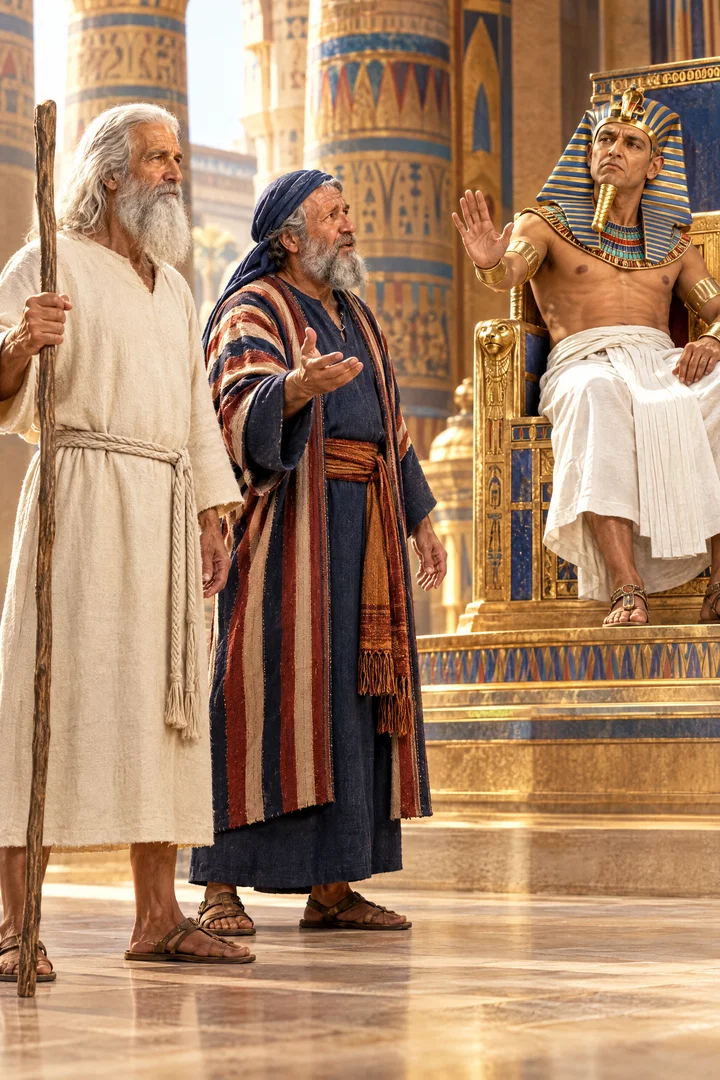
And afterward Moses and Aaron went in, and told Pharaoh, Thus saith the LORD God of Israel, Let my people go, that they may hold a feast unto me in the wilderness.
Translations
And afterward Moses and Aaron went in, and told Pharaoh, Thus says the LORD God of Israel, Let my people go, that they may hold a feast to me in the wilderness.
And afterward Moses and Aaron went in, and told Pharaoh, Thus saith the LORD God of Israel, Let my people go, that they may hold a feast unto me in the wilderness.
And afterward Moses and Aaron went in, and told Pharaoh, Thus saith the Lord God of Israel, Let my people go, that they may hold a feast unto me in the wilderness.
And afterward Moses and Aaron went in, and told Pharaoh, Thus saith the LORD God of Israel, Let my people go, that they may hold a feast to me in the wilderness.
And afterward Moses and Aaron came, and said unto Pharaoh, Thus saith the LORD, the God of Israel, Let my people go, that they may hold a feast unto me in the wilderness.
And afterward Moses and Aaron came, and said unto Pharaoh, Thus saith Jehovah, the God of Israel, Let my people go, that they may hold a feast unto me in the wilderness.
And afterwards have Moses and Aaron entered, and they say unto Pharaoh, 'Thus said Jehovah, God of Israel, Send My people away, and they keep a feast to Me in the wilderness;'
And afterwards Moses and Aaron went in, and said to Pharaoh, Thus saith Jehovah, the God of Israel, Let my people go that they may celebrate a feast to me in the wilderness.
And afterwards, Moses and Aaron went in and said unto Pharaoh,—Thus, saith Yahweh God of Israel, Let my people go, that they may hold a festival to me in the desert.
Berean Standard Bible, Majority Standard Bible
After that, Moses and Aaron went to Pharaoh and said, “ This is what the LORD, the God of Israel, says: ‘ Let My people go, so that they may hold a feast to Me in the wilderness.’”
Afterward Moses and Aaron came, and said to Pharaoh, “ This is what the LORD, the God of Israel, says, ‘ Let my people go, that they may hold a feast to me in the wilderness.’”
And after that, Moses and Aaron came to Pharaoh, and said, The Lord, the God of Israel, says, Let my people go so that they may keep a feast to me in the waste land.
Then afterwarde Moses and Aaron went and said to Pharaoh, Thus saith the Lord God of Israel, Let my people go, that they may celebrate a feast vnto me in the wildernesse.
Douay-Rheims (Challoner revision)
After these things Moses and Aaron went in, and said to Pharao: Thus saith the Lord God of Israel: Let my people go that they may sacrifice to me in the desert.
Pictures
Cross-references 20 of 31
- Exodus 8:1
And the LORD spake unto Moses, Go unto Pharaoh, and say unto him, Thus saith the LORD, Let my people go, that they may serve me.
Repeats the demand to release Israel to serve God.
- Exodus 3:14
And God said unto Moses, I AM THAT I AM: and he said, Thus shalt thou say unto the children of Israel, I AM hath sent me unto you.
Moses and Aaron speak to Pharaoh in the name of I AM.
- Exodus 7:10-12
And Moses and Aaron went in unto Pharaoh, and they did so as the LORD had commanded: and Aaron cast down his rod before Pharaoh, and before his servants, and it became a serpent.
Aaron's rod becomes a serpent and swallows the magicians' rods.
- Genesis 15:13-14
And he said unto Abram, Know of a surety that thy seed shall be a stranger in a land that is not theirs, and shall serve them; and they shall afflict them four hundred years;
Foretells Israel’s Egyptian bondage and deliverance from Egypt.
- Hebrews 11:27
By faith he forsook Egypt, not fearing the wrath of the king: for he endured, as seeing him who is invisible.
Moses’s bold demand reflects enduring by faith as he saw the invisible God.
- Exodus 4:23
And I say unto thee, Let my son go, that he may serve me: and if thou refuse to let him go, behold, I will slay thy son, even thy firstborn.
God tells Pharaoh to release Israel so they can serve him.
- Exodus 7:13
And he hardened Pharaoh’s heart, that he hearkened not unto them; as the LORD had said.
Pharaoh hardens his heart against the demand to release Israel.
- Exodus 3:18
And they shall hearken to thy voice: and thou shalt come, thou and the elders of Israel, unto the king of Egypt, and ye shall say unto him, The LORD God of the Hebrews hath met with us: and now let us go, we beseech thee, three days’ journey into the wilderness, that we may sacrifice to the LORD our God.
God instructed Moses to ask Pharaoh for a wilderness journey to worship.
- Exodus 10:3
And Moses and Aaron came in unto Pharaoh, and said unto him, Thus saith the LORD God of the Hebrews, How long wilt thou refuse to humble thyself before me? let my people go, that they may serve me.
Moses and Aaron repeat the demand that Pharaoh let God’s people go.
- Exodus 8:20
And the LORD said unto Moses, Rise up early in the morning, and stand before Pharaoh; lo, he cometh forth to the water; and say unto him, Thus saith the LORD, Let my people go, that they may serve me.
The demand to Pharaoh to let the people go is repeated.
- Exodus 12:31-33
And he called for Moses and Aaron by night, and said, Rise up, and get you forth from among my people, both ye and the children of Israel; and go, serve the LORD, as ye have said.
Pharaoh urgently releases Israel, fearing the consequences of refusing the command.
- Exodus 3:7
And the LORD said, I have surely seen the affliction of my people which are in Egypt, and have heard their cry by reason of their taskmasters; for I know their sorrows;
God hears Israel’s suffering before sending Moses to demand their release.
- Exodus 4:27-31
And the LORD said to Aaron, Go into the wilderness to meet Moses. And he went, and met him in the mount of God, and kissed him.
Aaron meets Moses, and they deliver God’s message to Israel.
- Exodus 6:11
Go in, speak unto Pharaoh king of Egypt, that he let the children of Israel go out of his land.
God sends Moses to renew the demand that Pharaoh let Israel go.
- Isaiah 11:16
And there shall be an highway for the remnant of his people, which shall be left, from Assyria; like as it was to Israel in the day that he came up out of the land of Egypt.
The later recovery of God’s people is compared to the Exodus.
- Exodus 2:23-24
And it came to pass in process of time, that the king of Egypt died: and the children of Israel sighed by reason of the bondage, and they cried, and their cry came up unto God by reason of the bondage.
Israel’s cries rose to God, who remembered his covenant before sending Moses and Aaron.
- Exodus 10:7
And Pharaoh’s servants said unto him, How long shall this man be a snare unto us? let the men go, that they may serve the LORD their God: knowest thou not yet that Egypt is destroyed?
Egypt is laid waste before Pharaoh will release Israel.
- Exodus 20:2
I am the LORD thy God, which have brought thee out of the land of Egypt, out of the house of bondage.
Both texts contrast Egypt’s bondage with freedom to serve and obey God.
- Exodus 5:8
And the tale of the bricks, which they did make heretofore, ye shall lay upon them; ye shall not diminish ought thereof: for they be idle; therefore they cry, saying, Let us go and sacrifice to our God.
'they be idle' shows Pharaoh opposed that Sabbath rest.
- Exodus 7:5
And the Egyptians shall know that I am the LORD, when I stretch forth mine hand upon Egypt, and bring out the children of Israel from among them.
God’s acts in Egypt would make the Egyptians know that He is Jehovah.
Commentary
Each commentary is drawn from primary sources: the writings of Ellen G. White and Adventist pioneers and periodicals. Each commentary is separate. Its own words are not a quotation; follow the references to read the source passages.
Ellen G. White
11 sources
Moses and Aaron went into Pharaoh's palace as God's representatives and ambassadors of the King of kings, speaking with divine authority in the name of the great I AM and delivering God's command to release Israel as His people to hold a feast to Him and worship Him in the wilderness.1SP 177.1–180.1SG3 197.1ST Mar 4, 1880PP 257.2–4RH Dec 21, 1911 The request itself was modest, asking only for a three days' journey into the desert to sacrifice to the Lord.1SP 177.1–180.1SG3 197.1 It carried the warning lest He fall upon them with pestilence or with the sword.SG3 197.1
Their divine commission included going before the profligate king in person and in the name of the great I AM rebuking his cruelty and oppression, unlike Paul when confined to his own dwelling, who had no such command to go before the king.RH Dec 21, 1911 Pharaoh haughtily refused to obey, asking who the Lord was that he should obey His voice and professing not to know the God of Israel.1SP 177.1–180.1SG3 197.1PP 333.1 That question did not come from genuine ignorance of the true God but from hatred and defiance of God's power.PP 333.1
By this demand God purposed to let Pharaoh know that His voice must be obeyed, that He is above all, and that He will compel proud rulers to bow to His authority.1SP 177.1–180.1SG3 197.1 The power with Moses was not human influence or power over minds but the power of God, shown in signs and wonders to convince Pharaoh that the great I AM had sent him. Israel was not yet ready for deliverance after four hundred years in Egypt and slavery, having lost the knowledge of God, largely forgotten His law and neglected the Sabbath.SG3 197.1FE 287.1Ms 10, 1894, par. 17–19PP 257.5–258.2 Many lacked faith, feared the hardships of leaving for a strange land, let their habits become like the Egyptians, preferred Egypt, and expected to be freed from bondage without any particular trial of faith or suffering on their part.SG3 197.1PP 260.2
God therefore used the first demand and Pharaoh's response to expose the king's tyranny and to reveal His own justice, power, and love, so that the people would choose to leave Egypt and serve Him.PP 260.2 The demand called them from bondage to worship and obedience, reflecting the principle that obedience to God comes before deliverance.Ms 10, 1894, par. 17–19PP 257.5–258.2 The purpose of the release was that they might obey God's laws and keep the Sabbath instituted in Eden, which they had neglected and which efforts to restore brought to the notice of their Egyptian oppressors.FE 287.1Ms 10, 1894, par. 17–19PP 257.5–258.2 God later spoke the Ten Commandments to them at Sinai so they would recognize the law's sacred, enduring authority and teach its binding claims to their children.FE 287.1
Moses' work of breaking the yoke of bondage that Israel might serve God prefigured Christ's first advent to break Satan's power over the human family and deliver those made captives by him. Satan opposed the mission because he was unwilling for Israel to be released to serve God, working to harden Pharaoh against God's manifestations, to stagger the faith of Moses and Aaron in the divine origin of their mission, and to destroy the influence of God's work by counterfeiting it through his agents the magicians. That counterfeit work would reach down through all ages to destroy faith in the miracles of Christ. God's call of Israel out of Egypt to worship Him and keep His Sabbath parallels His call for His people to come out of Babylon, refuse worship of the beast and its image, and reject the false Sabbath that has replaced God's memorial.2MR 228.2–3
Sources
Pioneers and periodicals
76 sources
Thus says the Lord God of Israel commands Pharaoh through Moses and Aaron to release Israel to go into the wilderness to hold a feast and serve Him.ST Mar 4, 1880ST Nov 14, 1906ST May 11, 1891 It was a reasonable, kind and merciful first demand, showing the justice and forbearance of Jehovah, the self-existent covenant God, toward both Israel and Egypt.ST Apr 22, 1913ST Feb 4, 1913ST Mar 18, 1889ST Dec 28, 1888 The feast meant liberty to worship the true Creator and obey His law, and above all to rest from bondage on the seventh-day Sabbath which Israel had known but under hard taskmasters had grown lax in keeping.ST Aug 1, 1911RH Mar 25, 1909ST Dec 20, 1905ST Jun 16, 1887RH Jun 20, 1912 Pharaoh answered who is Jehovah that he should obey, hardened his heart and laid heavier burdens to prevent the Sabbath-keeping, until increasingly severe plagues culminating in the death of the firstborn broke his resistance and then his renewed pursuit ended with his army drowned and his kingdom laid waste.ST Aug 1, 1911ST Dec 28, 1888RH Feb 12, 1901RH Sep 27, 1870ST Aug 27, 1902 Moses and Aaron pressed the demand again and again as representatives of a mightier King, refusing to yield Pharaoh's law in order to obey God's command, proving rulers must not be obeyed when obedience would violate God's law.ST Feb 25, 1889ST Jun 16, 1887ST Feb 16, 1882ST Aug 13, 1885
Narrative Setting in Exodus
Exodus 5:1 opens the interviews of Moses and Aaron with Pharaoh that lead into the contest with the magicians and the warnings and plagues.ST Jan 25, 1910 It records their first appearance before Pharaoh with the demand that Israel be released to hold a feast to the Lord in the wilderness, a demand that brought severer oppression upon the children of Israel.ST Jan 25, 1910 That demand was followed by God's repetition of His promises and by the first plagues of waters turned to blood, frogs, lice, and flies.RH Jan 20, 1916 Those plagues stood at the beginning of the warnings and plagues in Exodus 5 to 8 and began Israel's deliverance from bitter bondage.ST Jan 25, 1910RH Jan 20, 1916
The verse belongs to the history section of Exodus, chapters 1 to 18, which tells the story of Israel's great deliverance from bitter bondage and oppression in Egypt.RH Jan 20, 1916ST Jan 30, 1912 Moses acts here as the chosen leader demanding the departure from Egypt, the going out that gives the book its name.RH Jan 20, 1916 That going out begins how Israel became a nation with thorough organization, efficient leadership, a complete code of laws, and an established form of worship.RH Jan 20, 1916 It stands at the beginning when Israel lay under oppression and bondage with the whole power of Egypt set against them, in contrast to the song of triumph on the farther side of the Red Sea with the host of Egypt overthrown.ST Jan 30, 1912 The mighty work God did in saving them between those two points was creative power shown over again, such as was never done in the saving of any other nation.ST Jan 30, 1912
The events belong to Egypt three and one-half millenniums ago when it ruled the world as the greatest of all kingdoms, acknowledged for might and power and skill and wisdom in statecraft.ST Nov 14, 1906 Egypt deified her annually overflowing and fertilizing river as one of her gods and worshiped the sun that joined with the river in producing food.ST Nov 14, 1906 From that sun her kings received their title as representative of the sun-god upon the throne of men.ST Nov 14, 1906 The people Moses and Aaron claim for the Lord God of Israel are the few descendants of the nomadic patriarch Abraham who sought supplies from her granaries.ST Nov 14, 1906 They knew no oppression while Joseph the captive slave was prime minister, who taught Pharaoh how to store grain in plenteous years to become rich in famine and who instituted one of the best land-laws the world has known with easy combined rental and taxes.ST Nov 14, 1906 As long as his memory was honored and his laws governed, Egypt prospered and the people in Egypt prospered.ST Nov 14, 1906
That brief prosperity for Abraham's family in Egypt was followed by long and terrible oppression, the bitter servitude and iron furnace foreshadowed to Abraham by the horror of great darkness and the smoking furnace.ST Nov 14, 1906RH Dec 17, 1861 The family had to go down into Egypt to endure it before they could possess the land designed for them when the iniquity of the Amorites was full.RH Dec 17, 1861 The Exodus events are not generally expected to appear in Egyptian historical records because public monuments recorded royal successes and triumphs.RH Apr 23, 1908 Points such as forced labor could nevertheless be compared with Egyptian records.RH Apr 23, 1908
Moses had first undertaken the mission to deliver God's people on his own and failed.ST Jan 24, 1911RH Nov 30, 1916 After forty years of wilderness training God called him, and the mission succeeded.ST Jan 24, 1911RH Nov 30, 1916 He bore God's demand to Pharaoh after forty years, when he had little confidence in himself and had begged to be excused because of his inability.RH Nov 30, 1916 He gave the message after failing at the beginning through looking to and relying on his own ability and training in Egypt, and after learning that his only hope of accomplishing anything worthwhile for God was to look to the Source of all strength and wisdom.RH Nov 30, 1916 Every victory that was won and all the advancement that was made in the deliverance of the people of God from Egypt and bondage came because Moses had learned to look to the One from whom his strength must come.RH Nov 30, 1916
Moses was raised up by God and prepared for eighty years for the special work of leading, educating, and preparing Israel to be a great blessing to the human family.RH Oct 22, 1908 Through the selection, instruction, and development of that people the knowledge of the true God was preserved in the earth.RH Oct 22, 1908 God in compassion remembered His covenant with Abraham and His promise to Isaac and Jacob after more than four hundred years of affliction and servitude in Egypt.RH Jun 20, 1912 He heard the cries of anguish and distress of Israel ascending to heaven, and raised up Moses and Aaron and sent them to Pharaoh with the request to let His people Israel go for their deliverance.RH Jun 20, 1912 By then, by intermingling with the Egyptians Israel had imbibed their spirit, adopted their customs, and in large measure lost living connection with the God of their fathers and the purity and simplicity of religious faith.RH Jun 20, 1912
The requested worship is described as a three-day journey to offer sacrifice and to hold a feast in the wilderness.ST Mar 10, 1881 Those who held it to be a four-day feast described it as held at the beginning of their year, requested by an enslaved Aramaean people located about Tapanhes who met great opposition from the governor of the place in celebrating it.RH Mar 18, 1858 Moses and Aaron appear as two simply-clad Hebrews standing before Pharaoh in his throne room, suspending all other business in amazement.ST One speaks solemnly with uplifted hand, demanding on the warrant of the Most High God the release of His people, in a message short and simple but impressive.ST It is followed by ominous silence broken only by the wafting of fans, while courtiers wait breathless and expectant and guards stand alert ready for a signal to act that does not come.ST In this setting Israel's forced labor and denial of religious privileges intensified its rebellion against Egyptian oppression.ST Aug 11, 1909
Wording and Divine Name
The small capitals LORD mark the Hebrew Jehovah, also rendered Yaweh, the covenant name by which God identifies Himself and not merely the title Lord.ST Nov 14, 1906 Jehovah means the self-existent God, the great I AM, a covenant pledge left blank for faith to fill out according to promise and need, setting the true God apart from gods many and lords many. The speaker is thus identified as Jehovah, the distinctive name of the one true God and the covenant-keeping God who remembers His people, whereas Lord alone could be confused with the titles of Egypt's many gods including the sun-god Ra.ST Dec 28, 1888ST Dec 13, 1905
The message carries divine authority, identifies Israel as God's people belonging to the Lord, and declares God's command that they be released to worship Him with a feast in the wilderness.ST Mar 4, 1880ST May 11, 1891 The first demand was only to let Israel go to hold that feast and serve God, showing God's mercy and forbearance in a reasonable, kind, considerate, and gracious opening appeal that revealed the justice of Jehovah.ST Apr 22, 1913ST Feb 4, 1913ST Mar 18, 1889ST Jan 20, 1909ST Feb 4, 1903 The request showed Israel could not properly serve God while kept in Egypt under Pharaoh's treatment, and God would have left them in Egypt if Pharaoh had allowed them the privilege of serving Him.ST Apr 22, 1913ST Jan 20, 1909 He did not demand that Egyptians serve Him against desire or conscience, but only that His own long-unrecompensed toiling people, who through one of their number had preserved the land, should serve Him.ST Mar 18, 1889
The request was reasonable because after years in which Egypt was enriched by Israel while worshiping its multitude of gods with multiplied ceremonies, Israel desired only to worship the one God apart from Egypt and keep a simple feast in the wilderness.ST Nov 14, 1906 Israel had been a blessing to Egypt while its later forced bondage was unjust, so Egypt owed the people both wages and liberty.ST Aug 27, 1902 Had Pharaoh yielded to that first simple demand for justice and equal rights, he would have received blessing and partial emancipation from idolatry, with light and joy, freedom of soul, and willingness to accept further truth and instruction unto salvation.ST Apr 22, 1913ST Feb 4, 1913ST Mar 18, 1889ST Nov 14, 1906ST Dec 13, 1905 God's power would then have been shown through him to his own everlasting good and to God's glory.ST Dec 13, 1905ST Aug 27, 1902
Worship and Sabbath Demand
The demand to let the people go to hold a feast in the wilderness was a demand for freedom to worship the true Creator and to obey His law, securing religious liberty to worship God and not merely civil rights or temporal privileges, while leaving the Egyptians free to worship as they pleased.RH Mar 25, 1909ST Dec 20, 1905 The feast asked for meant rest from work to serve God, namely the seventh-day Sabbath that Israel already knew and at the instance of Moses and Aaron would have kept in Egypt if permitted.ST Jun 16, 1887RH Jun 20, 1912 Moses and Aaron were teaching the people to observe the Sabbath and to return to its observance as preparation for deliverance, after hard bondage had made them lax and neglectful of it under the taskmasters.ST Aug 1, 1911RH Mar 25, 1909ST Apr 28, 1909RH Oct 29, 1914
Pharaoh's complaint that they hindered the people from works and made them rest from burdens literally means making them Sabbatize and keep Sabbath, and his further charge that they are idle comes from that Sabbath ceasing from work.ST Aug 1, 1911ST Apr 28, 1909ST Jun 16, 1887ST Nov 8, 1899 That rest could not mean nightly rest but meant the unusual rest of the holy Sabbath.RH Jun 20, 1912 This made Sabbath observance a direct issue and crisis and a conflict of authority, with Moses and Aaron coming with God's authority teaching rest and Pharaoh refusing that authority, charging them with turning the people from work, and making them continue burdens to prevent Sabbath-keeping.RH Mar 25, 1909ST Apr 28, 1909ST Jun 16, 1887
To prevent Sabbath-keeping Pharaoh laid more work upon them, no longer furnishing straw but requiring them to gather stubble, and finally decreed a fixed number of bricks every day without deviation in the matter of a day in his day, excluding the possibility of keeping a day.ST Aug 1, 1911 Thus as servants Israel was not allowed to keep the Sabbath and in great measure was prevented from practically observing the law by rigorous servitude.ST Aug 1, 1911ST Oct 11, 1883 Israel's attempt at Sabbath observance brought added hardship under which they murmured bitterly, and Pharaoh's refusal showed contempt for God and His law and stubborn resistance broken only by terrible plagues and direct miraculous intervention.RH Mar 25, 1909ST Mar 7, 1906
God brought Israel out of the house of bondage so they might enjoy the privilege and liberty of obeying and serving Him in a land flowing with milk and honey; their bondage was hardship because it prevented serving Him, and their deliverance was liberty to serve and obey Him, proving God's law is not antagonistic to liberty.ST Oct 11, 1883ST Mar 31, 1898 Their freedom made it possible to keep God's law, with the Sabbath given as a particular test of loyalty and means of maintaining connection with God as Creator and Preserver.ST Aug 18, 1909 Deliverance was necessary so the Sabbath memorial of creation would not be erased but honored before the world, which God then marked out by the manna and rebukes for unfaithful observance.ST Nov 8, 1899ST Aug 11, 1909
The call to go out and serve God began a Sabbath reform and reformation from spiritual bondage to idolatry, leading to deliverance from Egyptian sun-worship and Sunday-keeping and restoration to the true Sabbath and to faith in His promises.ST Nov 8, 1899RH Jun 20, 1912 Their deliverance explains why they were required to observe the Sabbath, but it was not the Sabbath's original purpose or its appointed memorial of the Exodus.RH May 16, 1854
Pharaoh's Defiance and Ruin
Pharaoh answered the demand to release Israel for a wilderness feast with defiance, asking who the Lord or Jehovah was that he should obey His voice, declaring he did not know the Lord and refusing to let Israel go.ST Dec 28, 1888 That question was not an honest request to know who God is but a refusal to obey His command.RH Feb 12, 1901 He did not know or acknowledge Jehovah, the distinctive name of the one true God, which the small-capitals LORD marks and which means the self-existent great I AM, set apart from gods many and lords many.ST Dec 28, 1888 The title Lord alone could be confused with the titles of Egypt's many gods, including the sun-god Ra.ST Dec 28, 1888 God gave Pharaoh opportunity to know and recognize Him, and meant through Moses and Aaron to teach Pharaoh and Egypt that Jehovah is God, but Pharaoh refused.ST Dec 28, 1888ST Oct 27, 1898
He saw in Moses and Aaron only a superior magic to that of his wise men and sorcerers, not divine authority, so he despised the messengers, reviled their God, and dismissed them as enemies of the land.RH May 1, 1866ST He demanded a sign, hardened his heart against them, and reasoned away the miracles performed before him to convince him they were specially sent of God.RH May 1, 1866ST Mar 10, 1881 Appearing unbidden before Pharaoh was an offense punishable with death because the Egyptian king was deified as a god, the mighty Horus, yet Moses and Aaron withdrew unharmed because a greater King kept His servants and Pharaoh dared not harm them.ST He received the demand with angry glittering eyes and sneering mockery and challenged them to show by miracle that their God was greater than Horus, since gods or prophets do miracles.ST That challenge was answered when one of them cast his rod to the floor and it became a great hissing venomous serpent, which devoured the apparent serpents produced by Pharaoh's called magicians with their enchantments, and then became a rod again when fearlessly grasped.ST
His response is described both as his heart being hardened and as Pharaoh hardening his own heart, and his refusal to release Israel was an act of defiance against God's claim and command.RH Jul 22, 1873 The demand resulted in severer oppression of Israel, followed by God's repetition of His promises and by the first plagues of waters turned to blood, frogs, lice, and flies. Those plagues were directed against things worshiped or connected with Egyptian worship to show Pharaoh and the people that their gods were vanity and that the God of Israel is the true God. The judgments that followed compelled acknowledgment of His power.ST Dec 28, 1888
He refused to obey under increasingly severe divine judgments culminating when all the firstborn of Egypt were slain.RH Sep 27, 1870RH May 1, 1866 Then in consternation he told Israel to leave and hastened them, not because he loved God nor loved His people but to avoid further plagues, and afterward he consented and then relented.RH Sep 27, 1870RH May 1, 1866 The wisdom of the Egyptians led them to reject the message as less wise than keeping Israel and its labor, even after witnessing miracles that revealed God's power.ST Aug 27, 1902RH Jul 3, 1879 Their later pursuit after Israel crossed the sea showed the same false confidence and ended in disaster, when the waters drowned the pursuing horsemen and the army perished while pursuing Israel.RH Jul 3, 1879RH Jul 16, 1872 Because Pharaoh would not obey and refused to submit to God, Egypt was laid waste and the flower of its young men lay at the bottom of the Red Sea, bringing ruin on his kingdom.ST Dec 13, 1905ST Aug 27, 1902
If he had agreed, God's name would have been spread throughout the earth through Israel's deliverance rather than through Egypt's humiliation and defeat, with blessing to Pharaoh and glory to Jehovah.ST Oct 27, 1898 The demand was a merciful warning and last message of mercy in a great crisis in which the fate of Egypt was decided, a final decisive test which the Egyptians could have respectfully obeyed and thereby saved themselves from terrible disasters.RH Oct 22, 1908RH Mar 20, 1913 Pharaoh rejected it and Egypt was lost.RH Mar 20, 1913
Faithfulness of God's Messengers
Moses acted in the conscious presence of God, and that presence kept him and led him to attempt and to accomplish great things for God. He entered the presence of the proud Pharaoh without faltering to deliver God's command to let Israel go to hold a feast to Him in the wilderness, revealing the certainty and assurance that marks God's special messengers in every age, whose word carries no uncertainty, not yea and nay but yea and amen.RH Jul 31, 1913 Though Pharaoh ridiculed and threatened him, he endured by looking beyond the powerful king and his armies to the invisible God, whom the Egyptians could not see before him in material form and whose sustaining power they could not understand.ST Sep 22, 1914
In humble shepherd dress with his staff and accompanied by his younger brother, he entered the proud palace not as a suppliant but as the representative of a mightier King with an uncompromising demand for Israel's release for wilderness worship. He made the demand again and again, returning with the same unfaltering message even after being driven out and forbidden on pain of death to see Pharaoh's face again, until Pharaoh, fearing disaster on himself and his whole kingdom, yielded to circumstances and hastened Israel on their journey. With Aaron alone excepted, he stood all alone against Egypt, the most enlightened nation of the world at that time, to confront Pharaoh for Israel, proving that God's people are the salt of the earth and the light of the world even when the world thinks the contrary, and that Moses against the world was correct.RH Apr 21, 1863
The power with him was not human influence or power over minds but the power of God, shown in signs and wonders with the rod of God to convince Pharaoh that the great I AM had sent him.ST Feb 14, 1884 Under divine command he went before a profligate king, demanded his attention, and in the name of the great I AM rebuked his cruelty and oppression.ST Feb 14, 1884RH Dec 21, 1911 He refused to yield to Pharaoh's laws in order to obey God's command to let Israel go that they might hold a feast to Him in the wilderness, and God vindicated that course and put Pharaoh to confusion.ST Feb 25, 1889ST Feb 16, 1882 Disobedience to rulers is right when rulers enact laws contrary to the law of God which if obeyed would lead to violation of the law of God, and the same principle justifies working on Sunday in disobedience to Sunday laws.ST Feb 25, 1889ST Feb 16, 1882
He and Aaron kept urging the matter and would not take no for an answer when Pharaoh answered who is the Lord that he should obey His voice and refused to let Israel go.ST Jun 16, 1887 God compelled Pharaoh to release them from bondage so they could serve God, so that Pharaoh's resistance ultimately fails.ST Jun 16, 1887ST Aug 13, 1885 Proclaiming the message God gave him and carrying that warning and direct demand to release Israel for wilderness worship was God's work and Christian duty, not political activity.ST Dec 11, 1901ST Dec 11, 1901 That wise opposition in Egypt stands as a parallel to Elijah's opposition to Jezebel's scheme.RH Dec 4, 1913 Paul when confined to his own dwelling had no such divine command to go before the king as Moses and Aaron had to go before the profligate king.RH Dec 21, 1911
Prophecy Liberty and Application
Moses sent to break the yoke of bondage prefigured Christ's first advent to break Satan's power over the human family and deliver those made captives by him. Satan opposed that mission because he was unwilling for Israel to be released to serve God, working to harden Pharaoh against God's manifestations, to stagger the faith of Moses and Aaron in the divine origin of their mission, and to destroy the influence of God's work by counterfeiting it through his agents the magicians. That counterfeit work reaches down through all ages to destroy faith in the miracles of Christ.
The demand to let Israel go free to serve God begins a long warfare between the God of Israel and Pharaoh over who will be obeyed and served, in which Pharaoh answers by requiring them to keep serving him and get back to their burdens.RH Sep 29, 1863 In that warfare God pours ten plagues of wrath on Egypt and humbles Pharaoh, leads His people out toward Canaan, and overthrows Pharaoh and his soldiers in the sea when they pursue Israel.RH Sep 29, 1863 The song of deliverance then sung by Moses and Israel shows what will happen to those who overcome the beast and refuse his mark after a like long warfare between God and the beast.RH Sep 29, 1863 They too will be delivered, sing of the reign of the omnipotent Lord God, and see the beast and his worshipers cast into the lake of fire burning with brimstone.RH Sep 29, 1863
The command means an end to toiling in bondage, departure with Egypt's goods, leadership by Moses and Aaron, division of the waters by God's command and the rod, triumph over Pharaoh and his host who are lost in the sea, and guidance by cloud and fire through the wilderness toward possession of Canaan.RH Dec 31, 1861 It includes crossing Jordan and the fall of Jericho under Joshua.RH Dec 31, 1861 The same command means freedom in Christ from slavery chains and weeping and mourning, fleeing bondage in this world's wilderness of woe to go on to Canaan and the beautiful morning when time breaks into eternity.RH Dec 31, 1861 First spoken toward Egypt in its darkness it led to departure from bondage for worship, and the same demand for release for worship was spoken again as in former days when Babylon's darkness lifted with the slaying of Belshazzar, when the captives who had wept by the waters felt their chains breaking and light rising upon them.RH Aug 21, 1856
The story of deliverance to which the verse belongs sets the context in which God established the sanctuary service. The movement begun by this demand was foretold long beforehand yet is small in comparison with Christ's second coming.RH Oct 22, 1908 The ever-present God's message for that age was addressed both to Pharaoh the oppressor and to oppressed Israel, and that message brings opposite results, death to the rejecter and life to the receiver.ST Moses bringing God's merciful light to Pharaoh in asking for Israel to be let go, and Pharaoh resisting that entreaty, exemplifies how the unconverted at the end will resist all the entreaties of God's light, as Sodom resisted the angels. When no more sinners can be led to repentance the righteous will be called out and the doomed who are left will meet destruction.
The call to leave Egypt applies to leaving selfishness and yielding to God, while Pharaoh's challenge represents the carnal mind resisting God's authority and refusing to yield to His service.ST Aug 27, 1902 Jesus Christ is the Deliverer from sin.ST Aug 27, 1902 Pharaoh's opposition to Moses is an example of false religion resisting true religion.RH Mar 10, 1868 The demand stands where idolatrous Egyptians in civil power persecuted Hebrews worshiping the true God, illustrating that he that is born after the flesh persecutes him that is born after the Spirit and that the wicked persecute the righteous.RH Jun 8, 1916
God did not sanction even the modified serf slavery of Israel in Egypt.RH Oct 1, 1861 He allowed Israel to remain in that servile condition for a time, then demanded their instant release, and on refusal brought terrible judgments on their Egyptian oppressors, led Israel out as an army of fugitive slaves, and drowned their pursuers in the Red Sea.RH Oct 1, 1861 God commands the American nation to set enslaved Black people free.RH Aug 19, 1862 That command exposes a gigantic national sin of cherishing slavery, stopping ears and hardening hearts against the sighs and groans of the downtrodden and oppressed, enriching the nation with unrequited toil, and using government power to thicken and rivet chains whenever liberty is sought or the enslaved rise to regain God-given rights.RH Aug 19, 1862 God speaks this command for release through the past national history and through all the events of the Civil War, and obedience to it is the path of safety while every other course brings fear and danger.RH Aug 19, 1862
The demand sounds night and day in the plaintive song of the enslaved bondman pleading for freedom, calling the ruler to be guided by God to put righteousness first and then peace.RH Sep 23, 1862 It is the cry of enslaved millions in America for deliverance from bondage, with their long groans and prayers going up before God from the hidden recesses of forests and from the secrecy of rude cabins, and the demand for release is the refrain of their plaintive hymn.RH Sep 23, 1862 It voices their forlorn condition after generations deprived of knowledge and hope of freedom, lashed for trying to learn to read the word of God, with wives polluted and children sold, fleeing through midnight swamps toward freedom and hurled back into bondage, and now scourged and driven in awful uncertainty not knowing whom to trust.RH Sep 23, 1862 It carries their simple trust that the president stands placed by God as father over them and as the appointed agent of their deliverance to make them secure in freedom.RH Sep 23, 1862
The demand and refusal illustrate the selfish love of slavery, the desperate measures slaveholders adopt to cherish the institution, and the dreadful lengths they go before yielding.RH May 1, 1866 They show seared and hardened consciences like Pharaoh's, unchanged principles if compelled to release slaves, a firm Pharaoh-like grasp determined they shall not go, and oppressive power renewed when suffering is removed.RH May 1, 1866 The miracles performed before Pharaoh to convince him the messengers were especially sent of God were reasoned away as Pharaoh hardened his heart, refusing to release Israel until visited by increasingly severe divine judgments culminating when the firstborn of Egypt were slain, after which he consented and then relented.RH May 1, 1866
The command to release Israel to worship God in the wilderness does not promise the modern Jewish people a return to Palestine.ST Oct 21, 1897 Those addressed are not now God's people in the sense required for that command to apply, and no promise of their return has been given.ST Oct 21, 1897 Their rejection of Christ and continued lack of repentance are reasons God would not bless their effort to re-establish themselves in the land.ST Oct 21, 1897 Moses confronting Pharaoh with Israel belonging to the Lord made him a bearer of unwelcome warning of coming change, telling Pharaoh to let the people go so they can worship the Lord in the wilderness.ST May 11, 1891 The call for release for worship was a final test in a great crisis in which the fate of Egypt was decided, and Pharaoh rejected it and Egypt was lost.RH Mar 20, 1913 This illustrates that to every sinful person and to every nation and generation comes a final decisive call where acceptance brings salvation and rejection or neglect brings loss, because God respects human free will and can do no more.RH Mar 20, 1913
Sources