Exodus 5:10
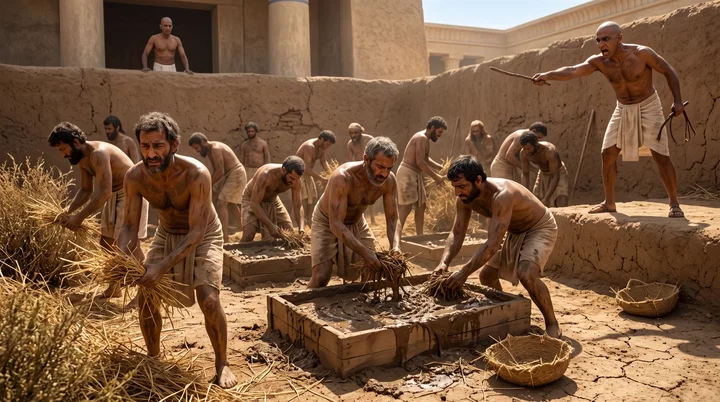
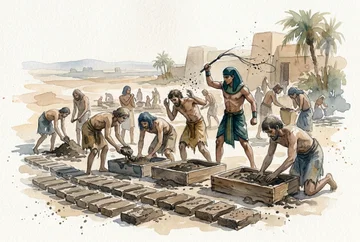
And the taskmasters of the people went out, and their officers, and they spake to the people, saying, Thus saith Pharaoh, I will not give you straw.
Translations
And the taskmasters of the people went out, and their officers, and they spoke to the people, saying, Thus says Pharaoh, I will not give you straw.
King James Version, KJV Cambridge Paragraph Bible, Revised Version, American Standard Version
And the taskmasters of the people went out, and their officers, and they spake to the people, saying, Thus saith Pharaoh, I will not give you straw.
And the task-masters of the people went out, and their officers, and they spoke to the people, saying, Thus saith Pharaoh, I will not give you straw.
And the exactors of the people, and its authorities, go out, and speak unto the people, saying, 'Thus said Pharaoh, I do not give you straw,
And the taskmasters of the people and their officers went out and spoke to the people, saying, Thus says Pharaoh: I will not give you straw:
Then went forth the taskmasters of the people and their overseers, and spake unto the people,—saying,—Thus, saith Pharaoh, I am not going to give you straw,
Berean Standard Bible, Majority Standard Bible
So the taskmasters and foremen of the people went out and said to them, “ This is what Pharaoh says: ‘ I am no longer giving you straw.
The taskmasters of the people went out with their officers, and they spoke to the people, saying, “ This is what Pharaoh says: ‘ I will not give you straw.
And the overseers of the people and their responsible men went out and said to the people, Pharaoh says, I will give you no more dry stems.
Then went the taskemasters of the people and their officers out, and tolde the people, saying, Thus saith Pharaoh, I will giue you no more strawe.
Douay-Rheims (Challoner revision)
And the overseers of the works and the taskmasters went out and said to the people: Thus saith Pharao, I allow you no straw:
Pictures
Cross-references
- Exodus 5:1-2
And afterward Moses and Aaron went in, and told Pharaoh, Thus saith the LORD God of Israel, Let my people go, that they may hold a feast unto me in the wilderness.
Moses and Aaron ask Pharaoh to let Israel go worship God, and Pharaoh refuses.
- Exodus 1:13-14
And the Egyptians made the children of Israel to serve with rigour:
Describes the Israelites’ severe forced labor in Egypt.
- Exodus 5:18
Go therefore now, and work; for there shall no straw be given you, yet shall ye deliver the tale of bricks.
The Israelites are ordered to keep making bricks without straw.
- Exodus 3:7
And the LORD said, I have surely seen the affliction of my people which are in Egypt, and have heard their cry by reason of their taskmasters; for I know their sorrows;
God sees Israel’s affliction and hears their cry.
- Exodus 1:11
Therefore they did set over them taskmasters to afflict them with their burdens. And they built for Pharaoh treasure cities, Pithom and Raamses.
Both describe Israel forced to build Raamses.
- Exodus 5:5
And Pharaoh said, Behold, the people of the land now are many, and ye make them rest from their burdens.
Pharaoh accuses Moses of making the people rest from their burdens.
- Deuteronomy 4:20
But the LORD hath taken you, and brought you forth out of the iron furnace, even out of Egypt, to be unto him a people of inheritance, as ye are this day.
Egypt is described as an iron furnace from which God brought Israel out.
- Acts 7:34
I have seen, I have seen the affliction of my people which is in Egypt, and I have heard their groaning, and am come down to deliver them. And now come, I will send thee into Egypt.
Recalls Israel’s affliction and God’s response.
- Exodus 5:20-23
And they met Moses and Aaron, who stood in the way, as they came forth from Pharaoh:
The officers blame Moses for their suffering, which he brings before God.
Commentary
Each commentary is drawn from primary sources: the writings of Ellen G. White and Adventist pioneers and periodicals. Each commentary is separate. Its own words are not a quotation; follow the references to read the source passages.
Ellen G. White
14 sources
Pharaoh's command was brought out to the people by his taskmasters together with the Hebrew officers, that no straw would any longer be supplied for brickmaking and the people must gather it for themselves.1SP 177.1–180.1PP 257.1 The full quota of bricks was still demanded though the material was withheld, imposing an unreasonable and impossible burden that deepened slavery and hardship.ST Mar 4, 1880Lt 262, 1899, par. 2–5 To make bricks without straw is to be ordered to carry necessary work forward while denied the facilities, help and means to do it, struggling under severe conditions beyond one's control.Lt 119, 1902, par. 18–2421MR 359.6–360.1Ms 3, 1897, par. 22 Work cannot be advanced without the resources it requires, so sending laborers and missionaries out without needed money, facilities and support, as handicapped the work begun in Australia and in new missionary fields, is to require bricks without straw.Lt 92, 1902, par. 14–15Lt 2, 1899, par. 14–1521MR 359.4–5 It also pictures the shortsighted ambition that expects results without providing support and the wrong done when the strong press or undervalue fellow workers, a lack felt in educational and publishing work when books must be produced and workers paid without money and means, sometimes because funds have been withheld through mismanagement and misuse.18MR 67.2–3Lt 140, 1898, par. 16Lt 262, 1899, par. 2–5Lt 140, 1898, par. 8
Setting and Plain Meaning
The command belongs to the mission of Moses and Aaron to Egypt, coming after they had told the elders of Israel of God's dealings with Moses and had shown the signs God had given him.PP 257.1 The taskmasters of the people went out with their officers to carry Pharaoh's order to the people, declaring that no straw would any longer be furnished for brickmaking and that the people must gather it for themselves.1SP 177.1–180.1ST Mar 4, 1880 The supply of straw was cut off while the required tale of bricks was left unchanged, imposing an unreasonable burden that intensified their bondage and hardship.ST Mar 4, 1880Lt 262, 1899, par. 2–5
Requiring Work Without Resources
The phrase making bricks without straw describes workers struggling to carry forward necessary work under severe, difficult conditions beyond their control.Lt 119, 1902, par. 18–2421MR 359.6–360.1 It pictures being told to go forward but given no facilities, help, or means, while still being expected to complete the work though denied what is needed to do it.21MR 359.6–360.1Ms 3, 1897, par. 22 Withholding the straw made the required brickmaking impossible to carry out as ordered, showing that work cannot be advanced without the resources it needs.Lt 2, 1899, par. 14–15 That condition applied to the shortage of money and facilities that handicapped the work in Australia despite directions to begin it, as a new missionary field facing advancing work under a shortage of means.Lt 2, 1899, par. 14–1521MR 359.4–5
Sending missionaries to do their work without the needed facilities and means is like requiring bricks without straw.Lt 92, 1902, par. 14–15 The same image pictures having much to accomplish while lacking the means to do it, as when there is so much work to do and so little money available.Lt 23, 1905, par. 5 Demanding brickmaking while withholding straw also pictures shortsighted ambition that expects work without providing necessary support, and the injustice done when the strong press or undervalue fellow workers.18MR 67.2–3
Being expected to carry out work without the materials and means needed applies to the need for adequate resources to support educational and publishing work.Lt 140, 1898, par. 16 Being required to produce bricks without straw applies to being expected to produce books and pay workers without the money or support needed for the work.Lt 262, 1899, par. 2–5 The loss of the straw needed to make brick came because resources needed to advance the work had been withheld through mismanagement and misuse of funds in America, yet the work was not to stop, and money was borrowed to carry it forward.Lt 140, 1898, par. 8
Sources
Pioneers and periodicals
38 sources
The verse records the Egyptian taskmasters and Israelite officers going out to tell the people that Pharaoh will give them no straw, tightening their forced labor under overseers.ST Jan 25, 1910RH Apr 23, 1908RH Mar 25, 1909 No straw is supplied while the required number of bricks remains unchanged, so the laborers must gather stubble for themselves, which is withholding of supplied material to add labor rather than demanding bricks with no material at all.ST Mar 4, 1880RH Jun 20, 1912ST Mar 18, 1880 Pharaoh laid on this heavier work to stop Sabbath keeping when Moses and Aaron were calling the people to rest, requiring the full daily quota with no deviation for any day so that as servants in Egypt Israel was not allowed to keep the Sabbath, though others teach the conflict with no mention of a dispute over a sacred rest day.ST Aug 1, 1911ST Oct 21, 1889ST Oct 21, 1889 While oppressed in that rigorous servitude they were in great measure prevented from practically observing God's law and could not have kept the Sabbath even if they had desired it, and God wrought deliverance with a mighty hand to bring them where they could keep it.ST Apr 28, 1909ST Oct 11, 1883RH Feb 3, 1852RH May 27, 1852RH May 16, 1854 Chopped straw seen in ancient Egyptian bricks supports the account, and the store-chambers at Pithom with lower courses containing straw and most without fit the denial of straw while the quota was still required.RH Apr 23, 1908RH Nov 27, 1866ST Oct 21, 1930ST Aug 12, 1913RH Jun 25, 1901
Words and Historical Setting
Egyptian taskmasters and Israelite officers went out to the people to announce Pharaoh's decision that straw would no longer be given, and that announcement made forced labor under overseers still harsher.ST Mar 4, 1880ST Jan 25, 1910RH Apr 23, 1908RH Mar 25, 1909ST Apr 22, 1913 That forced labor under overseers was the attested practice of Egypt, with hard work laid upon laborers under supervision.RH Apr 23, 1908 The order belonged to Pharaoh's answer to the call for Israel to be released to worship God and keep the Sabbath, and his refusal to supply straw showed stubborn resistance to a reasonable appeal for their departure to serve God where they were.RH Mar 25, 1909ST Apr 22, 1913ST Feb 4, 1913
The refusal did not end brickmaking but withdrew the supplied material while the required tale of bricks remained unchanged, so the workers themselves had to gather stubble and the added gathering increased their toil.ST Mar 4, 1880RH Jun 20, 1912ST Mar 18, 1880RH Jan 25, 1906 It was withholding of material brought to hand, not a command to make bricks with no material at all, for that would have demanded the impossible as the condition of life and welfare, since no man can labor without necessary means.RH Jan 25, 1906 The tightening was meant to leave no time for what Pharaoh counted idleness or for efforts to observe the Sabbath, and the unpaid increase of forced work added to the wages owed them.RH Jun 20, 1912ST Mar 18, 1880
The verse stands in Israel's oppression in Egypt at the first appearing before Pharaoh, which brought severer oppression and opened the contest with Pharaoh. That contest was followed by God's repeated promises and then the plagues upon the waters turned to blood and upon the frogs and lice and flies, by which the gods of Egypt worshiped in connection with those things were shown to be vanity and the God of Israel to be the true God. It was spoken three and one-half millenniums ago as part of God's call to the kingdoms of earth in Exodus 1 to 12, when Egypt ruled the world as greatest in might and power and skill and wisdom in statecraft, enriched by its river and sun.ST Nov 14, 1906 That greatness had earlier prospered without oppression under Joseph's storing of grain in the plenteous years and his just land-laws.ST Nov 14, 1906 In the ordering of the book it stands in the history portion, Exodus 1 to 18, after Israel had grown more and mightier than the Egyptians and had come into bitter bondage, on the way to great deliverance and to becoming an organized nation with efficient leadership under Moses, a complete code of laws, and an established worship in the departure that gives Exodus its Greek name.RH Jan 20, 1916
It belongs to the long and terrible oppression that followed brief prosperity after Abraham's family went down into Egypt, the bitter servitude of the iron furnace of Egypt under Pharaoh's taskmasters.RH Dec 17, 1861 That bondage had been foreshadowed to Abraham by the horror of great darkness and the smoking furnace seen in vision.RH Dec 17, 1861 It filled the waiting time while Israel could not yet possess the promised land until the iniquity of the Amorites was full.RH Dec 17, 1861
Sabbath and Worship Denied
Pharaoh withheld straw to stop Sabbath keeping when Moses and Aaron were teaching the people to rest from their labor.ST Aug 1, 1911 He answered by laying heavier work on them, first by refusing straw while requiring them to gather stubble themselves, then by demanding a fixed number of bricks every day with no deviation for any day.ST Aug 1, 1911 As servants in Egypt Israel was not allowed to keep the Sabbath, and this denial is what is recalled in the command to let servants rest on the Sabbath day.ST Aug 1, 1911 The conflict arose when Israel tried to keep the seventh-day Sabbath and they were probably prevented from keeping it while enslaved, and the trouble was not about keeping or neglecting the first day of the week.ST Oct 21, 1889 Hard bondage had made Israel lax in Sabbath observance, and the preparation for deliverance called them to return to observance of the Sabbath of the Lord.RH Oct 29, 1914
When Israel expressed desire to worship God their labor was greatly increased with straw withheld yet full work required.ST Oct 11, 1883 In that rigorous servitude they were in great measure prevented from practically observing God's law, since acceptable worship includes obeying His law.ST Oct 11, 1883 Oppressive labor driven to the utmost left the people unable to keep the Sabbath, with taskmasters and officers relaying the order withholding straw while still demanding the full brick quota.ST Apr 28, 1909RH Feb 3, 1852RH May 27, 1852RH May 27, 1852 While Israel might have kept the other nine commandments, they could not have kept the Sabbath in that oppressed condition even if they had desired to.RH May 16, 1854 God wrought deliverance with a mighty hand to bring them where they could keep it, which is why they were afterward required to keep it.RH May 16, 1854
Pharaoh tightened bondage after Moses's demand for release to leave no time for what he viewed as idleness or efforts to observe the Sabbath.RH Jun 20, 1912 Under this withholding of straw because of their attempt at Sabbath observance Israel murmured and complained most bitterly.ST Mar 7, 1906 Those cruel conditions were afterward swept away with their oppressors so they could no longer excuse Sabbath breaking by them.ST Mar 7, 1906 The teaching of those who held otherwise is that the episode is a source of conflict between Pharaoh and the Hebrew slaves with no mention of a dispute over a sacred rest day.ST Oct 21, 1889 The account of Pharaoh's conflict with Israel is connected to the Israelites' attempt to observe the seventh-day Sabbath, and they were probably deprived of opportunity to keep it in Egypt.ST Oct 21, 1889
Bondage and Mighty Deliverance
Pharaoh's refusal to supply straw kept Israel from properly serving God where they were, so they needed to leave Egypt, and his answer to God's reasonable appeal to let the people go illustrates his stubbornness.ST Apr 22, 1913 The verse shows Israel in oppression and bondage at the start of deliverance, with the whole power of Egypt set against them.ST Jan 30, 1912 It stands opposite the song of triumph on the farther shore of the Red Sea with the host of Egypt overthrown.ST Jan 30, 1912 The work of God in bringing Israel from that bondage to that triumph is mighty work, creative power shown again, such as was never done in saving any other nation.ST Jan 30, 1912
That deliverance came after hundreds of years of slavery that left the people unfitted to understand God's salvation and the character He required. Egypt forced the children of Joseph, who had saved Egypt as its deliverer, to work in the brick-kilns without supplied material while groaning under oppression. Having quickly forgotten Joseph, Egypt murdered their infant children to hide guilt, an evil from an enemy that no man would bear. Such human ingratitude and rebellion proves God's great forbearance in leaving man without excuse.
Confirmation from Egyptian Remains
The forced labor in Egypt was carried on under overseers, with taskmasters and their officers going out to convey Pharaoh's order to the people, and this system of harsh work imposed on laborers is a practice attested in Egyptian records.RH Apr 23, 1908 The chopped straw still visible in ancient Egyptian bricks supports the description of brickmaking given in Exodus.RH Nov 27, 1866 The denial of straw while the brick quota was still required is matched on the ground, for the bricks of the Pithom store-chambers are some containing straw and others containing none, fitting the account of different materials used in making them.RH Apr 23, 1908
The command to make bricks without supplied straw belongs to the bondage under Rameses II and is historical fact, confirmed at Pithom where bricks are stamped with the name Raamses.ST Oct 21, 1930ST Aug 12, 1913 Palace pictures show slaves mixing straw and mud for brickmaking, and houses have actually been found built with strawless bricks.ST Oct 21, 1930 The storehouses at Pithom built by Hebrew slaves show the change itself, since their lower portions are bricks containing straw while most are bricks without straw, and the ruins of that storage city built for Pharaoh thus contained brickwork both with straw and without it, confirming the biblical record of the brickmaking conditions.ST Aug 12, 1913RH Jun 25, 1901
Egyptian monuments give no record of the Bible miracles of the time of the oppression, because kings do not report their disasters.ST Nov 20, 1884 Their pictures and accounts nevertheless show slaves with Hebrew features working at brickmaking as the Hebrews worked, so that the whole color of the Bible story agrees with Egypt at that time.ST Nov 20, 1884 The region where the Hebrews lived held Pithom, one of the two store cities built by the children of Israel, found bearing the name Pithom on an inscription.ST Nov 20, 1884 Its chief buildings were great brick store-houses without windows or doors for preserving grain for use in war or famine, illustrating the habits and customs of the land and people of the Nile.ST Nov 20, 1884
Doctrine Proved by Bondage
The withholding of straw displays idolatrous Egyptians persecuting Hebrews who worshiped the true God.RH Jun 8, 1916 It proves the principle that he that was born after the flesh persecutes him that was born after the Spirit.RH Jun 8, 1916 It proves that the wicked persecute the righteous.RH Jun 8, 1916
When Israel expressed desire to worship God their labor was greatly increased, with straw withheld yet the full tale of work still required.ST Oct 11, 1883 In that rigorous servitude they were in great measure prevented from practically observing God's law.ST Oct 11, 1883 Acceptable worship includes obeying His law, so to hinder their worship was to hinder their obedience.ST Oct 11, 1883 God calls that condition out of which He brought them the house of bondage, even though they were then free from keeping the law.ST Oct 11, 1883 That proves that not being subject to the law of God is not liberty.ST Oct 11, 1883 He brought them out to enjoy the privilege of obeying and serving Him in a land flowing with milk and honey.ST Oct 11, 1883 He spoke His law audibly to the whole multitude and gave it in indestructible form to assist their liberty, because obedience frees from condemnation.ST Oct 11, 1883
The command only added to their labor by requiring them to gather the straw for themselves instead of having it brought to their hand.RH Jan 25, 1906 Even Pharaoh as the embodiment of cruelty and oppression never commanded his slaves to make bricks without any material whatever.RH Jan 25, 1906 Such a command would have been a command to do the impossible as the condition of life and welfare.RH Jan 25, 1906 No man can labor without the necessary means.RH Jan 25, 1906 This proves that the infinitely just and benevolent God would never command men to labor without granting them a right to the necessary means of labor.RH Jan 25, 1906
Present Application of Oppression
The withholding of straw while still demanding the full tale of bricks means laying onerous burdens on the oppressed while denying them what they need to bear them.RH May 17, 1860 It pictures a hard, close-fisted tyrant in a hurry for brick who gives his brick-makers no time to read or pray.RH May 17, 1860 The same ugly sin is committed by modern Pharaohs, who must beware, for Sabbath-keeping doctrines will only be a millstone to sink them in an ocean deep as eternity.RH May 17, 1860 God must speedily pity and deliver the oppressed from such burdens.RH May 17, 1860
Pharaoh's cruel and impossible exaction demanded the full quota of bricks while withholding straw and leaving only stubble from the field for the laborers.RH Sep 23, 1862 The same oppression is done by great men of the American republic, who require hard service while sustaining slavery.RH Sep 23, 1862 That conduct exposes forgetting the brother in bonds as bound with him, and guilt for voting for ambitious men who embrace slavery, so that the people must now grapple with its consequences themselves.RH Sep 23, 1862 Deliverance from coming national punishment comes only by repentance toward God, with humbling, sackcloth, and prayer for a little respite until the servants of God are sealed, that they may enjoy everlasting life in the kingdom of the Lord and His Christ.RH Sep 23, 1862
Israel working for Pharaoh under the lash of the taskmaster with no straw given with which to make bricks makes their sighing and crying as they worked no marvel.ST Sep 22, 1881 It pictures forced, joyless toil for masters who withhold materials yet demand the work.ST Sep 22, 1881 By contrast, working for God is working for a Father who guarantees strength and supplies all materials and talks with His workers all the time and forgives blunders and is quick in love to accept the work.ST Sep 22, 1881 His service is therefore perfect freedom and ought to be done cheerfully for the sheer joy of doing it even if there were no heaven and no crown and no Well done good and faithful servant.ST Sep 22, 1881
Requiring brick without straw and keeping people on short allowance while still demanding full work pictures a hard master, even a cruel slave-holder, who commands without supplying what is needed to obey.RH Mar 26, 1861 Applied to Christian life, it exposes as false the representation that Christ keeps His children on short allowance and supplies their spiritual wants so sparingly as to leave famine and starvation.RH Mar 26, 1861 It likewise exposes the claim that He requires obedience beyond possibility even by grace received in this life, making His commandments grievous and His yoke too heavy to bear.RH Mar 26, 1861 That representation is opposite to Christ's teaching.RH Mar 26, 1861
Brickmaking is divided work in which making brick and gathering straw are distinct parts, so those who cannot make brick can still help by gathering straw for the workmen.RH Jan 9, 1872 In the harvest field every person has a sphere for effective work.RH Jan 9, 1872 Those weakened by age who can no longer do heavier labor can do this lighter supporting work by staying up the hands of the workmen with cheering words and encouragement.RH Jan 9, 1872
The refusal to supply straw while the Israelites were still required to work added to their forced labor and to the wages owed them.ST Mar 18, 1880 That order to make bricks without supplied straw illustrates a severe hardship like entering adult life without economy.ST Mar 18, 1880ST Nov 27, 1879
Sources