Exodus 5:12
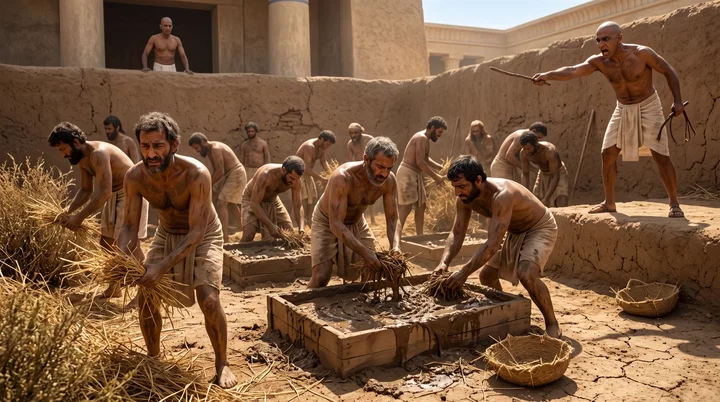
So the people were scattered abroad throughout all the land of Egypt to gather stubble instead of straw.
Translations
American King James Version, King James Version, KJV Cambridge Paragraph Bible
So the people were scattered abroad throughout all the land of Egypt to gather stubble instead of straw.
So the people were scattered abroad throughout all the land of Egypt, to gather stubble instead of straw.
Revised Version, American Standard Version, World English Bible
So the people were scattered abroad throughout all the land of Egypt to gather stubble for straw.
And the people is scattered over all the land of Egypt, to gather stubble for straw,
And the people were scattered abroad throughout the land of Egypt to gather stubble for straw.
So the people dispersed themselves throughout all the land of Egypt,—to gather stubble for straw:
Berean Standard Bible, Majority Standard Bible
So the people scattered all over the land of Egypt to gather stubble for straw.
So the people were sent in all directions through the land of Egypt to get dry grass for stems.
Then were the people scattered abroade throughout all the land of Egypt, for to gather stubble in steade of strawe.
Douay-Rheims (Challoner revision)
And the people was scattered through all the land of Egypt to gather straw.
Pictures
Cross-references
- Exodus 5:7-8
Ye shall no more give the people straw to make brick, as heretofore: let them go and gather straw for themselves.
Straw is withheld while the full brick quota remains demanded.
- Exodus 1:13-14
And the Egyptians made the children of Israel to serve with rigour:
Describes the harsh Egyptian labor, including brick-making without straw.
- Exodus 5:18
Go therefore now, and work; for there shall no straw be given you, yet shall ye deliver the tale of bricks.
They are ordered to make bricks without straw.
- Exodus 5:5
And Pharaoh said, Behold, the people of the land now are many, and ye make them rest from their burdens.
Pharaoh objects that Moses is making the people rest from their labor.
- Exodus 5:21
And they said unto them, The LORD look upon you, and judge; because ye have made our savour to be abhorred in the eyes of Pharaoh, and in the eyes of his servants, to put a sword in their hand to slay us.
The officers blame Moses and Aaron for worsening their treatment.
- Exodus 5:8
And the tale of the bricks, which they did make heretofore, ye shall lay upon them; ye shall not diminish ought thereof: for they be idle; therefore they cry, saying, Let us go and sacrifice to our God.
Pharaoh’s demand for bricks without straw explains the search for stubble.
- Exodus 5:1-3
And afterward Moses and Aaron went in, and told Pharaoh, Thus saith the LORD God of Israel, Let my people go, that they may hold a feast unto me in the wilderness.
A modest request to worship provokes harsher bondage.
- Acts 7:34
I have seen, I have seen the affliction of my people which is in Egypt, and I have heard their groaning, and am come down to deliver them. And now come, I will send thee into Egypt.
God sees Israel’s affliction in Egypt and comes to deliver them.
- Exodus 3:7
And the LORD said, I have surely seen the affliction of my people which are in Egypt, and have heard their cry by reason of their taskmasters; for I know their sorrows;
God sees Israel’s oppression in Egypt.
- Genesis 15:13
And he said unto Abram, Know of a surety that thy seed shall be a stranger in a land that is not theirs, and shall serve them; and they shall afflict them four hundred years;
The foretold Egyptian servitude is later imposed on the Israelites.
- Exodus 6:6
Wherefore say unto the children of Israel, I am the LORD, and I will bring you out from under the burdens of the Egyptians, and I will rid you out of their bondage, and I will redeem you with a stretched out arm, and with great judgments:
Promises to free Israel from bondage.
- Deuteronomy 4:20
But the LORD hath taken you, and brought you forth out of the iron furnace, even out of Egypt, to be unto him a people of inheritance, as ye are this day.
calls Egypt the iron furnace
Commentary
Each commentary is drawn from primary sources: the writings of Ellen G. White and Adventist pioneers and periodicals. Each commentary is separate. Its own words are not a quotation; follow the references to read the source passages.
Ellen G. White
13 sources
After Moses asked to let Israel go to sacrifice, Pharaoh hardened his heart and made their bondage far harsher by ordering the same full number of bricks while no longer supplying straw, so the people were scattered throughout Egypt to gather stubble from the fields as a substitute.SG3 198.11SP 177.1–180.1ST Mar 4, 1880 The bricks were made of sun-dried earth that needed straw mixed in to hold them together, so without the supply they could not gather enough material to meet their daily quota even as the taskmasters drove them as before.SG3 198.11SP 177.1–180.1ST Mar 4, 1880 The Hebrew officers set over the work were beaten and questioned for failing to complete the required tale of bricks, and this added affliction showed Israel was not yet ready for deliverance, expecting it without trial of faith and unwilling to endure suffering patiently until God wrought it.SG3 198.11SP 177.1–180.1ST Mar 4, 1880 The verse thus stands for the hardship of demanding hard results while withholding the means to do the work, whether in lack of funds, in sending missionaries without facilities, or in shortsighted ambition that burdens workers instead of regarding them with care.Lt 92, 1902, par. 14–1521MR 359.6–360.1Ms 3, 1897, par. 22Lt 2, 1899, par. 14–1518MR 67.2–3
Pharaoh's Harsher Bondage
After the request to let the people go to hold a feast and sacrifice in the wilderness, Pharaoh's heart became more unfeeling toward Israel in greatly increased labor.SG3 198.11SP 177.1–180.1 Egyptian taskmasters were placed over the Hebrews, with Hebrew officers under them who directed the work and were responsible for the work of the people under them.SG3 198.11SP 177.1–180.1 Pharaoh stopped supplying straw but still demanded the same full number of bricks, unjustly requiring the people to gather their own material for brick.SG3 198.11SP 177.1–180.1ST Mar 4, 1880Lt 262, 1899, par. 2–5
Bricks were made from sun-dried earth mixed with straw to hold them together, even in fine buildings later faced with stone.ST Mar 4, 1880 The people were scattered abroad throughout all the land of Egypt to gather scattered straw and stubble found in the fields instead of straw.SG3 198.11SP 177.1–180.1ST Mar 4, 1880PP 258.3–4 Because of this they could not gather enough to perform their usual amount of labor and meet the quota, while the taskmasters hastened them to fulfill their daily tasks as when straw was given.SG3 198.11SP 177.1–180.1ST Mar 4, 1880PP 258.3–4
The Hebrew officers and workers responsible for the work were beaten and questioned for not fulfilling and compelling the full tale of bricks, and the added demand made their already hard labor more burdensome.SG3 198.11SP 177.1–180.1ST Mar 4, 1880PP 258.3–4Lt 262, 1899, par. 2–5 This increased suffering exposed that the Hebrews expected deliverance without trial of faith or suffering on their part and were not yet prepared to be delivered, having little faith and being unwilling to patiently suffer and perseveringly endure affliction until God worked for them a glorious deliverance.1SP 177.1–180.1
Bricks Without Straw Today
The scattering throughout Egypt to gather stubble after straw for brickmaking was withheld pictures workers burdened with a demanding task while denied the materials and help needed to accomplish it.Ms 3, 1897, par. 22Lt 2, 1899, par. 14–15 Their forced search for substitute material shows how withholding what the work requires makes the work itself more difficult.Lt 2, 1899, par. 14–15 Sending missionaries to foreign fields without facilities or means is the same hardship, demanding the work while withholding what is needed to do it.Lt 92, 1902, par. 14–15
Having to scatter through the land to gather stubble themselves describes the perplexities of carrying forward missionary work without adequate support or resources because of decisions made by others.21MR 359.6–360.1 The same image applies to having much work to do while lacking funds.Lt 23, 1905, par. 5 Requiring brick without straw is shortsighted ambition that demands results while withholding what workers need, whereas God's work should instead be done with careful regard for one another.18MR 67.2–3
Being forced to find for themselves the material their work required fits the lack of resources for carrying out the work in Cooranbong, where brick could not be made without straw.Lt 140, 1898, par. 16 Being forced to find substitute materials under harsh conditions describes being deprived of resources needed to build the work, which nevertheless must continue.Lt 140, 1898, par. 8
Sources
Pioneers and periodicals
41 sources
Pharaoh stopped supplying straw for brickmaking yet still demanded the same full daily number of bricks, so the people were scattered throughout Egypt to gather stubble for themselves, and were beaten when they could not meet the quota.ST Mar 4, 1880ST Jan 20, 1909 It was not a demand to work with nothing at all, but to add to their labor by gathering the material through the land instead of having it brought to hand.RH Jan 25, 1906ST Jun 3, 1880 Moses had been calling the Israelites back to keep the Sabbath, and Pharaoh answered by filling their days with this added toil to leave them no time to rest and to crush their spirit.ST Aug 1, 1911RH Mar 25, 1909ST Apr 28, 1909RH Oct 29, 1914RH Jun 20, 1912 In that bondage they were in great measure unable to keep the Sabbath even if they had desired to, sighing and crying under greatly increased labor with no time to read or pray.ST Oct 11, 1883RH Feb 3, 1852RH May 27, 1852 God therefore brought them out with a mighty hand to a place where they could keep the Sabbath, and gave His law to help them enjoy that liberty.ST Oct 11, 1883RH May 16, 1854RH May 27, 1852
Setting in Exodus Story
Three and one-half millenniums ago Egypt ruled the world as the greatest of all kingdoms, acknowledged for might and power and skill and wisdom in statecraft, with its river fertilizing the land and deified as a god and the sun producing food and worshiped with its kings taking title as representative of the sun-god upon the throne of men.ST Nov 14, 1906 This was after the descendants of the nomadic patriarch Abraham had come to her granaries for supplies and after the captive slave Joseph had taught Pharaoh to store grain in plenteous years.ST Nov 14, 1906 Joseph had instituted a good land-law with easy rental and taxes, and had brought prosperity without oppression for Egypt and its inhabitants as long as his memory lived among the rulers.ST Nov 14, 1906
After brief prosperity there the family of Abraham grew more and mightier than the Egyptians and fell into bitter servitude and long and terrible oppression.RH Jan 20, 1916RH Dec 17, 1861 That bondage was the iron furnace foreshadowed to Abraham by the horror of great darkness and the smoking furnace seen in vision.RH Dec 17, 1861 The verse belongs to the history part of Exodus in chapters 1 to 18, as part of the story of their great deliverance into a nation with thorough organization, efficient leadership, a complete code of laws, and an established form of worship, in the book whose name means going out referring to the departure of Israel from Egypt.RH Jan 20, 1916
Egypt quickly forgot Joseph their deliverer and saviour, to whom it owed its own deliverance, and enslaved his descendants. It set them to make bricks without straw and murdered his infant descendants lest its own iniquity find it out, leaving Israel groaning in the brick-kilns under cruel oppression and forced to work without material. That such ingratitude and cruelty from enemies was borne by God without cutting them off at once proves His forbearance.
The verse records part of the severer oppression of the children of Israel that followed the first appearance of Moses and Aaron before Pharaoh with the demand that Israel be allowed to worship God in the wilderness.ST Feb 4, 1913 It stands at the beginning of the deliverance story when Israel was in oppression and bondage with the whole power of Egypt set against them, within the account that also includes God's repetition of His promises.ST Feb 4, 1913ST Jan 30, 1912 There followed the plagues of the waters turned to blood, the frogs, the lice, and the flies by which God showed that the gods of Egypt were vanity and that the God of Israel was the true God, then the crossing of the Red Sea.ST Feb 4, 1913 On the farther side after the host of Egypt was overthrown came the song of triumph, showing God's mighty work in saving them by creative power as never done in saving any nation.ST Jan 30, 1912
Brickmaking Hardship Described
Pharaoh stopped supplying straw for brickmaking yet still demanded the same full daily number of bricks with no deviation, so the people were scattered abroad throughout all the land of Egypt to gather stubble instead of straw.ST Mar 4, 1880ST Jan 20, 1909 When they could not meet the unchanged quota, the Hebrew officers and workers were beaten for the shortfall.ST Mar 4, 1880 This scattering belonged to the cruel tasks imposed on the Israelites in Egypt after the straw they had been given was withheld.ST Mar 4, 1880ST Jan 20, 1909
The bricks were made from sun-dried earth mixed with straw to hold them together, even in fine buildings later faced with stone.ST Mar 4, 1880 Straw or stubble was required in the process because, although neither had strength to bind the clay, something in the material helped produce good bricks.ST Mar 4, 1880AUST Jun 21, 1920
The order was not to make bricks with no material whatever, but to make bricks without supplied straw by gathering straw and stubble for themselves throughout Egypt instead of having it brought to hand, thus adding to their labor.RH Jan 25, 1906ST Jun 3, 1880 A command to make bricks with no material whatever would be a command to labor without necessary means and to do the impossible as the condition of life and welfare, which even Pharaoh in his cruelty and oppression never gave.RH Jan 25, 1906 The phrase making brick without straw alludes to this hardship of gathering the material while still bearing the full burden.RH Jan 25, 1906ST Jun 3, 1880
Confirmed by Archaeological Finds
The narrative's descriptions of Egyptian labor stand to be compared with historical records, and the chopped straw still visible in ancient Egyptian bricks confirms how the bricks were made.RH Apr 23, 1908RH Nov 27, 1866
After Pharaoh stopped supplying straw while still requiring the same production of bricks, the Israelites were scattered throughout Egypt to gather stubble, and the bricks of Pithom generally contain straw but some are strawless, matching that hardship.RH Apr 23, 1908
The discovered storehouses at Pithom fit the account of forced labor, with some tiers containing straw and some containing no straw, most of the storehouse bricks being made without straw.RH Apr 23, 1908ST Aug 12, 1913
It is historical fact that Semites were collected to build the city of Raamses-Mera-Amen on the eastern delta of the Nile, and bricks stamped with the name Raamses are found at Pithom.ST Oct 21, 1930
Palace pictures show slaves with Hebrew features mixing straw and mud for bricks as the Hebrews worked, and houses at Pithom are actually built with strawless bricks.ST Oct 21, 1930ST Nov 20, 1884
Pithom, one of the two store cities built by the children of Israel, has been found bearing the name Pithom on an inscription.ST Nov 20, 1884
While building the treasure city Pithom in Goshen for Pharaoh under bitter bondage in mortar and in brick, Israel built a square town enclosed by walls twenty-two feet thick and filled with vast storage chambers built of brick laid with mortar, whose builder was Rameses II.RH Jun 25, 1901
Its chief buildings were great brick store-houses without windows or doors for preserving grain for use in war or famine.RH Jun 25, 1901ST Nov 20, 1884
No record of Bible miracles is found on the monuments because kings do not report their disasters, but Egyptian pictures, stories and pious books illustrate the habits and customs of the land and people of the Nile.ST Nov 20, 1884
Sabbath Conflict in Egypt
Hard bondage in Egypt had made Israel lax in Sabbath observance, and Moses was teaching the people to observe the Sabbath again as preparation for deliverance called them to return to observance of the Sabbath of the Lord.RH Oct 29, 1914RH Jun 20, 1912 His efforts to restore Sabbath observance had come to Pharaoh's attention, and before the added burden Israel had been able to meet the brick quota in six days and keep the seventh day for holy rest.RH Oct 29, 1914RH Jun 20, 1912 Pharaoh answered that attempt by heaping added hardship on their brickmaking labor, demanding the full daily quota without supplying straw and scattering them throughout all Egypt to gather stubble instead.ST Aug 1, 1911RH Mar 25, 1909ST Apr 28, 1909RH Jun 20, 1912 By adding work while demanding the same number of bricks every day with no deviation from day to day, he filled their days, left them no time to rest, and excluded the possibility of their keeping a day.ST Aug 1, 1911ST Apr 28, 1909RH Jun 20, 1912 The added work was meant to crush their independent spirit and stop the Sabbath rest Moses was teaching, and under that increased oppression the people murmured and complained bitterly.RH Mar 25, 1909ST Mar 7, 1906RH Jun 20, 1912
The trouble between Pharaoh and the Israelite slaves arose because they attempted to keep the seventh-day Sabbath, and they were deprived of keeping it and probably prevented from keeping it in Egypt.ST Oct 21, 1889ST Oct 21, 1889 That rigorous servitude under a ruler who denied knowledge of Jehovah left them in abject bondage and greatly increased hard labor in which they sighed and cried as they worked.ST Oct 11, 1883RH May 27, 1852RH May 27, 1852 Driven to search the whole land for brickmaking material after straw was withheld, they were given no time to read or pray.ST Oct 11, 1883RH Feb 3, 1852RH May 27, 1852RH May 17, 1860 In great measure they could not practically observe God's law in that condition, and could not have kept the Sabbath even if they had desired to, though they might have kept the other nine commandments.ST Oct 11, 1883RH Feb 3, 1852RH May 27, 1852RH May 16, 1854RH May 27, 1852
The verse thus proves that as servants in Egypt Israel were not allowed to keep the Sabbath, which is the reason Israel was afterward commanded to let their servants rest with them on the Sabbath day.ST Aug 1, 1911 God wrought deliverance and brought them out of the house of bondage with a mighty hand to where they could keep the Sabbath and placed them where they could observe it.ST Oct 11, 1883RH May 16, 1854RH May 27, 1852 He brought them out so they might enjoy obeying and serving Him in a land flowing with milk and honey, since acceptable worship includes obeying His law.ST Oct 11, 1883 He spoke His law aloud to the whole multitude and gave it in lasting form to help them enjoy that liberty, which is why they were then required to keep it.ST Oct 11, 1883RH May 16, 1854 Those who held otherwise taught from the same labor conflict between Pharaoh and the Hebrew slaves that the account mentions no dispute over a sacred rest day, and that if Israel had observed a weekly Sabbath that silence would be notable.ST Oct 21, 1889
Bondage and Deliverance Theology
The scattering throughout Egypt to gather stubble instead of straw shows idolatrous Egyptians persecuting Hebrews who worshiped the true God, proving that he who was born after the flesh persecutes him who was born after the Spirit and that the wicked persecute the righteous.RH Jun 8, 1916 That added hardship and labor of being forced to scatter to gather stubble while still producing the full tale of bricks was part of the unpaid service for which Egypt owed Israel compensation.ST Mar 18, 1880 Hundreds of years of such slavery had unfitted Israel to comprehend God's great salvation and the character He required, yet God had redeemed them with a mighty hand. Because of that unfitness they needed a great, multiple object-lesson by various forms and rites that would teach the great plan of salvation, so God instructed Moses to take free-will offerings and let them make Him a sanctuary that He might dwell among them.
That joyless toil for a hard master under the lash, sighing and crying while working without supplied straw, stands in contrast to working for God as Father.ST Sep 22, 1881 He guarantees strength, supplies all materials, talks with workers while they work, forgives blunders, and is quick in love to accept the work, so His service is perfect freedom to be done cheerfully for the sheer joy of doing it even apart from heaven, crown, or praise.ST Sep 22, 1881 Pharaoh's demand for brick without straw pictures a hard master and cruel slave-holder who keeps servants on short allowance, supplies wants so sparingly as to leave them near famine and starvation, and lays on a yoke too heavy to be borne with commandments beyond possibility of obedience even by grace received in this life.RH Mar 26, 1861 To apply that picture to Christ misrepresents Him, for His will is perfect, His service is the perfection of liberty, His yoke is as easy as possible, and His commandments are not grievous.RH Mar 26, 1861 Moses's course in Egypt amid this oppression was wise action in opposing a hostile scheme, equal to the wisdom of Noah at the flood, Abraham in Canaan, David with Saul, Elijah in opposing Jezebel, John the Baptist at the annunciation, and Paul before the Roman tribunal.RH Dec 4, 1913
Lessons and Present Applications
The scattering to gather stubble while the full tale of bricks was still exacted was cruel and impossible oppression, laying the whole burden on those in bonds while withholding the help needed to bear it.RH Sep 23, 1862 It stands as the measure of the great men of the American republic who uphold slavery, forgetting their brother in bonds and laying heavy exactions on the oppressed.RH Sep 23, 1862
Pharaoh's tyranny in hurrying the work for brick and scattering the people through all Egypt to gather stubble instead of straw gave his brickmakers no time to read or pray and laid onerous burdens on the oppressed.RH May 17, 1860 A hard, close-fisted master makes a bad servant, for cutting reproaches and rapacious demands for more work stir up evil passions and sink him lower until strength fails, arm trembles and knees grow weak, because discouragement of mind afflicts the body.RH May 17, 1860 A kind, good master, like Cornelius, makes a good servant bound by love.RH May 17, 1860 Modern Pharaohs must beware this ugly sin, for Sabbath-keeping doctrines will only be a millstone to sink them in an ocean deep as eternity, and God must speedily pity and deliver the oppressed, for there will soon be an end of this.RH May 17, 1860
Making bricks without straw is an impossible task, and prospective ministers must not try to do such a work in ministry.ST Jan 30, 1912 Yet brickmaking has two parts, making brick and gathering straw, so those who cannot make brick can gather straw for the workmen.RH Jan 9, 1872 In the wide gospel harvest field there is a sphere where each can work effectively, and old men who bore the burden and heat of the day in times past but now by age and failing strength need lighter work can still serve by gathering straw, staying up the hands of the workmen with cheering words and encouragement in the different departments of the work.RH Jan 9, 1872 The hardship of being forced to make bricks without straw serves as a comparison for the difficulties of life without economy.ST Nov 27, 1879
Sources