Exodus 9:3
Behold, the hand of the LORD is upon thy cattle which is in the field, upon the horses, upon the asses, upon the camels, upon the oxen, and upon the sheep: there shall be a very grievous murrain.
Translations
Behold, the hand of the LORD is on your cattle which is in the field, on the horses, on the asses, on the camels, on the oxen, and on the sheep: there shall be a very grievous murrain.
Behold, the hand of the LORD is upon thy cattle which is in the field, upon the horses, upon the asses, upon the camels, upon the oxen, and upon the sheep: there shall be a very grievous murrain.
behold, the hand of the Lord is upon thy cattle which is in the field, upon the horses, upon the asses, upon the camels, upon the oxen, and upon the sheep: there shall be a very grievous murrain.
Behold, the hand of the LORD is upon thy cattle which are in the field, upon the horses, upon the asses, upon the camels, upon the oxen, and upon the sheep: there shall be a very grievous murrain.
behold, the hand of the LORD is upon thy cattle which is in the field, upon the horses, upon the asses, upon the camels, upon the herds, and upon the flocks: there shall be a very grievous murrain.
behold, the hand of Jehovah is upon thy cattle which are in the field, upon the horses, upon the asses, upon the camels, upon the herds, and upon the flocks: there shall be a very grievous murrain.
lo, the hand of Jehovah is on thy cattle which [are] in the field, on horses, on asses, on camels, on herd, and on flock — a pestilence very grievous.
behold, the hand of Jehovah shall be on thy cattle which is in the field, on the horses, on the asses, on the camels, on the oxen and on the sheep, with a very grievous plague.
lo! the hand of Yahweh, is coming on thy cattle which are in the field, on the horses, on the asses on the camels, on the herds and on the flocks,—a very grievous pestilence;
Berean Standard Bible, Majority Standard Bible
then the hand of the LORD will bring a severe plague on your livestock in the field— on your horses, donkeys, camels, herds, and flocks.
behold, the LORD’s hand is on your livestock which are in the field, on the horses, on the donkeys, on the camels, on the herds, and on the flocks with a very grievous pestilence.
Then the hand of the Lord will put on your cattle in the field, on the horses and the asses and the camels, on the herds and the flocks, a very evil disease.
Beholde, the hande of the Lord is vpon thy flocke which is in the fielde: for vpon the horses, vpon the asses, vpon the camels, vpon the cattell, and vpon the sheepe shalbe a mightie great moraine.
Douay-Rheims (Challoner revision)
Behold my hand shall be upon thy fields: and a very grievous murrain upon thy horses, and asses, and camels, and oxen, and sheep.
Pictures
Cross-references
- Exodus 9:19-21
Send therefore now, and gather thy cattle, and all that thou hast in the field; for upon every man and beast which shall be found in the field, and shall not be brought home, the hail shall come down upon them, and they shall die.
The warning distinguishes those who bring their livestock indoors from those who leave it exposed to the hail.
- Exodus 12:12
For I will pass through the land of Egypt this night, and will smite all the firstborn in the land of Egypt, both man and beast; and against all the gods of Egypt I will execute judgment: I am the LORD.
The livestock plague anticipates judgment against Egypt’s gods.
- Revelation 16
And I heard a great voice out of the temple saying to the seven angels, Go your ways, and pour out the vials of the wrath of God upon the earth.
repeats the Egypt plagues
- Exodus 9:9
And it shall become small dust in all the land of Egypt, and shall be a boil breaking forth with blains upon man, and upon beast, throughout all the land of Egypt.
The next plague brings boils on people and animals.
- Psalms 105:26-38
He sent Moses his servant; and Aaron whom he had chosen.
Recounts the plagues and Israel’s deliverance from Egypt.
- Exodus 12:29
And it came to pass, that at midnight the LORD smote all the firstborn in the land of Egypt, from the firstborn of Pharaoh that sat on his throne unto the firstborn of the captive that was in the dungeon; and all the firstborn of cattle.
Later mentions cattle during the final plague.
- Exodus 9:10
And they took ashes of the furnace, and stood before Pharaoh; and Moses sprinkled it up toward heaven; and it became a boil breaking forth with blains upon man, and upon beast.
Another plague in the same chapter illustrates the comparison.
- Revelation 15:5-8
And after that I looked, and, behold, the temple of the tabernacle of the testimony in heaven was opened:
Egyptian plagues pattern the final vials
- 1 Samuel 4:7-8
And the Philistines were afraid, for they said, God is come into the camp. And they said, Woe unto us! for there hath not been such a thing heretofore.
The passage cites the Philistines’ acknowledgment of Egypt’s plagues as evidence they were literal.
- Exodus 7:19-25
And the LORD spake unto Moses, Say unto Aaron, Take thy rod, and stretch out thine hand upon the waters of Egypt, upon their streams, upon their rivers, and upon their ponds, and upon all their pools of water, that they may become blood; and that there may be blood throughout all the land of Egypt, both in vessels of wood, and in vessels of stone.
Both describe Egypt’s plagues as displays of the LORD’s power.
Commentary
Each commentary is drawn from primary sources: the writings of Ellen G. White and Adventist pioneers and periodicals. Each commentary is separate. Its own words are not a quotation; follow the references to read the source passages.
Ellen G. White
6 sources
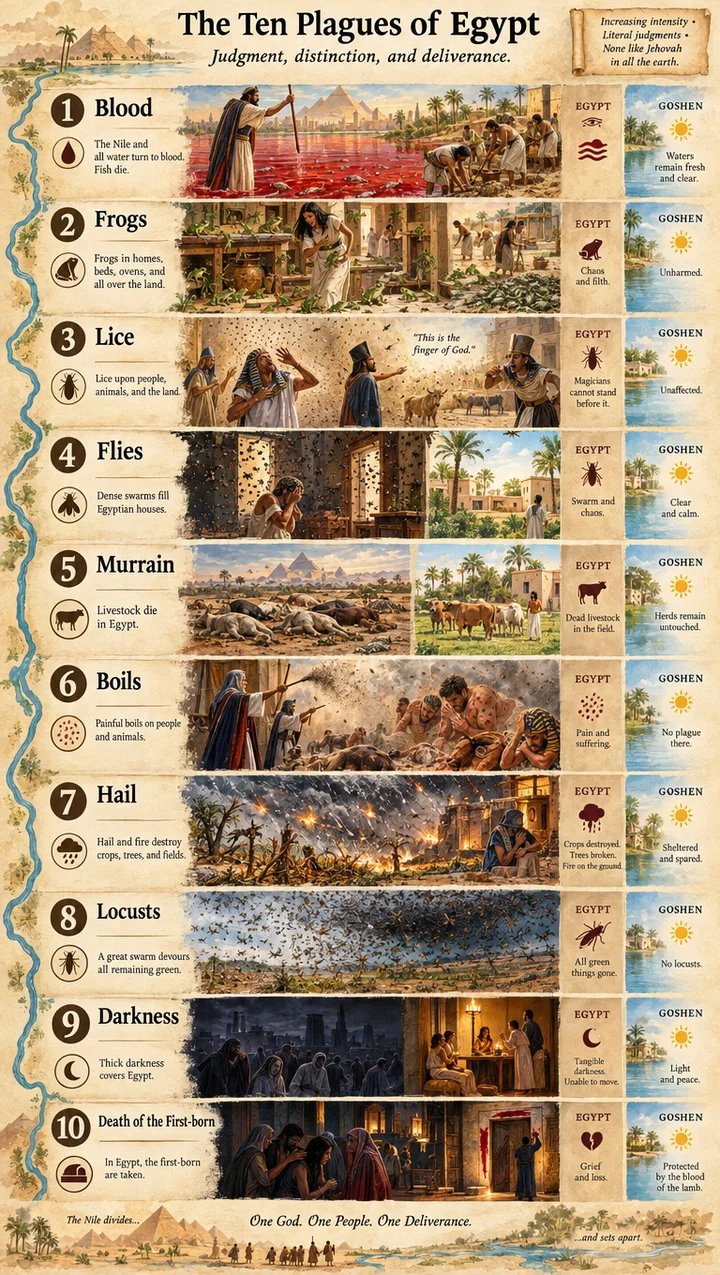
Moses was to warn that if Pharaoh kept refusing to release Israel, the hand of the Lord would fall in judgment upon Egypt's cattle in the field — upon the horses, asses, camels, oxen, and sheep — in a very grievous murrain, a still more terrible visitation than those before it.SG3 211.31SP 189.2PP 267.1ST Mar 18, 1880 Its time was announced beforehand and it came as predicted, so it could not be dismissed as happening by chance.1SP 217.1ST Mar 18, 1880 The murrain struck and destroyed the Egyptian cattle it visited, including beasts of burden and sacred animals.1SP 189.2PP 267.11SP 217.1PP 758.3–760.1
The cattle of the Israelites were distinctly exempted as Moses had declared, so that not one of them died or was afflicted.SG3 211.31SP 189.2PP 267.11SP 217.1ST Mar 18, 1880 That exemption extended to all that belonged to Israel, while the plague destroyed the Egyptian cattle except those belonging to the Israelites.SG3 211.31SP 189.21SP 217.1ST Mar 18, 1880PP 758.3–760.1 By killing sacred bulls, rams, heifers, goats, and other venerated animals, the plague struck at Egypt's worship of animals.PP 267.1PP 758.3–760.1 It showed that its animal gods could not protect themselves or their worshipers and that Jehovah alone is supreme.PP 758.3–760.1
The plague was meant to demonstrate to the Egyptians that the whole earth is under the command of the God of the Hebrews and that thunder, hail, and storm obey His voice.1SP 217.1 Pharaoh verified the distinction by inquiry, sending messengers to the homes of the Israelites who found they had entirely escaped.SG3 211.31SP 189.2PP 267.1ST Mar 18, 1880 Yet he hardened his heart and remained obstinate and refused to release Israel, encouraged in persistency by the priests and magicians, until proud Pharaoh would be humbled to confess his sin and the righteousness of the Lord.SG3 211.31SP 189.2PP 267.11SP 217.1ST Mar 18, 1880
Sources
Pioneers and periodicals
41 sources
Behold, if Pharaoh kept refusing to release Israel, the hand of Jehovah whom he said he did not know would bring a very grievous murrain, a severe deadly disease, upon Egypt's livestock in the field, upon horses, asses, camels, oxen and sheep.ST Jan 25, 1910ST Jan 14, 1889ST Jan 20, 1909 The stroke fell not first upon men but upon the gods Egypt worshiped, destroying the brute-worship system of sacred bull, ram, heifer, goat and other revered beasts and showing those deities powerless to protect the cattle or save themselves before the living God.RH Jan 6, 1903ST Jan 25, 1910ST Jan 14, 1889RH Mar 11, 1915ST Jan 22, 1885 It came as forewarned after time to consider, killing Egyptian cattle across the land while the Hebrews in Goshen were distinctly exempted so that none of their cattle died, a fact Pharaoh's messengers confirmed, yet he hardened his heart and would not obey.ST Mar 18, 1880RH Jan 6, 1903ST Nov 23, 1904ST Nov 23, 1904ST Nov 23, 1904 The literal plague before Israel's deliverance foreshadows the literal seven last plagues just before the final deliverance, when the saints though present in the time of trouble will be protected by the seal of the living God as Israel was protected in Egypt.STRH Dec 23, 1851ST Jul 18, 1878ST Oct 28, 1930 It was part of God's breaking of the oppressor's power in the controversy over worship, asserting Israel's right to serve God free from the state's jurisdiction and vindicating His ability and right to rule and their obligation to obey.RH Mar 25, 1909RH Jun 9, 1903ST Mar 7, 1906
Historical Setting in Exodus
The word was spoken to Egypt three and one-half millenniums ago, when Egypt ruled the world as the greatest kingdom in might and power and skill and wisdom in statecraft.ST Nov 14, 1906 It was enriched by its river, which in annual overflow fertilized its land and which it deified as one of its gods, and by the sun, which joined with the river in producing food and which it worshiped, its kings receiving title as representatives of the sun-god upon the throne of men.ST Nov 14, 1906 This was after the few descendants of the nomadic patriarch Abraham had sought supplies from Egypt's granaries, and after Joseph, a captive slave, had taught Pharaoh how to store grain in plenteous years to become rich in famine.ST Nov 14, 1906 Joseph had instituted land-laws with easy rental and taxes under which Egypt prospered without oppression as long as his memory lived and was honored among the rulers of Egypt.ST Nov 14, 1906
The word belongs to the plagues inflicted on Egypt during Moses' interviews with Pharaoh and the contest with Pharaoh's magicians, part of the plagues in Exodus 7 to 12 and in Exodus 9 to 12, leading to the tenth plague and Israel's departure from Egypt.RH Jan 20, 1916 It stands in the history part of Exodus, chapters 1 to 18, which tells the going out of Israel from Egypt, their great deliverance from bitter bondage and oppression, and how they became a nation with thorough organization, efficient leadership, a complete code of laws, and an established form of worship.RH Jan 20, 1916 It belongs to the mighty work God did in saving Israel, creative power manifested over again, such work as was never done in the saving of any nation, on the way to Israel's song of triumph beyond the Red Sea with the host of Egypt overthrown.ST Jan 30, 1912 That deliverance from oppression and bondage under the whole power of Egypt was marked by darkness, plagues, and storms, showing nature accompanying a divine act in history.ST Jan 30, 1912ST Sep 28, 1904
The verse shows the mighty hand of God upon Egypt as part of His redemption of Israel from Egyptian bondage after hundreds of years of slavery. That long slavery had left Israel unfitted to comprehend God's great salvation and the character He required. Afterward God gave them a great, multiple object-lesson in the sanctuary to teach the plan of salvation.
Wording and Scope of Plague
The warning is conditional upon Pharaoh's continued refusal to release Israel, declaring that the hand of the Lord, the hand of Jehovah whom Pharaoh said he did not know, will bring a very grievous murrain, a severe disease, upon the livestock of Egypt in the field, upon the horses, upon the asses, upon the camels, upon the oxen, and upon the sheep.ST Jan 25, 1910ST Jan 14, 1889ST Jan 20, 1909ST Dec 4, 1901 That very grievous murrain was the Word of God spoken through Moses smiting the land, just as that Word turned the rivers into blood, for the power was not in Moses the man but in the Word, in the message God spoke through him.ST Apr 4, 1911
Murrain is a deadly disease raging among flocks and herds throughout a country, smiting entire pastoral regions with a disorder like small-pox among sheep and pulmonary disease among cattle that rapidly thins the herds, kills a large share of horses and horned cattle, leaves thousands of skeletons covering the ground, and strips shepherds of their whole herds.ST Jun 17, 1875 The threat is limited to cattle in the field, so cattle kept elsewhere may not have been afflicted, and thus the later statement that all Egypt's cattle died may refer to all the cattle struck by the disease, not every animal in Egypt.ST Jun 7, 1910
The plague came at the appointed time after Pharaoh persisted in rebellion despite warning and time to consider, killing animals across the land and bringing loss and despair, striking livestock in the fields and leaving only a few beasts by the time the hail warning was given.ST Nov 23, 1904ST Nov 23, 1904 It is counted as the fifth plague, a severe disease that killed the Egyptians' livestock.RH Oct 31, 1912ST Dec 4, 1901 Others count it as the sixth plague, or the sixth miracle in the contest, in which the Lord struck Egypt's livestock while sparing Israel's cattle.ST Jan 14, 1889RH Mar 11, 1915ST Jan 22, 1885
The ten plagues are grouped in pairs, and murrain is paired with boils as the third pair.ST Apr 13, 1904 Both are diseases, with murrain affecting beasts and boils affecting people.ST Apr 13, 1904 Like the other early plagues murrain affects man in a material or physical way, unlike the last two plagues of darkness and death which cause mental anguish.ST Apr 13, 1904
Judgment Against Egyptian Gods
The murrain belongs among the miracles of Exodus 7 to 12 in which the religious system of God was arrayed against the religious system of Egypt, with both supported by miracles, so that the Lord would be recognized as the only true God and His religious system as the only true worship.RH Mar 11, 1915 Like the other early plagues, this stroke upon cattle was directed not at first against human beings but against the gods the Egyptians worshiped, being bound up with their worship to show that their gods were utterly unworthy of trust.ST Jan 20, 1909 It fittingly and mercifully met the Egyptian belief in a multitude of gods each having his own field and function in nature, for the hand of the Lord upon the cattle shows the one God of Israel to be all-embracing, all-efficient, all-powerful and all-wise, and shows the gods worshiped by king and peasant to be nothing in the sight of Jehovah, who was above them wherein they dealt proudly.ST Nov 1, 1899
The plague challenged Egyptian ox-worship and struck the livestock including oxen and beasts of burden.RH Jan 6, 1903ST Jan 25, 1910 Counted by those who so held it as the sixth plague, or the sixth miracle in the contest, it destroyed the whole system of animal worship, including the sacred bulls, rams, heifers, goats and other creatures, demonstrating Jehovah's supremacy over the idols.ST Jan 14, 1889ST Jan 22, 1885 It was directed against the debasing system of brute worship, and by it the sacred bull, ram, heifer, goat and many other sacred animals were destroyed, revealing the power of the living God in contrast to the impotence of the now dead brute deities.RH Mar 11, 1915 The animals worshiped as sacred could neither protect the cattle nor save themselves, and Jehovah's power and supremacy were displayed against the entire system of animal worship.ST Jan 22, 1885
It struck horses and camels that were both sacred animals and beasts of burden, as well as oxen and sheep, bringing loss and despair across the land at the appointed time.ST Nov 23, 1904 Counted by those who so held it as the fifth plague, the severe disease upon horses, asses, camels, oxen and sheep struck animals regarded as sacred, for the ox and cow were symbols of Osiris and Isis and the sheep was a symbol of Amon, and therefore humiliated those deities.ST Dec 4, 1901 The threatened plague on livestock was one of the mighty signs during Moses' demand that Israel be allowed to worship God in the wilderness, showing that Egypt's gods were powerless before the Lord.ST Feb 4, 1913 The calamity struck especially hard because the Egyptians held the affected animals in great reverence, so that even an Israelite offering one for sacrifice could put the offerer's life at risk.RH Oct 31, 1912 The plagues humbled proud Egypt to the dust and utterly destroyed the claimed power of its many gods, giving each individual an unusual opportunity to gain a personal knowledge of the King of kings and Lord of lords.ST Nov 27, 1901
Warning Pharaoh and Sparing Israel
Moses and Aaron were to lay a request before Pharaoh with disease upon the livestock in the field threatened if he refused, and the threat included a word about the cattle in the land of Goshen that gave Pharaoh reason to think and to check.RH Jan 6, 1903 Its significance and its effect on Pharaoh carry practical lessons from his course about obedience and about when safety from evil is found.RH Jan 6, 1903 It was one of the miracles wrought by the power of God in the days of Moses to convince Pharaoh and his people of their duty to obey God.ST May 4, 1882 It stood in contrast to the miracles wrought by the magicians by the power of Satan and his angels to deceive Pharaoh and to shut his heart against the message God had sent to him.ST May 4, 1882
The visitation was forewarned as still more terrible upon all the Egyptian cattle out in the field, with the Hebrews distinctly stated to be exempted from the evil.ST Mar 18, 1880RH Jan 6, 1903 The plague came as predicted, and none of the cattle of Goshen died, even as the plague struck elsewhere.ST Mar 18, 1880RH Jan 6, 1903ST Nov 23, 1904 Pharaoh on sending messengers to the homes of the Israelites found that they had entirely escaped, which his messengers confirmed in Goshen.ST Mar 18, 1880RH Jan 6, 1903 Yet the king remained obstinate, encouraged in persistency by the priests and magicians, and still hardened his heart.ST Mar 18, 1880RH Jan 6, 1903 In this way the plague destroyed the cattle of those who did not heed God's word, while Israel's flocks in Goshen escaped.ST Nov 24, 1898
Its hardening effect came only as Pharaoh utterly rejected God's appeals, until God withdrew His Spirit and Pharaoh's heart remained hardened with no hope of saving him.ST Jan 20, 1909 It did not soften his heart but only made him want relief from the plagues.ST Jan 20, 1909ST Dec 4, 1901 The hand of the LORD in the warning is the hand of Jehovah, whom Pharaoh said he did not know and would not obey, and the plague was sent in mercy to deliver Israel and in mercy to Pharaoh and the Egyptians upon the reasonable request to let My people go that they may serve Me.ST Jan 20, 1909 Counted as the fifth plague, it was a severe disease that killed Egypt's cattle and other livestock, including horses, asses, camels, oxen, and sheep.ST Dec 4, 1901
Type of Final Plagues
The hand of the Lord bringing a very grievous murrain upon livestock in the field was a literal, tangible plague on Egypt, striking both man and beast in its loss, and the Egyptian plagues as a whole stand as the precedent showing that the plagues of Revelation 16 are to be understood as literal, real judgments.STST May 31, 1910RH Mar 23, 1852 The literal plagues God sent on Egypt before delivering Israel foreshadow the seven last plagues, which will likewise be literal and will fall just before the final deliverance of the saints.RH Dec 23, 1851 The ten plagues that fell on Egypt just before God delivered His ancient people are similar to the seven terrible plagues that will sweep over the world, and those coming plagues will be the wrath of God without mercy, after whose beginning no forgiveness of sin will be granted.ST Oct 28, 1930
Israel was present yet protected during the plagues on Egypt, and that gives the pattern for the seven last plagues.ST Jul 18, 1878 The saints are not removed from the earth until after six plagues are poured out but must witness the time of trouble, and the seal of the living God protects them amid pestilence, famine, earthquake and the battle of the great day so that destruction falls at their side without coming near them.ST Jul 18, 1878 Israel's struggle under Pharaoh when he resisted their departure illustrates the persecution and mental struggle of coming out of the world to join God's people, and as those who refused to unite with Israel would have been destroyed by the plagues, so those who reject the final call to come out of Babylon will face the seven last plagues, while the 144,000 remain as one united body.RH Nov 3, 1868
The very grievous murrain upon cattle in Egypt is one of the ten plagues of Exodus 7 to 12 proving the power of God's two witnesses, the Old and New Testaments, to smite the earth with all plagues as often as they will, and the same power will be exercised again under the seven last plagues.ST Apr 13, 1904RH Jan 14, 1862 The ten plagues are grouped in pairs, with murrain paired with boils as the third pair, both being diseases with murrain affecting beasts and boils affecting people.ST Apr 13, 1904 Like the other early plagues murrain affects man in a material or physical way, unlike the last two plagues of darkness and death which cause mental anguish.ST Apr 13, 1904
Call to Worship and Obedience
The hand of the Lord upon the livestock in the field was part of His command to Pharaoh to release Israel so that the people could serve and worship God, with refusal to bring a severe plague upon Egypt's cattle.RH Jun 9, 1903 That command asserted Israel's right to freedom in religious service and set the state as having no rightful jurisdiction over that choice.RH Jun 9, 1903
It was one of the terrible plagues by which God broke the power of the Egyptian oppressor and delivered Israel in the controversy over worship and keeping the commandments, particularly the Sabbath.RH Mar 25, 1909 When Pharaoh refused to let Israel go to hold a feast to God and answered the teaching of Sabbath rest with contempt and heavier work, God intervened with direct miraculous power.RH Mar 25, 1909 He sent grievous judgment upon the cattle in the field until Egypt was laid waste and Israel was set free.RH Mar 25, 1909 It was also one of the terrible judgments brought upon the Egyptians as slaveholders because they refused immediately to release the Israelites.RH Oct 1, 1861 Israel had been allowed to remain for a time in a servile condition as serfs for God's own purposes, but even that modified form of slavery was not sanctioned, and the grievous plague on livestock shows His displeasure against slaveholding and His power to lead out an army of fugitive slaves.RH Oct 1, 1861
The plague shows God's wisdom, love, and power in the wonderful deliverance of Israel from Egypt, demonstrating His ability and right to rule and Israel's obligation to obey before they were tested whether they would walk in His law.ST Mar 7, 1906 The plagues humbled proud Egypt to the dust and utterly destroyed the claimed power of its many gods.ST Nov 27, 1901 They gave each individual an opportunity few have had before or since to gain a personal knowledge of and acquaintance with the King of kings and Lord of lords.ST Nov 27, 1901 That knowledge prepared Israel to hear God introduce Himself as the Lord who brought them out of the land of Egypt, out of the house of bondage.ST Nov 27, 1901
Sources