Ezra 9:3
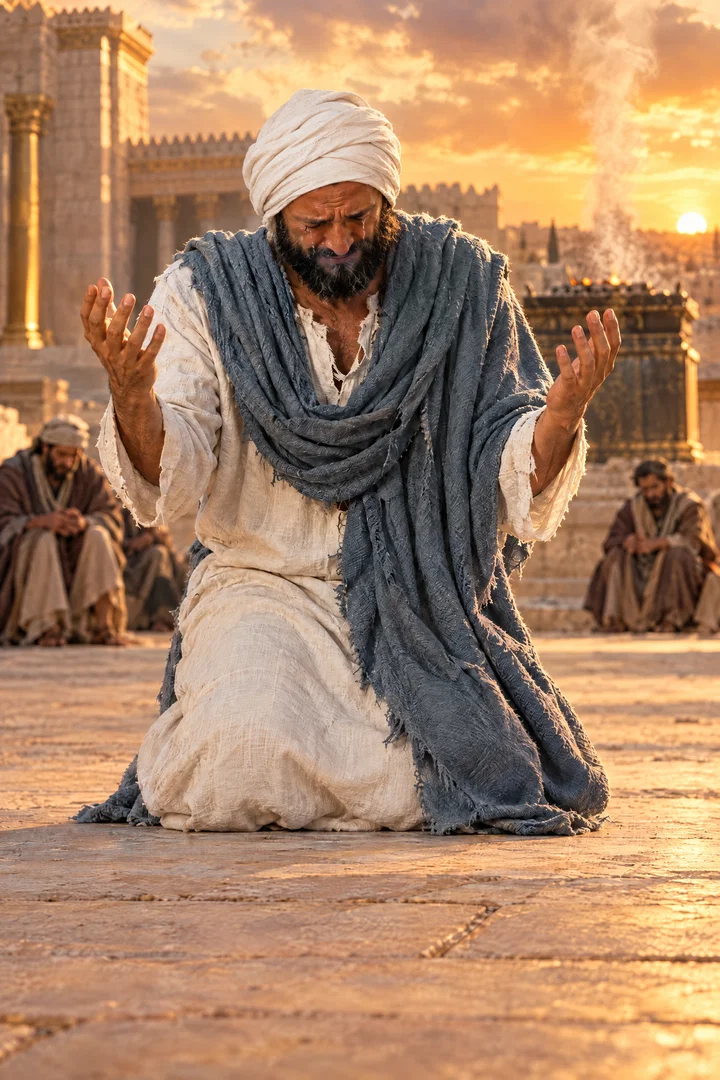
And when I heard this thing, I rent my garment and my mantle, and plucked off the hair of my head and of my beard, and sat down astonied.
Translations
And when I heard this thing, I rent my garment and my mantle, and plucked off the hair of my head and of my beard, and sat down astonished.
King James Version, Revised Version
And when I heard this thing, I rent my garment and my mantle, and plucked off the hair of my head and of my beard, and sat down astonied.
And when I heard this thing, I rent my garment and my mantle, and pluckt off the hair of my head and of my beard, and sat down astonied.
And when I heard this thing, I rent my garment and my mantle, and plucked off the hair of my head and of my beard, and sat down confounded.
And when I heard this thing, I rent my garment and my robe, and plucked off the hair of my head and of my beard, and sat down confounded.
And at my hearing this word, I have rent my garment and my upper robe, and pluck out of the hair of my head, and of my beard, and sit astonished,
And when I heard this thing, I rent my mantle and my garment, and plucked off the hair of my head and of my beard, and sat down overwhelmed.
When I heard this thing, I rent my garment, and my robe,—and tore out of the hair of my head and my beard, and sat stunned.
Berean Standard Bible, Majority Standard Bible
When I heard this report, I tore my tunic and cloak, pulled out some hair from my head and beard, and sat down in horror.
When I heard this thing, I tore my garment and my robe, and pulled the hair out of my head and of my beard, and sat down confounded.
And hearing this, with signs of grief and pulling out the hair of my head and my chin, I took my seat on the earth deeply troubled.
But when I heard this saying, I rent my clothes and my garment, and pluckt off the heare of mine head, and of my beard, and sate downe astonied.
Douay-Rheims (Challoner revision)
And when I had heard this word, I rent my mantle and my coat, and plucked off the hairs of my head and my beard, and I sat down mourning.
Pictures
Cross-references
- Deuteronomy 7:3-4
Neither shalt thou make marriages with them; thy daughter thou shalt not give unto his son, nor his daughter shalt thou take unto thy son.
The command against intermarriage warns that foreign spouses may turn Israel to other gods.
- Ezra 10:1-4
Now when Ezra had prayed, and when he had confessed, weeping and casting himself down before the house of God, there assembled unto him out of Israel a very great congregation of men and women and children: for the people wept very sore.
The people join Ezra in grieving, confessing, and resolving to end the forbidden marriages.
- Nehemiah 13:25
And I contended with them, and cursed them, and smote certain of them, and plucked off their hair, and made them swear by God, saying, Ye shall not give your daughters unto their sons, nor take their daughters unto your sons, or for yourselves.
Nehemiah confronts renewed intermarriage with surrounding nations.
- 2 Kings 22:11
And it came to pass, when the king had heard the words of the book of the law, that he rent his clothes.
Both describe mourning upon hearing the law of God.
- Joshua 23:12
Else if ye do in any wise go back, and cleave unto the remnant of these nations, even these that remain among you, and shall make marriages with them, and go in unto them, and they to you:
Warns that intermarriage with other nations violates religious fidelity.
- Judges 3:5-7
And the children of Israel dwelt among the Canaanites, Hittites, and Amorites, and Perizzites, and Hivites, and Jebusites:
Intermarriage with surrounding peoples led Israel to serve other gods.
- Ezra 10:18-44
And among the sons of the priests there were found that had taken strange wives: namely, of the sons of Jeshua the son of Jozadak, and his brethren; Maaseiah, and Eliezer, and Jarib, and Gedaliah.
Lists those who had married foreign wives.
Commentary
Each commentary is drawn from primary sources: the writings of Ellen G. White and Adventist pioneers and periodicals. Each commentary is separate. Its own words are not a quotation; follow the references to read the source passages.
Ellen G. White
3 sources
Ezra had just been told that the people of Israel, including the priests, the Levites, and chiefly the princes and rulers, had intermarried with the surrounding heathen peoples and mingled the holy seed.PK 620.1–621.2RH Feb 20, 1908 The laws thus transgressed had commanded Israel to remain separate, given as a safeguard against apostasy in order to spare them sad and humiliating experiences.PK 620.1–621.2RH Feb 20, 1908 Ezra knew from his study of the causes of the Babylonish captivity that mingling with heathen nations had largely caused Israel's terrible apostasy, and that obedience would have prevented those sad and humiliating experiences.PK 620.1–621.2RH Feb 20, 1908
His grief was sharpened by God's goodness in again giving His people a foothold in their native land notwithstanding the lessons of the past.PK 620.1–621.2 That men of prominence dared to transgress despite the plain lessons of the past made his heart inexpressibly sad, with intense agony of soul over such grievous sin by those with great light and privileges.RH Feb 20, 1908 His rending of garment and mantle, plucking off the hair of his head and beard, and sitting astonished expressed righteous indignation and grief and sorrow over such ingratitude and sin.PK 620.1–621.2RH Feb 20, 1908 He remained stunned until the evening sacrifice, joined by everyone who trembled at the words of the God of Israel because of the transgression of those who had been carried away.PK 620.1–621.2RH Feb 20, 1908
The verse also depicts the sorrow and mourning proper when it is understood that God's law has been disregarded and transgressed.Ms 12, 1894, par. 17–19 It is like what was felt when the lost law was brought and read, weeping and mourning with tears because the law had not been kept.Ms 12, 1894, par. 17–19 This involves confessing to children that God's law has been disregarded, bringing offerings and gifts and praise to God with tears and mourning, rejoicing that the law is now known, and resolving to lay hold of God's commandments and keep them and live.Ms 12, 1894, par. 17–19
Sources
Pioneers and periodicals
14 sources
When Ezra heard the report he tore his garment and his mantle, tore out hair from his head and beard, and sat down stunned in silent, motionless horror, for to be astonied is to be stunned or petrified.RH Sep 7, 1916ST Jun 2, 1909 What he had heard was that the returned people had dealt unfaithfully by entering forbidden alliances with the surrounding heathen nations through intermarriage and heathen practices, mingling the holy seed in compromise with sin and idolatry, with priests, Levites, princes and rulers involved.RH Dec 24, 1901RH Feb 7, 1907 His grief and astonishment were deepened because God had restored and favored them to be separate for His service, yet they returned to the very mingling that had largely caused the apostasy leading to the Babylonish captivity, and daring transgression by men of prominence with great light threatened their standing with God and brought inexpressible sadness and agony of soul.RH Feb 20, 1908RH Dec 24, 1901RH Jul 30, 1908 He remained in that stunned grief until the evening sacrifice, joined by all who trembled at the words of God over the transgression, and this opens his work of reform and revival to humble himself in pleading prayer and to restore the people and the church to purity by separating them from corruption and worldliness.RH Feb 20, 1908ST May 7, 1902RH Jul 30, 1908 That call to separation stands as a warning to read, consider, and obey God's counsel against marriage with those who do not share the faith before such choices bring painful regret, though that reform later waned as the people returned to worldly ways.RH May 2, 1871ST Jun 18, 1902
Grief and Historical Setting
When Ezra heard the report he tore his garment and his mantle, plucked off hair from his head and from his beard, and sat down stunned in silent, motionless horror.RH Sep 7, 1916ST Jun 2, 1909ST Jun 10, 1913ST May 7, 1902 His grief and astonishment were intense shock at the people's wrongdoing and unfaithfulness, and "astonied" means stunned or petrified.RH Sep 7, 1916ST Jun 2, 1909ST Jun 10, 1913ST May 7, 1902
What he had heard was that the returned people had acted unfaithfully by entering forbidden alliances and mingling with the surrounding heathen nations.RH Dec 24, 1901ST Jun 18, 1902 That mingling came through intermarriage with heathen peoples and joining themselves to heathen practices, a compromising with sin and idolatry in violation of God's commands.RH Dec 24, 1901ST May 7, 1902ST Jun 18, 1902 Those involved included the people of Israel, priests, Levites, and chiefly princes and rulers, so that the holy seed was mingled.RH Feb 20, 1908RH Dec 24, 1901
His profound grief and astonishment were deepened because God had restored the people to be separate for His service, yet after favor and deliverance they had returned to the old mingling.RH Dec 24, 1901 That mingling with the nations had largely caused the terrible apostasy that led to the Babylonish captivity, and God's command to keep separate was given as a safeguard against apostasy to spare them sad and humiliating experiences.RH Feb 20, 1908 That men of prominence dared to transgress despite the plain lessons of the past made his heart inexpressibly sad, and grievous sin by those with great light and privileges caused intense agony of soul and threatened their relationship with God.RH Feb 20, 1908RH Jul 30, 1908
The verse belongs to the restoration of the Jews at the close of the Babylonian captivity after the decree of Cyrus, in the days of Ezra and Nehemiah confirmed by Babylonian life.ST Jun 10, 1913ST Mar 10, 1909 Within the readings from Ezra 1 through Ezra 10 it stands with Zerubbabel as governor of Judea, the laying of the foundation of the second temple and its completion, and the decrees of Cyrus, Darius, and Artaxerxes.ST Jun 10, 1913 At that time after the captivity the people were widely ignorant of God's law and had departed from it.ST Feb 4, 1897 Chapters 9 and 10 describe Ezra's efforts to separate the people from the heathen and to prepare them spiritually to understand the importance of rebuilding Jerusalem.RH Feb 7, 1907
He remained in that stunned grief until the evening sacrifice.RH Feb 20, 1908ST May 7, 1902RH Jul 30, 1908 He was then joined by everyone who trembled at the words of God because of the transgression of those carried away.RH Feb 20, 1908
Reform and Present Warning
Ezra 9:3 opens the account of a reform and revival to restore the people and the church to purity by separating them from corruption and worldliness.ST Jun 2, 1909ST Jun 18, 1902ST Mar 1, 1910 That separation included putting away foreign wives and their children after unfaithful intermarriage with heathen practices.ST Jun 18, 1902 Ezra and other leaders gave direct testimony to bring about that reform.ST Mar 1, 1910 In his shock and shame at the forbidden alliances, even by rulers, Ezra humbled himself and pleaded with God for the people, remaining in grief until the evening sacrifice.RH Jul 30, 1908 His response helped the people recognize and confess their condition, bringing them to humility, to seeking God, and to receiving faithful reproof.ST Jun 2, 1909
That revival later waned, and the people returned to worldly ways.ST Jun 18, 1902
The verse stands as a warning about disregarding God's counsel against marriage with those who do not share the faith, to be read, considered, and obeyed before such choices bring painful regret.RH May 2, 1871
Sources