Ezra 9:6
And said, O my God, I am ashamed and blush to lift up my face to thee, my God: for our iniquities are increased over our head, and our trespass is grown up unto the heavens.
Translations
And said, O my God, I am ashamed and blush to lift up my face to you, my God: for our iniquities are increased over our head, and our trespass is grown up to the heavens.
And said, O my God, I am ashamed and blush to lift up my face to thee, my God: for our iniquities are increased over our head, and our trespass is grown up unto the heavens.
and said,O my God, I am ashamed and blush to lift up my face to thee, my God: for our iniquities are increased over our head, and our trespass is grown up unto the heavens.
And said, O my God, I am ashamed and blush to lift up my face to thee, my God: for our iniquities are increased over our head, and our trespass is grown up to the heavens.
and I said, O my God, I am ashamed and blush to lift up my face to thee, my God: for our iniquities are increased over our head, and our guiltiness is grown up unto the heavens.
and I said, O my God, I am ashamed and blush to lift up my face to thee, my God; for our iniquities are increased over our head, and our guiltiness is grown up unto the heavens.
and say, 'O my God, I have been ashamed, and have blushed to lift up, O my God, my face unto Thee, for our iniquities have increased over the head, and our guilt hath become great unto the heavens.
and said: O my God, I am ashamed and blush to lift up my face to thee, my God; for our iniquities are increased over [ our] head, and our trespass is grown up to the heavens.
and said, O my God, I turn pale and am ashamed, to lift up, O my God, my face unto thee,—for, our iniquities, have multiplied above the head, and our guilt hath magnified itself unto the heavens.
Berean Standard Bible, Majority Standard Bible
and said:“ O my God, I am ashamed and embarrassed to lift up my face to You, my God, because our iniquities are higher than our heads, and our guilt has reached the heavens.
and I said, “ My God, I am ashamed and blush to lift up my face to you, my God, for our iniquities have increased over our head, and our guiltiness has grown up to the heavens.
I said, O my God, shame keeps me from lifting up my face to you, my God: for our sins are increased higher than our heads and our evil-doing has come up to heaven.
And said, O my God, I am confounded and ashamed, to lift vp mine eyes vnto thee my God: for our iniquities are increased ouer our head, and our trespasse is growen vp vnto the heauen.
Douay-Rheims (Challoner revision)
And said: My God I am confounded and ashamed to lift up my face to thee: for our iniquities are multiplied over our heads, and our sins are grown up even unto heaven,
Pictures
Cross-references
- Deuteronomy 7:3-4
Neither shalt thou make marriages with them; thy daughter thou shalt not give unto his son, nor his daughter shalt thou take unto thy son.
The prohibition on intermarriage explains the trespass Ezra confesses.
- Daniel 9:7
O Lord, righteousness belongeth unto thee, but unto us confusion of faces, as at this day; to the men of Judah, and to the inhabitants of Jerusalem, and unto all Israel, that are near, and that are far off, through all the countries whither thou hast driven them, because of their trespass that they have trespassed against thee.
Both contrast God’s righteousness with shame over sin.
- Ezra 9:1-2
Now when these things were done, the princes came to me, saying, The people of Israel, and the priests, and the Levites, have not separated themselves from the people of the lands, doing according to their abominations, even of the Canaanites, the Hittites, the Perizzites, the Jebusites, the Ammonites, the Moabites, the Egyptians, and the Amorites.
Describes forbidden marriages and the resulting crisis confessed by Ezra.
- Nehemiah 1:6-7
Let thine ear now be attentive, and thine eyes open, that thou mayest hear the prayer of thy servant, which I pray before thee now, day and night, for the children of Israel thy servants, and confess the sins of the children of Israel, which we have sinned against thee: both I and my father’s house have sinned.
Nehemiah likewise confesses Israel’s sins before God.
- Ezra 10:1
Now when Ezra had prayed, and when he had confessed, weeping and casting himself down before the house of God, there assembled unto him out of Israel a very great congregation of men and women and children: for the people wept very sore.
prayer moved offenders to weep and confess
- Isaiah 66:2
For all those things hath mine hand made, and all those things have been, saith the LORD: but to this man will I look, even to him that is poor and of a contrite spirit, and trembleth at my word.
God looks with favor on the humble and contrite.
- Psalms 51:3
For I acknowledge my transgressions: and my sin is ever before me.
Both acknowledge transgressions and keep sin before them.
- Nehemiah 9:2
And the seed of Israel separated themselves from all strangers, and stood and confessed their sins, and the iniquities of their fathers.
The people confess their sins and the iniquities of their fathers.
- Jeremiah 2:22
For though thou wash thee with nitre, and take thee much soap, yet thine iniquity is marked before me, saith the Lord GOD.
Human washing cannot remove the iniquity marked before God.
- Ezra 9:15
O LORD God of Israel, thou art righteous: for we remain yet escaped, as it is this day: behold, we are before thee in our trespasses: for we cannot stand before thee because of this.
Ezra acknowledges God’s righteousness while confessing Israel’s guilt.
- Romans 3:23
For all have sinned, and come short of the glory of God;
Both texts affirm that all humanity has sinned before God.
- Psalms 3:3
But thou, O LORD, art a shield for me; my glory, and the lifter up of mine head.
God is described as the one who lifts up the head.
- Psalms 138:6
Though the LORD be high, yet hath he respect unto the lowly: but the proud he knoweth afar off.
The Lord regards the lowly but keeps the proud at a distance.
- Luke 18:13
And the publican, standing afar off, would not lift up so much as his eyes unto heaven, but smote upon his breast, saying, God be merciful to me a sinner.
Both express humble confession of sin before God.
Commentary
Each commentary is drawn from primary sources: the writings of Ellen G. White and Adventist pioneers and periodicals. Each commentary is separate. Its own words are not a quotation; follow the references to read the source passages.
Ellen G. White
7 sources
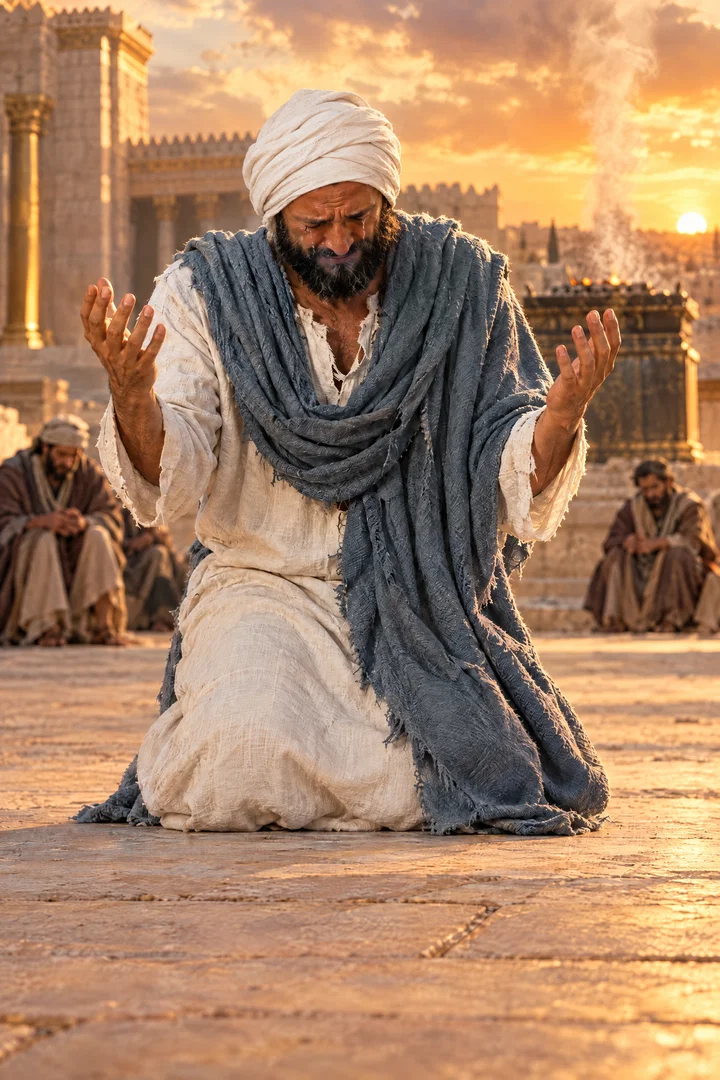
The prayer was offered at the time of the evening sacrifice after learning that Israel, including the priests, the Levites, and the princes and rulers, had intermarried with the surrounding heathen peoples in disobedience to God's command to remain separate.PK 620.1–621.2RH Feb 20, 1908 He prayed having arisen from heaviness with garment and mantle rent, fallen on his knees with hands spread to God.PK 620.1–621.2RH Feb 20, 1908Ms 84b, 1897, par. 1–8 Ashamed and blushing, he could not lift his face to God because iniquities had increased over the head and trespass had grown up to the heavens.PK 620.1–621.2RH Feb 20, 1908Ms 84b, 1897, par. 1–8
His shame expressed righteous indignation and grief at ingratitude after God's goodness in again giving His people a foothold in their native land.PK 620.1–621.2RH Feb 20, 1908 That ingratitude stood out despite the lesson of the Babylonian captivity that apostasy came largely from mingling with heathen nations in violation of laws given as a safeguard against apostasy.PK 620.1–621.2RH Feb 20, 1908 He made the people's sin his own, admitting his own sins and the sins of his people and entreating pardon as if he himself were the offender.RH Feb 20, 1908PK 675.2ST Jan 24, 1884
The prayer teaches kneeling as always the proper position when offering prayer to the Sovereign of the universe.21MR 59.1–60.1Ms 84b, 1897, par. 1–8 Bowing on the knees in public and private worship shows dependence on God, and the chapter containing the prayer is a precious lesson on this for the receptive heart.21MR 59.1–60.1 His humbling of himself in confession belonged to patient toil and prayer and suffering for reform.PK 675.2
The shame and blushing over iniquity increased over the head and trespass grown to the heavens means telling children that God's law has been disregarded, with sorrow like his own and like Josiah's when the lost law was found.Ms 12, 1894, par. 17–19 It means weeping and mourning with tears when the light of the law brings intelligent conviction of transgression, bringing offerings and gifts with praise to God in that mourning and rejoicing that the law is now possessed.Ms 12, 1894, par. 17–19 It means resolving to lay hold of God's commandments and keep them and live, so as not to come up to the judgment as transgressors putting Christ to open shame.Ms 12, 1894, par. 17–19
Sources
Pioneers and periodicals
25 sources
Ezra prays this at the evening sacrifice with garment rent, on his knees with hands spread toward God, making his people's sin his own though he had no personal part in it.RH Feb 20, 1908RH Feb 7, 1907ST Jan 7, 1889ST May 7, 1902 The occasion is Israel's forbidden mingling with surrounding nations in mixed marriages against God's safeguard laws, which had left priests and people morally demoralized and departed from the commandments.RH Feb 20, 1908RH Dec 24, 1901 To be ashamed and blush to lift the face means deep guilt and unwillingness to look up to God, with iniquities pictured as abundant and piled above the head and trespass as grown up to the heavens.RH Sep 7, 1916RH Jan 2, 1908RH May 20, 1862 It is a model of humble, contrite prayer that is short, direct and simple without vain repetition, and such prayer opens the way for God to work and leads sinners to weep, confess and retrace their steps.ST Feb 19, 1885RH Jul 10, 1860ST Apr 29, 1875RH Oct 7, 1909RH Sep 23, 1909 Human guilt here stands in contrast with God's righteousness with no ground for boasting, for sin grown to heaven cannot be washed by human effort and calls for trust in Jesus' full atonement, and honestly facing its weight is the hopeful path for God's people now.RH Jan 2, 1908RH Apr 27, 1911ST Jan 22, 1902RH Sep 12, 1871
Context and Meaning
The words open Ezra's prayer of confession after he learns of Israel's transgression.ST May 7, 1902 They belong to the latter part of the book, after the renewed and enlarged decree of Artaxerxes Longimanus recorded in Ezra 7, which deals with backsliding at Jerusalem, humility and seeking God, and faithful reproof.ST Jun 2, 1909 They stand in the account of the close of the Babylonian captivity and the restoration following the decree of Cyrus.ST Jun 10, 1913 They are bound up with Ezra's prayer and the beginning of Jerusalem's wall, expressing shame before God over great iniquity pictured as rising above the head and reaching to heaven.RH Aug 31, 1869
They belong to Ezra's work after carrying the last portion of the decree from Babylon to Jerusalem in the seventh year of Artaxerxes in 457 B.C., closing seventy-nine years from the first year of Cyrus in 536 B.C.RH Feb 7, 1907 That work was to separate the people from intermarriage with the heathen contracted during the more than half a century between the decree of Darius and the decree of Artaxerxes when nothing was done to forward the decree.RH Feb 7, 1907 It was to bring them into such spiritual condition that they could realize the importance of rebuilding Jerusalem.RH Feb 7, 1907 He had no personal part in the work until this last period, and mentions himself only as connected with carrying out the decree.RH Feb 7, 1907
The occasion was Israel's mingling with the surrounding nations in forbidden alliances and mixed and forbidden marriages, in transgression of laws given as a safeguard against apostasy.RH Feb 20, 1908RH May 20, 1862 The discovery shocked Ezra, for great numbers even among the priests had married strange wives and corrupted their homes so they could not serve the Lord in purity.RH Oct 7, 1909 The people were left morally demoralized, with little knowledge of the commandments, departed from the law, given to loose worship, immoral conduct, and mixing with the world, which grieved those seeking faithfulness.ST Feb 4, 1897 The chapter illustrates the consequences of departure from God's command and stands as warning and instruction about marriage choices, where any human effort to separate men from wives would bring conflict with a stubborn multitude.RH May 20, 1862RH May 2, 1871RH Oct 7, 1909
At the time of the evening sacrifice he prays with garment and mantle rent, fallen on his knees with hands spread to God, lying on his face in hopeless perplexity in earnest supplication.RH Feb 20, 1908RH Oct 7, 1909 He identifies himself with his people and makes their sin his own, pleading for pardon as though he himself had committed their sins.RH Feb 20, 1908ST Jan 24, 1884ST May 7, 1902 Their guilt leaves him unable to lift his face toward God, like a guilty person who hangs the head and fears facing the law.ST Jan 7, 1889
The language means deep shame and blushing before God and unwillingness to lift the face to Him.ST Jan 7, 1889ST Jan 22, 1902 Iniquities are pictured as great, grave, abundant and accumulated, increased over the head and risen above the people.RH Sep 7, 1916RH Jan 2, 1908RH May 2, 1871 Trespass is pictured as grown up unto the heavens, overwhelming and reaching as high as heaven.RH May 20, 1862ST Jan 22, 1902ST May 7, 1902 The confession springs from remembering God's goodness in giving His people a foothold again in their native land and mercy and help to restore Jerusalem, its worship, land and privileges.RH Feb 20, 1908ST Feb 19, 1885RH Dec 24, 1901 It is filled with righteous indignation and grief at their ingratitude in again disobeying after such mercy.RH Feb 20, 1908ST Feb 19, 1885RH Dec 24, 1901
Prayer Doctrine Application
Ezra's prayer is a pointed, expressive, direct and short model, taking about three minutes to repeat, showing how those who know how to pray lift the heart to commune with Heaven without wandering, without wearying fellow worshipers, without vain repetitions, and without many Ohs and Ahs, but tenderly, filially, directly, quietly and simply asking for the blessing desired as a child addressing One more willing to give good gifts than to be asked.ST Apr 29, 1875 Confession with shame and a sense of guilt become overwhelming is a fitting part of humble prayer when seeking mercy.RH Jul 10, 1860
It exemplifies contrition, humility and humble prayer that God hears.ST Feb 19, 1885 It is an example of the constant prayer by which Ezra and Nehemiah frustrated their enemies' plans during the rebuilding of Jerusalem, and it stands connected with the beginning of Jerusalem's wall.RH Sep 23, 1909RH Aug 31, 1869 Ezra lay on his face pleading to God for help in hopeless perplexity over the returned people, when great numbers even among the priests had married strange wives and corrupted their very homes so they could not serve the Lord in purity, and when any human effort to separate men from their wives would bring conflict with a stubborn and immovable multitude.RH Oct 7, 1909 His prayer opened a way when there was none and made it possible for the Omnipotent to work, so that when he finished the very men who had taken strange wives gathered about him weeping sorely, confessing sin and anxious to retrace their wrong steps.RH Oct 7, 1909
Prayer is the unfailing key to life's problems, giving power with God and with men and making weak and erring man a prince of heaven.RH Oct 7, 1909 God's Bible answer to such a prayer of shame from one feeling unworthy to lift up the face to Him because of sin is the command not to fear with the promise that He Himself is a shield and an exceeding great reward.ST Sep 25, 1893
The verse presents human guilt in contrast with God's righteousness, leaving no basis to boast in own righteousness.RH Jan 2, 1908 It shows the case of professed people as it stands before final judgment, having transgressed covenant and law with iniquities piled high above them and reaching heaven, dead in trespasses and sins and in desperate condition.RH Apr 27, 1911ST Jan 22, 1902 That guilty condition is accurately recorded without prejudice or partiality, cannot be washed away by any human effort, and merits death, so salvation must come through another.RH Apr 27, 1911 Guilt grown to heaven calls for trust in Jesus' full atonement.RH Feb 18, 1875
Ezra's earnest humiliation helped the people recognize their condition and confess, and practical separation from the forbidden alliances preceded their being taught the law, for their forbidden alliances with surrounding nations had left them morally demoralized. Honestly recognizing the weight of sin as Ezra did is a hopeful response for the Laodicean church.RH Nov 6, 1860 The prayer was offered at the appointed evening hour under the Jewish dispensation, when the pious Jew prayed while the priests interceded through sacrifice and incense, at the time of the daily morning lamb and evening lamb with meat offering and drink offering when God met Israel at the door of the tabernacle.RH Sep 12, 1871 It gives the pattern for now, when burnt offerings are gone and there is no holy temple to go up to, for every Christian family of husband and wife and children to assemble around the family altar at the morning and evening hour with grateful praise and earnest supplication, which goes up before the throne of mercy sweeter than any offering made by fire and where the Lord meets His children.RH Sep 12, 1871 True repentance turns from demons and idols and worldly customs, obeys the holy precepts, worships one God alone, cultivates the heart, seeks heavenly glories and everlasting life and happiness, bears fruits with overflowing joy, and turns from the miseries of hell.RH Feb 18, 1875
Sources