Galatians 3:17
And this I say, that the covenant, that was confirmed before of God in Christ, the law, which was four hundred and thirty years after, cannot disannul, that it should make the promise of none effect.
Translations
And this I say, that the covenant, that was confirmed before of God in Christ, the law, which was four hundred and thirty years after, cannot cancel, that it should make the promise of none effect.
King James Version, KJV Cambridge Paragraph Bible
And this I say, that the covenant, that was confirmed before of God in Christ, the law, which was four hundred and thirty years after, cannot disannul, that it should make the promise of none effect.
And this I say, that the covenant that was confirmed before by God in Christ, the law, which was four hundred and thirty years after, cannot disannul, that it should make the promise of no effect.
Now this I say; A covenant confirmed beforehand by God, the law, which came four hundred and thirty years after, doth not disannul, so as to make the promise of none effect.
Now this I say: A covenant confirmed beforehand by God, the law, which came four hundred and thirty years after, doth not disannul, so as to make the promise of none effect.
and this I say, A covenant confirmed before by God to Christ, the law, that came four hundred and thirty years after, doth not set aside, to make void the promise,
Now I say this, A covenant confirmed beforehand by God, the law, which took place four hundred and thirty years after, does not annul, so as to make the promise of no effect.
And, this, I say—a covenant previously confirmed by God, the law which, after four hundred and thirty years, hath been brought into being, doth not annul, so as to do away with the promise.
What I mean is this: The law that came 430 years later does not revoke the covenant previously established by God, so as to nullify the promise.
What I mean is this: The law that came 430 years later does not revoke the covenant previously established by God in Christ, so as to nullify the promise.
Now I say this: A covenant confirmed beforehand by God in Christ, the law, which came four hundred thirty years after, does not annul, so as to make the promise of no effect.
Now this I say: The law, which came four hundred and thirty years after, does not put an end to the agreement made before by God, so as to make the undertaking without effect.
And this I say, that the couenant that was confirmed afore of God in respect of Christ, the Lawe which was foure hundreth and thirtie yeeres after, can not disanull, that it shoulde make the promise of none effect.
Douay-Rheims (Challoner revision)
Now this I say, that the testament which was confirmed by God, the law which was made after four hundred and thirty years, doth not disannul, to make the promise of no effect.
Pictures
Cross-references 20 of 81
- Romans 4:13-16
For the promise, that he should be the heir of the world, was not to Abraham, or to his seed, through the law, but through the righteousness of faith.
Abraham’s promised inheritance comes through faith, not the law.
- Exodus 12:40-41
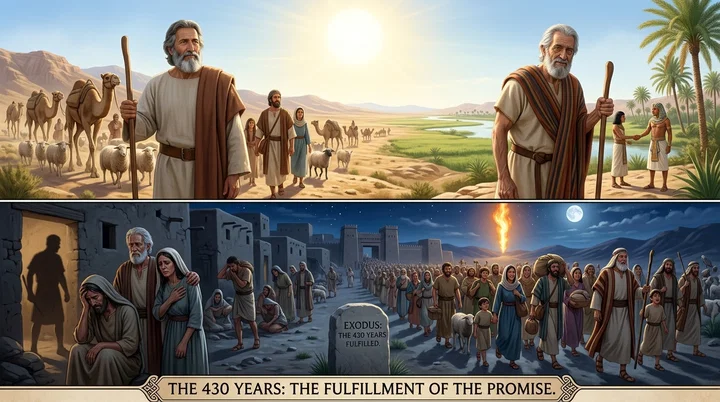
Now the sojourning of the children of Israel, who dwelt in Egypt, was four hundred and thirty years.
Gives the 430-year period from the promise through Israel’s deliverance from Egypt.
- Galatians 3:8
And the scripture, foreseeing that God would justify the heathen through faith, preached before the gospel unto Abraham, saying, In thee shall all nations be blessed.
The promise to Abraham is identified as the gospel preached beforehand.
- Genesis 12:1-3
Now the LORD had said unto Abram, Get thee out of thy country, and from thy kindred, and from thy father’s house, unto a land that I will shew thee:
God’s promise to Abraham begins the 430-year period and blesses all nations through him.
- Genesis 15:13
And he said unto Abram, Know of a surety that thy seed shall be a stranger in a land that is not theirs, and shall serve them; and they shall afflict them four hundred years;
The 400 years of affliction are reconciled with the 430-year span.
- Genesis 22:18
And in thy seed shall all the nations of the earth be blessed; because thou hast obeyed my voice.
Promises blessing to all nations through Abraham’s seed, identified with Christ.
- Galatians 3:29
And if ye be Christ’s, then are ye Abraham’s seed, and heirs according to the promise.
Those who belong to Christ are Abraham’s seed and heirs according to the promise.
- Genesis 26:5
Because that Abraham obeyed my voice, and kept my charge, my commandments, my statutes, and my laws.
Abraham’s obedience is linked to God’s promise renewed to Isaac.
- Exodus 19:5-8
Now therefore, if ye will obey my voice indeed, and keep my covenant, then ye shall be a peculiar treasure unto me above all people: for all the earth is mine:
Israel accepts the covenant’s obedience condition, contrasted with God’s prior promise to Abraham.
- Hebrews 6:13-18
For when God made promise to Abraham, because he could swear by no greater, he sware by himself,
God confirms his promise to Abraham with an oath, assuring its heirs of its certainty.
- Genesis 17:8
And I will give unto thee, and to thy seed after thee, the land wherein thou art a stranger, all the land of Canaan, for an everlasting possession; and I will be their God.
identifies the covenant as the land promise to Abraham
- Psalms 105:8-10
He hath remembered his covenant for ever, the word which he commanded to a thousand generations.
God’s covenant with Abraham is remembered and confirmed to Isaac and Jacob.
- Romans 4:11
And he received the sign of circumcision, a seal of the righteousness of the faith which he had yet being uncircumcised: that he might be the father of all them that believe, though they be not circumcised; that righteousness might be imputed unto them also:
Circumcision seals Abraham’s righteousness by faith, and he is father of all who share his faith.
- Romans 3:20
Therefore by the deeds of the law there shall no flesh be justified in his sight: for by the law is the knowledge of sin.
The law reveals sin and guilt but cannot justify anyone.
- Genesis 15:6
And he believed in the LORD; and he counted it to him for righteousness.
Abraham’s faith was counted to him for righteousness.
- Galatians 3:21
Is the law then against the promises of God? God forbid: for if there had been a law given which could have given life, verily righteousness should have been by the law.
The law cannot give life or annul God’s promise.
- Genesis 12:4
So Abram departed, as the LORD had spoken unto him; and Lot went with him: and Abram was seventy and five years old when he departed out of Haran.
Abram’s departure at age 75 marks the start of the 430-year count.
- Acts 7:6
And God spake on this wise, That his seed should sojourn in a strange land; and that they should bring them into bondage, and entreat them evil four hundred years.
The 400-year affliction fits the period associated with the 430 years.
- Exodus 20:1-17
And God spake all these words, saying,
The commandments were given at Sinai after the Abrahamic promise and could not annul it.
- Romans 3:31
Do we then make void the law through faith? God forbid: yea, we establish the law.
Faith does not void the law but establishes it.
Commentary
Each commentary is drawn from primary sources: the writings of Ellen G. White and Adventist pioneers and periodicals. Each commentary is separate. Its own words are not a quotation; follow the references to read the source passages.
Ellen G. White
3 sources
Four hundred and thirty years passed from the making of the covenant with Abraham to the giving of the law at Sinai.PP 760.2–3 The reckoning dates from the promise given to Abraham when he was commanded to leave Ur of the Chaldees, and it includes the time when Abraham, Isaac, and Jacob sojourned as strangers in Canaan before the descent into Egypt.PP 760.2–3 It therefore does not mean that the Israelites were in Egypt for four hundred years, for the actual time in Egypt was only about two hundred and fifteen years.PP 760.2–3 The four hundred years of affliction date from thirty years later than the promise to Abraham, about the time Ishmael persecuted Isaac.PP 760.2–3
The surrounding passage in Galatians 3:15-25 gives plain light about the covenants with clear and convincing evidence that every candid, unprejudiced mind would receive.Lt 59, 1890, par. 18–19 The covenant of grace given to Abraham belongs to Gentiles as well as to Jews.ST Mar 25, 1897 Those who knew nothing of circumcision are brought under that covenant, and the blessings given to the Jewish nation are given equally to Gentiles who accept Christ as Saviour.ST Mar 25, 1897
Efforts to make the passage produce a different position on the covenants waste investigative power for nothing and repeat a misconstruing, misinterpreting, and twisting of Scripture that hangs on words to make them mean what is wanted and creates false issues to cloud and mislead minds.Lt 59, 1890, par. 18–19 Turning from this plain light comes from fear of having to accept what it says about the law in Galatians.Lt 59, 1890, par. 18–19 No one is prepared to receive light to establish or refute a position on the passage until truly converted before God.Lt 59, 1890, par. 18–19
Sources
Pioneers and periodicals
93 sources
God confirmed his covenant of promise in Christ long before, so the law given four hundred and thirty years afterward cannot cancel, alter, or add to it to make the promise void.ST Feb 15, 1899ST Feb 8, 1899RH Feb 23, 1911ST Oct 10, 1900ST Dec 19, 1900 The inheritance is given freely as a gift by promise, not earned or obtained through law of any kind.ST Feb 15, 1899RH Feb 23, 1911ST Oct 3, 1906 That covenant is no bargain in which man gives something in exchange, for man has nothing to give; God freely promises all that is needed and man's part is only to accept and receive.ST Feb 8, 1899ST Oct 10, 1900 The four hundred and thirty years run from God's first promise and call to Abraham when he entered Canaan to the deliverance from Egypt and the giving of the law at Sinai.ST Sep 26, 1911ST Apr 20, 1888 The law was added in written form because of transgression to expose sin and condemn the sinner, serving as tutor to lead to Christ for justification by faith, not to justify or save or change the covenant from promise to works.ST Oct 3, 1906ST Feb 25, 1913ST Sep 2, 1886RH Jul 18, 1854ST Sep 1, 1909
Meaning of Key Terms
The covenant and the promise are one and the same thing, so that to disannul the covenant is to make the promise of none effect.ST Feb 8, 1899ST Oct 10, 1900ST Oct 10, 1900RH Feb 23, 1911ST Feb 15, 1899 The covenant is God's promise to Abraham to give him the land of Canaan, which is the whole world made new and free from the curse, for an everlasting possession.ST Feb 8, 1899ST Feb 15, 1899 God's covenant with men can be nothing else than promises to them, for it is unchangeable and its terms are fixed.ST Feb 8, 1899ST Oct 10, 1900 The later law, given four hundred and thirty years afterward, cannot void, alter, cancel, add to, or conflict with that earlier confirmed covenant so as to make its promise ineffective.ST Oct 10, 1900RH Feb 23, 1911ST Feb 15, 1899
God's covenant is not a mutual bargain in which man fulfills his part in exchange, because man has first given nothing to God and has nothing to give, being wretched and miserable and poor and blind and naked.ST Feb 8, 1899ST Oct 10, 1900 God promises man everything he needs and more as a free gift to be received without money and without price.ST Feb 8, 1899 Man's part is only to accept and receive, giving himself, that is nothing, and receiving God Himself, that is everything.ST Feb 8, 1899ST Oct 10, 1900
Confirmed before of God in Christ means the promise was secured in Christ by God's promise and oath before the law came.ST Jul 15, 1886ST Feb 22, 1899RH Apr 13, 1876 Christ Himself is the surety of the everlasting and new covenant, in whom every promise of God is yea and amen.ST Feb 8, 1899 In giving Christ for human sin God pledged Himself to human salvation, and because the whole universe depends on Christ He thereby pledged the universe to that salvation, valuing one trusting soul as highly as the universe.ST Nov 24, 1898 The same everlasting covenant made at the beginning when humanity sinned and renewed with Noah and Abraham was renewed and confirmed in Christ, the promised Seed to whom the promise was made, its provisions having been obscured through human corruption and now restored.RH Apr 1, 1915 It was confirmed in Christ in anticipation and finally ratified by Christ's blood at His death, so that no later change was possible.ST Jul 15, 1886 In Him the inheritance is already obtained, for the Holy Spirit is the first-fruits and pledge of the inheritance, and to possess the Holy Spirit is to have Christ Himself dwelling in the heart by faith.ST Feb 8, 1899 That oath remains the heirs' hope, comfort, and assurance, and Abraham received circumcision as the outward sign and seal of his faith in the promise.ST Feb 15, 1899RH Apr 13, 1876
In one view the law in the verse means the whole law system or dispensation, including moral and ceremonial elements as constituent parts, namely the Mosaic dispensation introduced four hundred and thirty years after the promise.RH Oct 8, 1857ST May 22, 1884ST May 22, 1884 It does not mean the Ten Commandments or the ceremonial law considered separately, for the moral law existed before Moses and continued after Christ.RH Oct 8, 1857RH Oct 8, 1857 This law gives the starting point for Paul's discussion, reckoned by adding the four hundred and thirty years to the chronological year associated with Genesis 12 and comparing the result with the chronological year of Exodus 20.RH Oct 8, 1857 God's covenant with Abraham that all nations would be blessed in Abraham and his seed, Christ, was not annulled by that law system introduced later, for the blessing was to come through Christ, not through the law on which the Jews relied.RH Apr 20, 1869
In a differing view the law in the verse means the moral law, the Ten Commandments stating unchangeable eternal principle, with the added typical rites being temporary.ST Sep 17, 1902RH Jul 25, 1854 The law that came at Sinai was twofold in this sense.ST Sep 17, 1902 Neither was newly created or first legislated at that time, for sacrifices and offerings were practiced from Cain and Abel and by Abraham at his stopping-places, and murder was already sin in the days of Cain and violation of the seventh commandment was already glaring sin in Sodom.ST Sep 17, 1902 Added therefore does not mean original creation, inventive promulgation, or legislation, but being reduced to written form because of transgressions.ST Sep 17, 1902 There is no justification in a broken though holy and just and good law, and redemption described in Galatians 4 is from that law's curse, which is not treated as the Levitical law.ST Feb 23, 1882RH Jul 25, 1854 The law only condemns, proves the transgressor a sinner, and thus leads him to seek a Saviour from his transgressions and the curse, for the law is not of faith and is distinct from faith and the gospel.ST Feb 23, 1882
The law came in written and formally announced form at Sinai and was added to the earlier covenant.ST Feb 25, 1913ST Jul 15, 1886RH Jan 28, 1902ST Sep 1, 1909 That earlier covenant included more than the promise, for circumcision was its stated sign.RH Jan 28, 1902 At Sinai God renewed this covenant with Israel, and together the renewed covenant and its ordinances, including the ceremonial law added at Sinai, are called the old covenant.RH Jan 28, 1902RH Jan 28, 1902 The covenant is the everlasting covenant of faith, made at the beginning when humanity sinned and later ratified by Jesus' death.ST Feb 25, 1913 The law is everlasting and points out sin but does not save from sin, being given in written form because of transgression to reveal sin and show the need for the help promised through the Abrahamic covenant, which is the same as the second covenant.ST Feb 25, 1913ST Jul 15, 1886ST Sep 1, 1909 The promise of the inheritance therefore remains a promise received through faith, contingent on Abraham's faith and involving the righteousness of faith and forgiveness of sins, not a reward for works or self-earned righteousness or human effort.ST Jul 15, 1886
The principles and requirements of God's law existed from creation and were already the foundation and condition of the Abrahamic covenant, which embodies His requirements and man's duty and therefore cannot be contrary to His own promise.RH Jan 1851ST Jul 15, 1886 Abraham was called to walk before God and be perfect, obeyed God's voice, charge, commandments, statutes and laws, kept the Edenic Sabbath set apart before humanity's fall, and commanded his children and household after him to keep the way of the Lord.ST Jul 15, 1886RH Dec 17, 1861ST Feb 26, 1880 God said the promise was renewed to Isaac because Abraham obeyed, and its commandments are also conditions of the second covenant, which is the same covenant made with Abraham.ST Jul 15, 1886 Those commandments were not necessarily identical in every respect to the law given at Sinai, though they shared some elements.RH Mar 25, 1873 What was added was God making perfect obedience to His law and the works of the law the condition on which He took Israel the literal seed of Abraham to be His people and on which they would receive the inheritance, instead of the righteousness of faith which was the condition of the promise to Abraham securing to Abraham and his seed the inheritance of the earth.RH Jan 1851 If the inheritance is of the law it is no more of promise, because if deeds of the law are made the ground of justification then justification by faith is made void, and since fallen guilty man cannot be justified by a law which already condemns him he could then have no hope of salvation.RH Jan 1851 The addition making works the condition was to continue only till the Seed should come to whom the promise was made, who is Jesus Christ, but the law itself did not expire at that point, and Christ's death emphasized its permanence rather than abolishing it.RH Jan 1851ST Jul 15, 1886 At the exodus at the end of the four hundred and thirty years God publicly entered into covenant with Israel and the people publicly accepted Him and His law, but this association did not make the Sabbath or the law Jewish in origin or ownership.RH Dec 17, 1861
In a differing position there is no evidence that Abraham kept the law, and the law was not added in Abraham's time but four hundred and thirty years after the promise.RH Mar 8, 1864
Four Hundred Thirty Years
The 430 years run from God's first promise and call to Abraham, when he left his homeland and entered Canaan as a wanderer, to the exodus and deliverance from Egypt and the giving of the law at Sinai immediately afterward.ST Sep 26, 1911ST Apr 20, 1888ST Jun 4, 1885RH Dec 3, 1867 The period is not 430 years in Egypt alone but sojourning in Canaan and Egypt together, comprising 215 years from the promise to Jacob's family going down into Egypt and 215 years of sojourn in Egypt.ST Jun 4, 1885ST Aug 9, 1910RH Aug 24, 1916 The first 215 years are 25 years from the promise to the birth of Isaac, 60 years from Isaac to Jacob, and 130 years from Jacob to the going down into Egypt.ST Apr 20, 1888ST Aug 9, 1910 Abraham was 75 when he left Haran, Isaac was born 25 years later, Jacob was born when Isaac was 60, and Jacob was 130 when he entered Egypt.ST Apr 20, 1888ST Aug 9, 1910
On this reckoning the period is dated from Abraham's call and entry into Canaan in 1921 B.C. to the law in 1491 B.C., with Egyptian bondage beginning about 1706 B.C. and lasting about 215 years.ST Aug 7, 1901 The promises were first given, renewed at different times, and later solemnly ratified and sealed as a covenant about 24 years after they were first given.RH Oct 25, 1853 This reckoning agrees with Exodus 12:40 that the sojourning included Canaan as well as Egypt, as shown by the Samaritan and Alexandrian Septuagint reading.ST Sep 26, 1911ST Aug 7, 1901 The Hebrew underlying the King James Version omitted words by mistake that would have made the Canaan sojourn explicit.ST Apr 30, 1894ST Aug 7, 1901
The 400 years of sojourning and affliction in Genesis 15:13 and Acts 7:6 are distinct and shorter, beginning about 30 years after the 430 years began.ST Sep 26, 1911ST Apr 20, 1888ST Aug 12, 1913 They began when Isaac was about five and Ishmael, born after the flesh, mocked Isaac, born after the Spirit, at weaning, while those who held otherwise reckoned them from the offering up of Isaac, the 400 years also being reckoned in round numbers as four centuries.ST Sep 26, 1911ST Apr 20, 1888ST Feb 4, 1889 About 185 of those 400 years were endured in Canaan and adjoining lands, with oppression by Canaanites as well as Egyptians.ST Apr 20, 1888RH Aug 24, 1916 The 430 years end at Israel's encampment at Sinai, and the laws for life in Canaan were received 430 years after the land was promised.ST Apr 20, 1888ST Feb 4, 1889ST Sep 17, 1902ST Aug 1, 1911
The long wait did not mean the promise failed.RH Dec 12, 1871 Abraham's descendants waited until the Canaanites were ripe for judgment and Egyptians and Israelites were ready to act, after which events moved swiftly.RH Dec 12, 1871 The span made the Passover a significant era for those expecting Christ's return.RH May 8, 1856
Promise Stands Despite Law
The covenant was confirmed beforehand by God in Christ, and the law given four hundred and thirty years afterward cannot disannul, cancel, alter, add to, or conflict with it so as to make the promise void or ineffective.ST Feb 15, 1899ST Feb 8, 1899RH Feb 23, 1911ST Oct 17, 1900RH Jan 23, 1900 The promise of the inheritance therefore remains a promise received through faith, not a reward for works or self-earned righteousness, made to Abraham and his Seed, Christ, and belonging to those who are Christ's.ST Feb 8, 1899RH Feb 23, 1911ST Jul 15, 1886 The inheritance and all it includes are secured by God's promise, not by the law, and the promise remains the basis of salvation for people who lived before, during, and after the giving of the law.RH Feb 23, 1911RH Jan 23, 1900ST Jul 15, 1886 The things given to Israel were not for Israel alone but were meant to lead Israel and all people to the full light and blessing of the Abrahamic covenant, which Israel was to pass on to the nations.RH Jan 23, 1900ST Jul 15, 1886
The sentence places the object before the action to stress that the later law cannot disannul the earlier covenant.ST Oct 10, 1900 God's covenant is unchangeable, its terms fixed, secured by promise and oath, and God cannot lie or take back what He promised.ST Oct 10, 1900ST Dec 19, 1900ST Feb 22, 1899ST Oct 17, 1900 The covenant with Abraham and his Seed was confirmed beforehand with the promised inheritance fixed in its terms, so the law given four hundred and thirty years afterward cannot alter the terms of the inheritance or set the promise aside.ST Dec 19, 1900ST Feb 22, 1899ST Oct 17, 1900 The promised inheritance is righteousness and the everlasting inheritance of righteousness, given to Abraham and his Seed, Christ, through promise and the righteousness of faith, not through the law.ST Feb 22, 1899ST Oct 17, 1900
Even a man's confirmed covenant cannot be disannulled or added to, and much more God's covenant, doubly confirmed in Christ, cannot be disannulled or added to.ST Sep 9, 1913 Nothing that came afterward can take the place of the covenant or be added to it, since the promises were made to Abraham and his Seed, which is Christ, and the covenant was confirmed beforehand by God in Christ.ST Sep 9, 1913 That covenant is the everlasting covenant to last to a thousand generations, and only forty-two generations passed from Abraham till Christ, so it remains in force and did not end at the cross as the sacrificial system that shadowed Christ's sacrifice did at His death.ST Sep 9, 1913 God keeps His covenant when men fail, and this is the hope of all the redeemed, for even today believing in Christ as Abraham did makes a person Abraham's child and heir of that eternal promise.ST Sep 9, 1913
The inheritance is granted as a gift by promise, not earned or obtained through law of any kind; if the inheritance is of law it is no more of promise, and the later law could not introduce any new feature or another way of gaining it.ST Feb 15, 1899RH Feb 23, 1911ST Oct 10, 1900RH Apr 16, 1908RH Jan 1851 The covenant confirmed in Christ is the same as the promise to Abraham and his Seed, conveying the land, even the whole earth made new, and including the making righteous of all who believe, which is done in Christ.ST Feb 15, 1899RH Apr 16, 1908RH Jan 1851 Since perfect righteousness and the inheritance were already assured by that covenant, the law spoken four hundred and thirty years later could not introduce any new feature or any other way of gaining the inheritance.ST Feb 15, 1899RH Jan 1851 The law of God which embodies His requirements and man's duty cannot be contrary to His own promise, and what was added was God making perfect obedience to His law the condition on which He took Israel the literal seed of Abraham to be His people, making the works of the law the condition of receiving the inheritance instead of the righteousness of faith which was the condition of the promise to Abraham.ST Oct 3, 1906RH Jan 1851 If deeds of the law are made the ground of justification then justification by faith is made void, and since fallen guilty man cannot be justified by a law which already condemns him he could then have no hope of salvation.ST Oct 3, 1906RH Jan 1851
The law was added in written form because of transgression: it exposes sin and serves as a tutor leading sinners to Christ for justification by faith.ST Oct 3, 1906RH Jan 1851 Until the fulfillment at Christ's second coming, the law continues to condemn sinners and the Spirit uses it to reveal sin.ST Oct 3, 1906 The addition making perfect obedience or works the condition of receiving the inheritance was to continue only till the Seed should come to whom the promise was made, who is Jesus Christ, but the law itself did not expire at that point.ST Oct 3, 1906RH Jan 1851
If the inheritance had to be gained in some other way so the promise became of no effect and the covenant made void, it would overthrow God's government and end His existence, because He pledged His own existence to give Abraham and his Seed the inheritance and the righteousness necessary for it.ST Feb 15, 1899 In Christ, God pledged Himself to humanity's salvation; because the whole universe depends on Christ, giving Christ for human sin pledged the universe to that salvation.ST Feb 15, 1899ST Nov 24, 1898 God values one trusting soul as highly as the universe, for the heirship of the world was not through the law but through the righteousness of faith.ST Feb 15, 1899ST Nov 24, 1898
This holds even for the Jewish people who received the law: they could not gain God's righteousness through law-keeping, but only by believing the gospel, the everlasting covenant, as Abraham did.RH Feb 23, 1911 The law, given four hundred and thirty years after God made the promise to Abraham and his Seed in Christ, could not cancel that promise or transfer the promised inheritance from Christ to the Jews.RH Feb 23, 1911RH May 23, 1854 The law did not give title to the inheritance; it was given because of transgressions and served as a guardian leading to Christ.RH Feb 23, 1911RH May 23, 1854 The Jewish nation held the land temporarily until the promised Heir came, while the inheritance belongs to Christ and to those who are in Him by faith.RH May 23, 1854
Inheritance in Christ
The promised inheritance is the land pledged to Abraham, which is Canaan enlarged to the whole earth as an everlasting possession, even the restored first dominion lost through disobedience, made new and free from the curse.ST Feb 15, 1899ST Feb 8, 1899RH Mar 3, 1853RH Feb 4, 1915 It includes perfect righteousness, the blessing of Abraham, and the making righteous of all who believe, which is done in Christ.ST Feb 15, 1899ST Feb 8, 1899 Receiving the promise of the Spirit through faith means receiving that inheritance of which the presence of the Spirit is the pledge and first-fruits, not merely the Spirit itself nor a promise of sometime future possession.ST Feb 8, 1899ST Feb 22, 1899ST Feb 8, 1899 Since perfect righteousness and the inheritance were already assured by the covenant confirmed in Christ, the law spoken 430 years later could not introduce any new feature or any other way of gaining the inheritance, for if the inheritance had to be gained in another way the promise would be made of no effect and the covenant made void.ST Feb 15, 1899RH Mar 3, 1853ST Feb 22, 1899 The heirship of the world was not through the law but through the righteousness of faith, and the inheritance was given by promise to be received through faith, ultimately as the eternal inheritance in the new heavens and new earth.ST Feb 15, 1899RH Mar 3, 1853
The promise was made to Abraham and his Seed, who is Christ, and it belongs to those who are Christ's by faith, who thereby become Abraham's children and heirs; the Seed thus includes Christ himself and all who belong to him.ST Jul 15, 1886RH May 5, 1851ST Apr 6, 1888RH Mar 3, 1853RH Apr 27, 1911 It is the gospel promise that God would bless the nations through faith, centered on Christ so that the blessing and the Spirit come to Gentiles as well as Jews through him.ST Jul 15, 1886RH May 5, 1851ST Apr 6, 1888RH Apr 27, 1911 Those who have faith in Christ are counted as Abraham's children and heirs of the promise, which remains a promise received through faith and not a reward for works or self-earned righteousness.ST Jul 15, 1886RH Apr 27, 1911 The law given at Sinai did not give title to the inheritance nor transfer it from Christ to the Jews, and it did not replace the promise or make the inheritance depend on keeping the law.ST Jul 15, 1886RH Mar 3, 1853RH May 23, 1854
The promise is the gospel of righteousness by faith and forgiveness of sins through Christ, by which Abraham was made righteous and made able to keep the law; his faith was counted to him for righteousness.RH Jan 1851ST Jul 15, 1886ST Dec 9, 1897 The covenant already contained the full provision for salvation, so Abraham was made righteous by faith in Christ and not by works of the law, with faith making him able to keep the law and with pardon and power restoring the law in the believer's heart unto freedom.RH Jan 1851ST Dec 9, 1897 Together with Galatians 3:8 this shows the gospel was preached to Abraham, including knowledge of a divine atonement, and Abraham's faith in Christ's death and resurrection was of the same nature as the faith now required for forgiveness and eternal life.ST Mar 10, 1887 If deeds of the law were made the ground of justification then justification by faith would be made void, and since fallen guilty man cannot be justified by a law which already condemns him he could then have no hope of salvation.RH Jan 1851ST Jul 15, 1886
Christ's birth began the fulfillment of the promise to inherit the world through his Seed but did not complete it, for the promise was not fulfilled at his first coming.ST Oct 3, 1906RH Mar 13, 1900 Neither was it fulfilled and enjoyed under the dispensation of the law when Israel entered Canaan and possessed it only a little while, the Jewish nation holding the land only temporarily until the promised Heir should come, and it is not to be fulfilled in this present world.RH Mar 13, 1900RH Jan 19, 1864RH May 23, 1854 It awaits fulfillment at his second coming and the resurrection, in the future world of glory and the new heavens and new earth, when the Seed to whom the promise was made receives the inheritance and the fullness of the everlasting covenant — the righteousness of God, the keeping of the commandments of God and the faith of Jesus — is met in believers.ST Oct 3, 1906RH Mar 13, 1900RH Jan 19, 1864 Until then the law continues to condemn sinners and the Spirit uses it to reveal sin, serving as tutor leading sinners to Christ for justification by faith.ST Oct 3, 1906RH May 23, 1854
God answered Abraham's question how he would know he would inherit by entering the blood covenant in which he pledged his life that the promise would never fail.RH Mar 13, 1900ST Feb 15, 1899 That oath, by which the promise was secured and solemnly ratified, remains the heirs' hope, comfort, and assurance that the inheritance of righteousness will never fail.RH Mar 13, 1900ST Feb 22, 1899ST Feb 15, 1899 In giving Christ, on whom the universe depends, for human sin, God pledged himself and the universe dependent on Christ to human salvation, valuing one trusting soul as highly as the universe.ST Feb 15, 1899ST Nov 24, 1898 In Christ himself as surety, in whom every promise is yea and amen, the inheritance is already obtained, for the Holy Spirit is the first-fruits of the inheritance and to possess the Holy Spirit is to have Christ himself dwelling in the heart by faith.ST Feb 8, 1899ST Nov 24, 1898ST Feb 8, 1899
Purpose of Added Law
The law came in written form 430 years after the promise because of transgression and unbelief, to expose sin, prove the transgressor a sinner, condemn him, and show his need for the help already promised in the Abrahamic covenant.ST Oct 3, 1906ST Feb 25, 1913ST Sep 1, 1909ST Feb 23, 1882RH May 23, 1854 It does not save from sin, though it is everlasting, holy, just and good, and there is no justification in a broken law.ST Feb 25, 1913ST Feb 23, 1882ST Jul 15, 1886 It was given to Israel at Sinai and did not give title to the inheritance or transfer it from Christ to the Jews, who held the land only temporarily until the promised Heir should come.RH May 23, 1854 The inheritance belongs to Christ and to those in Him by faith.RH May 23, 1854
It serves as tutor, schoolmaster and guardian to lead sinners to Christ for justification by faith and redemption from the curse.ST Oct 3, 1906RH Jul 18, 1854RH Aug 5, 1851RH May 23, 1854 It cannot justify, but Christ is the believer's righteousness, and the law vindicated in its majesty and permanence is in harmony with the gospel.ST Sep 2, 1886 It continues to condemn sinners, and the Spirit uses it to reveal sin until they come to Christ, and it continues to help believers remain with Christ.ST Oct 3, 1906ST Sep 2, 1886 If those under it had kept it in self-trust it would have failed to bring them to Christ and would have led them to seek justification by personal obedience instead of seeking the Saviour.RH Jul 18, 1854
The law was not given to justify offenders, to save from sin, or to change the covenant's character from promise and faith to works.ST Feb 25, 1913RH Jan 16, 1900ST Sep 1, 1909 The covenant with Abraham was of promise and faith, not of law and works, confirmed in Christ when made, and the law 430 years later could not cancel the promise or replace it with righteousness by works.RH Jan 16, 1900 The law is not of faith and is distinct from faith and the gospel.ST Feb 23, 1882ST Jul 15, 1886 Israel mistook its standing and the purpose of what God gave after the covenant, for had the covenant been faithfully held nothing further would have needed to enter, and as men fell into unbelief God gave instruction and means to lead them back.RH Jan 16, 1900
Everything God gave or ordained after the promise is by nature contributory to the promise when the promise is kept in view, and to use anything given afterward without holding the promise in view frustrates His purpose in giving it. Those gifts were meant to lead Israel back to the covenant's faith, light and blessing, and Israel was to pass that light and blessing to the nations, not keep it for itself alone.RH Jan 16, 1900RH Jan 23, 1900 This includes the written law on tables of stone at Sinai and in the Bible, which came in blessing to enable men to attain the fullness of the covenant and so the inheritance.RH Mar 13, 1900 It did this by bringing transgressions to a head and making sins abound, so men would find the grace of Christ much more abounding through faith unto the fullness of righteousness, which is the keeping of the commandments of God and the faith of Jesus, not met in believers until the second coming when the Seed receives the inheritance.RH Mar 13, 1900RH Jan 16, 1900
What was added was making perfect obedience to God's law, which embodies His requirements and man's duty, the condition on which He took Israel the literal seed of Abraham to be His people, making works of the law the condition of receiving the inheritance instead of the righteousness of faith which was the condition of the promise to Abraham.RH Jan 1851 At Sinai God referred Israel to the covenant already in force, and keeping it meant relying on God's promise, but Israel's choice to take responsibility for righteousness by personal obedience brought bondage.ST Mar 22, 1899 That separate covenant at Sinai, confirmed as the condition of another covenant to continue for a limited time, exposed weakness and sin because the law on which the Abrahamic covenant was founded had been violated and all were under the curse.RH Jul 18, 1854RH Jul 18, 1854 The Hagar scheme arose by forsaking the promise and trusting human effort, and the Sinai covenant represented by Hagar is thus seeking righteousness and inheritance through the flesh rather than trusting God's promise.RH Jun 12, 1900 The law was added because of transgression as an appendage and remained until Christ the promised Seed came.RH Mar 4, 1873
That addition was to continue only till the Seed should come to whom the promise was made, who is Jesus Christ.RH Jan 1851 If the inheritance is of law it is no more of promise, because if deeds of law are made the ground of justification then justification by faith is made void, and since fallen guilty man cannot be justified by a law which already condemns him he could then have no hope of salvation.RH Jan 1851 Through Christ the Mediator of that covenant men are redeemed from the curse so the promise may be inherited, and through Him Gentiles as well as Jews become Abraham's seed and receive adoption as sons by faith.RH Jul 18, 1854RH Jul 18, 1854 The law itself did not expire at that point.RH Jan 1851 The covenant was confirmed in Christ in anticipation and finally ratified by Christ's blood at His death, so no later change was possible, and His death emphasized the law's permanence rather than abolishing it, the commandments remaining also conditions of the second covenant which is the same covenant made with Abraham.ST Jul 15, 1886
Faith, Law, and Heirs
Salvation has always been by faith in Christ's righteousness, as it was for Abraham, and the written law given 430 years after the covenant promise did not cancel or alter that plan or make the promise ineffective.ST Sep 1, 1909ST Feb 21, 1906 The faithful of earlier ages were reconciled to God through faith in Christ, and as Abraham's children through the same faith they died trusting the promise without receiving it in their lifetime, with their hope resting in the promised inheritance.ST Jul 2, 1885 Faith does not create the freedom taught in the chapter but takes hold of what God has already accomplished and given, so that people may accept it and live free.ST Apr 5, 1899 The promise to Abraham that sinners would be justified by faith was confirmed in Christ and remained unchanged after the law was given at Sinai, for the law was given in written form because of transgression to reveal sin, not to save by human righteousness or to justify the offender.ST Sep 1, 1909RH Sep 28, 1905 The law therefore does not overturn the promise of justification by faith, through which the blessing reaches the nations.RH Sep 28, 1905ST Feb 21, 1906
The covenant confirmed to Abraham is the holy, everlasting, gospel covenant, later ratified by Jesus' death, made at the beginning when humanity sinned and renewed with Noah, Abraham, and Israel.ST Feb 25, 1913RH Apr 27, 1911RH Apr 1, 1915RH Apr 12, 1860 It is also called the new, or gospel, and second covenant, confirmed to Abraham in Christ by promise and oath and confirmed by Christ's blood, with its provisions obscured through human corruption and then renewed by Christ both to restore them and because the promise was made to him as the Seed.RH Apr 27, 1911RH Apr 1, 1915RH Jun 4, 1857 Its blessings include salvation through faith in Jesus and the restoration of what was lost in Adam's fall, and the inheritance comes by God's promise rather than by law or human effort.ST Feb 25, 1913RH Apr 12, 1860 That covenant is everlasting to a thousand generations, and since only forty-two generations passed from Abraham till Christ it remains in force and never will end, unlike the sacrificial system that shadowed Christ's sacrifice and met its fulfillment in his death; no law given 430 years afterward could conflict with, add to, change, or supersede it, even as no man can change a confirmed human covenant, and God keeps his covenant when men fail, which is the hope of all the redeemed.RH Apr 8, 1915ST Sep 9, 1913 Even today, believing in Christ as Abraham did makes a person Abraham's child and heir of that eternal promise, fulfilled in Christ, Abraham's seed.RH Apr 27, 1911ST Sep 9, 1913
The Ten Commandments are the basis and condition of that covenant, though the promise does not come through the law of Moses, nor is the promise apart from obedience to God's law.RH May 5, 1851RH Jul 18, 1854RH Apr 12, 1860 The moral law is the basis of the gospel covenant, and its later confirmation at Sinai did not mix it with or abolish it through the ceremonial law of types and shadows.RH Oct 7, 1851 The law of the Levitical priesthood is distinguished from God's moral law, and the better covenant established on better promises provides pardon through Christ and strength to obey God's law.RH Under the new covenant, grace forgives sin and removes the condemnation meant by being under the law, but it does not permit sin; grace writes God's law in the heart so that people keep and cherish it and live in harmony with it.ST Feb 20, 1912 The law is not against the promise, and its curse falls on transgressors, whose sin prevents them from receiving the promised blessing apart from redemption through Christ, so the covenant blessing is received through faith in Christ by those who claim God's promise.RH Jul 18, 1854
The argument vindicates the law's majesty and permanence while showing its harmony with the gospel, with the law serving the sinner by exposing sin and bringing the sinner to Christ, and continuing to help believers remain with Christ, while Christ is the believer's righteousness.ST Sep 2, 1886 It is a discussion of justification by faith, not an argument that those freed from past guilt should stop keeping the law, and it leaves the law of God still binding, with keeping the commandments of God together with the faith of Jesus defining holiness.RH Feb 20, 1872 The ceremonial law that pointed forward to Christ is distinguished from the Ten Commandments, which were the subject of the old covenant rather than the covenant itself, since the old covenant was the people's agreement to obey them and was ratified before God wrote them.ST Jan 3, 1878 The chapter does not abolish God's commandments but establishes and keeps them, restoring the law in believers' hearts and bringing freedom through pardon and the power to keep the law, for the covenant existed in substance from the beginning when sacrifices showed faith in a Savior whose blood would bring pardon. It must be read with its context in Galatians 4-5 and Romans 3 and 7, keeping distinct the purposes of pointing out sin and providing the remedy.
The covenant of grace belongs to Gentiles as well as Jews, for those who have faith in Christ are counted as Abraham's children and heirs of the promise, fulfilled in Christ, Abraham's seed.RH Apr 27, 1911 Jew and Gentile together who are Christ's constitute the true Israel of God, namely Abraham's seed which is Christ and all who are Christ's, receiving the same blessings, the restored kingdom, and adoption as sons.RH Jan 19, 1864RH Feb 4, 1915RH Mar 8, 1915 The promised inheritance is the lost dominion of the world restored through Christ's life and sacrifice to those who belong to him, and the law given 430 years later did not give title to that inheritance or transfer it from Christ to the Jews.RH Feb 4, 1915RH Mar 8, 1915RH May 23, 1854 The Jewish nation held the land temporarily until the promised heir came, while the inheritance belongs to Christ and to those in him by faith; it was not fulfilled and enjoyed under the dispensation of the law when Israel entered Canaan and possessed it only a little while, nor is it to be fulfilled in this present world, but remains to be fulfilled in the future world of glory to all heirs of promise.RH Jan 19, 1864RH May 23, 1854 Circumcision was the outward sign and seal of faith in the promise, and the seventh-day Sabbath, set apart before the fall and kept by Abraham, is the sign of accepting this renewed, everlasting covenant through which Abraham's blessing comes to the Gentiles and people receive the promised Holy Spirit through faith, rather than Jewish in origin.
Paul's argument was addressed to Gentile Galatians whom Judaizing teachers were urging to observe the Jewish ritual, which they had not observed before, so describing that appeal as a return is inaccurate.RH Aug 27, 1857 The children of Israel had by transgression forfeited the blessing of Abraham, so the Sinaitic law was added because of transgressions to convince them of sin and bring them to Christ, and since future obedience could not redeem them from past transgression, Christ was given to redeem them from the curse of the law that they might obtain Abraham's blessing. Those who continued to transgress and refused Christ therefore have no just claim to the blessing of either covenant and no right to be called the children of Israel or the children of Abraham.
Sources