Genesis 12:13
Say, I pray thee, thou art my sister: that it may be well with me for thy sake; and my soul shall live because of thee.
Translations
Say, I pray you, you are my sister: that it may be well with me for your sake; and my soul shall live because of you.
King James Version, KJV Cambridge Paragraph Bible, Webster Bible
Say, I pray thee, thou art my sister: that it may be well with me for thy sake; and my soul shall live because of thee.
Say, I pray thee, thou art my sister: that it may be well with me for thy sake, and that my soul may live because of thee.
Say, I pray thee, thou art my sister; that it may be well with me for thy sake, and that my soul may live because of thee.
say, I pray thee, thou [art] my sister, so that it is well with me because of thee, and my soul hath lived for thy sake.'
Say, I pray thee, thou art my sister, that it may be well with me on thy account, and my soul may live because of thee.
Say, I beseech thee that my sister, art thou,—to the end it may be well with me for thy sake, so shall my soul be preserved alive because of thee.
Berean Standard Bible, Majority Standard Bible
Please say you are my sister, so that I will be treated well for your sake, and on account of you my life will be spared.”
Please say that you are my sister, that it may be well with me for your sake, and that my soul may live because of you.”
Say, then, that you are my sister, and so it will be well with me because of you, and my life will be kept safe on your account.
Say, I pray thee, that thou art my sister, that I may fare well for thy sake, and that my life may be preserued by thee.
Douay-Rheims (Challoner revision)
Say, therefore, I pray thee, that thou art my sister: that I may be well used for thee, and that my soul may live for thy sake.
Pictures
Cross-references
- Genesis 20:5-9
Said he not unto me, She is my sister? and she, even she herself said, He is my brother: in the integrity of my heart and innocency of my hands have I done this.
The sister plea leads Abimelech to call taking another man’s wife a great sin.
- Genesis 26:9-10
And Abimelech called Isaac, and said, Behold, of a surety she is thy wife: and how saidst thou, She is my sister? And Isaac said unto him, Because I said, Lest I die for her.
Abimelech rebukes Isaac’s sister-wife deception for risking guilt through adultery.
- Genesis 12:18-19
And Pharaoh called Abram, and said, What is this that thou hast done unto me? why didst thou not tell me that she was thy wife?
The king rebukes Abram for the deception that led him to take Sarah.
- Genesis 20:2
And Abraham said of Sarah his wife, She is my sister: and Abimelech king of Gerar sent, and took Sarah.
Abraham again passed Sarah off as his sister.
- Genesis 20:14-16
And Abimelech took sheep, and oxen, and menservants, and womenservants, and gave them unto Abraham, and restored him Sarah his wife.
Abimelech also sent Abraham away with gifts.
- Genesis 27:19
And Jacob said unto his father, I am Esau thy firstborn; I have done according as thou badest me: arise, I pray thee, sit and eat of my venison, that thy soul may bless me.
Both involve deception, pointing to the need for Christ.
- Genesis 19:20
Behold now, this city is near to flee unto, and it is a little one: Oh, let me escape thither, ( is it not a little one?) and my soul shall live.
Lot says his soul will live if he escapes.
- Galatians 4:21-28
Tell me, ye that desire to be under the law, do ye not hear the law?
Hagar-bondage versus Sarah-freedom allegory
- Genesis 39:1-6
And Joseph was brought down to Egypt; and Potiphar, an officer of Pharaoh, captain of the guard, an Egyptian, bought him of the hands of the Ishmeelites, which had brought him down thither.
Both accounts describe a patriarch’s experience in Egypt.
Commentary
Each commentary is drawn from primary sources: the writings of Ellen G. White and Adventist pioneers and periodicals. Each commentary is separate. Its own words are not a quotation; follow the references to read the source passages.
Ellen G. White
4 sources
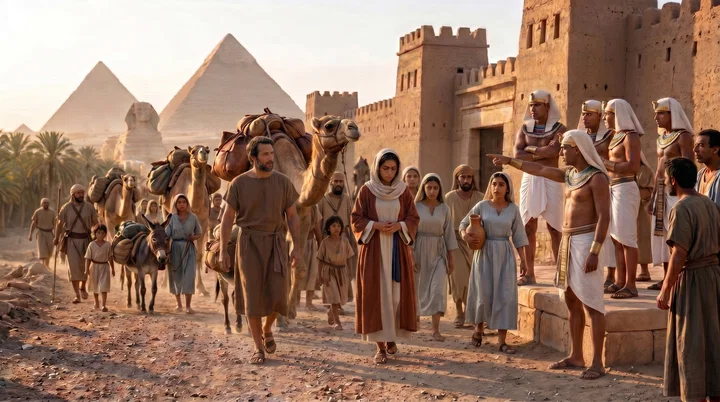
A severe famine in the land came as another trial for Abraham and caused him to move down into Egypt.Ms 19, 1886, par. 4 God gave him favor with the Egyptians there, so that when he left Egypt he had more than he had when he went in.Ms 19, 1886, par. 4 This saying belongs to that sojourn in Egypt, when his life and conduct were among the means through which God was revealed to the people around him.PP 368.2
It stands in the record of his sin and failure, showing that even one favored by God can be overcome by temptation and fall.ST May 31, 19104T 12.1–3 That failing was recorded as a warning to later generations that even believers can fall.ST May 31, 19104T 12.1–3 It was recorded also as encouragement that through God's grace those who struggled and fell can take heart and rise again, overcome, and keep pressing on.ST May 31, 19104T 12.1–3
Sources
Pioneers and periodicals
27 sources
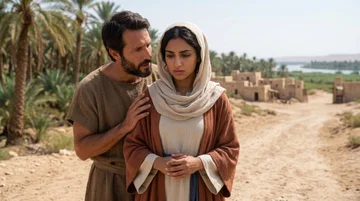
As he was about to enter Egypt to sojourn because of famine, Abram feared he would be killed because of his beautiful wife, so he asked her to say she was his sister that he might be treated well and kept alive for her sake.ST Jul 31, 1901RH Aug 29, 1912ST Jan 29, 1885ST Aug 11, 1914ST May 17, 1899 By my soul he meant himself, his life and person, showing that the soul is the whole man who can die and need to be spared.RH Apr 25, 1871ST Jan 30, 1879RH Jun 8, 1916 The request was unbelief and untruthfulness, putting his own safety ahead of truth and trusting human scheming instead of God's protecting care and promise to bring forth the Seed through Sarah.AUST Jun 14, 1920ST Sep 28, 1915ST Mar 10, 1887RH Aug 29, 1912ST May 17, 1899 It was a lie God did not approve, repeated later before Abimelech, leaving a stain even on a good man and proving that the strongest fail where they are strongest.ST Dec 29, 1909ST Sep 8, 1898ST Apr 13, 1882ST Jan 29, 1885 Yet the taking of Sarah and the plea of innocency because she was called his sister prove taking another man's wife was already known as sinful adultery long before Sinai, and the failure stands recorded as a warning that sin brings consequences, and as encouragement that through God's overruling providence those who fall may rise again.ST Jan 2, 1912ST Dec 29, 1909ST May 4, 1882RH Jan 15, 1875ST Jun 3, 1875
Words and Egyptian Setting
The words were spoken by Abram to Sarai as he was about to enter Egypt.RH Apr 25, 1871 There “my soul” means Abram himself, the whole man, the same as I or myself.RH Apr 25, 1871 It is used in the same sense as the souls gotten in Haran.RH Apr 25, 1871 It shows the soul can die, for Abram believed his soul, that is himself, might die, and he was not immortal even in his soul.RH Apr 25, 1871
The Hebrew nephesh translated “my soul” means his life, his individuality or person, not an entity with the qualities commonly assigned to the soul.ST Jan 30, 1879RH Jun 8, 1916 Abram meant his life might be killed and could die and needed to be spared.ST Jan 30, 1879RH Jun 8, 1916 Fearing he would be killed because of his wife, he asked her to say she was his sister so that it would go well with him for her sake and he would be treated well and kept alive.ST Jan 30, 1879RH Jun 8, 1916RH Aug 29, 1912ST Jan 29, 1885ST May 17, 1899
The verse belongs to Moses’ inspired patriarchal history, which records God’s dealings with the human family up to the Exodus.ST Jul 31, 1901ST Aug 11, 1914 It tells how Abram went down into Egypt to sojourn there because of famine.ST Jul 31, 1901 That account of the sojourn in Egypt is remarkably accurate in its details about Egypt and its customs.RH Nov 9, 1916 After God manifested divine judgments in his behalf so that fear fell upon the Egyptians, Abram came out of Egypt with great substance.ST Jul 31, 1901 Pharaoh sent his household on its journey enriched with rich gifts and goodwill.ST Jul 31, 1901RH Mar 18, 1915
Failure of Faith Recorded
The verse shows imperfect faith and unbelief in God's protecting care, for fearing for his safety and life on entering Egypt Abram asked Sarai to say she was his sister, relying on deception instead of trusting God's protection.AUST Jun 14, 1920ST Mar 10, 1887 Even a great believer did not always trust God, and fear in Egypt led him to put his own safety ahead of telling the truth about his marriage so that he would be treated well because of her and spared from death.ST Mar 10, 1887RH Aug 29, 1912 Unable to believe God's promise to bring forth the Seed through Sarah, he tried by human scheming to help God out.ST Sep 28, 1915 That staggering in faith contrasts with his later trust in God's promise, and it led only to bondage and trouble, unlike Isaac who came contrary to human order by the power and promise of God and represents the children of freedom saved through the new covenant.ST Sep 28, 1915ST May 17, 1899
Though Abram was the man of faith, he failed in his strongest point, faith.ST Apr 13, 1882 This proves the strongest men fail where they are strongest, and warns against self-confidence and depending on one's own strength instead of God.ST Apr 13, 1882 The act was equivocation, untruthfulness and a lie before Pharaoh, when he told Sarah to say she was his sister so that he might be treated well and spared because of her.ST Jan 29, 1885RH Dec 9, 1862 It was a sin, not something God approved, and this fear-driven lack of truthfulness before Pharaoh was later repeated in untruthfulness before Abimelech.ST Sep 8, 1898ST Jan 29, 1885 The recorded failure left a stain on his character and brought reproach on the truth, showing that even a good man's holiness was marred by sin so that perfect, untarnished holiness is not found in human beings.ST Apr 7, 1881RH Dec 9, 1862
Sin brings its consequences sooner or later, and the account shows the wrongdoing of a former servant of God and the punishment that followed, as God providentially cared for the promised Seed and dealt with His children.ST Dec 29, 1909ST Jan 29, 1885 The failure is recorded as a warning, yet also as encouragement that even a man favored by God could be overcome by temptation and that through God's grace those who fall can take heart and rise again.ST May 31, 1910 Though the failure brought reproach, the cause of God itself remained pure.ST Apr 7, 1881 This failure, along with other failures after leaving Haran, preceded his final great test.ST Sep 8, 1898
Doctrine Prophecy and Witness
The request to say she was his sister led to her being taken by the king, and the king's plea that he had acted in integrity of heart and innocency of hands because she was said to be his sister shows taking another man's wife was already recognized as sinful.ST May 4, 1882RH Jan 15, 1875ST Jun 3, 1875RH Oct 18, 1853 His charge that this had brought a great sin upon him and his kingdom proves that act was already known to be sinful adultery.RH Jan 15, 1875ST Jun 3, 1875RH Oct 18, 1853 The episode therefore proves the seventh commandment was known and binding on mankind long before it was spoken on Sinai.ST May 4, 1882RH Jan 15, 1875ST Jun 3, 1875RH Oct 18, 1853 Genesis 12 supplies the chronological starting point for the 430 years given by Paul, which when added to its chronological year identifies the time associated with the law's beginning at Exodus 20.RH Oct 8, 1857
The verse belongs to Abram's sojourn and to a period marked by repeated lessons and trials of faith with notable evidence of God's overruling providence.ST Jan 2, 1912 It belongs to the story of Abraham and the generations after him, in which God providentially cared for the promised Seed and dealt with His children, while also illustrating that sin brings its consequences sooner or later.ST Dec 29, 1909 The going down into Egypt because of famine to sojourn there, followed by coming out with great substance after God manifested divine judgments in his behalf so that fear fell upon the Egyptians and they enriched him with gifts, foreshadows the later experience of his posterity centuries later.ST Jul 31, 1901 They likewise went into Egypt because of famine, sojourned there, were vindicated through divine judgments that put fear upon the Egyptians, and went out enriched with great substance.ST Jul 31, 1901
In Egypt Abram presenting himself as Sarah's brother stands as a witness who made the living God known. Because of lack of faith he was sent away from Egypt, as shown in Genesis 12:11-20, and so he did not extend the light of God to the Egyptians.RH Jan 2, 1913 His deception about his wife proves even the best men in the Mosaic dispensation were sinners who deceived and falsified and committed the same sins people commit today, like Cain killing, Jacob deceiving, Achan stealing, and David committing murder and adultery.ST Apr 8, 1897 It shows sinners then needed pardon just as now, and those who repented were pardoned through Christ.ST Apr 8, 1897 There is one Saviour for all men in both the Mosaic and Christian dispensations, because pardon comes only through divine blood, and the blood of Christ is the only divine blood ever shed in this world.ST Apr 8, 1897
Sources