Genesis 12:18
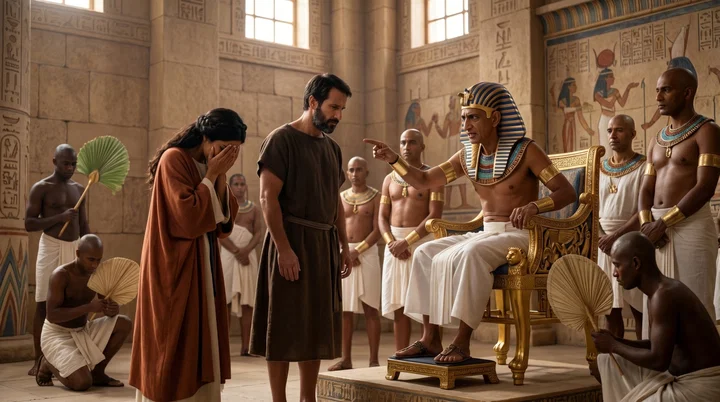
And Pharaoh called Abram, and said, What is this that thou hast done unto me? why didst thou not tell me that she was thy wife?
Translations
And Pharaoh called Abram and said, What is this that you have done to me? why did you not tell me that she was your wife?
King James Version, KJV Cambridge Paragraph Bible, Revised Version, American Standard Version
And Pharaoh called Abram, and said, What is this that thou hast done unto me? why didst thou not tell me that she was thy wife?
And Pharaoh called Abram, and said, What is this that thou hast done to me? why didst thou not tell me that she is thy wife?
And Pharaoh calleth for Abram, and saith, 'What [is] this thou hast done to me? why hast thou not declared to me that she [is] thy wife?
And Pharaoh called Abram, and said, What is this thou hast done to me? Why didst thou not tell me that she was thy wife?
And Pharaoh called out to Abram, and said, What is this thou hast done to me? Wherefore didst thou not tell me, that she was, thy wife?
Berean Standard Bible, Majority Standard Bible
So Pharaoh summoned Abram and asked, “ What have you done to me? Why didn’t you tell me she was your wife?
Pharaoh called Abram and said, “ What is this that you have done to me? Why didn’t you tell me that she was your wife?
Then Pharaoh sent for Abram, and said, What have you done to me? why did you not say that she was your wife?
Then Pharaoh called Abram, and saide, Why hast thou done this vnto me? Wherefore diddest thou not tell me, that she was thy wife?
Douay-Rheims (Challoner revision)
And Pharao called Abram, and said to him: What is this that thou hast done to me? Why didst thou not tell me that she was thy wife?
Pictures
Cross-references
- Genesis 20:9
Then Abimelech called Abraham, and said unto him, What hast thou done unto us? and what have I offended thee, that thou hast brought on me and on my kingdom a great sin? thou hast done deeds unto me that ought not to be done.
Abimelech rebukes Abraham for concealing Sarah’s marriage and calls his act a great sin.
- Genesis 26:9-10
And Abimelech called Isaac, and said, Behold, of a surety she is thy wife: and how saidst thou, She is my sister? And Isaac said unto him, Because I said, Lest I die for her.
Isaac’s concealment likewise brings a warning of guilt for taking another man’s wife.
- Genesis 12:12-13
Therefore it shall come to pass, when the Egyptians shall see thee, that they shall say, This is his wife: and they will kill me, but they will save thee alive.
Abram’s sister claim leads Pharaoh to take Sarai and rebuke him.
- Genesis 20:14-16
And Abimelech took sheep, and oxen, and menservants, and womenservants, and gave them unto Abraham, and restored him Sarah his wife.
Abimelech also sends Abraham away with gifts.
- Psalms 105:14-15
He suffered no man to do them wrong: yea, he reproved kings for their sakes;
Recalls God reproving kings to protect Abraham and his descendants.
Commentary
Each commentary is drawn from primary sources: the writings of Ellen G. White and Adventist pioneers and periodicals. Each commentary is separate. Its own words are not a quotation; follow the references to read the source passages.
Ellen G. White
4 sources
The rebuke belongs to Abraham's further trial when severe famine in the land drove him down into Egypt.Ms 19, 1886, par. 4 Pharaoh confronted Abram after discovering that Sarai was his wife, reproaching him for concealing the marriage and asking why he had not told him.PP 130.1–2PP 368.2 The concealment had put Sarai in danger, since it could have led Pharaoh to take her as his wife.PP 130.1–2
The episode stands as a record of failure showing that even a man entrusted with great responsibilities can yield to temptation and sin.ST May 31, 1910 Yet God gave Abraham favor with the Egyptians, so that he left Egypt with more than he had when he entered.Ms 19, 1886, par. 4 Through Abraham God was made known in Egypt, as his integrity and benevolence represented God among the surrounding peoples.PP 368.2
The account of this failure is preserved as a warning and lesson.ST May 31, 1910 Believers can rise again through God's grace, which encourages others to renew their struggle against sin.ST May 31, 1910
Sources
Pioneers and periodicals
20 sources
Pharaoh confronted Abram after Sarai had been taken into his house on Abram's word that she was his sister, once he learned she was Abram's wife and demanded why the marriage had been hidden from him.ST May 4, 1882ST Jun 3, 1875RH Jan 2, 1913 Abram's withholding of the truth showed imperfect faith, for he did not fully trust God to protect him and yielded to temptation as even a man of faith may do under worldly influence.ST May 31, 1910ST Dec 20, 1910AUST Jun 14, 1920RH Jan 2, 1913ST Mar 10, 1887 The rebuke proves that taking another man's wife was already known, even by a heathen king, to be sinful adultery and a great wrong that would bring guilt upon the taker and his kingdom.RH Aug 17, 1876ST May 4, 1882RH Jan 15, 1875ST Jun 3, 1875 His lie was not approved by God but is recorded as a warning that sin brings trouble and is reaped sooner or later, yet the account stands within God's providential care for Abraham's family as the chosen line through which the promised Seed would come.ST Dec 29, 1909ST Dec 20, 1910STRH Jan 2, 1913ST Jan 29, 1885
Encounter In Egypt
The Pharaoh who called Abram to account was not designated by a personal name, for Pharaoh was the title borne by successive kings of Egypt, probably meaning father of the country.RH Nov 12, 1861 The rebuke belongs to the sojourn in Egypt recorded in Genesis 12:10-20, a historically accurate account whose details reflect familiarity with Egypt and its customs.RH Nov 9, 1916 After Sarai had been taken into Pharaoh's house on Abram's word that she was his sister, Pharaoh discovered she was Abram's wife and confronted him, asking why he had concealed the marriage and had not told that she was his wife.ST May 4, 1882ST Jun 3, 1875RH Jan 2, 1913RH Oct 18, 1853
Abraham's experience in Egypt matches that of his descendants centuries later, for both went down into Egypt because of famine and sojourned there, divine judgments manifested in Abraham's behalf caused fear of him to fall upon the Egyptians, and enriched by gifts of the Egyptians he went out with great substance, as Israel later did.ST Jul 31, 1901 In Egypt Abraham made known the living God, so that Egypt was given an opportunity to receive God's light through him.RH Jan 2, 1913 Yet after the confrontation over the concealed marriage, which had brought trouble upon Pharaoh's household through Abram's withholding of the truth, he left without sharing that light.RH Jan 2, 1913
Genesis 12 contains God's first promise to Abraham, and the time from that promise to Israel's departure from Egypt is counted as 430 years, with the 400-year period of affliction reckoned as beginning thirty years later.ST Jan 21, 1913
Law Known Before Sinai
The taking of Sarai in Genesis 12:14-20 was a taking of another man's wife, and as such it violated the tenth commandment against coveting, which shows that commandment was known and could be broken before the law was proclaimed at Sinai.ST Jun 6, 1906 Pharaoh's rebuke to Abram for hiding that Sarai was his wife proves that taking another man's wife was already known among mankind to be sinful adultery.RH Aug 17, 1876RH Jan 15, 1875ST Jun 3, 1875RH Oct 18, 1853 That knowledge means the prohibition of the seventh commandment existed and was understood long before it was spoken from Mount Sinai.RH Aug 17, 1876RH Jan 15, 1875ST Jun 3, 1875RH Oct 18, 1853 Even a heathen king of Egypt understood that taking another man's wife was forbidden.RH Aug 17, 1876ST Jun 3, 1875
The confrontation after Sarai had been taken into Pharaoh's house on Abram's word that she was his sister centers on the question why Abram concealed that she was his wife.ST May 4, 1882ST Jun 3, 1875RH Oct 18, 1853 It treats taking another man's wife as a great sin and a serious wrong.ST May 4, 1882RH Jan 15, 1875ST Jun 3, 1875RH Oct 18, 1853 That wrong would bring guilt upon the taker and upon his kingdom.ST May 4, 1882RH Jan 15, 1875ST Jun 3, 1875RH Oct 18, 1853 Pharaoh understood he had been led toward that great sin against Abram and his kingdom, and Abram's deception in withholding the truth was the cause that led him toward it.RH Jan 15, 1875
Unbelief Failure And Providence
Abram's statement that Sarai was his sister and his withholding of the truth that she was his wife showed imperfect faith and unbelief, for he did not fully trust God to protect him.AUST Jun 14, 1920RH Jan 2, 1913ST Mar 10, 1887 That lack of faith led him to conceal the marriage and brought trouble upon Pharaoh's household.RH Jan 2, 1913 His conduct shows that even a person known for faith can fail to trust God.ST Mar 10, 1887 The rebuke belongs to the larger story in Genesis 12 to 21 in which Abraham tried to carry out God's promise by human scheming and self-devised planning to help God out instead of believing God's power and promise.ST Sep 28, 1915 This was not God's plan and only led to bondage and trouble, in contrast to Sarah the freewoman and Isaac the child born contrary to human order by the power and promise of God, who represents the children of freedom saved in Christ Jesus through the new covenant.ST Sep 28, 1915
The verse illustrates the influence of worldly associations upon a good man within God's progressive dealings with Abram.ST Dec 20, 1910 It shows that even a man entrusted with great responsibilities could yield to temptation and sin, and that even one known for faith can fail to trust God.ST May 31, 1910ST Mar 10, 1887 Abram's lie was not approved by God but is recorded as a warning that sin brings consequences.ST Jan 29, 1885 That warning was seen in the trouble brought upon Pharaoh's household, and in the truth that sin may not bring an immediate warning or consequence but its fruit is reaped sooner or later.ST Dec 29, 1909RH Jan 2, 1913 Abram's mistake left a stain on his character and brought reproach on the truth, but it did not destroy the cause of God, which remained pure.ST Apr 7, 1881
The account of such failure is preserved as a warning and lesson, while the fact that believers can rise again through God's grace encourages others to renew their struggle against sin.ST May 31, 1910 The verse stands within God's progressive dealings with Abram and His providential care and interest in people.ST Dec 20, 1910 It is part of His providential care for the promised Seed and His dealings with His children, especially His providential dealings with Abraham's family as the chosen line through which the promised Seed would come.ST Dec 29, 1909ST
Sources