Genesis 21:12
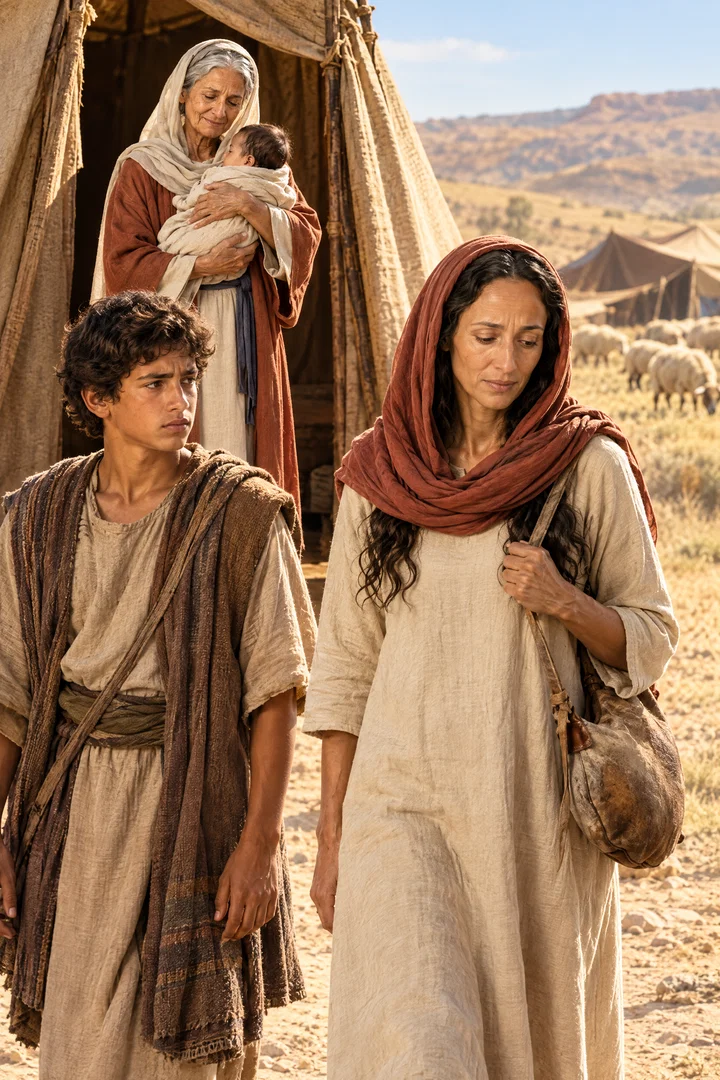
And God said unto Abraham, Let it not be grievous in thy sight because of the lad, and because of thy bondwoman; in all that Sarah hath said unto thee, hearken unto her voice; for in Isaac shall thy seed be called.
Translations
And God said to Abraham, Let it not be grievous in your sight because of the lad, and because of your female slave; in all that Sarah has said to you, listen to her voice; for in Isaac shall your seed be called.
King James Version, KJV Cambridge Paragraph Bible
And God said unto Abraham, Let it not be grievous in thy sight because of the lad, and because of thy bondwoman; in all that Sarah hath said unto thee, hearken unto her voice; for in Isaac shall thy seed be called.
And God said to Abraham, Let it not be grievous in thy sight, because of the lad, and because of thy bond-woman; in all that Sarah hath said to thee, hearken to her voice: for in Isaac shall thy seed be called.
And God said unto Abraham, Let it not be grievous in thy sight because of the lad, and because of thy bondwoman; in all that Sarah saith unto thee, hearken unto her voice; for in Isaac shall thy seed be called.
And God said unto Abraham, Let it not be grievous in thy sight because of the lad, and because of thy handmaid; in all that Sarah saith unto thee, hearken unto her voice; for in Isaac shall thy seed be called.
and God saith unto Abraham, 'Let it not be wrong in thine eyes because of the youth, and because of thy handmaid: all that Sarah saith unto thee — hearken to her voice, for in Isaac is a seed called to thee.
And God said to Abraham, Let it not be grievous in thy sight because of the lad and because of thy handmaid: [ in] all that Sarah hath said to thee hearken to her voice, for in Isaac shall a seed be called to thee.
And God said unto Abraham Let it not be grievous in thine eyes concerning the boy and concerning thy bondwoman, In all that Sarah may say unto thee, hearken to her voice,—For in Isaac, shall there be called to thee—a seed.
Berean Standard Bible, Majority Standard Bible
But God said to Abraham, “ Do not be distressed about the boy and your maidservant. Listen to everything that Sarah tells you, for through Isaac your offspring will be reckoned.
God said to Abraham, “Don’t let it be grievous in your sight because of the boy, and because of your servant. In all that Sarah says to you, listen to her voice. For your offspring will be named through Isaac.
But God said, Let it not be a grief to you because of the boy and Hagar his mother; give ear to whatever Sarah says to you, because it is from Isaac that your seed will take its name.
But God said vnto Abraham, Let it not be grieuous in thy sight for the childe, and for thy bonde woman: in all that Sarah shall say vnto thee, heare her voyce: for in Izhak shall thy seede be called.
Douay-Rheims (Challoner revision)
And God said to him: Let it not seem grievous to thee for the boy, and for thy bondwoman: in all that Sara hath said to thee, hearken to her voice: for in Isaac shall thy seed be called.
Pictures
Cross-references 20 of 47
- Romans 9:7-8
Neither, because they are the seed of Abraham, are they all children: but, In Isaac shall thy seed be called.
Isaac’s promised line distinguishes children of promise from physical descendants.
- Hebrews 11:17-19
By faith Abraham, when he was tried, offered up Isaac: and he that had received the promises offered up his only begotten son,
Abraham trusted God to raise Isaac and fulfill the promise through him.
- Genesis 17:19-21
And God said, Sarah thy wife shall bear thee a son indeed; and thou shalt call his name Isaac: and I will establish my covenant with him for an everlasting covenant, and with his seed after him.
God establishes the covenant through Isaac while promising to bless Ishmael.
- Genesis 16:1-4
Now Sarai Abram’s wife bare him no children: and she had an handmaid, an Egyptian, whose name was Hagar.
Sarah’s plan leads Abraham to take Hagar as a wife and conceive Ishmael.
- Galatians 4:22-31
For it is written, that Abraham had two sons, the one by a bondmaid, the other by a freewoman.
Uses Sarah and Hagar’s sons as figures of the two covenants and their children.
- Genesis 22:1-18
And it came to pass after these things, that God did tempt Abraham, and said unto him, Abraham: and he said, Behold, here I am.
Abraham’s test of faith appears to threaten the promise concerning Isaac, yet he obeys.
- Galatians 3:16
Now to Abraham and his seed were the promises made. He saith not, And to seeds, as of many; but as of one, And to thy seed, which is Christ.
Identifies the promised Seed as Christ.
- Galatians 3:29
And if ye be Christ’s, then are ye Abraham’s seed, and heirs according to the promise.
Those who belong to Christ are Abraham’s seed and heirs according to the promise.
- Genesis 15:2-4
And Abram said, Lord GOD, what wilt thou give me, seeing I go childless, and the steward of my house is this Eliezer of Damascus?
Abraham earlier lamented having no heir before God promised an heir from his own offspring.
- Galatians 4:30
Nevertheless what saith the scripture? Cast out the bondwoman and her son: for the son of the bondwoman shall not be heir with the son of the freewoman.
The command to cast out Hagar and her son explains Isaac’s inheritance under the promise.
- Genesis 22:18
And in thy seed shall all the nations of the earth be blessed; because thou hast obeyed my voice.
The promises confirmed through Isaac encompass all nations.
- Romans 4:20-21
He staggered not at the promise of God through unbelief; but was strong in faith, giving glory to God;
Abraham trusted God’s power to fulfill what he had promised.
- Matthew 3:9
And think not to say within yourselves, We have Abraham to our father: for I say unto you, that God is able of these stones to raise up children unto Abraham.
Physical descent from Abraham alone does not make someone an heir.
- Genesis 16:12
And he will be a wild man; his hand will be against every man, and every man’s hand against him; and he shall dwell in the presence of all his brethren.
Describes Ishmael’s future, fulfilling the prophecy given at his birth.
- Genesis 25:23
And the LORD said unto her, Two nations are in thy womb, and two manner of people shall be separated from thy bowels; and the one people shall be stronger than the other people; and the elder shall serve the younger.
Both show the promise continuing through the younger son.
- Galatians 4:28
Now we, brethren, as Isaac was, are the children of promise.
Calls believers, both Jews and Gentiles, children of promise like Isaac.
- Genesis 15:5
And he brought him forth abroad, and said, Look now toward heaven, and tell the stars, if thou be able to number them: and he said unto him, So shall thy seed be.
The promised offspring are compared with the stars.
- Genesis 17:20
And as for Ishmael, I have heard thee: Behold, I have blessed him, and will make him fruitful, and will multiply him exceedingly; twelve princes shall he beget, and I will make him a great nation.
God promises to make Ishmael a great nation.
- 1 Peter 3:6
Even as Sara obeyed Abraham, calling him lord: whose daughters ye are, as long as ye do well, and are not afraid with any amazement.
Sarah’s obedience to Abraham is presented as an example of reverence for her husband.
- Genesis 25:5-6
And Abraham gave all that he had unto Isaac.
Abraham gives Isaac his inheritance and sends his other sons away.
Commentary
Each commentary is drawn from primary sources: the writings of Ellen G. White and Adventist pioneers and periodicals. Each commentary is separate. Its own words are not a quotation; follow the references to read the source passages.
Ellen G. White
10 sources
God told Abraham not to consider the matter grievous on account of the lad and the bondwoman but to listen to Sarah's voice and send Hagar and Ishmael away, refusing to let grief and love and affection for them hold him back.ST Mar 27, 1879PP 146.2SG3 103.2–104.21SP 97.1–98.2PP 147.2–148.1 That sending away was the course required to restore peace and happiness to the household.ST Mar 27, 1879SG3 103.2–104.2 In so directing him, God did not rebuke Sarah but upheld her rights as Abraham's first and only true wife and as Isaac's mother, rights that no other person was entitled to share.SG3 103.2–104.21SP 97.1–98.2PP 147.1 The instruction teaches that the marriage relation and the rights and happiness belonging to it must be respected and guarded and protected, even at great sacrifice and personal cost.ST Mar 27, 1879SG3 103.2–104.21SP 97.1–98.2PP 147.1
The verse fixes that Abraham's promised seed and descendants and line would be called and counted through Isaac, not Ishmael, and that the promise of a numberless seed rested on Isaac as the child miraculously given by God.PP 151.4ST Mar 27, 1879PP 146.2SG3 103.2–104.2PP 147.2–148.1 Ishmael's separation did not mean God forsook him, for God would preserve him and make him a great nation.ST Mar 27, 1879PP 146.21SP 97.1–98.2 Abraham's marriage to Hagar had come from distrust and doubt of God's power to fulfill the promise through Sarah, a failure of faith shared by Abraham and Sarah.SG3 103.2–104.21SP 97.1–98.2PP 147.1 The instruction taught Abraham that affection must not prevent obedience to God.1SP 97.1–98.2
This promise through Isaac sustained Abraham when he later faced the command to offer Isaac, for he trusted that the God who gave Isaac life could restore it by raising him from the dead.PP 151.41SP 98.3–99.3ST Apr 3, 1879SG3 105.1–106.2 Because God had fixed the promise on Isaac, Abraham did not suppose when commanded to offer Isaac that the promise would instead be fulfilled through Ishmael.SG3 105.1–106.2
Sources
Pioneers and periodicals
58 sources
God told Abraham not to grieve over the lad and the bondwoman but to heed Sarah's voice and send Hagar and Ishmael away, because his seed would be reckoned and called through Isaac.ST May 28, 1885RH Jul 3, 1900RH Dec 28, 1916ST Jan 24, 1900RH Mar 16, 1869
Isaac alone was recognized as heir of the covenant promise, while Ishmael and Abraham's other sons were not heirs of that promise, for the inheritance came through Sarah the free wife by God's miraculous power and not through the human arrangement with Hagar.ST Apr 11, 1900ST Mar 1, 1905RH Nov 13, 1856ST Jan 24, 1900ST May 20, 1889
This choosing of the younger son to perpetuate the promise was election to the temporal work of carrying the lineage that would lead to the Messiah, not a decree of salvation to one brother and destruction to the other.RH Nov 18, 1862RH Jul 5, 1915ST Apr 10, 1907ST Oct 15, 1896
Jesus Christ descended from Abraham through Isaac according to the flesh, and He is the true Seed in whom people must be by faith to have title to the promise and be counted true seed and heirs.RH Nov 18, 1862RH Jul 5, 1915ST May 8, 1884ST Jan 24, 1900ST Aug 21, 1901
Paul applies the distinction to set children of the flesh apart from children of the promise who are counted as the seed, so that people become God's children and partakers of the promises through new birth by the Spirit by faith in Christ, whether Jew or Gentile.ST May 8, 1884ST Dec 2, 1913ST Sep 16, 1889
The two sons set forth in allegory the two covenants, Isaac representing freedom and birth through God's promise and power and Ishmael representing bondage arising from human schemes, and because the promise depended on Isaac alone Abraham's later offering of Isaac tested his faith that God would keep His word even by raising him from the dead.RH Jun 26, 1900ST Sep 28, 1915RH Feb 5, 1861ST Jan 18, 1883ST Jan 24, 1900
Command and Household Context
God told Abraham not to be grieved over the lad and over the bondwoman but to listen to Sarah's voice and send Hagar and Ishmael away, because his seed would be called and reckoned through Isaac.ST May 28, 1885RH Jul 3, 1900RH Dec 28, 1916 The promised covenant line, seed, descendants, and inheritance would come through Isaac, the son God had promised and the heir of the covenant, and not through Ishmael, who was set aside as the product of the human plan involving Hagar.RH Jul 3, 1900ST Apr 11, 1900ST Mar 1, 1905 The separation from the boy and his mother was thus included in the testing of Abraham's faith.RH Dec 28, 1916
Sarah demanded the expulsion after thirteen-year-old Ishmael mocked at the feast held for Isaac's birth, declaring that the bondwoman's son should not be heir with Isaac.ST Jan 24, 1900 Abraham at length consented and sent them away, though the demand was very grievous to him because Ishmael was his son also, and by that act the bond of heirship and inheritance as it pertained to Ishmael was broken.ST Jan 24, 1900RH Mar 16, 1869 Isaac was born when Abraham was a hundred years old and Sarah ninety, after the human contrivance of bearing Ishmael through Hagar had failed to fulfill the promise of a son.ST Jan 24, 1900 Before Isaac appeared Hagar and her son had held a comparatively exalted position in which Ishmael would have succeeded to Abraham's titles and inheritance, but afterward Hagar and her son were in bondage indeed and Isaac remained the heir in whom the seed would be called.ST Jan 24, 1900
The expulsion did not mean God had abandoned Ishmael, for God also promised to preserve him and make him a great nation because he was Abraham's seed.ST Mar 27, 1879STRH Nov 13, 1856 That separate promise concerning Ishmael was granted for Abraham's sake, and though Abraham had several sons, Ishmael became the father of a great nation while Isaac alone was recognized as heir of the covenant promise.RH Nov 13, 1856ST Mar 4, 1897 Sarah's earlier advice to take Hagar had been wrong, but God approved her advice to send Hagar and her son away and told Abraham to follow it.RH Jun 4, 1867 In this matter Sarah spoke truly, and Abraham's heeding her counsel concerning the boy and the bondwoman belonged to their relationship as husband and wife, since Isaac was the son through whom Abraham's descendants would be called.RH Jun 4, 1867ST Jun 3, 1913
The episode of the bondwoman's son mocking Isaac marks the starting point of the four hundred years that ended with Israel's deliverance from Egypt.ST Aug 7, 1901 Isaac, Abraham's son, lived at the same time as Shem, who conversed with him for fifty years, so that Isaac like Abraham could receive instruction about Enoch's prophecy and translation.ST Oct 4, 1883
Promised Heir Through Isaac
God told Abraham not to grieve over the boy and his mother but to heed Sarah's request to send them away, because Abraham's descendants would be named, reckoned and called through Isaac.STST May 28, 1885RH Jul 3, 1900RH Dec 28, 1916 The covenant line would continue through Isaac rather than through Ishmael or through every son of Abraham.STST May 28, 1885RH Jul 3, 1900ST May 7, 1885 Ishmael, born through the human plan involving Hagar, was set aside, while Isaac was the son God had promised and the heir of the covenant.RH Jul 3, 1900ST May 7, 1885 This word belongs to the account of Abraham's faith being tested.RH Dec 28, 1916
Ishmael was decidedly rejected from being co-heir with Isaac and was not to share Isaac's inheritance.RH Nov 13, 1856ST Jan 24, 1900 By sending Hagar and Ishmael away Abraham broke the bond of heirship and inheritance as it pertained to Ishmael, whereas before Isaac appeared Ishmael would have succeeded to Abraham's titles and inheritance.ST Jan 24, 1900 Isaac alone was recognized by God as heir of the covenant promise, while Ishmael and Abraham's other sons through Hagar, Keturah, and Esau were not heirs of that promise.ST May 20, 1889ST Mar 4, 1897ST Mar 4, 1897 Though Abraham had several sons and Ishmael became father of a great nation, God recognized a particular line, not every natural descendant.ST Mar 4, 1897ST Mar 4, 1897 Being first in birth order did not make Ishmael heir, for Isaac though younger was chosen as the son through whom the promised seed would be called. The line God recognized was spiritual, not simply one of natural descent.ST Mar 4, 1897
The promised seed and inheritance came through Sarah, Abraham's lawful free wife, by God's power, not through the human arrangement with Hagar.ST Apr 11, 1900ST Mar 1, 1905 Isaac's birth to Sarah despite her barrenness fulfilled God's promise, when Abraham was a hundred years old and Sarah ninety after the human contrivance of bearing Ishmael through Hagar failed to fulfill the promise of a son.ST Jan 24, 1900ST Ishmael's birth through human planning and as a human expedient did not make him the promised heir.ST Jan 24, 1900ST Isaac represents the children of freedom born through God's promise and power, while Ishmael represents bondage arising from human schemes and reliance on one's own works.ST Sep 28, 1915
Isaac's birth and heirship therefore illustrate that salvation and fulfillment of God's promise come by God's promise and power through faith, not by human effort, schemes, reliance on one's own works, or visible circumstances.ST Apr 11, 1900ST Mar 1, 1905ST Sep 28, 1915ST Apr 6, 1915ST Dec 2, 1913 The promised seed, and the salvation signified by it, came by God's power rather than human effort.ST Apr 11, 1900 God's promise establishes His people as children of promise resting on grace rather than through human works.ST Dec 2, 1913 Isaac's birth taught that human power could not accomplish God's promise, and Abraham's faith rested on God's word rather than on Isaac or visible circumstances, trusting God to interpret and fulfill what He had promised.RH Jan 14, 1904
Isaac's birth in the flesh did not itself fulfill the promise of the Redeemer, for the promised Seed was still future.RH Jan 14, 1904 The Seed was to come through Isaac, and the promise was later extended from Isaac to Jacob.ST Jan 14, 1913 The succession of the promise through Isaac ultimately meant Christ as its primary heir.
Election and Children of Promise
God chose Isaac, the younger of Abraham's two sons, to perpetuate the promise to Abraham to be father of the promised Seed.ST Apr 10, 1907 Being first in birth order did not make Ishmael heir of that promise, for the promised seed would be called through Isaac.ST Apr 10, 1907 This choosing was special election to a temporal work of carrying the lineage.ST Apr 10, 1907ST Oct 15, 1896 It was not a guarantee of eternal salvation to Isaac nor a decree of destruction to the brother passed by, for it concerned the Messiah's earthly ancestry and not the salvation of either son.ST Apr 10, 1907ST Oct 15, 1896
Abraham's promised seed was to be reckoned through Isaac rather than through every son of Abraham.RH Nov 15, 1853 Being descended from Isaac did not by itself make every descendant an heir of the promised inheritance.RH Mar 27, 1900RH Jul 17, 1866 Physical descent from Abraham alone does not make someone a child of God, part of the chosen line through which the church would be called and the world blessed, or heir of the promises.RH Nov 15, 1853RH Mar 27, 1900RH May 23, 1854RH Jul 17, 1866 Paul applies this distinction to teach that physical descendants are not all God's children, but those who receive God's promise through faith are counted as Abraham's seed, whether Jew or Gentile.RH Mar 27, 1900RH Jul 17, 1866
Paul applies the verse to distinguish children of the flesh from children of the promise, who are counted as the seed and reckoned as God's children.ST May 8, 1884RH Mar 27, 1900 Descent from Abraham or honorable ancestors does not make a person a child of God, for God seeks character.RH Jul 17, 1866 People become His children and partakers of the promises through new birth by the Spirit, received by accepting His gift, through faith in Christ and belonging to Him, whether Jew or Gentile.ST May 8, 1884RH Jul 17, 1866RH Apr 17, 1900 God's word remains faithful even when many of Abraham's descendants reject the gospel, and God also calls people from among the Gentiles to be His people.RH Mar 27, 1900 Those born again through faith in Christ are Israel and the church through whom the world is blessed, while those who reject Christ are not Israel even if they descend from Abraham physically.RH May 23, 1854RH Jul 17, 1866
God's promise to come through Isaac establishes His people as children of promise rather than through human works, and this promise rests on grace.ST Dec 2, 1913ST Sep 16, 1889 Isaac's birth by God's miraculous power illustrates the new birth by which people become children of promise through faith in Christ.ST Dec 2, 1913ST Sep 16, 1889 The promised seed called through Isaac is defined by faith, for Isaac was a child of faith and shared Abraham's faith, so those who have that faith are counted as Abraham's seed. True faith is shown by works, as Abraham's faith was shown in his obedience to God.
Christ and Two Covenants
The promised descendants of Abraham and the line leading to the Messiah were to come through Isaac, not through Ishmael.RH Nov 18, 1862RH Jul 5, 1915ST Oct 15, 1896 Jesus Christ was descended from Abraham through Isaac according to the flesh, for the promised Seed was to be traced through Isaac rather than taken to mean all of Abraham's literal descendants.RH Nov 18, 1862ST May 8, 1884ST Aug 21, 1901 Isaac was the miraculous child of promise, while Ishmael was Abraham's other son outside that line.RH Jul 5, 1915 The succession of the promise came through Isaac, and the Seed ultimately meant Christ as its primary heir, with the promise belonging also to those who belong to Christ by faith.ST May 8, 1884
This choosing of Isaac rather than Ishmael for the line through which the promised Seed would come concerned the Messiah's earthly ancestry, not the salvation of either son.ST Oct 15, 1896 Being chosen for that lineage did not assure salvation, and those not chosen were not rejected by God for salvation.ST Oct 15, 1896 Isaac was a type of Christ, and Christ is the true Seed and the antitypical Isaac.ST Jan 24, 1900ST Aug 21, 1901 The promised seed and inheritance belong to those called in that antitypical Isaac, so people must be in Christ to have valid title to Abraham's possessions, and those who belong to Christ by faith are the true seed and heirs of the promise.ST Jan 24, 1900ST Aug 21, 1901
The history of Abraham's two sons, Ishmael born of Hagar the maidservant and Isaac born of Sarah the freewoman, sets forth in allegory the two covenants, testaments or dispensations.RH Jun 26, 1900ST Jan 24, 1900 It sets forth the two systems typical and antitypical, and the two peoples, the literal Israel and the true Israel, Jews and Gentiles, as representatives of the Lord and His work in two special periods of its development on earth.ST Jan 24, 1900 The difference of the mothers gives the basis for that application, read alongside Galatians 4:21-30 which identifies the two women and their sons with the two covenants, and every particular of the incident carries significance worth close examination.RH Jun 26, 1900ST Jan 24, 1900 In this account God directs Abraham to heed Sarah because the promised seed is to be called through Isaac rather than through Abraham's human plan involving Hagar.RH Jun 26, 1900ST Sep 28, 1915 Isaac represents the children of freedom, born through God's promise and power and pointing to salvation through faith in Christ and God's promises, while Ishmael represents bondage arising from human schemes and reliance on one's own works.ST Sep 28, 1915ST Jan 24, 1900
Test of Faith and Resurrection
The word spoken about the lad and the bondwoman belongs to the gradual development of Abraham's faith and to the story of Isaac.RH Dec 28, 1916ST Jan 6, 1909 To heed Sarah and send Hagar and Ishmael away, though it was grievous to him, was a test of faith and obedience.RH Dec 28, 1916ST Sep 8, 1898 He met that test by trusting and obeying rather than treating God's promise and God's command as contradictory or unjust.ST Sep 8, 1898RH Aug 7, 1866
The promise made the seed to depend on Isaac individually, with no fallback to Ishmael if Isaac were lost.ST Jun 2, 1881ST Jun 2, 1881 Ishmael was decidedly rejected from being co-heir, and the promise was limited not only to the son of Sarah but to Isaac alone as the only son and alone heir of the great promises.ST Jun 2, 1881 The later command to offer Isaac therefore appeared to leave no natural way for the promise to be fulfilled, to leave no heir to perpetuate the name and house and receive the vast possession, and to threaten the hope that the Messiah would come through Isaac.ST Apr 1, 1875ST Jan 18, 1883 For that reason it was a complete and thorough test.ST Jan 18, 1883
Abraham trusted that God would keep His word that the seed would be called in Isaac even if Isaac were offered as a sacrifice.ST Apr 3, 1879ST Apr 1, 1875ST Feb 12, 1894 He reminded Isaac of the promise and believed God could raise him from the dead.ST Apr 1, 1875ST Apr 1, 1875RH Feb 5, 1861 His willingness to offer him was like giving him up as already dead, and receiving him back was like receiving him from the dead, with Isaac's life embodying hope in God's faithfulness even against deep love for an only son.RH Feb 5, 1861ST Jan 18, 1883ST Jun 2, 1881
By this he was taught that death and resurrection must take place before his seed received the inheritance.ST Jun 2, 1881 His faith and hope grasped the resurrection and the life to come and did not look only to temporal blessings, looking beyond his own lifetime to the heavenly city God had prepared.RH Feb 23, 1911 Faith in the promised Seed thus rested on resurrection, and faith in Christ's resurrection gives assurance of forgiveness of sin.RH Dec 31, 1903RH Feb 23, 1911 Isaac's birth in the flesh did not itself fulfill the promise of the Redeemer, for the promised Seed was still future and human power could not accomplish it, so Abraham's faith rested on God's word rather than on Isaac or visible circumstances, trusting God to interpret and fulfill what He had promised.RH Jan 14, 1904RH Aug 7, 1866
Marriage and Practical Warning
God told Abraham to heed Sarah's voice and send Hagar and Ishmael away, not letting affection for the bondwoman or the lad keep him from doing so, because that separation was the course needed to restore peace in the household.ST Mar 27, 1879ST Oct 27, 1898 Abraham's yearning for his firstborn did not overturn that direction.ST Mar 27, 1879ST Oct 27, 1898 The same direction assured him that his seed would be called through Isaac, while Ishmael, though sent away, would be preserved and made a great nation.ST Mar 27, 1879 For this reason the rights and happiness of the marriage relation are to be respected and guarded, even at great sacrifice.ST Mar 27, 1879
Abraham's household suffered great unhappiness because of polygamy, in the conflict involving Sarah and Hagar and their sons.ST Mar 17, 1914RH Mar 1, 1870 The trouble that followed Sarah's direction concerning Hagar and Ishmael, since Isaac and not Ishmael was to be the line through which Abraham's seed was called, stands as an example of plural marriage bringing trouble and being disapproved by God.ST Mar 17, 1914
Abraham's decision to take Hagar as a concubine was a human expedient, and sending Ishmael away brought Abraham deep sorrow.ST Jan 20, 1898 Such trying to secure God's work through human arrangements is warned against, for expedients of that kind do not inherit the promise and can bring conflict and separation, since Ishmael, born through human planning, was not the promised heir but Isaac was named as the line through which Abraham's seed would be called.ST Jan 20, 1898ST Jan 20, 1898 The Bedouins, identified with the Ishmaelites, regard Ishmael as unjustly deprived by Isaac of a share in Abraham's property, which explains their claim but is not a biblical endorsement of it.
Sources