Genesis 17:2
And I will make my covenant between me and thee, and will multiply thee exceedingly.
Translations
And I will make my covenant between me and you, and will multiply you exceedingly.
King James Version, KJV Cambridge Paragraph Bible, Webster Bible, Revised Version, American Standard Version
And I will make my covenant between me and thee, and will multiply thee exceedingly.
and I give My covenant between Me and thee, and multiply thee very exceedingly.'
And I will set my covenant between me and thee, and will very greatly multiply thee.
That I may set my covenant betwixt me and thee, And may multiply thee, exceedingly.
Berean Standard Bible, Majority Standard Bible
I will establish My covenant between Me and you, and I will multiply you exceedingly.”
I will make my covenant between me and you, and will multiply you exceedingly.”
And I will make an agreement between you and me, and your offspring will be greatly increased.
And I will make my couenant betweene me and thee, and I will multiplie thee exceedingly.
Douay-Rheims (Challoner revision)
And I will make my covenant between me and thee: and I will multiply thee exceedingly.
Pictures
Cross-references 20 of 71
- Romans 4:13
For the promise, that he should be the heir of the world, was not to Abraham, or to his seed, through the law, but through the righteousness of faith.
The covenant promise to Abraham is described as inheritance of the world through faith.
- Genesis 15:6
And he believed in the LORD; and he counted it to him for righteousness.
Abraham’s faith is counted as righteousness.
- Genesis 22:16-18
And said, By myself have I sworn, saith the LORD, for because thou hast done this thing, and hast not withheld thy son, thine only son:
The promise to multiply Abraham’s seed and bless all nations is renewed.
- Genesis 12:1-3
Now the LORD had said unto Abram, Get thee out of thy country, and from thy kindred, and from thy father’s house, unto a land that I will shew thee:
God promises Abram blessing, descendants, and blessing for all families through him.
- Genesis 26:3-5
Sojourn in this land, and I will be with thee, and will bless thee; for unto thee, and unto thy seed, I will give all these countries, and I will perform the oath which I sware unto Abraham thy father;
God confirms the promise to Isaac.
- Romans 4:11
And he received the sign of circumcision, a seal of the righteousness of the faith which he had yet being uncircumcised: that he might be the father of all them that believe, though they be not circumcised; that righteousness might be imputed unto them also:
Circumcision seals the righteousness of faith Abraham had before receiving the sign.
- Genesis 13:14-16
And the LORD said unto Abram, after that Lot was separated from him, Lift up now thine eyes, and look from the place where thou art northward, and southward, and eastward, and westward:
God promises Abram the land and descendants too numerous to count.
- Genesis 17:11
And ye shall circumcise the flesh of your foreskin; and it shall be a token of the covenant betwixt me and you.
Circumcision is given as the token of the covenant.
- Galatians 3:29
And if ye be Christ’s, then are ye Abraham’s seed, and heirs according to the promise.
Those who belong to Christ are Abraham’s seed and heirs of the promise.
- Genesis 28:13
And, behold, the LORD stood above it, and said, I am the LORD God of Abraham thy father, and the God of Isaac: the land whereon thou liest, to thee will I give it, and to thy seed;
God confirms to Jacob the covenant promise of the land and descendants.
- 1 Chronicles 16:15-17
Be ye mindful always of his covenant; the word which he commanded to a thousand generations;
God’s covenant with Abraham is commanded to a thousand generations and confirmed as everlasting.
- Romans 4:16-17
Therefore it is of faith, that it might be by grace; to the end the promise might be sure to all the seed; not to that only which is of the law, but to that also which is of the faith of Abraham; who is the father of us all,
God’s certain promise to Abraham of many descendants is secured by faith and grace.
- Galatians 4:22-28
For it is written, that Abraham had two sons, the one by a bondmaid, the other by a freewoman.
Contrasts the covenants through Hagar’s son and Isaac, the child of promise.
- Acts 7:5
And he gave him none inheritance in it, no, not so much as to set his foot on: yet he promised that he would give it to him for a possession, and to his seed after him, when as yet he had no child.
God promised Abraham the land for his seed, though Abraham received no inheritance there during his lifetime.
- Genesis 17:7
And I will establish my covenant between me and thee and thy seed after thee in their generations for an everlasting covenant, to be a God unto thee, and to thy seed after thee.
quoted as continuation of same covenant
- Genesis 21:1-12
And the LORD visited Sarah as he had said, and the LORD did unto Sarah as he had spoken.
Isaac is born as promised, and God declares the promised seed is called through him.
- Exodus 4:24-26
And it came to pass by the way in the inn, that the LORD met him, and sought to kill him.
The passage contrasts Genesis 17’s circumcision command with its neglect here.
- Galatians 3:9
So then they which be of faith are blessed with faithful Abraham.
People of faith share Abraham’s blessing.
- Hebrews 8:8-10
For finding fault with them, he saith, Behold, the days come, saith the Lord, when I will make a new covenant with the house of Israel and with the house of Judah:
It contrasts the former covenant with God’s promised new covenant.
- Hebrews 6:13-18
For when God made promise to Abraham, because he could swear by no greater, he sware by himself,
God confirms his promise to Abraham with an oath, giving heirs strong consolation.
Commentary
Each commentary is drawn from primary sources: the writings of Ellen G. White and Adventist pioneers and periodicals. Each commentary is separate. Its own words are not a quotation; follow the references to read the source passages.
Ellen G. White
7 sources
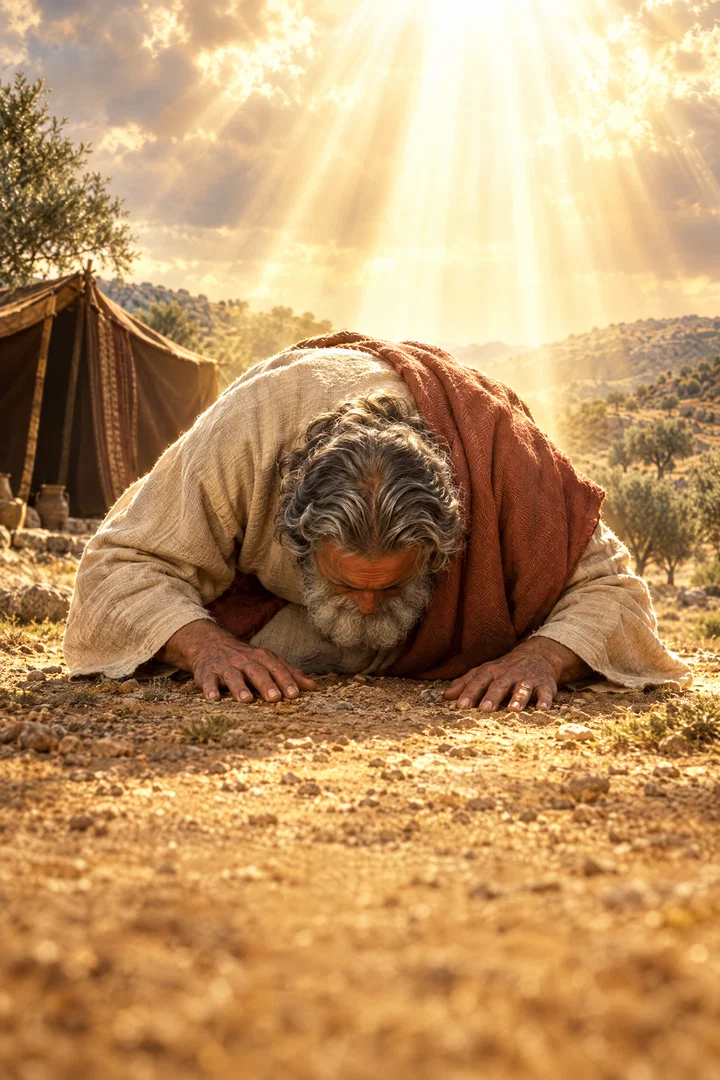
This renewal came after nearly twenty-five years in Canaan, when Abraham was ninety-nine years old, after he had left his father's house and family and an idolatrous nation to live in a strange land among people who worshiped idols.PP 137.3–138.1Ms 91, 1899, par. 18–1913MR 184.2–3 In that strange land God was educating and teaching him in order to make him a chosen instrument for the light and laws of His kingdom, first requiring him to break connection with his father's family and separate from their influence so that Jehovah alone would be the object of his worship.Ms 91, 1899, par. 18–1913MR 184.2–3 Presenting Himself as the Almighty God, He commanded Abraham to walk before Him and be perfect, and Abraham fell on his face while God talked with him.PP 137.3–138.113MR 184.2–3
He then established His covenant between Himself and Abraham and promised to multiply him exceedingly by making him a father of many nations with exceedingly many descendants.PP 137.3–138.1Ms 91, 1899, par. 18–1913MR 184.2–3SG3 296.21SP 262.2–4 That covenant was everlasting and extended to Abraham and his seed through their generations, with God to be their God.SG3 296.21SP 262.2–4 The promised multiplication was tokened by changing his name from Abram to Abraham to signify father of a great multitude, and Sarai's name to Sarah to mean princess, for she would be a mother of nations with kings among her offspring.PP 137.3–138.1
At that time circumcision was given as a seal of the righteousness of the faith Abraham already had while still uncircumcised, and as its token and sign that he and his descendants were devoted to God's service, accepted as His peculiar treasure, and set apart from idolaters and other nations.PP 137.3–138.1SG3 296.2 By that sign Abraham and his descendants pledged on their part to fulfill the conditions of the covenant by remaining separate from other nations, living faithfully before God, being perfect, devoting life to God's service, and obeying the divine requirements including God's law and consulting God's will in marriage, family relations, and public life.PP 137.3–138.1SG3 296.21SP 262.2–4SG3 297.1–2PP 177.3–178.1 A central condition was not to contract marriages with the heathen, lest they lose reverence for God and His holy law and be tempted into the sinful practices of other nations and seduced into idolatry.PP 137.3–138.1
The covenant was both temporal and spiritual and was to pass through the birthright from Abraham to Isaac and then to the heir, including inheritance of worldly wealth, spiritual pre-eminence as priest of the family, great increase of posterity, and the promise that the Redeemer of the world would come in that line.PP 177.3–178.1 Failure to keep separate exposed them to idolatry, caused loss of reverence and much holy character, and drew them toward sinful practices, yet God did not forsake the descendants in Egypt because of His covenant with Abraham.1SP 262.2–4SG3 297.1–2 Isaac and Rebekah held these promises as the great object of desire and hope and taught them to Esau and Jacob, with Isaac declaring Esau as eldest entitled, while Esau had no love for devotion and regarded the requirements of the spiritual birthright and the law as an unwelcome and hateful yoke of bondage, desiring only liberty for self-indulgence, power, riches, feasting, reveling, and wild freedom.PP 177.3–178.1
Sources
Pioneers and periodicals
56 sources
God solemnly renewed promises first given about twenty-four years earlier and gathered them into one ratified agreement that formally established His church in Abraham's family.ST Jun 2, 1881RH Oct 25, 1853 To multiply him exceedingly means to make him exceedingly fruitful as father of a multitude of nations, with nations and kings coming from him through an heir of his own blood.ST Jun 2, 1881ST Jan 29, 1894 The covenant gives him and his seed the land of Canaan as an everlasting possession, which is equivalent to giving them the earth and the world, to be inherited by the meek.ST Jun 29, 1882RH Jun 2, 1859RH Sep 16, 1873 It was given as a free gift to be received through faith and righteousness by faith, with uprightness and obedience to God's moral law as its condition for receiving the inheritance.ST Jan 29, 1894ST Jun 29, 1882RH Jun 2, 1859ST Jul 15, 1886ST Sep 8, 1898 That promise is included in the new and everlasting covenant in Christ, so Abraham is father of all who share his faith whether circumcised or uncircumcised, and all who belong to Christ by faith are heirs of the Spirit and the inheritance.ST Sep 9, 1889ST Jul 15, 1886ST Feb 1, 1899RH Feb 4, 1873ST Jan 29, 1894
Words and Historical Setting
The promise gathers up what had first been given about twenty-four years earlier and renewed at different times into one solemnly ratified agreement, formally establishing God's church in Abraham's family and containing all the great promises and not merely temporal blessings.ST Jun 2, 1881RH Oct 25, 1853 It renews the assurance that his descendants would become exceedingly numerous, that he would become very fruitful and the father of a multitude of nations with nations and kings coming from him, and that the covenant would extend to his descendants with the land, including Canaan and Palestine and even the world, as a future possession although he still lived there as a stranger and not as heir.ST Apr 11, 1900ST Jul 28, 1914 Circumcision was instituted after the promise as its outward sign, token and surety.ST Jun 2, 1881RH Oct 25, 1853 The renewal came when he was ninety-nine years old.RH Oct 25, 1853
He was then childless and with little human hope of having a child, yet God promised to establish the covenant between them and to multiply him exceedingly into a people who would serve God.RH Oct 25, 1853ST Apr 6, 1888 The change of Abram's name to Abraham gave force to the promise of a numerous posterity and would continually remind him that his posterity would become exceedingly numerous.ST Jun 2, 1881 God spoke of him as father of many nations before he had a son, because what exists in God's purpose is certain to come to pass and may be spoken of as already existing.ST Jun 30, 1881ST Mar 15, 1877RH Mar 28, 1865
The covenant is one progressive step in God's dealing with Abraham from his call from country, kindred and home to a strange land through testing until he came fully to trust God, a lesson in the school of faith to be kept in mind with the Promised Seed.ST Dec 20, 1910ST Jul 22, 1913 After sin entered the world God instructed Abraham by speaking to him audibly.PGGC 5.1–2 In that address the same speaker is called Jahweh, El Shaddai and Elohim, and the change in divine names does not make the passage three separate accounts.RH Jun 18, 1901
What was really made with Abraham is true history, not myth, fiction or legend.ST Oct 8, 1912 Christian theology and Messianic doctrine stand or fall with its historical trustworthiness, because the conception of the Messiah is interwoven with Jewish history and the identification of Jesus of Nazareth with that Messiah rests on the Hebrew Scriptures possessing the historical character assigned to them; if the covenant was not made, the doctrine loses its foundation and Christian dogma is built on legendary quicksands.ST Oct 8, 1912
Multiplied Seed and Nations
To multiply exceedingly is to renew the covenant and make Abraham exceedingly fruitful with exceedingly many descendants.ST Jun 2, 1881ST Jan 29, 1894ST Jan 29, 1894 The multiplying means making him the father of a multitude of nations and of many nations, being exceeding fruitful with nations and kings coming from him and descending from him.ST Jan 29, 1894ST Jan 29, 1894 The change of Abram's name to Abraham gives force to this promise of a numerous posterity and would continually remind him that his posterity would become exceedingly numerous.ST Jun 2, 1881 This renewal came when Abraham was ninety-nine, and the covenant would extend to his descendants through their generations, with circumcision instituted after the promise as its outward sign and token and as surety and seal of the promise and of the righteousness of the faith he already had while still uncircumcised.ST Jun 2, 1881ST Jan 29, 1894ST Jan 29, 1894 The covenant was so given while he was uncircumcised that he might be father of all who believe though uncircumcised, so that righteousness is reckoned to them, for the promise of heirship of the world to Abraham and his seed comes through righteousness of faith and not through works of law, being of faith according to grace so it is sure to all the seed, and those of faith are blessed with faithful Abraham.ST Jan 29, 1894ST Jan 29, 1894
The multiplying means seed through an heir of Abraham's own blood, not an adopted son, who would become numerous after God called Abram from country, kindred and home to a strange land and tested his trust.ST Jul 22, 1913 Through that heir the promised Seed would come, in and through whom all the families of the earth would be blessed and Abraham's name made great and made a great nation.ST Jul 22, 1913 The promised line includes a favored line through Sarah, who bore the child of promise in old age despite disbelief, and Isaac's birth fulfilled God's sure promise.ST Sep 8, 1898 That promised seed and the salvation represented by it would come by God's power and promise rather than by human schemes such as the arrangement with Hagar following the attempt to secure an heir through her.ST Apr 11, 1900ST Mar 1, 1905ST Sep 28, 1915 Isaac, the child God would give through Sarah by God's promise and power, rather than Ishmael, is the heir of the promise, so the promised seed and salvation come in God's way.ST Mar 1, 1905ST Sep 28, 1915 Relying on human effort to fulfill the promise leads to bondage and trouble, while Isaac born through God's promise represents those who receive freedom through Christ under the new covenant.ST Mar 1, 1905ST Sep 28, 1915
God's choosing of Abraham for the special work of being father of the promised Seed and establishing the covenant through him concerned his role in God's plan.ST Apr 10, 1907 That choice did not itself guarantee his eternal salvation nor condemn those not chosen for that role.ST Apr 10, 1907
Land and Everlasting Inheritance
The covenant promises the land, including Canaan and Palestine, as an everlasting possession to Abraham and his seed.ST Jun 29, 1882RH Jun 2, 1859ST Sep 17, 1874RH Jun 2, 1859 Although Abraham was living in Canaan he was still a stranger there, not yet its heir, and the everlasting terms point beyond any temporal possession received during his lifetime.RH Jun 2, 1859ST Jul 28, 1914 The surrounding promise extends the covenant to his descendants and includes circumcision as its token and surety.
The promise is equivalent to giving Abraham and his seed the earth and the world as an everlasting possession.RH Sep 18, 1856ST Jan 28, 1903ST Jan 29, 1894 It is the same as the promise that the meek will inherit the earth, now under the curse and awaiting redemption.RH Sep 16, 1873 The promise to Abraham himself could not be fulfilled merely by his descendants possessing the land. It is heirship of the world through righteousness of faith to all who are Christ's, heirs according to promise, sure to all the seed both of the law and of the faith of Abraham.ST Jan 29, 1894
The verse repeats the first and larger promise given in Genesis 13.ST Nov 11, 1930 It is distinct from the promise in Genesis 15:13-21 that fixed the boundaries of earthly Canaan and the time of its possession in the fourth generation.ST Nov 11, 1930 That larger promise means the new earth and the city which hath foundations whose builder and maker is God.ST Nov 11, 1930
The covenant also foretells that the seed would early become afflicted and that four hundred years would pass before deliverance.ST Jul 22, 1913 Afterward the descendants would receive the Land of Promise from the river Euphrates to the river of Egypt.ST Jul 22, 1913 They would receive it by dispossessing certain named nations stronger than themselves.ST Jul 22, 1913
The everlasting inheritance was not fulfilled when Abraham, Isaac and Jacob lived as strangers without possessing the land during their lifetimes.RH Jun 2, 1859RH Jun 2, 1859 Nor was it fulfilled when Israel entered Canaan, for it reaches beyond Israel's possession under Joshua.RH Jun 2, 1859 Because the promised seed is Christ, its fulfillment could not precede Christ's first advent, and Abraham and the other heirs will receive the promised inheritance together with God's people.RH Jun 2, 1859 Abraham understood this breadth and lived as a pilgrim and stranger on earth, joyfully waiting for that better, heavenly country God has prepared, the new earth, the renewed righteous earth, and the city with foundations.ST Jan 28, 1903ST Nov 11, 1930
The promised inheritance was made sure through Abraham's seed, identified as Christ, by righteousness of faith to those who belong to Christ by faith as Abraham's heirs.RH Sep 18, 1856ST Jan 28, 1903 The promise of the Spirit is the inheritance, and the gift of the Spirit is its pledge, with circumcision of the heart — the seal of the Holy Spirit — as its counterpart and earnest assuring God's people of their inheritance.ST Oct 10, 1900RH Sep 16, 1873 God confirmed the covenant by an oath.ST Oct 10, 1900 The promise belongs to one unified divine plan and continuity of purpose through all ages and dispensations, all teaching toward one central end, the restoration of the dominion lost in Adam, with what it implies in heaven and on earth.ST Jun 17, 1897
Obedience and Faith Conditions
The command joined to the covenant to be perfect means to be upright and sincere.ST Jun 29, 1882RH Jun 2, 1859ST Sep 17, 1874 Perfection there means purity of motive and purpose, the heart of character, not equality with God in wisdom or knowledge, and it is called for from infinite love and not from arbitrary authority because God desires His children to be like Himself.RH Feb 3, 1916 God's declaration that He is Almighty is the all-sufficient reason Abraham could be perfect, and the same condition of perfection applies now. Abraham was called to walk before God faithfully while God promised to establish the covenant and multiply him greatly, and his faith did not excuse him from obedience.ST Nov 16, 1888
Such uprightness is developed as God's grace enables obedience to His perfect law.ST Jun 29, 1882 That law is the same moral law later expressed in the Ten Commandments, on which the covenant with Abraham was based.RH Jun 2, 1859ST Sep 17, 1874ST May 11, 1915 Keeping that law is the condition for Abraham and his descendants to receive the covenant inheritance, including the land as an everlasting possession.ST Jun 29, 1882RH Jun 2, 1859ST Sep 17, 1874RH Jun 2, 1859 Faith and obedience were thus conditions of covenant relationship and salvation in every age.ST Nov 16, 1888
The covenant is a free gift by grace, for the Hebrew word translated make means give.ST Sep 8, 1898 God gives both the covenant and the power to keep it.ST Sep 8, 1898 The promise was confirmed with an oath after Abraham fulfilled the stated condition of faith and obedience, while his earlier failures had shown his lack of faith and obedience.ST Sep 8, 1898
The promise was contingent on faith and righteousness by faith, not on unaided efforts or works of law.ST Jul 15, 1886 The inheritance promised to Abraham and his seed comes through faith rather than works of the law, and it is of faith according to grace so that the promise is sure to all the seed.ST Jan 29, 1894ST Jan 29, 1894 Because the covenant was made before Abraham was circumcised, it is not limited to literal descendants but teaches salvation and an equal share for all who have Abraham's faith, whether Jew or Gentile, circumcised or uncircumcised, concerning the spiritual seed.ST Sep 9, 1889 Circumcision was its seal as the seal of the righteousness of the faith Abraham already had while still uncircumcised, so that he might be father of all who believe though uncircumcised and righteousness is reckoned to them.ST Jan 29, 1894 The promise to Abraham and his seed is heirship of the world through righteousness of faith, and the seed includes all who are Christ's as heirs according to promise; heirship by law would void faith and the promise.ST Jan 29, 1894 Abraham became righteous and heir by believing God, and the same reckoning is for all who believe on Him who raised Jesus from the dead, so that those of faith are blessed with faithful Abraham.ST Jan 29, 1894 The promise included forgiveness of sins and was made in Christ, being the same as the second covenant, which the later law given at Sinai could not cancel.ST Jul 15, 1886
Abraham obeyed the covenant command to circumcise the males of his household on the selfsame day.ST Nov 8, 1899 That prompt obedience shows that faith acts on God's word.ST Nov 8, 1899 His faith did not excuse him from obedience.ST Nov 16, 1888
Circumcision as Covenant Token
Circumcision was instituted after the promise as the outward sign, token, seal and surety of the covenant made when Abraham was ninety-nine.ST Jun 2, 1881RH Oct 25, 1853 That covenant solemnly ratified and gathered into one agreement promises first given about twenty-four years earlier, formally establishing God's church in Abraham's family, and it contained all the great promises and not merely temporal blessings.RH Oct 25, 1853 It renewed the promise that descendants would become exceedingly numerous, that Abraham would become father of many nations, and that the covenant would extend to descendants with the land of Canaan as an everlasting possession, while the change of Abram's name to Abraham gave force to the promise of multitude.ST Jun 2, 1881 The ordinance originated in Abraham's family, was enjoined upon him and his household, and was retained by them.ST Jul 11, 1911RH Dec 17, 1861 The sign must be distinguished from the covenant it signified, for the covenant itself was not circumcision.RH Jul 8, 1862
Circumcision marked Israel as separated to God and marked Abraham's descendants as God's distinct people.ST Jun 10, 1880ST Jul 11, 1911 It was a sign that God's righteousness was upon them and signified their agreement to be separate from other nations and to live faithfully.ST Jun 10, 1880ST Jul 11, 1911 It should have led them to recognize their need for purity of heart.ST Jul 11, 1911 Their failure to keep the covenant exposed them to the influence of idolatrous nations.ST Jun 10, 1880 Yet God did not forsake them in Egypt because of His covenant with Abraham.ST Jun 10, 1880
The token's purpose remains to assure God's people of their inheritance in the promised land.RH Sep 16, 1873 Circumcision of the heart, the seal of the Holy Spirit, is its counterpart and earnest and continues that assuring purpose.RH Sep 16, 1873 That inheritance includes the earth, now under the curse and awaiting redemption, which the meek will inherit when the promise is fulfilled.RH Sep 16, 1873
Circumcision is distinguished from the divine moral law embodied in the Ten Commandments and is not part of that moral law.RH Nov 2, 1911 It belongs among the two or three covenants made with Abraham pertaining to Israel, and though called perpetual or everlasting, perpetual and everlasting are no stronger than commanded to a thousand generations.RH Apr 15, 1873 Like the Aaronic priesthood, the Passover and its feast, and the shewbread, the circumcision covenant has expired.RH Apr 15, 1873
Comparison with Exodus 4:24-26 distinguishes Moses' culpable neglect of circumcision from the Israelites' lack of circumcision during the wilderness years, which God did not reprove.RH Aug 27, 1872 That comparison is used to argue that Genesis was written after the events in Exodus 4.RH Aug 27, 1872
Gospel Scope and Heirs
The word covenant in Scripture has a broad application, covering promises as well as agreements and commanded law, and here it denotes God's promise to Abraham rather than the Ten Commandments.RH Apr 16, 1861RH Oct 21, 1873RH Aug 13, 1872 Its precise sense of promise, arrangement or compact depends on context, distinguishing this promise from a compact between human parties and from the conditional covenant later made with Israel.RH Apr 12, 1860RH Mar 18, 1875RH Oct 21, 1873 Genesis 17:1-8 is therefore an example of a covenant God made with Abraham that is distinct in sense from the Ten Commandments.RH Apr 16, 1861RH Oct 21, 1873 Those who held one argument identified this covenant as the covenant of circumcision, contrasted it with the covenant of the Ten Commandments, and connected it with being commanded to a thousand generations.RH Jul 8, 1862
This Abrahamic covenant is included in the new, second and everlasting covenant in Christ, whose promises are the blessings of the gospel, life, salvation and the kingdom.ST Jul 15, 1886ST Feb 1, 1899ST Jun 4, 1902 It was made in Christ and included forgiveness of sins, and every saved person receives salvation through that gospel covenant which God repeatedly promised and swore to.ST Jul 15, 1886ST Jun 4, 1902 The later law given at Sinai could not cancel its promise.ST Jul 15, 1886 The moral law forbidding stealing, adultery and idolatry is the basis of that Abrahamic covenant, so that there is righteousness in this law by which a Gentile who keeps it becomes a Jew inwardly and has uncircumcision counted for circumcision, thereby securing a covenant interest in the promises.RH Feb 4, 1873
Because the covenant was made before Abraham was circumcised, it is not limited to literal descendants.ST Sep 9, 1889ST Jan 29, 1894 Circumcision was its token and seal, but it was a seal of the righteousness of the faith Abraham already had while still uncircumcised, given so he might be father of all who believe though uncircumcised, so that righteousness is reckoned to them.ST Sep 9, 1889ST Jan 29, 1894 All who have Abraham's faith, whether Jew or Gentile, circumcised or uncircumcised, share equally through faith rather than law, and its promises concern the spiritual seed received through faith rather than through works of law.ST Sep 9, 1889ST Jan 29, 1894 The promise to Abraham and his seed is heirship of the world through righteousness of faith, and the seed includes all who are Christ's, heirs according to promise; it is of faith according to grace so the promise is sure to all the seed, both of the law and of the faith of Abraham, for heirship by law would void faith and the promise.ST Jan 29, 1894 Natural descent from Abraham did not make the Jews heirs of the kingdom.RH Jan 14, 1873 The Jews as the natural children of Abraham were God's chosen people and held that natural descent made them heirs, but wicked works and hardness of heart, ending in rejection of Christ as Messiah, disqualified the natural seed, so those not of Abraham's seed sit down with Abraham, Isaac and Jacob in the kingdom while those of his seed are cast out into outer darkness.RH Jan 14, 1873
Sarah and Hagar represent the two covenants, and their sons represent the children of those covenants.RH May 29, 1900 The promise to multiply Abraham exceedingly establishes that the covenant and its promised offspring depend on God's power, not human schemes, following Abraham's attempt to secure an heir through Hagar and pointing to the child God would give through Sarah.ST Mar 1, 1905 Isaac, rather than Ishmael, is the heir of the promise, so the promised seed and salvation come in God's way and by His power.ST Mar 1, 1905ST Sep 28, 1915 Abraham's attempt to secure the heir through Hagar was human scheming, not God's plan, and led to bondage and trouble, teaching that relying on human effort to fulfill God's promise leads to bondage.ST Mar 1, 1905ST Sep 28, 1915 Isaac, born through God's promise, represents those who receive freedom through Christ under the new covenant.ST Sep 28, 1915
God made the covenant and promised to multiply Abraham exceedingly when Abraham was ninety-nine and had no child and little human hope of having one.ST Apr 6, 1888 Abraham was chosen from an idolatrous family to preserve God's truth and law for future generations amid prevailing and increasing corruption.ST Jan 17, 1911 God gave him distinct knowledge of the requirements of the moral law and of the salvation to be accomplished through himself, with the high honor of being father of the people who for centuries would guard and preserve God's truth for the world and through whom all nations of the earth would be blessed in the advent of the promised Messiah.ST Jan 17, 1911 God judged him worthy of that honor because he obeyed God's voice and kept His charge, commandments, statutes and laws, and would teach his children and household after him to keep the way of the Lord to do justice and judgment, so that knowledge of God's law was preserved from Adam to Noah to Abraham to Moses and the promised seed would be those who served Him.ST Jan 17, 1911ST Apr 6, 1888
Sources