Translations
American King James Version, King James Version, KJV Cambridge Paragraph Bible, Webster Bible, Revised Version, American Standard Version
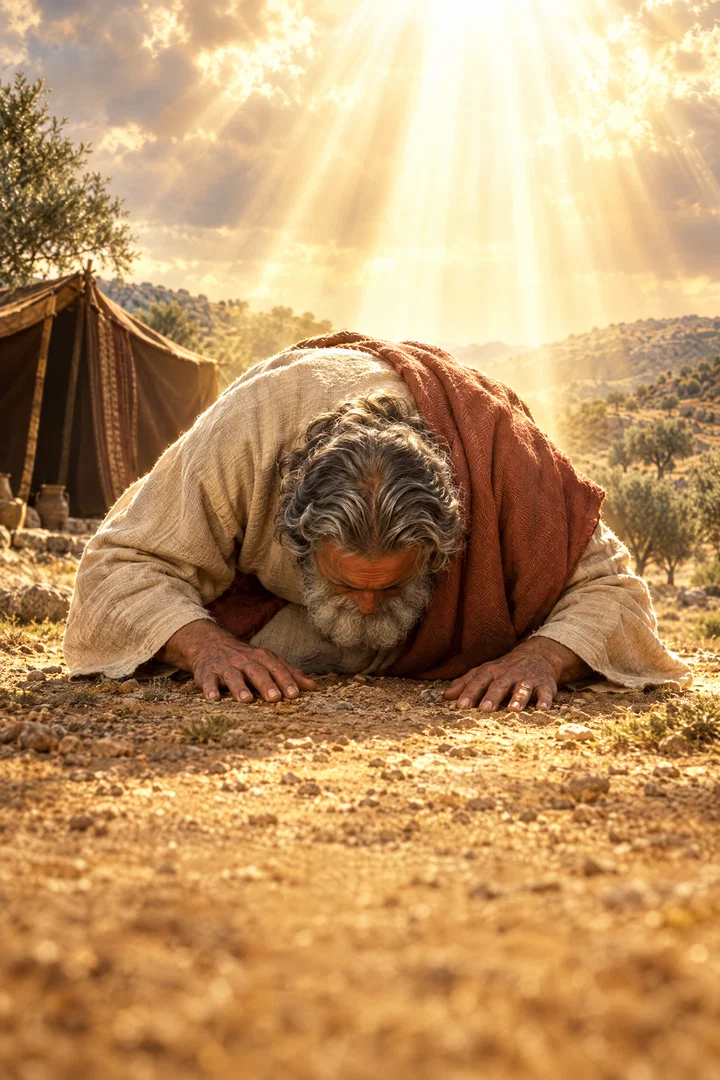
And Abram fell on his face: and God talked with him, saying,
And Abram falleth upon his face, and God speaketh with him, saying,
And Abram fell on his face; and God talked with him, saying,
And Abram fell on his face,—and God spake with him, saying:
Berean Standard Bible, Majority Standard Bible
Then Abram fell facedown, and God said to him,
Abram fell on his face. God talked with him, saying,
And Abram went down on his face on the earth, and the Lord God went on talking with him, and said,
Then Abram fell on his face, and God talked with him, saying,
Douay-Rheims (Challoner revision)
Abram fell flat on his face.
Pictures
Cross-references 20 of 47
- Romans 4:11
And he received the sign of circumcision, a seal of the righteousness of the faith which he had yet being uncircumcised: that he might be the father of all them that believe, though they be not circumcised; that righteousness might be imputed unto them also:
Circumcision is described as the sign and seal of Abraham’s righteousness by faith.
- Genesis 22:16-18
And said, By myself have I sworn, saith the LORD, for because thou hast done this thing, and hast not withheld thy son, thine only son:
God confirms the promise to Abraham with an oath.
- Romans 4:13
For the promise, that he should be the heir of the world, was not to Abraham, or to his seed, through the law, but through the righteousness of faith.
Identifies Abraham’s promised inheritance as the world, received through faith.
- Genesis 15:4-6
And, behold, the word of the LORD came unto him, saying, This shall not be thine heir; but he that shall come forth out of thine own bowels shall be thine heir.
God promises Abram an heir and counts his belief as righteousness.
- Genesis 12:1-3
Now the LORD had said unto Abram, Get thee out of thy country, and from thy kindred, and from thy father’s house, unto a land that I will shew thee:
God first promises Abram blessing, a great nation, and blessing for all families of the earth.
- Genesis 26:3-5
Sojourn in this land, and I will be with thee, and will bless thee; for unto thee, and unto thy seed, I will give all these countries, and I will perform the oath which I sware unto Abraham thy father;
God renews the covenant promises to Isaac, linking them with Abraham’s obedience.
- Galatians 3:16
Now to Abraham and his seed were the promises made. He saith not, And to seeds, as of many; but as of one, And to thy seed, which is Christ.
Identifies Christ as the promised Seed of Abraham.
- 1 Chronicles 16:16-17
Even of the covenant which he made with Abraham, and of his oath unto Isaac;
Identifies God’s covenant with Abraham as an enduring covenant confirmed to Jacob and Israel.
- Genesis 21:1-12
And the LORD visited Sarah as he had said, and the LORD did unto Sarah as he had spoken.
Isaac is born as promised, and God confirms that the seed is called through him.
- Genesis 13:14-16
And the LORD said unto Abram, after that Lot was separated from him, Lift up now thine eyes, and look from the place where thou art northward, and southward, and eastward, and westward:
God promises Abram the land and innumerable descendants.
- Genesis 17:11
And ye shall circumcise the flesh of your foreskin; and it shall be a token of the covenant betwixt me and you.
Circumcision is given as the sign of God’s covenant with Abraham.
- Romans 4:17
( As it is written, I have made thee a father of many nations,) before him whom he believed, even God, who quickeneth the dead, and calleth those things which be not as though they were.
God speaks to Abraham of the promised future as though it were already present.
- Psalms 105:9
Which covenant he made with Abraham, and his oath unto Isaac;
It recalls God’s covenant with Abraham and its enduring generations.
- Galatians 3:29
And if ye be Christ’s, then are ye Abraham’s seed, and heirs according to the promise.
Those who belong to Christ are Abraham’s seed and heirs of the promise.
- Genesis 15:18
In the same day the LORD made a covenant with Abram, saying, Unto thy seed have I given this land, from the river of Egypt unto the great river, the river Euphrates:
Both record God’s covenant with Abram.
- Exodus 4:24-26
And it came to pass by the way in the inn, that the LORD met him, and sought to kill him.
Genesis institutes circumcision, while Moses later neglects it for his son.
- Genesis 28:13
And, behold, the LORD stood above it, and said, I am the LORD God of Abraham thy father, and the God of Isaac: the land whereon thou liest, to thee will I give it, and to thy seed;
God confirms the land promise to Jacob.
- Hebrews 6:13-18
For when God made promise to Abraham, because he could swear by no greater, he sware by himself,
God confirms his covenant promise to Abraham with an oath, assuring the heirs of promise.
- Acts 7:8
And he gave him the covenant of circumcision: and so Abraham begat Isaac, and circumcised him the eighth day; and Isaac begat Jacob; and Jacob begat the twelve patriarchs.
God gave Abraham the covenant of circumcision.
- Galatians 3:17-18
And this I say, that the covenant, that was confirmed before of God in Christ, the law, which was four hundred and thirty years after, cannot disannul, that it should make the promise of none effect.
The promise to Abraham preceded the law, which cannot annul it or make the inheritance depend on works.
Commentary
Each commentary is drawn from primary sources: the writings of Ellen G. White and Adventist pioneers and periodicals. Each commentary is separate. Its own words are not a quotation; follow the references to read the source passages.
Ellen G. White
6 sources
The meeting came after Abram had lived nearly twenty-five years in Canaan, when he was ninety-nine years old.PP 137.3–138.1Ms 91, 1899, par. 18–1913MR 184.2–3 God had called him away from an idolatrous people to worship Jehovah, to be taught by Him and to receive His instruction.Ms 91, 1899, par. 18–1913MR 184.2–3 In this appearance God declared Himself the Almighty God and commanded Abram to walk before Him and be perfect.PP 137.3–138.1 Abram fell on his face in awe before the divine presence, and while he lay prostrate God continued talking with him.PP 137.3–138.1Ms 91, 1899, par. 18–1913MR 184.2–3SG3 296.2 What God then said was His covenant with Abram and his descendants, promising that he would become the father of many nations.PP 137.3–138.1Ms 91, 1899, par. 18–1913MR 184.2–3SG3 296.2
Those covenant promises to Abraham were later confirmed to Isaac.PP 177.3–178.1 They included spiritual blessings and the lineage through which the Redeemer would come, and receiving them carried the duty to serve God and obey His requirements.PP 177.3–178.1 The covenant's sign of circumcision marked Abraham and his descendants as separated from other nations and pledged them to keep the covenant by remaining separate and living obediently, since mixing with other nations exposed them to idolatry and drew them away from their holy character and God's requirements.SG3 297.1–2
Sources
Pioneers and periodicals
49 sources
Abram fell facedown in reverent worship and humility while God talked with him, renewing the covenant promise after pledging to make covenant with him and multiply him exceedingly.ST Jun 2, 1881ST Jan 29, 1894ST Apr 6, 1888 This came when he was ninety-nine years old, still childless about twenty-four years after leaving Haran, when the Lord revealed Himself as God Almighty and charged him to walk before Him and be perfect.ST Jan 29, 1894RH Oct 25, 1853ST Apr 6, 1888 While he was bowed down God declared that he would become the father of many nations and of a multitude, would be multiplied greatly, would receive the name Abraham, and would have the covenant extended to his descendants.ST Jun 2, 1881ST Jan 29, 1894RH Oct 25, 1853 The covenant promised Canaan to him and his seed as an everlasting possession, which is the whole renewed earth and inheritance of the world to be realized through Christ and those who belong to Christ by faith.ST Jun 2, 1881RH Oct 25, 1853ST Jul 28, 1914ST Jan 28, 1903 The promise was joined to the charge to be upright and walk perfectly before God, with obedience as the condition of its blessings, and circumcision was instituted only as the outward sign, seal and token of the covenant and not as the covenant itself or the basis of its promises.ST Jun 29, 1882RH Oct 25, 1853ST Sep 17, 1874ST Sep 9, 1889
Setting, Posture, and Context
Abram was ninety-nine years old, about twenty-four years after leaving Haran, still without a child, when the Lord appeared to him as God Almighty, commanded him to walk before Him and be perfect, and promised to make covenant with him and multiply him exceedingly.ST Jan 29, 1894RH Oct 25, 1853ST Apr 6, 1888 Abram fell on his face in reverent worship and humility while God talked with him, renewing the covenant promise.ST Jun 2, 1881ST Jan 29, 1894ST Apr 6, 1888ST Mar 1, 1905 The falling follows God's promise to make covenant and multiply him, with Abram bowed down as God declares His covenant.ST Jan 29, 1894ST Jan 29, 1894
In this exchange God is called Elohim, following the names Jahweh and El Shaddai in the same encounter.RH Jun 18, 1901 The account belongs to the Abraham section of Genesis in chapters 12-20.ST Aug 9, 1905 It stands within the second main division of Genesis in chapters 12-50 recording God's dealings with the chosen race, distinct from chapters 1-11 recording His dealings with the human race.ST Mar 17, 1914
The verse is one of God's repeated lessons to Abram in the school of faith from his call until he fully trusted God, showing God's providential favor, care and interest among men.ST Dec 20, 1910 It belongs to one unified divine plan continued through all ages toward the restoration of the dominion lost in Adam.ST Jun 17, 1897 God really talked with Abram in a definite, detailed event of real history, not myth, fiction or legend.ST Oct 8, 1912 The historical truth of that covenant is interwoven with the conception of the Messiah, so that if the covenant was not made the Messianic doctrine fails.ST Oct 8, 1912
God had enjoined circumcision upon Abraham and his family long before Moses, and the ordinance was retained by them.RH Dec 17, 1861 The prominence of circumcision in Genesis 17 is used to argue that Moses wrote Genesis after beginning the deliverance from bondage and after the event in Exodus 4:24-26.RH Aug 6, 1872RH Aug 27, 1872 That comparison contrasts Israel's unrebuked lack of circumcision in the wilderness with Moses' culpable neglect.RH Aug 27, 1872
Promises Spoken to Abraham
While Abram lay bowed facedown, God spoke to him declaring His covenant that he would be multiplied greatly and become the father of a multitude of nations, that his name would be changed from Abram to Abraham, and that the covenant would be extended to his descendants with Canaan promised as their everlasting possession.ST Jun 2, 1881ST Jan 29, 1894RH Oct 25, 1853ST Apr 6, 1888 This encounter came when he was ninety-nine years old, about twenty-four years after leaving Haran and still without a child, when the Lord revealed Himself as God Almighty and commanded him to walk before Him and be perfect.ST Jan 29, 1894RH Oct 25, 1853ST Apr 6, 1888 Circumcision was instituted at that time as the outward sign and surety of the covenant, connected with the later statement that the promise depends on Abraham's faithfulness.RH Oct 25, 1853ST Apr 11, 1900
God thus confirmed the covenant after calling Abram from country, kindred, and home to go to a strange land, renewing it through repeated promises and an oath as part of the everlasting covenant through which every saved person receives salvation.ST Jul 22, 1913ST Jun 4, 1902 This renewal repeated the first and larger promise first given in Genesis 13, distinct from the other promise in Genesis 15:13-21 that fixed the boundary of earthly Canaan and set the time of its possession in the fourth generation.ST Nov 11, 1930 The Genesis 17 promise means Abraham should be heir of the world, not through the law but through the righteousness of faith.ST Nov 11, 1930
No adopted son but one of Abraham's own blood would be his heir through whom the promised Seed would come.ST Jul 22, 1913 That seed would be numerous, would early become afflicted, four hundred years would pass before deliverance came, and afterward his descendants would receive the Land of Promise from the river Euphrates to the river of Egypt by dispossessing certain named nations, some stronger than the Hebrews.ST Jul 22, 1913 Through him God would make a great nation, make his name great, and bless all the families of the earth in and through him.ST Jul 22, 1913 These clear, distinct, specific promises and predictions concerning Abraham and his descendants, with prediction and fulfilment set so far apart in time, are God's infallible witness in a continuous people in which no human connivance or collusion is possible.ST Jul 22, 1913
God called Abraham the father of many nations while he still had no son, speaking of what exists in His purpose as though already fulfilled because it will surely come to pass.ST Jun 30, 1881ST Mar 15, 1877RH Mar 28, 1865 He renewed His promise that Abraham's seed would continue and that Sarah would bear the child of promise, and Isaac was born in their old age despite their disbelief.ST Sep 8, 1898 The promised seed and the salvation associated with it must come by God's power and way, not by human schemes or effort such as Abraham's arrangement involving Hagar, and the promised child came through God's plan and power.ST Apr 11, 1900ST Mar 1, 1905ST Sep 28, 1915
Inheritance and Its Fulfillment
As Abram fell facedown God renewed covenant with him, formally establishing it when he was ninety-nine, about twenty-four years after leaving Haran, declaring he would become father of many nations, receive the name Abraham, have the covenant extended to his descendants, and have Canaan given to him and his seed as an everlasting possession, with circumcision instituted as its outward sign, seal, surety, token and earnest and as God's assurance that He would fulfill the promise of the land.ST Jun 2, 1881RH Oct 25, 1853RH Sep 16, 1873 The land so promised is the whole earth, including Palestine, a renewed earth and an inheritance encompassing the whole world, equivalent to the promise that the meek shall inherit the earth.ST Jul 28, 1914ST Jan 28, 1903 It was given on condition of walking perfectly before God, and it is to be realized through Abraham's seed identified as Christ, with those who belong to Christ by faith as Abraham's heirs according to that promise.ST Jan 28, 1903
The promise was made to Abraham, Isaac and Jacob in person, yet though living in Canaan Abraham remained a stranger there and not its heir, did not receive the land in his lifetime, and died without receiving it.RH Jun 2, 1859ST Jul 28, 1914 The later possession of Canaan by descendants and the entry into Canaan could not by itself fulfill a promise made to them personally, since Abraham, Isaac and Jacob were not alive to receive it.RH Jun 2, 1859 The inheritance is therefore not merely temporal possession but everlasting, to be received by Abraham and the other faithful when the promise is fulfilled.RH Jun 2, 1859RH Jun 2, 1859 It is God's gift whose pledge is the Spirit, and it means life, salvation and a kingdom through Jesus Christ in the everlasting new covenant through which every saved person receives salvation.ST Oct 10, 1900ST Feb 1, 1899ST Jun 4, 1902
The Genesis 17 promise repeats the first and larger promise first given in Genesis 13 and is distinct from the other promise in Genesis 15:13-21 that fixed the boundary of earthly Canaan and set the time of its possession in the fourth generation; it means Abraham should be heir of the world, not through the law but through the righteousness of faith.ST Nov 11, 1930 Abraham understood it to include the inheritance of the new earth and therefore lived as a pilgrim and stranger on earth, joyfully waiting for a city which hath foundations whose builder and maker is God, a better heavenly country prepared by God, even though he died without receiving it.ST Nov 11, 1930 Its promises concern the spiritual seed, not merely literal descendants, and because the covenant was made before Abraham was circumcised, people of faith whether Jew or Gentile, circumcised or uncircumcised, share in Abraham's promises through faith, circumcision being its seal and not the basis of its promises.ST Sep 9, 1889
By the covenant of promise Abraham's natural seed became God's chosen people and heirs of the kingdom, but resting on natural descent could not secure the kingdom; wicked works, hardness of heart and final rejection of Christ as Messiah disqualified them, so those who were not of the seed of Abraham sit down with Abraham, Isaac and Jacob while those who were of the seed are cast out into outer darkness.RH Jan 14, 1873 God's choosing of Abraham to be father of the promised Seed and to carry forward a special work was for a temporal purpose and did not by itself secure his eternal salvation.ST Apr 10, 1907
Conditions for Receiving Promise
The covenant joined the promise of the land as an everlasting possession to a charge to be upright and sincere and to walk perfectly before God.ST Jun 29, 1882ST Sep 17, 1874RH Jun 2, 1859ST Jul 15, 1886 The promise renewed here was the land, identified as the whole earth, to Abraham and his seed as an everlasting possession, equivalent to the promise that the meek shall inherit the earth.ST Jun 29, 1882ST Sep 17, 1874 Possession was made everlasting and its blessing was joined to uprightness understood as keeping God's law.ST Jun 29, 1882ST Sep 17, 1874 Obedience is the condition of receiving the inheritance and its blessings, and the inheritance is not merely temporal since Abraham did not receive the land in his lifetime though it was promised as everlasting.ST Jun 29, 1882ST Sep 17, 1874RH Jun 2, 1859ST Jul 15, 1886 Such uprightness comes through God's grace enabling obedience to His perfect law.ST Jun 29, 1882
Walking before God and being perfect did not mean earning righteousness by unaided effort.ST Jun 29, 1882ST Jul 15, 1886 The covenant depended on the righteousness of faith, involved forgiveness of sins, and promised the inheritance through faith in Christ.ST Jul 15, 1886 God's law was the basis of the covenant with Abraham and was already binding, not first introduced at Sinai.ST Jun 29, 1882ST May 11, 1915RH Feb 4, 1873 Its blessings are the blessings of the gospel.RH Feb 4, 1873 A Gentile who keeps the law secures a covenant interest and his uncircumcision is counted for circumcision, while a Jew who breaks the law loses the efficacy of circumcision as a sign of righteousness.RH Feb 4, 1873
Abraham obeyed God's command to circumcise the males of his household.ST Nov 8, 1899 He did so on the very day it was given.ST Nov 8, 1899 His prompt obedience belongs to the covenant setting in which God talked with him while he was bowed down.ST Nov 8, 1899 It shows faith that acts on God's word.ST Nov 8, 1899
Circumcision as Covenant Sign
Genesis 17:3 places the formal establishment of God's covenant with Abram when he was ninety-nine years old, about twenty-four years after leaving Haran, as he fell on his face while God spoke to him of making him father of many nations and giving Canaan to him and his descendants.RH Oct 25, 1853 In that setting circumcision was instituted as the outward sign, seal and token of the covenant God made with Abraham.RH Oct 25, 1853ST Sep 9, 1889RH Jul 8, 1862RH Jul 8, 1862 These verses speak of that covenant itself, not of circumcision as the covenant, supporting the distinction between the covenant and circumcision which was given only as its sign or token and not as the covenant itself.RH Jul 8, 1862RH Jul 8, 1862
Circumcision was the seal of the covenant but not the basis of its promises, which concern the spiritual seed and not merely literal descendants.ST Sep 9, 1889 Because the covenant was made before Abraham was circumcised, people of faith whether Jew or Gentile, circumcised or uncircumcised, share in Abraham's promises through faith.ST Sep 9, 1889 Circumcision marked Israel as set apart to God and as a sign that God's righteousness was upon them, and it should have led them to recognize the need for cleanliness of heart.ST Jul 11, 1911
Circumcision is described as perpetual and everlasting, but perpetual and everlasting are no stronger than commanded to a thousand generations and do not mean never ending.RH Apr 15, 1873 The circumcision requirement has expired just as the Aaronic priesthood, the Passover and its feast, the shewbread, and other things called perpetual and everlasting have expired.RH Apr 15, 1873
Covenant Theology and Connections
Here covenant means God's arrangement and divine promise to Abraham, as shown in Genesis 17:3-8.RH Apr 12, 1860RH Mar 18, 1875RH Aug 13, 1872 A divine promise is itself called a covenant, establishing promises as one distinct sense of covenant alongside agreements made between parties and law commanded.RH Apr 12, 1860RH Aug 13, 1872 Covenant can mean different kinds of arrangement, and its precise sense depends on the context.RH Apr 12, 1860RH Mar 18, 1875 This arrangement with Abraham is distinct from the compact between Abraham and Abimelech and from the covenant later made with Israel.RH Mar 18, 1875
Genesis 17 shows one of the several covenants spoken of in Scripture.RH Jun 26, 1900 It must be read carefully with Genesis 15:18 and the whole of chapters 16, 17 and 21 to settle the covenant question.RH Jun 26, 1900 It is to be understood together with the two covenants of Galatians 4 and the old and new covenants of Hebrews 8.RH Jun 26, 1900 It is distinct from the covenant God made with Israel when He brought them out of Egypt.RH Jun 26, 1900RH Mar 18, 1875
Genesis 17 belongs to the beginning of the Two Covenants in the family of Abraham.RH May 29, 1900 There Hagar the bondwoman and Sarah the freewoman and their two sons represent the two covenants, the one from Mount Sinai and the other.RH May 29, 1900 It must be studied with Genesis 15, Genesis 16, and Genesis 21:1-21, read at least seven times, as the starting place for understanding the Two Covenants.RH May 29, 1900
The Abrahamic covenant begun here is one of the covenants included in the everlasting new covenant in Christ.ST Feb 1, 1899 Its covenant promise is life, salvation, and a kingdom through Jesus Christ.ST Feb 1, 1899
Sources