Translations
And tarry with him a few days, until your brother’s fury turn away;
And tarry with him a few days, until thy brother’s fury turn away;
KJV Cambridge Paragraph Bible, Revised Version, American Standard Version
and tarry with him a few days, until thy brother’s fury turn away;
And tarry with him a few days, until thy brother's fury shall turn away;
and thou hast dwelt with him some days, till thy brother's fury turn back,
and abide with him some days, until thy brother's fury turn away —
And thou shalt dwell with him a few days,—until that the wrath of thy brother turn away:
Berean Standard Bible, Majority Standard Bible
Stay with him for a while, until your brother’s fury subsides—
Stay with him a few days, until your brother’s fury turns away—
And be there with him for a little time, till your brother's wrath is turned away;
And tarie with him a while vntill thy brothers fiercenesse be swaged,
Douay-Rheims (Challoner revision)
And thou shalt dwell with him a few days, till the wrath of thy brother be assuaged,
Pictures
Cross-references
- Genesis 28:15
And, behold, I am with thee, and will keep thee in all places whither thou goest, and will bring thee again into this land; for I will not leave thee, until I have done that which I have spoken to thee of.
God promises to protect Jacob while he flees and to bring him back.
- Genesis 25:29-34
And Jacob sod pottage: and Esau came from the field, and he was faint:
Esau’s sale of the birthright sets up the later rivalry over the blessing.
- Genesis 28:1-2
And Isaac called Jacob, and blessed him, and charged him, and said unto him, Thou shalt not take a wife of the daughters of Canaan.
Isaac sends Jacob to Padan-aram to seek a wife among Rebekah’s family.
- Genesis 27:27-29
And he came near, and kissed him: and he smelled the smell of his raiment, and blessed him, and said, See, the smell of my son is as the smell of a field which the LORD hath blessed:
Jacob receives Isaac’s blessing by deception, forcing him to flee.
- Genesis 32:24-30
And Jacob was left alone; and there wrestled a man with him until the breaking of the day.
Jacob wrestles through the night seeking God’s blessing as Esau approaches.
- Genesis 28:5
And Isaac sent away Jacob: and he went to Padan-aram unto Laban, son of Bethuel the Syrian, the brother of Rebekah, Jacob’s and Esau’s mother.
Continues the account of Jacob being sent away.
- Genesis 32:11
Deliver me, I pray thee, from the hand of my brother, from the hand of Esau: for I fear him, lest he will come and smite me, and the mother with the children.
Jacob fears Esau and prays for deliverance from him.
- Malachi 1:2-3
I have loved you, saith the LORD. Yet ye say, Wherein hast thou loved us? Was not Esau Jacob’s brother? saith the LORD: yet I loved Jacob,
Jacob and Esau illustrate God’s differing treatment of them.
- Hebrews 12:16-17
Lest there be any fornicator, or profane person, as Esau, who for one morsel of meat sold his birthright.
Esau sold his birthright and was later rejected when he sought the blessing.
- Genesis 28:16
And Jacob awaked out of his sleep, and he said, Surely the LORD is in this place; and I knew it not.
Jacob recognizes the Lord’s presence after his dream, leading to his vow to serve God and give a tenth.
Commentary
Each commentary is drawn from primary sources: the writings of Ellen G. White and Adventist pioneers and periodicals. Each commentary is separate. Its own words are not a quotation; follow the references to read the source passages.
Ellen G. White
5 sources
Jacob had obtained by deceiving his father the blessing intended for Esau, and this provoked Esau's deadly anger and his threat to kill him.GC88 616.1–2PP 183.1 To escape that wrath Jacob had to flee for his life from his father's home as a fugitive.SG3 115.2PP 183.1 He left carrying Isaac's blessing and traveling to Mesopotamia to seek a wife from his mother's family.PP 183.1
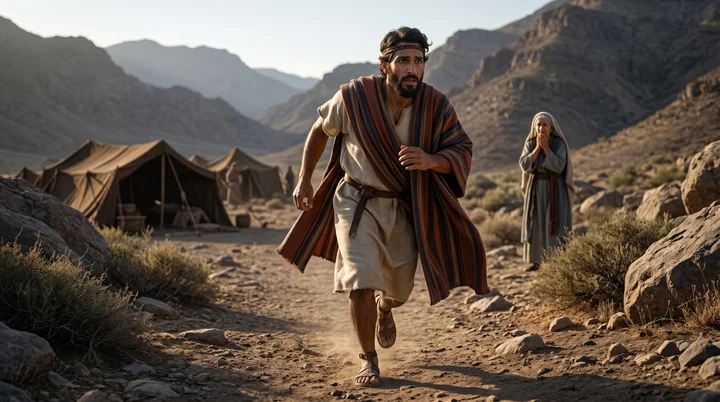
Rebekah told him to stay with her brother for a short time, only a few days, until Esau's fury turned away and his anger subsided.SG3 115.2PP 183.1 What was meant as a brief absence became an exile of many years.GC88 616.1–2 That flight separated him from Rebekah forever, for she never saw his face again.1SP 107.2SG3 115.2
When Jacob later returned at God's command, Esau's approach with warriors revived his fear of revenge.GC88 616.1–2 Rebekah repented in bitterness for her wrong counsel to Jacob because it had caused this lasting separation.SG3 115.2 Isaac lived many years after giving the blessing to Jacob and became convinced, from the later course of Esau and Jacob, that the blessing rightly belonged to Jacob.SG3 115.2
The deception connected with this sending away was carried out by partiality and hypocrisy and secret working and deceptive reasoning.Lt 7, 1896, par. 1–4 It perverts right principles by selfishness and covetousness to grasp all that can possibly be gained, irrespective of agreements and of the disappointment and wrong brought upon others, handling men as machinery and ruling as a lord over God's heritage.Lt 7, 1896, par. 1–4 Such dealing God will not tolerate, justify, or excuse, and angels veil their faces at it.Lt 7, 1896, par. 1–4
Sources
Pioneers and periodicals
24 sources
Rebekah directs Jacob to leave home for her brother Laban in Haran and remain there only a short time until Esau's anger cools and he forgets what was done, when she will send for him.ST Sep 29, 1898ST Apr 6, 1888ST Sep 29, 1898 The flight is to save his life after he secures by deception the blessing Isaac intended for Esau, leaving Esau enraged and threatening to kill him.ST Jul 31, 1901ST Jan 3, 1911ST Jan 3, 1911ST Feb 28, 1906ST Apr 1, 1897 The intended stay of a few days stretches into more than twenty years, and the parting becomes a lifelong separation in which Rebekah never sees her favorite son again.ST Jul 31, 1901STST Apr 6, 1888ST Oct 4, 1905 It stands as human interference with God's promise that the elder should serve the younger, attempting by craft and scheming to secure what God would have performed in His own time to those who quietly waited on Him.ST Jul 31, 1901STST Oct 4, 1905 It shows that such overreaching brings its own suffering and retribution, with Jacob's hardship and exile coming from his own wrong that gave Esau real cause for anger.ST Jan 9, 1912ST Apr 1, 1897RH Jul 7, 1903
Jacob's Flight and Separation
Rebekah told Jacob to leave home and tarry with her brother Laban among her relatives in Haran in Padan-aram in a distant country, to remain there only a few days until Esau's fury and anger should turn away and subside and he should forget what had been done, after which she intended to send for Jacob and bring him back.ST Sep 29, 1898ST Apr 6, 1888ST Sep 29, 1898ST Oct 4, 1905ST The flight followed Jacob obtaining by deception the blessing Isaac meant for Esau, while Esau was in the fields hunting, with his mother urging him to the act.ST Jul 31, 1901ST Feb 26, 1894ST Sep 4, 1901 He had taken advantage of Esau's appetite to purchase the birthright and then deceived his old blind father to take the father's blessing designed for his brother, attempting by human craft and his own wisdom to secure what God had promised, that the elder should serve the younger.ST Apr 1, 1897ST Oct 1, 1902ST Feb 26, 1894 His name means supplanter, and in his unregenerate state he displayed an overreaching, mercenary, covetous character, though God meant both birthright and blessing for him because of his superior character and meant to give them in His own way.ST Apr 1, 1897ST Feb 26, 1894
Esau became enraged with hatred and fury that put Jacob's life in danger, resolving and threatening to kill him, so that Jacob had to flee from home and remain away until the danger passed.ST Jul 31, 1901ST Jan 3, 1911ST Oct 1, 1902RH Sep 11, 1913ST Sep 4, 1901 His flight leads directly to his visit and sojourn with Laban.ST Jan 3, 1911 What was intended as tarrying a few days stretched into remaining many long years and passing through many bitter experiences, more than twenty years, with many years passing before Jacob returned.ST Jul 31, 1901ST Apr 6, 1888ST Oct 4, 1905ST Jun 12, 1884 The brief parting became a life-long separation of mother and son as a consequence of her error in arranging the deception, and Rebekah never saw her favorite son, who had been such a comfort to her, again on earth.ST Jul 31, 1901STST Oct 4, 1905ST Oct 1, 1902ST
Under grief over Esau's Hittite wives, Isaac and Rebekah sent Jacob to Padan-aram to take a wife from his own relatives, after which Esau took a daughter of Ishmael as wife.ST Feb 26, 1894 More than twenty years passed before even a formal reconciliation took place between the brothers.ST Oct 1, 1902 The animosity affected Esau's descendants for hundreds of years, so Edom refused to allow Israel to pass through their land on the journey from Egypt to Canaan, Israel afterward subdued Edom by warfare in the days of David and in the days of Amaziah, and Israel never could wield any moral influence upon Esau's descendants.ST Oct 1, 1902
The verse belongs to the continuing history of Abraham and his family and the channels through which the Promised Seed should come, showing Isaac and his two sons with their defects within gradual development of faith on the way to Jacob's victory that made him Israel, prevailer with God.STST Jan 6, 1909
Unbelief, Consequence, and Trust
The verse is Rebekah's device to save Jacob from Esau's fury by sending him away to her father's people in a distant country, after Jacob obtained Isaac's blessing by deception while Esau was hunting in the fields and left Esau so enraged that he resolved to kill him.ST Jul 31, 1901ST Oct 1, 1902ST Feb 26, 1894 It is human interference in God's plans, showing lack of faith that God could fulfill His promises unless Rebekah and Jacob took a hand in it, attempting by human craft and wisdom to make sure what God had promised that the elder should serve the younger.STST Oct 1, 1902ST Feb 26, 1894 They tried to supplement the Lord's promise with human works and to secure by deceit rather than by trusting God to fulfill it in His own way what God meant to give in His own way, and Jacob succeeded in spite of his deception rather than because of it.ST Oct 4, 1905ST Oct 1, 1902ST Feb 26, 1894 What was intended as tarrying a few days until anger turned away became remaining many long years, more than twenty years, passing through many bitter experiences, difficulties, hardships and distresses, with brief parting becoming life-long separation in which Rebekah never saw her favorite son again.ST Jul 31, 1901STST Oct 4, 1905ST Oct 1, 1902ST Feb 26, 1894 That lack of faith belongs to the history of the channels through which the Promised Seed should come, and it is the same lack first seen in Abraham and found at the basis of all union of church and state.ST
When the Lord promises a thing He will perform it at the proper time, so there must be no impatience, uneasiness, nervous ingenuity or scheming to help God, but quiet waiting on the Lord until ready to receive His blessings, which He will then promptly bestow.ST Jul 31, 1901 Rebekah's nervous human ingenuity to help God fulfill His promise that Jacob would inherit the blessing decreed to Abraham and Isaac brought her complete separation from the son who was such a comfort to her and plunged Jacob into sorrow and anxiety.ST Jul 31, 1901ST Oct 4, 1905 The verse therefore falls within the account of Jacob's checkered and unsatisfactory experiences, in which his selfish plotting brings suffering and his overreaching, mercenary, covetous character is met by overreaching, for God's providence brings retribution sooner or later.ST Jan 9, 1912ST Apr 1, 1897 Jacob took advantage of Esau's appetite to purchase his birthright and obtained through fraud the father's blessing designed for his brother, and his hardship came from his own actions.ST Apr 1, 1897RH Jul 7, 1903 Even those called God's children suffer serious effects from sin, and Jacob's flight shows his wrong against his brother that gave Esau real cause for anger and put Jacob's life in danger so that he had to remain away until the danger passed.RH Jul 7, 1903ST Mar 4, 1913ST Sep 11, 1901
The verse shows the bitter fruit of favoritism in the home, with Rebekah commanding Jacob to leave home and stay with Laban a few days until Esau's fury turns away in order to protect her favorite and darling son after scheming to win Isaac's blessing for Jacob away from Esau, who was Isaac's favorite because of his savory venison.ST Through his mother's influence Jacob was led into error and exile, and the few days became long, long years of separation in which Rebekah never saw him again on earth.STST Apr 12, 1883 The sin against Esau brought Jacob long-continued affliction and chastisement that continued as a captivity until he went down into Egypt, which was the turning point where it was closed up forever.ST Jul 21, 1881 The chastisement worked deep and thorough repentance in him so the rod was withdrawn, while his sojourn in Egypt was the period assigned for his ripening for the kingdom of God and his life ended in heavenly brightness.ST Jul 21, 1881
When Jacob acknowledged his sin, God appeared to him and promised to remain with and protect him.RH Jul 7, 1903 Forgiveness was given at Bethel, where the promises to Abraham and Isaac were transferred to him with added promises of personal protection and safe return to Canaan.ST Sep 11, 1901 Yet years later when Esau was approaching, that old wrong made Jacob question whether God had really forgiven his sins against his brother and whether his life since Bethel had been such that he could still claim the promises made at Bethel, for he did not deny or ignore his guilt.ST Sep 11, 1901 Jacob and Esau are types of two different classes, with Esau representing a worldly man who lives to gratify himself and sells his birthright for temporary gain, and Jacob representing an unconverted man who longs to know and do God's will and values the birthright.ST May 17, 1910 The birthright included a double share of property, authority in the family, and the priesthood, and in this case also included being the ancestor through whom Christ would come and in that sense a part in the salvation of the human race, and when Jacob was converted his name was changed to Israel.ST May 17, 1910
Sources