Genesis 29:12
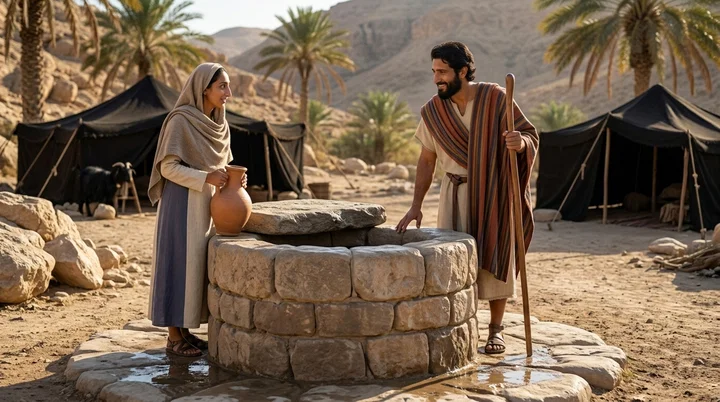
And Jacob told Rachel that he was her father’s brother, and that he was Rebekah’s son: and she ran and told her father.
Translations
American King James Version, King James Version, KJV Cambridge Paragraph Bible, Revised Version, American Standard Version
And Jacob told Rachel that he was her father’s brother, and that he was Rebekah’s son: and she ran and told her father.
And Jacob told Rachel that he was her father's brother, and that he was Rebekah's son; and she ran and told her father.
and Jacob declareth to Rachel that he [is] her father's brother, and that he [is] Rebekah's son, and she runneth and declareth to her father.
And Jacob told Rachel that he was a brother of her father, and that he was Rebecca's son; and she ran and told her father.
And when Jacob told Rachel that he was her father’s brother, and that he was Rebekah’s son, then ran she, and told her father.
Berean Standard Bible, Majority Standard Bible
He told Rachel that he was Rebekah’s son, a relative of her father, and she ran and told her father.
Jacob told Rachel that he was her father’s relative, and that he was Rebekah’s son. She ran and told her father.
And Rachel, hearing from Jacob that he was her father's relation and that he was the son of Rebekah, went running to give her father news of it.
(For Iaakob tolde Rahel, that he was her fathers brother, and that he was Rebekahs sonne) then she ranne and tolde her father.
Douay-Rheims (Challoner revision)
And he told her that he was her father’s brother, and the son of Rebecca: but she went in haste and told her father.
Pictures
Cross-references
- Genesis 29:18-20
And Jacob loved Rachel; and said, I will serve thee seven years for Rachel thy younger daughter.
After Jacob’s kinship is made known, he agrees to serve seven years for Rachel.
- Genesis 24:15-24
And it came to pass, before he had done speaking, that, behold, Rebekah came out, who was born to Bethuel, son of Milcah, the wife of Nahor, Abraham’s brother, with her pitcher upon her shoulder.
Jacob’s meeting with Rachel at a well parallels Abraham’s servant meeting Rebekah.
- Genesis 29:25
And it came to pass, that in the morning, behold, it was Leah: and he said to Laban, What is this thou hast done unto me? did not I serve with thee for Rachel? wherefore then hast thou beguiled me?
Laban deceives Jacob by giving him Leah instead of Rachel.
- Genesis 29:27-28
Fulfil her week, and we will give thee this also for the service which thou shalt serve with me yet seven other years.
Jacob’s marriage agreement reckons time by weeks.
- Genesis 29:1
Then Jacob went on his journey, and came into the land of the people of the east.
journey that brings him to Rachel
Commentary
Each commentary is drawn from primary sources: the writings of Ellen G. White and Adventist pioneers and periodicals. Each commentary is separate. Its own words are not a quotation; follow the references to read the source passages.
Ellen G. White
1 source
Jacob made his family connection known to Rachel, identifying himself as her father Laban's relative and as the son of Rebekah.PP 188.2 Rachel then ran to tell her father what she had learned.PP 188.2 Through her report Jacob was brought in and welcomed into Laban's home.PP 188.2
Sources
Pioneers and periodicals
10 sources
The meeting takes place at a well, the village fountain that served as a place to learn news about people and find relatives.ST Oct 6, 1898ST May 19, 1898 Jacob asked the shepherds with flocks about Laban the son of Nahor, learned they were from Haran and that Laban was well and his daughter Rachel would soon come with sheep, and waited until all the flocks were gathered and the well was opened and the sheep watered.ST Oct 6, 1898 When he desired to find his relatives he went to the fountain, for going to the well was the way to learn about people and find them.ST May 19, 1898
After watering the flock of Laban that Rachel had brought and kissing her, Jacob told her he was her father's kinsman and Rebekah's son, and she ran and told her father.ST Jan 3, 1911ST Oct 6, 1898 Telling Rachel his identity through their family relationship leads to Jacob meeting and greeting Laban, who receives him warmly and keeps him for a month.ST Oct 6, 1898 This identification followed by Rachel telling her father begins Jacob's visit to Laban.ST Jan 3, 1911
That visit comes after journeying to the land of the people of the East, where he meets Laban, later marries Leah and Rachel, and serves him fourteen years for his two daughters.ST Jan 3, 1911ST Mar 19, 1894 Jacob is then deceived as he had deceived his father.ST Jan 3, 1911
The verse continues the story of Abraham and his family through which the Seed was to come, with the promises extended from Abraham to Isaac and from Isaac to Jacob.ST Jan 6, 1909ST Jan 14, 1913 It shows the gradual development of faith through Isaac and his two sons with their defects, leading to Jacob's victory which made him Israel, prevailer with God.ST Jan 6, 1909ST Jan 14, 1913 The verse belongs to the checkered and unsatisfactory experience of Esau and Jacob in which Jacob's selfish plottings bring consequent suffering that better earlier experience would have spared.ST Jan 9, 1912ST Jan 14, 1913 That trouble grew from family division caused by the overfond aged father's overweening affection for Esau and the mother's stronger sympathy for her neglected favored child Jacob, because she knew God's promise would be manifest through Jacob and kept the importance of the Seed before him in a material way without the fullest appreciation of the spiritual blessings.ST Jan 14, 1913
Jacob who overreached and supplanted others meets overreaching himself when Laban deceives him in giving him his daughters, just as he had deceived his father and Esau, proving that God's providence though seeming slow brings retribution sooner or later.ST Jan 3, 1911ST Jan 9, 1912ST Mar 19, 1894 Jacob's sin did not justify Laban's deception.ST Mar 19, 1894 Jacob's material overreaching all the way through demonstrated the fitness of his name, supplanter, though God in mercy brings a change.ST Jan 14, 1913
The chapter records a plain violation of the marriage institution by the patriarchs in taking more than one wife, in the same class as Genesis 16, Genesis 25:6 and Genesis 30.RH Feb 3, 1852ST Jun 10, 1875 Jacob's family history is an instance of the unhappiness associated with polygamy.RH Mar 1, 1870 That violation does not destroy the sacred character of marriage, just as a violation of the Sabbath would not destroy the sacred character of the Sabbath.RH Feb 3, 1852ST Jun 10, 1875 Marriage was made for man before the fall, its holiness is not derived from the Decalogue or Ten Commandments, and the seventh commandment guards its sacredness as the fourth commandment guards the Sabbath.RH Feb 3, 1852ST Jun 10, 1875
Sources