Genesis 29:30
And he went in also unto Rachel, and he loved also Rachel more than Leah, and served with him yet seven other years.
Translations
American King James Version, Webster Bible
And he went in also to Rachel, and he loved also Rachel more than Leah, and served with him yet seven other years.
King James Version, KJV Cambridge Paragraph Bible, Revised Version, American Standard Version
And he went in also unto Rachel, and he loved also Rachel more than Leah, and served with him yet seven other years.
And he goeth in also unto Rachel, and he also loveth Rachel more than Leah; and he serveth with him yet seven other years.
And he went in also to Rachel; and he loved also Rachel more than Leah. And he served with him yet seven other years.
So he went in, unto Rachel also, and loved, Rachel also, more than Leah,—and he served with him, yet seven years more.
Berean Standard Bible, Majority Standard Bible
Jacob slept with Rachel as well, and indeed, he loved Rachel more than Leah. So he worked for Laban another seven years.
He went in also to Rachel, and he loved also Rachel more than Leah, and served with him seven more years.
Then Jacob took Rachel as his wife, and his love for her was greater than his love for Leah; and he went on working for Laban for another seven years.
So entred he in to Rahel also, and loued also Rahel more then Leah, and serued him yet seuen yeeres more.
Douay-Rheims (Challoner revision)
And having at length obtained the marriage he wished for, he preferred the love of the latter before the former, and served with him other seven years.
Pictures
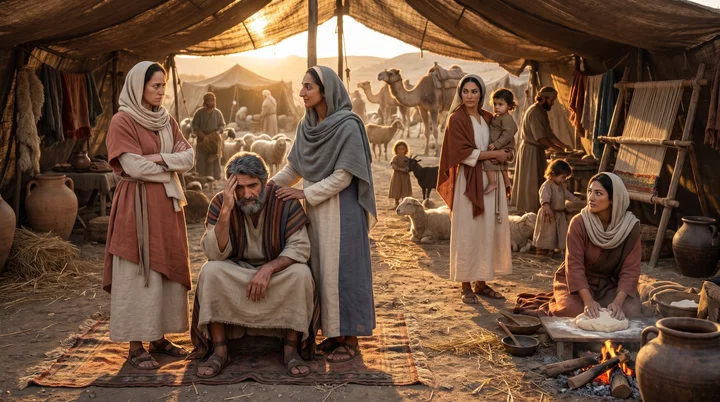
Cross-references
- Genesis 30:1-2
And when Rachel saw that she bare Jacob no children, Rachel envied her sister; and said unto Jacob, Give me children, or else I die.
Rachel’s jealousy and distress continue the conflict in Jacob’s polygamous household.
- Genesis 29:20
And Jacob served seven years for Rachel; and they seemed unto him but a few days, for the love he had to her.
Jacob serves seven years for Rachel because he loves her.
- Genesis 48:7
And as for me, when I came from Padan, Rachel died by me in the land of Canaan in the way, when yet there was but a little way to come unto Ephrath: and I buried her there in the way of Ephrath; the same is Beth-lehem.
Rachel’s death recalls Jacob’s enduring love for her.
- Genesis 32:28
And he said, Thy name shall be called no more Jacob, but Israel: for as a prince hast thou power with God and with men, and hast prevailed.
Jacob’s story culminates in his name being changed to Israel.
- Genesis 31:1-2
And he heard the words of Laban’s sons, saying, Jacob hath taken away all that was our father’s; and of that which was our father’s hath he gotten all this glory.
Laban’s sons complain about Jacob, and Laban’s attitude toward him changes.
- Deuteronomy 17:17
Neither shall he multiply wives to himself, that his heart turn not away: neither shall he greatly multiply to himself silver and gold.
God commanded against multiplying wives
- Deuteronomy 21:15-16
If a man have two wives, one beloved, and another hated, and they have born him children, both the beloved and the hated; and if the firstborn son be hers that was hated:
Cited as another example of the comparative use of “hate.”
- Malachi 1:2-3
I have loved you, saith the LORD. Yet ye say, Wherein hast thou loved us? Was not Esau Jacob’s brother? saith the LORD: yet I loved Jacob,
Both texts use Jacob to illustrate loving one more than another.
Commentary
Each commentary is drawn from primary sources: the writings of Ellen G. White and Adventist pioneers and periodicals. Each commentary is separate. Its own words are not a quotation; follow the references to read the source passages.
Ellen G. White
4 sources
Jacob took Rachel as wife in addition to Leah, and his affection rested more upon Rachel than upon Leah.1SP 109.1PP 189.2 Leah was loved far less because Laban had deceived him by giving Leah to him instead of Rachel.1SP 109.1 After marrying Rachel he served Laban seven more years to obtain her, making twice seven years of service for Rachel in all.1SP 109.1PP 189.2PP 206.3–4
He served rather than paying a bride-price because he had no money or other valuable property, since labor for a set period was accepted in place of a dowry.SG3 119.1 That period of service before the marriage provided time to test his worth and the depth of his affection.SG3 119.1 It was love for Rachel that moved him to such service, and that love made his hard toil feel light.PP 206.3–4
Preferring Rachel brought envy and jealousy into the family and made his life bitter through rivalry between the sisters.PP 189.2 His love for Rachel was deep and lasting, bringing him heavy grief at her death and enduring to his old age in Egypt, when looking back on his long and troubled family life he recalled alone the loss of Rachel.PP 206.3–4
Sources
Pioneers and periodicals
26 sources
Jacob had bargained to marry Rachel, was tricked into marrying Leah first, then also married Rachel, loved Rachel more than Leah, and bound himself to serve Laban seven more years.ST Apr 24, 1879ST Oct 6, 1898ST Oct 6, 1898 In this he who had deceived his father and supplanted others met deceit himself in Laban and suffered the same ungenerous dealing he had given Esau.ST Jan 3, 1911ST Taking Rachel in addition to Leah violated the marriage order of one husband and one wife given before the fall, yet the violation did not destroy the sacredness of marriage itself.RH Feb 3, 1852RH Nov 8, 1853ST Jun 10, 1875 Plural marriage was wrong then as now and never anything but evil, even while suffered through hardness of heart, and having two wives brought jealousy, strife, bitterness and unhappiness.ST Apr 11, 1911ST Oct 6, 1898RH Mar 1, 1870ST Feb 25, 1913 The seven years served twice over show seven as complete and show the week already recognized as a divinely appointed measure of time, tracing the Sabbath to creation.ST Jul 29, 1875RH Nov 24, 1868RH Feb 25, 1875
Story and Language
Jacob had contracted with Laban to marry Rachel, was deceived with Leah first, then married Rachel also, loved Rachel more than Leah, and served Laban yet seven other years.ST Oct 6, 1898ST Oct 6, 1898 Laban wished to retain his faithful service longer and therefore gave him Leah in place of Rachel, and when Jacob saw the deception and Leah's own part in it he could not love her equally and reproved Laban for trifling with his affections.ST Apr 24, 1879 Laban entreated him not to put Leah away because it would bring great disgrace upon her and upon the whole family, so Jacob decided to retain Leah and also marry her sister, though Leah was loved in a much less degree, leaving him in a most trying position with two wives who were sisters and without happiness in his marriage.ST Apr 24, 1879 Laban's dishonesty thus compelled Jacob to take two wives in order to obtain the one he had bargained for.
The episode is that of the deceiver deceived, for Jacob who had overreached and supplanted others and deceived his father met overreaching in Laban's dealing over Rachel and Leah.ST Jan 3, 1911ST Jan 9, 1912 He endured the same ungenerous treatment he had once given Esau, while still longing for God's blessing through fourteen years of labor for his two wives. His selfish plotting thus brought suffering upon himself, showing that God's providence brings retribution sooner or later though seeming slow, as part of his checkered and unsatisfactory experience of trials and victories.STST Jan 9, 1912 That checkered course culminates in a complete change of heart as he sets his face homeward, calling for constant readiness to obey God's leading.ST
The verse stands in the continuing story of Abraham and his family and in the family line through which the Seed was to come, with the promises extending from Abraham to Isaac and from Isaac to Jacob.ST Jan 6, 1909ST Jan 14, 1913 It shows gradual development of faith through defects in Isaac and his two sons and through Jacob's life toward his victory as Israel, prevailer with God.ST Jan 6, 1909 It belongs to Jacob's unsatisfactory experience in which trouble in later life follows failure in earlier life, and his material overreaching throughout showed the fitness of his name supplanter.ST Jan 14, 1913 Isaac's overfond favoritism toward Esau drew Rebekah's stronger sympathy and favoritism toward her neglected child Jacob and divided the family, while Rebekah knew God's promise would be manifest through Jacob yet kept the importance of the Seed before him in a material way without fullest appreciation of the spiritual blessings, though God in mercy brings a change afterward.ST Jan 14, 1913
To love Rachel more than Leah meant Leah was hated in the comparative sense, so hate in Scripture can mean an inferior degree of love rather than detestation.ST Feb 23, 1915 This comparative sense explains passages contrasting God's treatment of Jacob and Esau.ST Feb 23, 1915 Jacob's fourteen years of labor for Rachel was the bride-price required by ancient marriage custom, by which a bridegroom paid money according to his circumstances to the father of his wife, and if he had no money or anything of value his labor was accepted for a stated time regulated by the value of the dowry before he could obtain the daughter.ST Apr 24, 1879 That arrangement safeguarded the marriage contract, since fathers would not trust their daughters' happiness to men who had not made provision to care for a family nor shown ability to manage business and acquire cattle or lands, and it tested both the worth of those who had nothing to pay and the depth of the suitor's affections, so that marriage was not hasty.ST Apr 24, 1879 Generally all the dowry the father received was given to the daughter at her marriage, but Laban selfishly kept what should have gone to Rachel and Leah, which is why they said he had sold them and devoured their money.ST Apr 24, 1879 The seven years for Rachel and seven more afterward was not a marriage law or custom, of which this is the one such record in the Bible, but simply and solely a private bargain between Jacob, anxious to obtain Rachel, and Laban, anxious to gain as much as he could from Jacob, and service alone did not make them man and wife apart from their own laws and ceremonies whose details are not recorded.ST Sep 22, 1909
Marriage Doctrine and Consequences
Taking Rachel in addition to Leah was a plain violation of the marriage institution made for man before the fall, alongside other patriarchal departures from that institution.RH Feb 3, 1852RH Nov 8, 1853ST Jun 10, 1875ST May 18, 1882RH Jan 21, 1875 That violation does not destroy or lessen the sacred character of marriage, just as any violation of the Sabbath in the patriarchal age would not destroy the sacred character of the Sabbath.RH Feb 3, 1852RH Nov 8, 1853ST Jun 10, 1875ST May 18, 1882RH Jan 21, 1875
Having two wives brought trouble into Jacob's family, and his greater love for Rachel than for Leah illustrates that a person cannot truly love more than one wife.ST Apr 11, 1911ST May 27, 1908 The account places this marriage within the story of polygamy and connects it with jealousy, strife, bitterness, and unhappiness, proving that polygamy causes very great unhappiness in every family where it enters.ST Apr 11, 1911ST Oct 6, 1898RH Mar 1, 1870 Plural marriage brings a curse on those who practice it, even though God allowed it.RH Mar 1, 1870ST May 27, 1908ST Oct 16, 1879 Plural marriage was wrong in God's sight then as now, contrary to the original order in Eden of one husband and one wife that should never have been departed from, and contrary to His command.RH Mar 1, 1870ST Feb 25, 1913 It was never anything but evil and wrong even while allowed and suffered through the whole period of the Old Testament, tolerated because of hardness of heart and because of human blindness and wilfulness and lack of understanding.RH Mar 1, 1870ST Feb 25, 1913 Laban's dishonesty compelled Jacob to take two wives in order to get Rachel, the one he bargained for, whom he loved more than Leah.
God accepted and mightily used Jacob, who had four wives, not because of this sin but in spite of it, because his heart and motive were right toward God.ST Dec 7, 1904ST Feb 25, 1913 He served God with full purpose of heart to do His will though he did not see all things clearly, and he was the best instrument at hand.ST Feb 25, 1913 His two wives were the result of faithlessness, an incident in his life bitterly repented of, not an object of life, showing that God saves despite error but never because of it, showing Himself strong in behalf of them whose heart is perfect toward Him. Having more than one wife is sin and cannot be done now and be justified.ST Dec 7, 1904 Transgression of this kind always brought its own trouble, and Jacob's whole life was embittered more or less by the differences that crept in because of his two wives.ST Feb 25, 1913
Jacob's fourteen years of labor for Rachel was the bride-price required by ancient marriage custom, by which the bridegroom paid a sum of money according to his circumstance to the father of his wife.ST Apr 24, 1879 If he had no money or anything of value his labor was accepted for a stated length of time regulated by the value of the dowry before he could obtain the daughter.ST Apr 24, 1879 This was a safeguard to the marriage contract, because fathers would not trust their daughters' happiness to men who had not made provision to care for a family and who had not shown ability to manage business and acquire cattle or lands.ST Apr 24, 1879 The provision tested the worth of those who had nothing to pay and tested the depth of the suitor's affections, so marriage was not hasty.ST Apr 24, 1879 Generally all the dowry the father had received was given to the daughter at her marriage, but Laban selfishly kept the dowry that should have been given to Rachel and Leah, which is why they said he had sold them and devoured their money.ST Apr 24, 1879 The deliberate proving of fitness and affection contrasts with hasty marriages entered by solemn vows without weighing the matter, sober reflection, earnest prayer, and thorough acquaintance, which bring unhappiness that cannot be taken back and suffering when a husband is too indolent to provide, misery that proving ability beforehand would save.ST Apr 24, 1879
Time Service and Warning
The twice-told seven years are an example of a complete seven-year period, because seven signifies completeness or the whole.ST Jul 29, 1875 The agreement shows the seven-day week was recognized in that age and preserved as a divinely appointed arrangement of time.RH Nov 24, 1868RH Feb 25, 1875 That custom of measuring time by weeks gives a trace of the Sabbath from the beginning of the world and proves the Sabbath as old as creation.RH Nov 24, 1868RH Feb 25, 1875
The fourteen years of labor for the two wives were long and arduous service for Laban.ST Dec 8, 1898 That service is an example of faithful shepherd-like care and loving service.ST Dec 8, 1898 It was endured while still longing for God's blessing, under the same ungenerous treatment once given to Esau.
Selfish plotting brought suffering upon the plotter, as overreaching and supplanting others was met with overreaching in the dealing over Rachel and Leah.ST Jan 9, 1912 God's providence brings retribution sooner or later, though seeming slow.ST Jan 9, 1912 Laboring yet seven other years as a servant in the land God had called Abraham out of to freedom was a humiliating consequence of apostasy, when treachery toward Esau caused flight from Canaan back to Mesopotamia, unlike the trials of faith endured without such trouble. When God calls one from the world into His service there is no legitimate excuse for return, departure from God if unrepented leads back to the former condition, and being unequally yoked with unbelievers endangers covenant relation with God.
Loving Rachel more than Leah meant Leah was hated, so hatred includes far less than extreme animosity and includes comparative lack of love. Since whoever hates his brother is a murderer, such lesser love falls within the spirit of the sixth commandment against murder. That command therefore condemns failure to love, warn, and help a fellow being.
Sources