Genesis 29:6
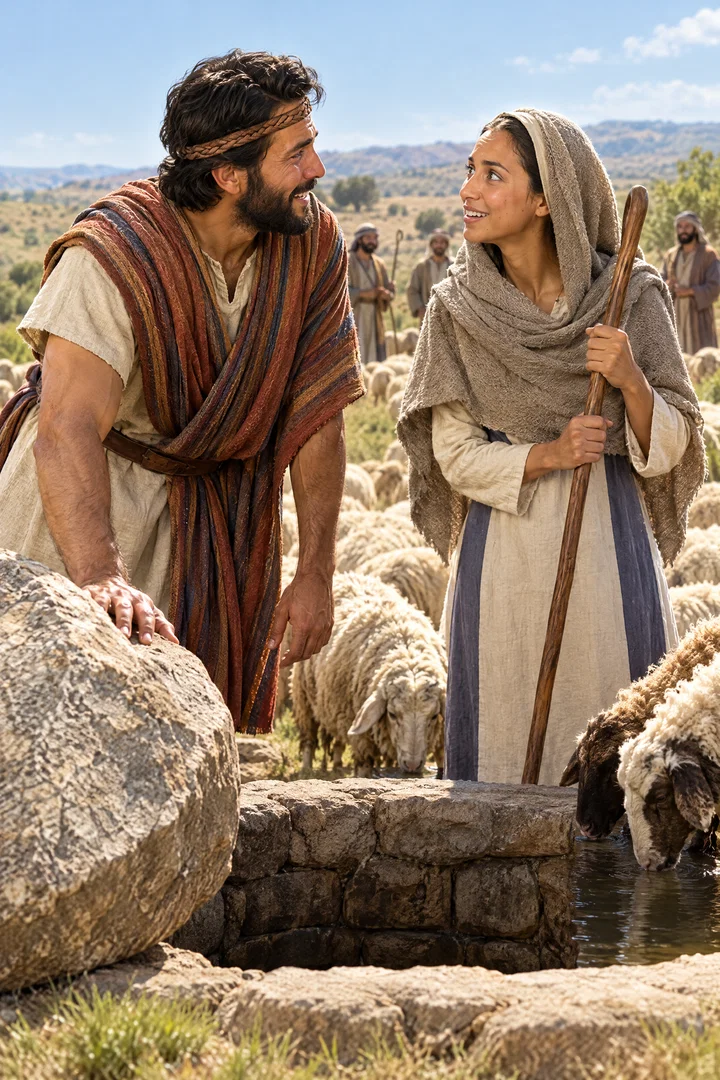
And he said unto them, Is he well? And they said, He is well: and, behold, Rachel his daughter cometh with the sheep.
Translations
And he said to them, Is he well? And they said, He is well: and, behold, Rachel his daughter comes with the sheep.
And he said unto them, Is he well? And they said, He is well: and, behold, Rachel his daughter cometh with the sheep.
And he said unto them, Is he well? And they said, He is well: and behold, Rachel his daughter cometh with the sheep.
And he said to them, Is he well? And they said, He is well: and behold, Rachel his daughter cometh with the sheep.
Revised Version, American Standard Version
And he said unto them, Is it well with him? And they said, It is well: and, behold, Rachel his daughter cometh with the sheep.
And he saith to them, 'Hath he peace?' and they say, 'Peace; and lo, Rachel his daughter is coming with the flock.'
And he said to them, Is he well? And they said, [ He is] well; and behold, there comes Rachel his daughter with the sheep.
And he said to them, Is it well with him? And they said, Well, but lo! Rachel his daughter, coming in with the sheep.
Berean Standard Bible, Majority Standard Bible
“ Is he well?” Jacob inquired.“ Yes,” they answered, “ and here comes his daughter Rachel with his sheep.”
He said to them, “ Is it well with him?”They said, “ It is well. See, Rachel, his daughter, is coming with the sheep.”
And he said to them, Is he well? And they said, He is well, and here is Rachel his daughter coming with the sheep.
Againe he sayd vnto them, Is he in good health? And they answered, He is in good health, and beholde, his daughter Rahel commeth with the sheepe.
Douay-Rheims (Challoner revision)
He said: Is he in health? He is in health, say they: and behold Rachel his daughter cometh with his flock.
Pictures
Cross-references
- Genesis 24:11
And he made his camels to kneel down without the city by a well of water at the time of the evening, even the time that women go out to draw water.
Jacob’s meeting with Rachel at a well parallels the servant’s meeting with Rebekah.
- Genesis 29:1
Then Jacob went on his journey, and came into the land of the people of the east.
Introduces Jacob’s journey eastward before he reaches the well.
- Exodus 2:15
Now when Pharaoh heard this thing, he sought to slay Moses. But Moses fled from the face of Pharaoh, and dwelt in the land of Midian: and he sat down by a well.
both show going to the fountain when seeking people in a strange land
- Genesis 28
And Isaac called Jacob, and blessed him, and charged him, and said unto him, Thou shalt not take a wife of the daughters of Canaan.
The preceding chapter in Jacob’s story.
- Genesis 31
And he heard the words of Laban’s sons, saying, Jacob hath taken away all that was our father’s; and of that which was our father’s hath he gotten all this glory.
Continues the account of Jacob’s experiences and their consequences.
Commentary
Each commentary is drawn from primary sources: the writings of Ellen G. White and Adventist pioneers and periodicals. Each commentary is separate. Its own words are not a quotation; follow the references to read the source passages.
Ellen G. White
1 source
Genesis 29:6 belongs to Jacob's arrival at the well, where his meeting with Rachel takes place.PP 188.2 Rachel in that meeting is Laban's younger daughter.PP 188.2 After Jacob makes his kinship known, Laban welcomes him.PP 188.2 In that setting Jacob serves by watering the flocks.PP 188.2
Sources
Pioneers and periodicals
11 sources
The verse belongs to Jacob's journey on from Bethel to the land of the children of the East to visit Laban, where he met the household he would join and sojourned with Laban.ST Jan 3, 1911ST Mar 19, 1894 It stands in the account of his marriage to Leah and Rachel and his serving fourteen years for his two daughters.ST Jan 3, 1911ST Mar 19, 1894 At the well he met three men from Haran with flocks of sheep, asked them where they lived and whether they knew Laban the son of Nahor, and was told Laban was well.ST Jan 3, 1911ST Oct 6, 1898 He was told also that Rachel his daughter was approaching and would soon come with the sheep to the well where the shepherds waited until all the flocks were gathered to open the well and water the sheep.ST Jan 3, 1911ST Oct 6, 1898
The scene shows Jacob arriving weary and thirsty at Haran's spring where villagers were gathered to water their flocks.ST Mar 27, 1907 It reflects the customs of everyday life around a public well.ST Mar 27, 1907 When Jacob desired to find his relatives he went to the fountain or well, because the village fountain is a bureau of information where the news of the day is passed about.ST May 19, 1898 It is where strangers inquire and learn about people.ST May 19, 1898
The verse stands within the account of Jacob in the family through which the Seed was to come, with the promises extending from Abraham to Isaac and from Isaac to Jacob.ST Jan 14, 1913 It belongs to Jacob's checkered and unsatisfactory experience in which his selfish plottings and material overreaching fitting his name supplanter brought consequent suffering.ST Jan 9, 1912ST Jan 14, 1913 In that experience Jacob who overreached and supplanted now meets overreaching himself.ST Jan 9, 1912 This shows God's providence bringing retribution sooner or later though seeming slow.ST Jan 9, 1912
The surrounding account of Jacob's polygamous family is an instance of the unhappiness caused by polygamy.RH Mar 1, 1870 His taking Leah and Rachel as wives is a plain violation of the marriage institution, but that violation no more destroys the sacred character of marriage than a violation of the Sabbath would destroy the Sabbath.RH Feb 3, 1852ST Jun 10, 1875 Marriage was made for man before the fall, its sanctity is not derived from the Decalogue, and the seventh commandment guards its sacredness.RH Feb 3, 1852ST Jun 10, 1875 The patriarchal history to which the verse belongs reckons time by weeks before the law was given at Sinai.RH Nov 8, 1853ST Jun 10, 1875 That reckoning by weeks and sevens of days is derived from nothing in nature but only from the six days of creation work and the rest of the seventh, showing the work of creation was remembered and commemorated and implying the rest and sanctification of the holy Sabbath was not forgotten.ST Jun 10, 1875
Sources