Genesis 29:7
And he said, Lo, it is yet high day, neither is it time that the cattle should be gathered together: water ye the sheep, and go and feed them.
Translations
And he said, See, it is yet high day, neither is it time that the cattle should be gathered together: water you the sheep, and go and feed them.
King James Version, KJV Cambridge Paragraph Bible, Revised Version, American Standard Version
And he said, Lo, it is yet high day, neither is it time that the cattle should be gathered together: water ye the sheep, and go and feed them.
And he said, Lo, it is yet high day, neither is it time that the cattle should be collected: water ye the sheep, and go and feed them.
And he saith, 'Lo, the day [is] still great, [it is] not time for the cattle to be gathered; water ye the flock, and go, delight yourselves.'
And he said, Behold, it is yet high day; it is not time that the cattle should be gathered together; water the sheep, and go, feed [ them].
And he said Lo! the day is yet high, it is not time for gathering together the cattle,—water the sheep, and go feed.
Berean Standard Bible, Majority Standard Bible
“ Look,” said Jacob, “ it is still broad daylight; it is not yet time to gather the livestock. Water the sheep and take them back to pasture.”
He said, “ Behold, it is still the middle of the day, not time to gather the livestock together. Water the sheep, and go and feed them.”
Then Jacob said, The sun is still high and it is not time to get the cattle together: get water for the sheep and go and give them their food.
Then he sayd, Lo, it is yet hie day, neither is it time that the cattell shoulde be gathered together: water ye the sheepe and go feede them.
Douay-Rheims (Challoner revision)
And Jacob said: There is yet much day remaining, neither is it time to bring the flocks into the folds again: first give the sheep drink, and so lead them back to feed.
Pictures
Cross-references
- John 4:6-7
Now Jacob’s well was there. Jesus therefore, being wearied with his journey, sat thus on the well: and it was about the sixth hour.
Both scenes involve drawing water at a well associated with Jacob.
- Genesis 24:10-20
And the servant took ten camels of the camels of his master, and departed; for all the goods of his master were in his hand: and he arose, and went to Mesopotamia, unto the city of Nahor.
Abraham’s servant also met a woman at a well while seeking a wife for the patriarch’s son.
- Exodus 2:15
Now when Pharaoh heard this thing, he sought to slay Moses. But Moses fled from the face of Pharaoh, and dwelt in the land of Midian: and he sat down by a well.
both show going to the fountain when seeking others
Commentary
Each commentary is drawn from primary sources: the writings of Ellen G. White and Adventist pioneers and periodicals. Each commentary is separate. Its own words are not a quotation; follow the references to read the source passages.
Ellen G. White
1 source
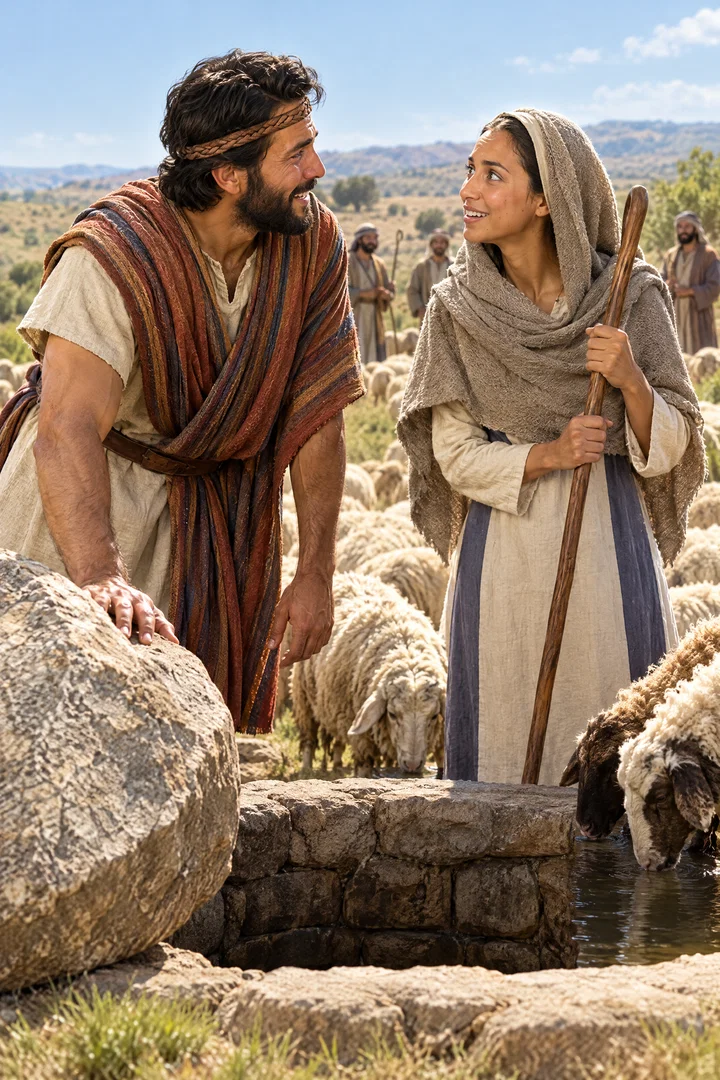
The words were spoken at the well where Jacob first met Rachel.PP 188.2 On that occasion he did a service for her by rolling the heavy stone away from the mouth of the well.PP 188.2 Having opened the well, he then watered the flocks himself.PP 188.2
Sources
Pioneers and periodicals
11 sources
Jacob, journeying on from Bethel while fleeing weary and thirsty, comes to a well or spring in the land of the children of the East near Haran and talks with the shepherds there.ST Oct 6, 1898ST Mar 19, 1894ST Mar 27, 1907 At the well he found three men with flocks of sheep.ST Oct 6, 1898 He asked where they lived and whether they knew Laban the son of Nahor, and learned they were of Haran, that Laban was well, and that his daughter Rachel would soon come with her flock.ST Oct 6, 1898
The shepherds remained at the well until all the flocks were gathered, when the well was opened and the sheep were watered.ST Oct 6, 1898 This reflects the custom of villagers coming to public wells at watering time.ST Oct 6, 1898ST Mar 27, 1907 The village fountain served as a place to pass news and for strangers to learn people and find those they sought, as Jacob went to the fountain when he desired to find his relatives.ST May 19, 1898
In its broader narrative the verse belongs to Jacob's visit to Laban, including meeting Laban, his marriages to Leah and Rachel, serving Laban fourteen years for his two daughters, his years with Laban, and his departure for Palestine.ST Jan 3, 1911ST Mar 19, 1894 It falls in the account of the family through which the Seed was to come, carrying the promises from Abraham to Isaac to Jacob.ST Jan 14, 1913 It belongs to Jacob's checkered and unsatisfactory experience, marked by selfishness, unfaithfulness, selfish plotting, family division, and material overreaching that showed the fitness of his name supplanter, where Jacob who overreached and supplanted others met overreaching himself and consequent suffering.ST Jan 3, 1911ST Jan 9, 1912ST Jan 14, 1913
The account shows God's care for Jacob despite his selfishness and unfaithfulness and God's mercy to bring a change, while God's providence, though seeming slow, brings retribution sooner or later.ST Jan 3, 1911ST Jan 9, 1912ST Jan 14, 1913 Connected with Jacob's marriage feast, which lasted a week, the verse is evidence that the week was an established measure of time in the patriarchal period.RH Jan 29, 1867 Holy men of old reckoned time by weeks and by sevens of days derived from nothing in nature but from the six days of creation work and rest on the seventh, giving a trace of the Sabbath from the beginning of the world and showing the seventh day set apart at creation was known and obligatory to all mankind, so that memory of creation implies remembrance of the sanctified Sabbath.ST Jun 10, 1875RH Feb 25, 1875
The verse belongs to a patriarchal account that plainly violates the institution of marriage, which was made for man before the fall and whose sacred character does not come from the Decalogue, though the seventh commandment guards its sacredness.RH Feb 3, 1852ST Jun 10, 1875 Such violation by the patriarchs no more destroys the sacredness of marriage than any patriarchal violation of the Sabbath would destroy the sacred character of the Sabbath made before the fall.RH Feb 3, 1852ST Jun 10, 1875
Sources