Genesis 30:23
And she conceived, and bare a son; and said, God hath taken away my reproach:
Translations
And she conceived, and bore a son; and said, God has taken away my reproach:
King James Version, KJV Cambridge Paragraph Bible
And she conceived, and bare a son; and said, God hath taken away my reproach:
And she conceived, and bore a son; and said, God hath taken away my reproach:
Revised Version, American Standard Version
And she conceived, and bare a son: and said, God hath taken away my reproach:
and she conceiveth and beareth a son, and saith, 'God hath gathered up my reproach;'
And she conceived, and bore a son, and said, God has taken away my reproach.
So she conceived and bare a son,—and said, God hath taken away my reproach;
Berean Standard Bible, Majority Standard Bible
and she conceived and gave birth to a son. “God has taken away my shame,” she said.
She conceived, bore a son, and said, “God has taken away my reproach.”
And she was with child, and gave birth to a son: and she said, God has taken away my shame.
So she conceiued and bare a sonne, and said, God hath taken away my rebuke.
Douay-Rheims (Challoner revision)
And she conceived, and bore a son, saying: God hath taken away my reproach.
Pictures
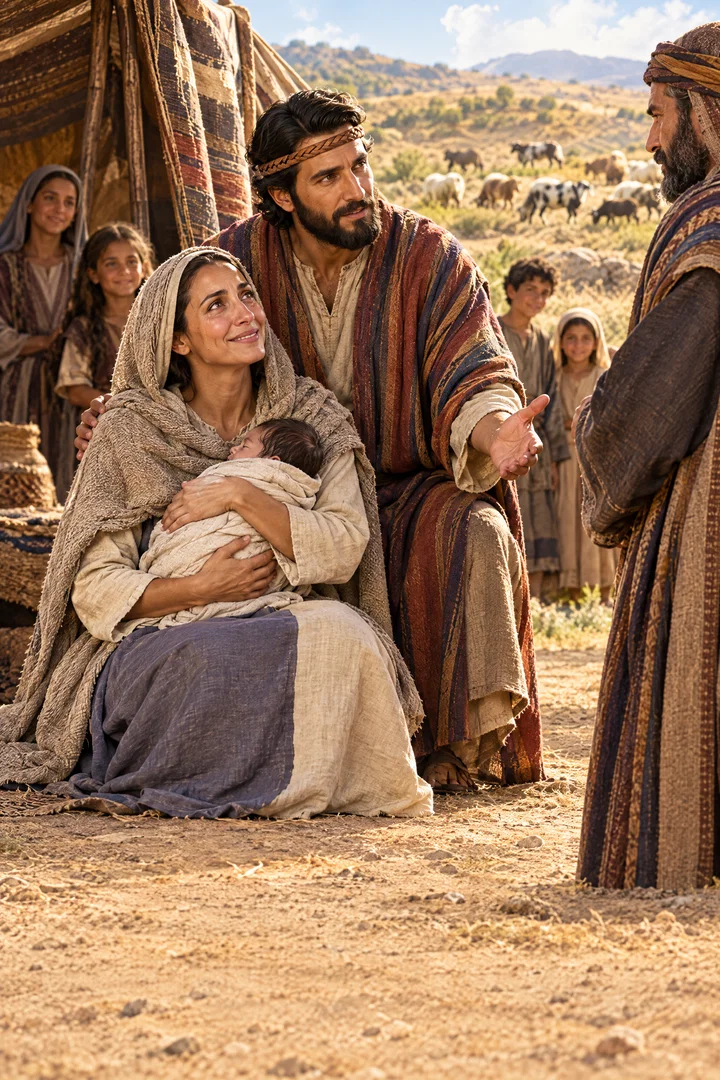
Cross-references
- Genesis 16:1-4
Now Sarai Abram’s wife bare him no children: and she had an handmaid, an Egyptian, whose name was Hagar.
Both texts describe polygamous households and the resulting family conflict.
- Genesis 29:16-30
And Laban had two daughters: the name of the elder was Leah, and the name of the younger was Rachel.
Both texts describe Jacob’s unhappy family and marriage practices.
Commentary
Each commentary is drawn from primary sources: the writings of Ellen G. White and Adventist pioneers and periodicals. Each commentary is separate. Its own words are not a quotation; follow the references to read the source passages.
Ellen G. White
1 source
Genesis 30:23 records the birth of Joseph to Rachel.ST Dec 18, 1879 Rachel was Jacob's beloved wife.ST Dec 18, 1879 Joseph was one of the children of Jacob's old age.ST Dec 18, 1879
Sources
Pioneers and periodicals
8 sources
Rachel, Jacob's beloved wife, conceived and bore him a son, Joseph, who was counted among the children of his old age.ST Dec 18, 1879ST Sep 2, 1889 In naming what had happened she declared that God had removed her reproach, meaning the shame she felt over being childless.ST Sep 2, 1889 That birth took place while Jacob was in the land of the children of the East serving Laban fourteen years for his two daughters, after his dream at Bethel in Genesis 28 and before his departure from Haran to return to Canaan.ST Mar 19, 1894
The verse stands in the record of Jacob's trials and victories, which culminate in a complete change of heart and his place among the Israel of God.ST It belongs to the history of the channels through which the Promised Seed would come.ST It falls within the account of his checkered experiences in which selfish plotting brings suffering and he himself is overreached, showing that God's providence may seem slow but retribution comes sooner or later.ST Jan 9, 1912
The chapter belongs to the record of Jacob's polygamous family and shows that polygamy was always evil and wrong and caused very great unhappiness in every family where it entered.RH Mar 1, 1870 The patriarchal conduct seen there violated the marriage institution, but such violations do not make the marriage institution itself less sacred.RH Feb 3, 1852RH Nov 8, 1853 Marriage was established before the Fall.RH Feb 3, 1852 The verse also shows that Joseph's mother had great influence in forming his character through her counsel and training during his first twelve or fifteen years.ST Sep 2, 1889
Sources