Genesis 31:52
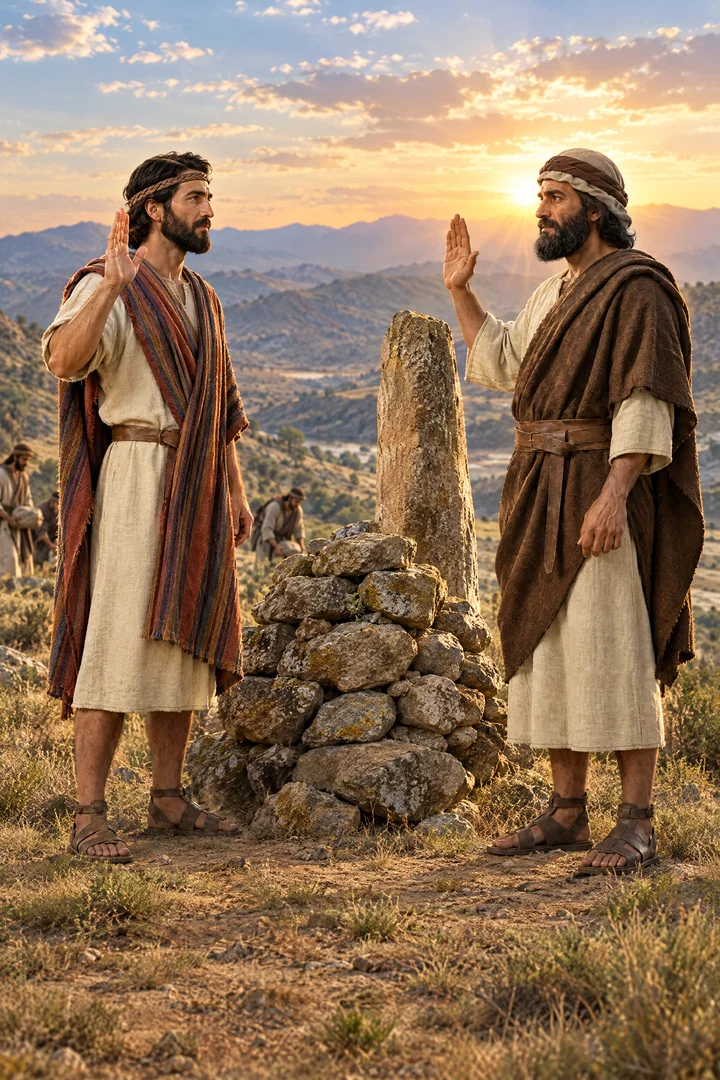
This heap be witness, and this pillar be witness, that I will not pass over this heap to thee, and that thou shalt not pass over this heap and this pillar unto me, for harm.
Translations
This heap be witness, and this pillar be witness, that I will not pass over this heap to you, and that you shall not pass over this heap and this pillar to me, for harm.
This heap be witness, and this pillar be witness, that I will not pass over this heap to thee, and that thou shalt not pass over this heap and this pillar unto me, for harm.
this heap be witness, and this pillar be witness, that I will not pass over this heap to thee, and that thou shalt not pass over this heap and this pillar unto me, for harm.
This heap be witness, and this pillar be witness, that I will not pass over this heap to thee, and that thou shalt not pass over this heap and this pillar to me, for harm.
Revised Version, American Standard Version
This heap be witness, and the pillar be witness, that I will not pass over this heap to thee, and that thou shalt not pass over this heap and this pillar unto me, for harm.
this heap [is] witness, and the standing pillar [is] witness, that I do not pass over this heap unto thee, and that thou dost not pass over this heap and this standing pillar unto me — for evil;
[ let] this heap be witness, and the pillar a witness, that neither I pass this heap [ to go] to thee, nor thou pass this heap and this pillar [ to come] to me, for harm.
A witness, be this heap, and, a witness, the pillar,—That, I, am not to pass, unto thee, over this heap, And, thou, art not to pass, unto me, over this heap and this pillar for harm.
Berean Standard Bible, Majority Standard Bible
This mound is a witness, and this pillar is a witness, that I will not go past this mound to harm you, and you will not go past this mound and pillar to harm me.
May this heap be a witness, and the pillar be a witness, that I will not pass over this heap to you, and that you will not pass over this heap and this pillar to me, for harm.
They will be witness that I will not go over these stones to you, and you will not go over these stones or this pillar to me, for any evil purpose.
This heape shall be witnesse, and the pillar shall be witnesse, that I will not come ouer this heape to thee, and that thou shalt not passe ouer this heape and this pillar vnto me for euill.
Douay-Rheims (Challoner revision)
Shall be a witness: this heap, I say, and the stone, be they for a testimony, if either I shall pass beyond it going towards thee, or thou shalt pass beyond it, thinking harm to me.
Pictures
Cross-references
- Genesis 31:44
Now therefore come thou, let us make a covenant, I and thou; and let it be for a witness between me and thee.
Jacob and Laban agree to make a covenant.
- Genesis 31:1-2
And he heard the words of Laban’s sons, saying, Jacob hath taken away all that was our father’s; and of that which was our father’s hath he gotten all this glory.
Jealous words and Laban’s changed countenance distressed Jacob.
- Genesis 30:25-27
And it came to pass, when Rachel had born Joseph, that Jacob said unto Laban, Send me away, that I may go unto mine own place, and to my country.
Jacob's request to leave and Laban's plea to stay
Commentary
Each commentary is drawn from primary sources: the writings of Ellen G. White and Adventist pioneers and periodicals. Each commentary is separate. Its own words are not a quotation; follow the references to read the source passages.
Ellen G. White
5 sources
The verse belongs to Jacob's departure from Laban after long service in which Laban's property had grown from little to a multitude and Jacob himself had increased exceedingly with cattle and servants.PP 192.3–193.1 Laban confessed the Lord had blessed him for Jacob's sake and urged him to remain, but Laban became envious and his countenance was not toward Jacob as before while his sons accused Jacob of taking their father's wealth and glory.PP 192.3–193.1 This left Jacob in perplexity and distress, fearing violence from Laban's sons as well as encountering Esau, so mindful of the Bethel promise he carried his case to God and was answered in a dream with the command to return to the land of his fathers and to his kindred with the assurance of divine presence with him.PP 192.3–193.1
The covenant was proposed on Laban's terms after he could not deny Jacob's charges of selfish and harsh treatment, and Jacob agreed to it.PP 193.6–194.1 As part of the covenant, Jacob entered a solemn promise before the Lord not to take other wives besides Leah and Rachel.1SP 117.1SG3 126.1–127.1 A pile of stones was raised as the token of the compact, with the heap and the pillar standing as witnesses and as a mutual boundary of peace that neither man was to pass over to harm the other.1SP 117.1ST May 1, 1879PP 193.6–194.1SG3 126.1–127.1 The stones served as a visible sign of the agreement and a solemn reminder that God witnesses it.ST May 1, 1879
Laban named the pillar Mizpah, meaning watch-tower, calling on the Lord to watch between them when they were absent from one another.PP 193.6–194.1 Laban called on the God of Abraham and of Nahor to judge between them, while Jacob swore by the Fear of his father Isaac.PP 193.6–194.1 The treaty was confirmed by a feast and a night of friendly communing, and at dawn Laban departed, ending all trace of connection between the children of Abraham and the dwellers in Mesopotamia.PP 193.6–194.1
Sources
Pioneers and periodicals
8 sources
This heap and pillar belong to the covenant Jacob and Laban made together after Jacob departed from Haran and Laban pursued him, when they met at Gilead.ST Oct 6, 1898ST Mar 19, 1894 The heap and the pillar are witnesses to their mutual agreement and oath, marking a boundary that neither man will pass over toward the other to do harm.ST May 1, 1879ST Jan 3, 1911ST Oct 6, 1898RH Mar 7, 1912 They stand as a visible sign of the agreement and a solemn reminder that God witnesses it.ST May 1, 1879 The agreement is also an example of the custom of sealing treaties or oaths with a feast.RH Mar 7, 1912
The verse belongs to the wider account of Jacob's visit to Laban, his mother's brother, including his marriages to Leah and Rachel, his sojourn with Laban, and his leaving Syria for Palestine with his face set homeward.ST Jan 3, 1911 The account shows the deceiver deceived, for as Jacob had deceived his father and by selfish plotting had overreached and supplanted others, he himself was deceived and met overreaching, and his plotting brought him suffering.ST Jan 3, 1911ST Jan 9, 1912 Though God's providence may seem slow, retribution comes sooner or later.ST Jan 9, 1912
The same account shows God's care for Jacob as promised, maintained notwithstanding his selfishness and unfaithfulness, and it teaches readiness to obey God's leading.ST Oct 6, 1898ST Jan 3, 1911 The verse stands within Jacob's checkered and unsatisfactory experience, trouble he would have saved himself by better earlier faithfulness.ST Jan 14, 1913ST Jan 9, 1912 It stands within the history of the family through which the promised Seed was to come, with the promises given to Abraham extending to Isaac and then to Jacob, while Jacob still proved the fitness of his name supplanter by material overreaching, encouraged by his mother keeping before him the material importance of the Seed without the fullest appreciation of the spiritual blessings, until God in mercy brings a change.ST Jan 14, 1913 The meeting also shows Jacob's faithfulness to Laban and warns against rash words, as seen in Jacob's hasty curse concerning the stolen images.ST Oct 6, 1898
Sources