Translations
American King James Version, King James Version, Revised Version
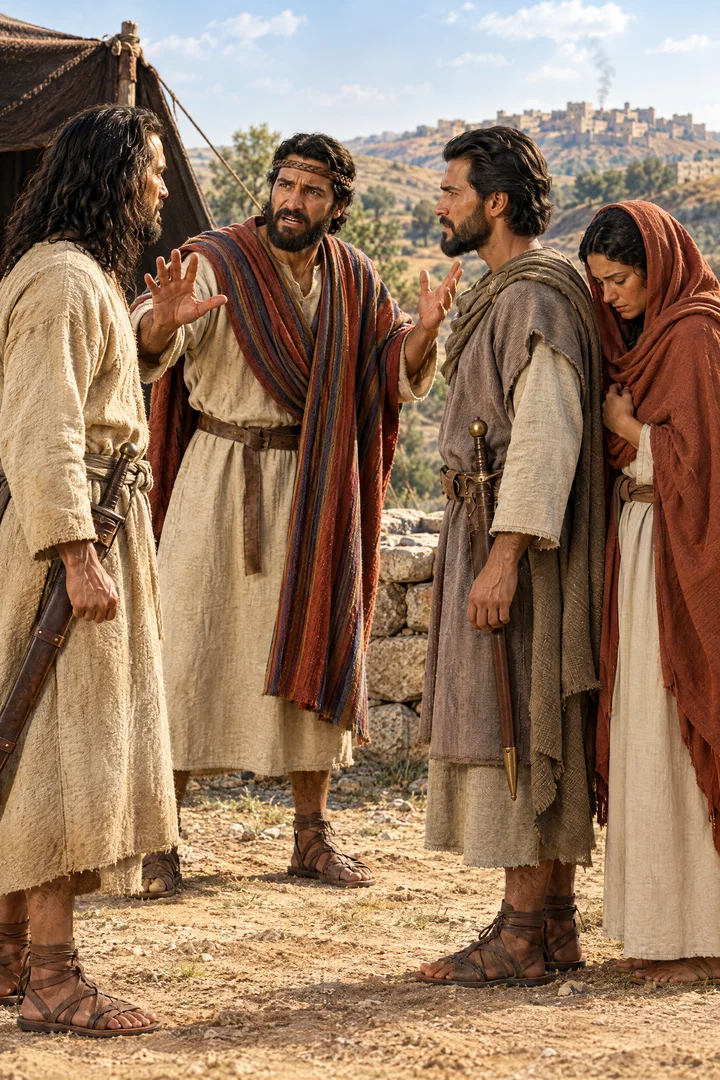
And they said, Should he deal with our sister as with an harlot?
KJV Cambridge Paragraph Bible, American Standard Version
And they said, Should he deal with our sister as with a harlot?
And they said, Should he deal with our sister, as with a harlot?
And they say, 'As a harlot doth he make our sister?'
And they said, Should people deal with our sister as with a harlot?
And they said,—As with a harlot, was he to deal with our sister.
Berean Standard Bible, Majority Standard Bible
But they replied, “ Should he have treated our sister like a prostitute?”
They said, “ Should he deal with our sister as with a prostitute?”
But they said, Were we to let him make use of our sister as a loose woman?
And they answered, Shoulde hee abuse our sister as a whore?
Douay-Rheims (Challoner revision)
They answered: Should they abuse our sister as a strumpet?
Pictures
Cross-references
- Genesis 49:5-7
Simeon and Levi are brethren; instruments of cruelty are in their habitations.
Jacob condemns Simeon and Levi’s violence, fierce anger, and cruelty at Shechem.
- Genesis 34:1-2
And Dinah the daughter of Leah, which she bare unto Jacob, went out to see the daughters of the land.
Dinah’s visit leads to her disgrace at Shechem.
- Genesis 34:25-26
And it came to pass on the third day, when they were sore, that two of the sons of Jacob, Simeon and Levi, Dinah’s brethren, took each man his sword, and came upon the city boldly, and slew all the males.
murder the reply defends
- Genesis 34:13
And the sons of Jacob answered Shechem and Hamor his father deceitfully, and said, because he had defiled Dinah their sister:
Simeon and Levi deceive the Shechemites.
- Genesis 34:7
And the sons of Jacob came out of the field when they heard it: and the men were grieved, and they were very wroth, because he had wrought folly in Israel in lying with Jacob’s daughter; which thing ought not to be done.
brothers' grief and wrath over Dinah
- Genesis 35:1-5
And God said unto Jacob, Arise, go up to Beth-el, and dwell there: and make there an altar unto God, that appeared unto thee when thou fleddest from the face of Esau thy brother.
After the violence at Shechem, Jacob’s household puts away idols and God protects them on their journey.
Commentary
Each commentary is drawn from primary sources: the writings of Ellen G. White and Adventist pioneers and periodicals. Each commentary is separate. Its own words are not a quotation; follow the references to read the source passages.
Ellen G. White
3 sources
The words are Simeon and Levi's defense of their violent revenge against the Shechemites, appealing to the shame brought upon their sister.PP 204.2–3SG3 171.1SG3 136.1–137.1 Their anger over what had been done to their sister had cause.PP 204.2–3 Yet the revenge they carried out was done with deceit.PP 204.2–3SG3 171.1 Their response was cruel and revengeful.PP 204.2–3SG3 171.1SG3 136.1–137.1
Their violence was a grievous sin.PP 204.2–3 Jacob's prophecy presents that violence as sin for which God would hold them accountable.SG3 171.1 Their response was not approved by God.SG3 136.1–137.1
Sources
Pioneers and periodicals
12 sources
Simeon and Levi spoke these words to Jacob to defend their killing of Shechem and the men of his city and bringing Dinah home, asking whether their sister should be treated as a prostitute when he rebuked them while their anger was still hot.RH May 25, 1916STST Jan 3, 1911RH Apr 16, 1901 The question expresses their outrage, indignation and condemnation at the sexual violation and dishonor done to her.RH May 25, 1916ST Jan 3, 1911ST Jan 3, 1911 Their objection holds up a standard of purity higher than that of the people of the land, condemning the low morality of Canaan and upholding chastity, monogamy and temperance.ST Jan 3, 1911RH Jan 17, 1865 Yet their outrage did not justify their treachery, deception and slaughter of innocent people or the further violence and bloodshed it brought, revealing both Levi's impetuous and fearless nature and the low moral standards and crime that had grown within Jacob's family.ST Dec 4, 1879RH May 25, 1916STRH Sep 21, 1911
Words and Historical Setting
The words are the reply of Simeon and Levi defending their killing of Shechem and his city by asking whether their sister should have been treated as a prostitute.ST Dec 4, 1879RH May 25, 1916STST Jan 3, 1911RH Apr 16, 1901 They spoke to Jacob when he rebuked them after they had killed all the men of the city and brought Dinah home.RH Apr 16, 1901 Their anger still burned hot and was not appeased by the respectable marriage arrangement meant to cover the shame.RH Apr 16, 1901 In the patriarchal age the family, not the individual, was the unit of society, so Shechem's treatment of Dinah was an injury done not to her alone but to the whole family to which she belonged, and her brothers were bound to stand together as one man with her to secure redress.RH Mar 12, 1908 By the reverse of the same law an offense committed by an individual was reckoned as chargeable to his entire family, and this family solidarity is the foundation of the Go'el, the father, brother, or nearest kinsman who stands as representative of another to demand performance of obligations owing to him and to perform duties owed by him.RH Mar 12, 1908
The surrounding chapter turns on circumcision and shows that circumcision was still known and retained among Abraham's descendants four hundred years after God enjoined it on Abraham and his family.RH Dec 17, 1861 Moses gave circumcision to the Hebrews not by originating it but by committing an existing ordinance to their trust, and in the same way God gave the already-made Sabbath to the Hebrews without then instituting it.RH Dec 17, 1861 Jacob's stay near the city of Shechem brought ruin on Dinah and became an occasion for his sons' sins, an event connected with Israel's later bondage in Egypt.RH May 18, 1905 After the killing God directed Jacob to go to Bethel and build an altar, where Jacob told his household to put away their foreign gods and be clean.ST May 4, 1882 With disgrace at home and uproar in the country over the murder, the family's only hope was to take Dinah and move to a new neighborhood where the disgrace was not publicly known.RH Apr 16, 1901
The full account in Genesis 34:1-31 is the vivid, inimitable story of Dinah, told with those of Judah and Joseph to give life and variety to the sober gravity and brevity of Genesis history.RH Jan 17, 1865
Moral Lessons and Judgments
The retort about treating a sister like a prostitute was an outburst of outrage, indignation and condemnation over sexual violation and dishonor done to Dinah.ST Dec 4, 1879RH May 25, 1916ST Jan 3, 1911RH Sep 21, 1911 It was the brothers' defense of their vengeance against Shechem, insisting that such misuse of their sister could not be left unanswered.ST Dec 4, 1879RH May 25, 1916ST Jan 3, 1911RH Sep 21, 1911 Their objection condemned the act itself as shameful and intolerable.ST Jan 3, 1911ST Jan 3, 1911
That condemnation marked a standard of purity higher than that of the people living in the land, standing in contrast to the low morality of Canaan.ST Jan 3, 1911 The whole story upholds chastity, monogamy and temperance, and condemns the opposite both expressly and by implication.RH Jan 17, 1865
Yet justifiable outrage did not justify treachery, deception and slaughter, nor the suffering inflicted on innocent people of the city.ST Dec 4, 1879RH May 25, 1916RH Sep 21, 1911 The retaliation for violation brought further violence and bloodshed in its train.RH May 25, 1916 It revealed an impetuous and fearless temper in Levi, willing to deceive and kill the men of Shechem.RH Sep 21, 1911 The episode also exposes the low moral standards and crime that had taken root within Jacob's own family as the fruit of his mistakes.ST
Sources