Genesis 35:10
And God said unto him, Thy name is Jacob: thy name shall not be called any more Jacob, but Israel shall be thy name: and he called his name Israel.
Translations
And God said to him, Your name is Jacob: your name shall not be called any more Jacob, but Israel shall be your name: and he called his name Israel.
King James Version, KJV Cambridge Paragraph Bible, Revised Version, American Standard Version
And God said unto him, Thy name is Jacob: thy name shall not be called any more Jacob, but Israel shall be thy name: and he called his name Israel.
And God said to him, Thy name is Jacob: thy name shall not be called any more Jacob, but Israel shall be thy name; and he called his name Israel.
and God saith to him, 'Thy name [is] Jacob: thy name is no more called Jacob, but Israel is thy name;' and He calleth his name Israel.
And God said to him, Thy name is Jacob: thy name shall not henceforth be called Jacob, but Israel shall be thy name. And he called his name Israel.
And God said to him, Thy name, is Jacob,—Thy name shall no longer be called Jacob But, Israel, shall be thy name. So he called his name, Israel.
Berean Standard Bible, Majority Standard Bible
And God said to him, “ Though your name is Jacob, you will no longer be called Jacob. Instead, your name will be Israel.” So God named him Israel.
God said to him, “ Your name is Jacob. Your name shall not be Jacob any more, but your name will be Israel.” He named him Israel.
Jacob is your name, but it will be so no longer; from now your name will be Israel; so he was named Israel.
Moreouer God said vnto him, Thy name is Iaakob: thy name shalbe no more called Iaakob, but Israel shalbe thy name: and hee called his name Israel.
Douay-Rheims (Challoner revision)
Saying: Thou shalt not be called any more Jacob, but Israel shall be thy name. And he called him Israel.
Pictures
Cross-references
- Genesis 32:28
And he said, Thy name shall be called no more Jacob, but Israel: for as a prince hast thou power with God and with men, and hast prevailed.
God first gave Jacob the name Israel at Penuel.
- Genesis 28:13-15
And, behold, the LORD stood above it, and said, I am the LORD God of Abraham thy father, and the God of Isaac: the land whereon thou liest, to thee will I give it, and to thy seed;
God renews at Bethel the promise first made to Jacob there.
- Genesis 12:1-3
Now the LORD had said unto Abram, Get thee out of thy country, and from thy kindred, and from thy father’s house, unto a land that I will shew thee:
The promise renewed to Jacob was first made to Abraham.
- Genesis 35:5
And they journeyed: and the terror of God was upon the cities that were round about them, and they did not pursue after the sons of Jacob.
God protects Jacob’s household on the journey to Bethel.
- Genesis 32:30
And Jacob called the name of the place Peniel: for I have seen God face to face, and my life is preserved.
Jacob’s earlier encounter at Peniel closes the account of his renaming.
- Genesis 35:2-3
Then Jacob said unto his household, and to all that were with him, Put away the strange gods that are among you, and be clean, and change your garments:
Household cleansing and putting away idols prepare for blessing.
- Genesis 35:1
And God said unto Jacob, Arise, go up to Beth-el, and dwell there: and make there an altar unto God, that appeared unto thee when thou fleddest from the face of Esau thy brother.
The command to go to Bethel leads to blessing.
- Genesis 35:14
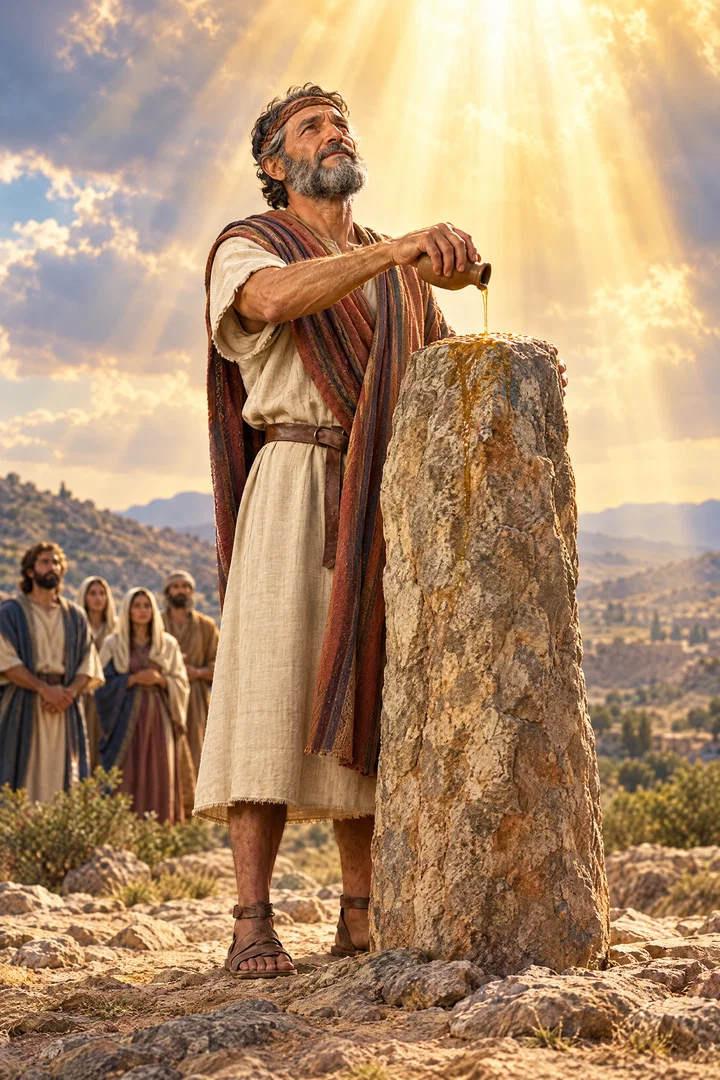
And Jacob set up a pillar in the place where he talked with him, even a pillar of stone: and he poured a drink offering thereon, and he poured oil thereon.
A stone pillar marks the place where God talked with Jacob.
- Genesis 28:20-22
And Jacob vowed a vow, saying, If God will be with me, and will keep me in this way that I go, and will give me bread to eat, and raiment to put on,
Jacob fulfills the vow he made on his journey to Mesopotamia.
- Genesis 26:2-5
And the LORD appeared unto him, and said, Go not down into Egypt; dwell in the land which I shall tell thee of:
God renews to Isaac the promise later made to Jacob.
- Judges 20:18-28
And the children of Israel arose, and went up to the house of God, and asked counsel of God, and said, Which of us shall go up first to the battle against the children of Benjamin? And the LORD said, Judah shall go up first.
Israel came to inquire of the Lord there in the time of the judges.
- Genesis 35:4
And they gave unto Jacob all the strange gods which were in their hand, and all their earrings which were in their ears; and Jacob hid them under the oak which was by Shechem.
idols and earrings surrendered and buried
Commentary
Each commentary is drawn from primary sources: the writings of Ellen G. White and Adventist pioneers and periodicals. Each commentary is separate. Its own words are not a quotation; follow the references to read the source passages.
Ellen G. White
4 sources
The renaming in Genesis 35:10 followed the cruel and revengeful attack by Jacob's sons upon the Shechemites, an act Jacob had neither sanctioned nor known beforehand.SG3 136.1–137.1 That deed left him despised by the surrounding peoples and in danger of being destroyed together with his whole household.SG3 136.1–137.1 In his distress Jacob called upon God and was told to go to Bethel and there build an altar to the God who had answered him in distress and had been with him.SG3 136.1–137.1
Before going, Jacob humbled himself and required his household to humble themselves, to put away the strange gods among them, to be clean, to change their garments and to lay aside their ornaments.SG3 136.1–137.1 At the same time he offered sacrifice to make atonement for their sins so that God might be entreated for them.SG3 136.1–137.1 God accepted Jacob's effort to remove the wrong from his family and protected them by putting His terror upon the cities round about so that they did not pursue them.SG3 136.1–137.1
The verse belongs to God's renewed appearance to Jacob at Bethel, when He appeared to him again and renewed and reaffirmed the covenant promise previously made to him.PP 205.1–3PP 206.11SP 126.1SG3 136.1–137.1 In that appearance God blessed Jacob and gave him the name Israel, because his fear was before God.1SP 126.1SG3 136.1–137.1 Jacob marked the place where God spoke with him by setting up a pillar of stone.PP 206.11SP 126.1SG3 136.1–137.1 The meaning of the change of his name from Jacob to Israel is not explained.PP 205.1–3
Sources
Pioneers and periodicals
17 sources
God met Jacob again at Bethel when he returned from Haran by way of Esau and Shechem to the place where he had met God before.ST Jul 2, 1885ST May 20, 1889ST Oct 20, 1898 There He repeated and confirmed the blessing given at Penuel, declaring that he should no more be called Jacob but Israel, the prevailer and prevailer with God named for his victory through faith in wrestling with the Angel at Jabbok.ST Jan 3, 1911ST Oct 20, 1898ST Jan 21, 1913ST Jan 16, 1912ST Oct 20, 1898 The change marked the crisis of his life and a complete change of heart, by which the supplanter became part of the Israel of God and gave origin to the people called Israel, who are those that prevail by faith.ST Jan 3, 1911ST Mar 17, 1914STST Jan 16, 1912 With the name He renewed to Jacob the everlasting covenant made with Abraham and Isaac, that he would be fruitful and that a nation and a company of nations and kings would come from him, to whom the land and the dominion of the earth lost in Adam's fall would belong.ST Jul 2, 1885RH Apr 12, 1860ST Apr 24, 1893ST Oct 20, 1898 It came in revival after his household put away idols to fulfill his vow, and his answer in building an altar and giving a substantial offering with his children calls back forgotten vows in repentance and forgiveness.ST Dec 4, 1879ST Mar 26, 1894ST Jan 3, 1911ST May 20, 1889
Setting and Name Change
God appeared to Jacob again at Bethel on his return from Haran to Bethel, where he had met God before, and that sacred history made Bethel a place of deep religious memory.ST Jul 2, 1885ST May 20, 1889 This coming stands at the end of his travels back, the way running from the meeting with Esau toward Mount Seir and Succoth and by way of Shalem and the field of Shechem between the two famous mountains.ST Oct 20, 1898 It belongs to his returning to Bethel to fulfill his vow and renew his commitment, after a revival in his family when they put away their idols.ST Mar 26, 1894ST May 20, 1889 It is a calling back to forgotten vows, renewing in repentance.ST May 20, 1889
The naming at Bethel repeats the previous blessing given at Penuel, recalling and confirming that blessing and Jacob's identity.ST Oct 20, 1898ST Oct 20, 1898 God declares that he shall no more be called Jacob but Israel shall be his name, confirming the transition from his former name to the name by which he and his descendants would be known.ST Jan 3, 1911ST Mar 17, 1914ST Oct 20, 1898 Israel means prevailer and prevailer with God, given following his victory through faith in wrestling with the Angel of Jehovah at the Brook Jabbok.ST Jan 21, 1913ST Jan 16, 1912
The change marks the crisis through which his life changed and a complete change of heart, so that the supplanter becomes part of the Israel of God.ST Jan 3, 1911ST It stands with being met by angels, reconciliation with Esau, and the death of Rachel. The name marks the origin of the people called Israel, and true Israel are those who prevail by faith.ST Mar 17, 1914ST Jan 16, 1912 It sets the naming within the contrast between Jacob who built altars to the Lord and Esau who built none, bearing on Jacob's mind toward Esau and his former course concerning the birthright.ST Oct 20, 1898
Covenant Renewal and Response
At Bethel God appeared to Jacob again and renewed to him the promise and blessing previously made to Abraham and Isaac.ST Dec 4, 1879ST Jul 2, 1885ST Apr 24, 1893 In giving him the name Israel He confirmed to him the Abrahamic and everlasting covenant and blessed him there.ST Dec 4, 1879ST Jul 2, 1885RH Apr 12, 1860 That renewal made Bethel a place of deep religious memory.ST Jul 2, 1885
The promises renewed there were that he would become fruitful, that a nation and a company of nations would come from him, that kings would descend from him, and that the land would belong to him and his offspring.ST Apr 24, 1893ST Oct 20, 1898 That confirmation carried the promise of the dominion of the earth, embracing all that was lost in the fall of Adam.RH Apr 12, 1860
The covenant confirmed to Israel is one everlasting promise with the promise to Abraham to make him a great nation, the oath to Isaac, and the law confirmed to Jacob. Abraham and his seed are heirs of the world, with the whole earth given to them as it had been given to Adam and afterward to Noah. God's kingdom under Abraham and his seed will subdue all other nations until it occupies and fills the whole earth, requiring only obedience and loyalty to God as king. The same everlasting or new covenant made with Abraham and Isaac and with the fathers was later given opportunity through the deliverance from Egypt as salvation, redemption, and recreation by Christ the Creator and Deliverer.ST Feb 15, 1905 The covenant at Sinai re-established the everlasting covenant made with Jacob; the historical basis was new because deliverance from Egypt had then happened for the first time, but the underlying principles were old.ST Feb 15, 1905
That promise concerns the inheritance and everlasting life received through faith.ST Jan 7, 1903 Jacob's response to God's favor was to fulfill his vow by building an altar and giving a substantial offering from the possessions entrusted to him.ST Dec 4, 1879 The chapter also records Israel's dedication with his children to God, marking the crisis through which his life changed.ST Jan 3, 1911 It calls people back to forgotten vows and renews them in repentance, with the mark of a changed heart set beside being met by angels, reconciliation with Esau, and the death of Rachel.ST May 20, 1889 In this it presses whether the spirit of forgiveness is in the heart.
Sources