Genesis 35:17
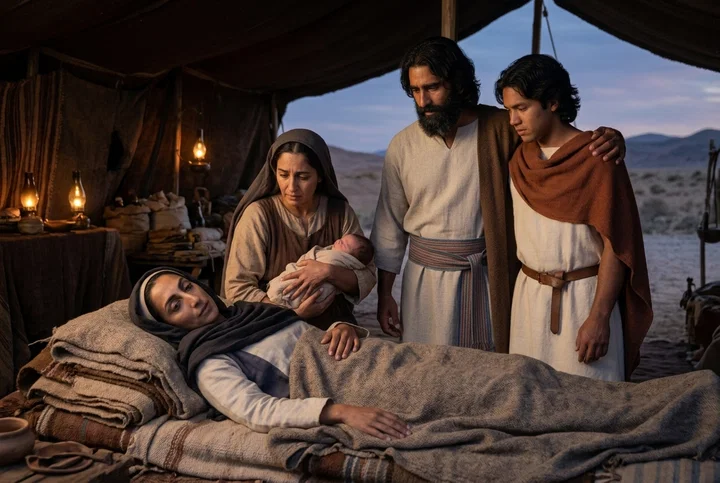
And it came to pass, when she was in hard labour, that the midwife said unto her, Fear not; thou shalt have this son also.
Translations
And it came to pass, when she was in hard labor, that the midwife said to her, Fear not; you shall have this son also.
King James Version, KJV Cambridge Paragraph Bible
And it came to pass, when she was in hard labour, that the midwife said unto her, Fear not; thou shalt have this son also.
And it came to pass when she was in hard labor, that the midwife said to her, Fear not; thou shalt have this son also.
And it came to pass, when she was in hard labour, that the midwife said unto her, Fear not; for now thou shalt have another son.
And it came to pass, when she was in hard labor, that the midwife said unto her, Fear not; for now thou shalt have another son.
and it cometh to pass, in her being sharply pained in her bearing, that the midwife saith to her, 'Fear not, for this also [is] a son for thee.'
And it came to pass when it went hard with her in her childbearing, that the midwife said to her, Fear not; for this also is a son for thee.
So it came to pass when she was in hard-labour in her child-birth, that the midwife said to her—Do not fear, for this also of thine, is, a son.
Berean Standard Bible, Majority Standard Bible
During her severe labor, the midwife said to her, “ Do not be afraid, for you are having another son.”
When she was in hard labor, the midwife said to her, “Don’t be afraid, for now you will have another son.”
And when her pain was very great, the woman who was helping her said, Have no fear; for now you will have another son.
And whe she was in paines of her labour, the midwife saide vnto her, Feare not: for thou shalt haue this sonne also.
Douay-Rheims (Challoner revision)
By reason of her hard labour she began to be in danger, and the midwife said to her: Fear not, for thou shalt have this son also.
Pictures
Cross-references
- Genesis 48:7
And as for me, when I came from Padan, Rachel died by me in the land of Canaan in the way, when yet there was but a little way to come unto Ephrath: and I buried her there in the way of Ephrath; the same is Beth-lehem.
Jacob recalls Rachel’s death near Ephrath.
- Matthew 2:17-18
Then was fulfilled that which was spoken by Jeremy the prophet, saying,
Rachel weeps long after her death
- Genesis 35:24
The sons of Rachel; Joseph, and Benjamin:
Lists Benjamin among Rachel’s sons, following his birth.
- Jeremiah 31:15-17
Thus saith the LORD; A voice was heard in Ramah, lamentation, and bitter weeping; Rahel weeping for her children refused to be comforted for her children, because they were not.
Rachel weeps long after her death
Commentary
Each commentary is drawn from primary sources: the writings of Ellen G. White and Adventist pioneers and periodicals. Each commentary is separate. Its own words are not a quotation; follow the references to read the source passages.
Ellen G. White
2 sources
The death took place on the journey toward Hebron to see Isaac again, before the family had gone far.ST Dec 4, 1879 She was in hard labor with her second son while the midwife reassured her not to fear, for she would have this son also.PP 206.3–4 The child was born before she died, and she lived only a moment afterward.ST Dec 4, 1879PP 206.3–4
With that fleeting moment she called him Benoni, meaning son of my sorrow, while his father called him Benjamin, meaning son of his right hand and strength, and it was his father who gave him the name Benjamin.ST Dec 4, 1879PP 206.3–4 She was buried where she died, and a stone monument was placed above her grave to preserve her memory.ST Dec 4, 1879
Sources
Pioneers and periodicals
8 sources
The verse records the midwife reassuring Rachel during her hard labor that she would have another son, and the chapter's chief incidents include Rachel's death.ST Jan 3, 1911ST Aug 25, 1881ST Jan 9, 1912 That son is Benjamin, and Rachel died in giving birth to him shortly afterward.ST Dec 4, 1879ST Mar 26, 1894ST Jan 3, 1911ST Aug 25, 1881ST Jan 9, 1912 This happened on the journey toward Hebron to see Isaac again, before the family had gone far.ST Dec 4, 1879 Benjamin was born at Bethlehem, near which Rachel died about 1700 years before Christ.ST Dec 4, 1879ST May 1, 1907 Bethlehem was formerly called Ephrath or Ephratah and Bethlehem-Judah, and was one of the oldest cities in Palestine, already very ancient in the days of Christ.ST May 1, 1907
Rachel was buried where she died, with a stone monument or roadside tomb placed above her grave to mark the place where she breathed her last and keep her memory.ST Dec 4, 1879RH Sep 3, 1872ST Aug 25, 1881 Living only a moment afterward, Rachel called the child Benoni, the son of my sorrow, while Jacob called him Benjamin, the son of my right hand and strength.ST Dec 4, 1879 Benjamin was still a small child when Jacob was about 109 years old.ST Mar 26, 1894 The verse belongs to the larger account in Genesis 32 to 35 in which Jacob is met by angels, receives a changed heart and a changed name, and is reconciled to his brother.
Because the passage records Rachel dying and being buried and entering sheol long ages before the slaughter among her posterity, her breaking forth into lamentation and bitter weeping and refusing to be comforted because her children were not is not literal weeping nearly 2000 years after her death, but a striking figure personifying the dead to set forth a great truth, exactly like the conscious speech and action attributed to persons in hades in the rich man and Lazarus.RH Sep 3, 1872 The name Rachel means ewe, and the name Leah probably means wild cow.RH Aug 12, 1909 Leah's six sons were near of kin with the wild cow or bovine antelope as a common totem, while the related tribes Manasseh, Ephraim, and Benjamin had the different ewe totem.RH Aug 12, 1909
Sources