Genesis 35:18
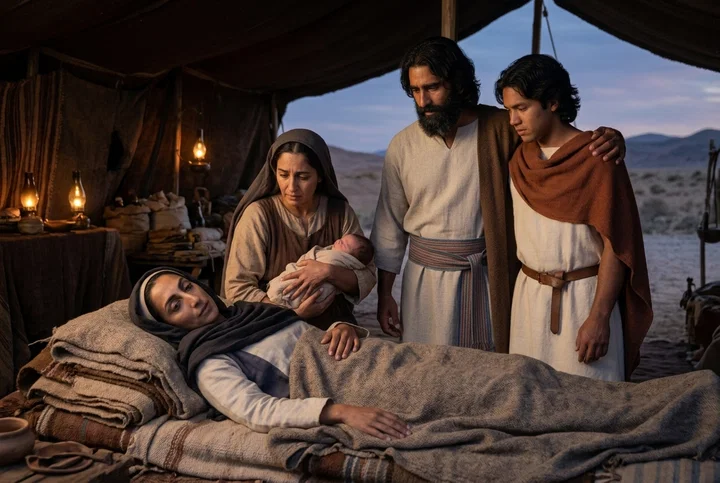
And it came to pass, as her soul was in departing, (for she died) that she called his name Ben-oni: but his father called him Benjamin.
Translations
And it came to pass, as her soul was in departing, (for she died) that she called his name Benoni: but his father called him Benjamin.
And it came to pass, as her soul was in departing, (for she died) that she called his name Ben-oni: but his father called him Benjamin.
And it came to pass, as her soul was in departing (for she died) that she called his name Ben-oni: but his father called him Benjamin.
And it came to pass as her soul was in departing (for she died) that she called his name Ben-oni: but his father called him Benjamin.
And it came to pass, as her soul was in departing ( for she died), that she called his name Ben-oni: but his father called him Benjamin.
And it came to pass, as her soul was departing ( for she died), that she called his name Ben-oni: but his father called him Benjamin.
And it cometh to pass in the going out of her soul (for she died), that she calleth his name Ben-Oni; and his father called him Benjamin;
And it came to pass as her soul was departing — for she died — that she called his name Benoni; but his father called him Benjamin.
And it came to pass when her soul was going forth—for she died, that she called his name Ben-oni,—but, his father, called him, Ben-jamin.
Berean Standard Bible, Majority Standard Bible
And with her last breath— for she was dying— she named him Ben-oni. But his father called him Benjamin.
As her soul was departing ( for she died), she named him Benoni, but his father named him Benjamin.
And in the hour when her life went from her ( for death came to her), she gave the child the name Ben-oni: but his father gave him the name of Benjamin.
Then as she was about to yeelde vp the Ghost (for she died) she called his name Ben-oni, but his father called him Beniamin.
Douay-Rheims (Challoner revision)
And when her soul was departing for pain, and death was now at hand, she called the name of her son Benoni, that is, The son of my pain: but his father called him Benjamin, that is, The son of the right hand.
Pictures
Cross-references
- Jeremiah 31:15
Thus saith the LORD; A voice was heard in Ramah, lamentation, and bitter weeping; Rahel weeping for her children refused to be comforted for her children, because they were not.
Rachel’s lament for her children recalls her death and burial.
- Matthew 2:17-18
Then was fulfilled that which was spoken by Jeremy the prophet, saying,
Matthew applies Rachel’s lament to the slaughter of the children.
- 1 Kings 17:21
And he stretched himself upon the child three times, and cried unto the LORD, and said, O LORD my God, I pray thee, let this child’s soul come into him again.
Both describe the soul in relation to a child’s life departing or returning.
- Genesis 48:7
And as for me, when I came from Padan, Rachel died by me in the land of Canaan in the way, when yet there was but a little way to come unto Ephrath: and I buried her there in the way of Ephrath; the same is Beth-lehem.
Jacob recalls Rachel’s death and burial near Ephrath.
- Genesis 35:24
The sons of Rachel; Joseph, and Benjamin:
groups Benjamin with Joseph as Rachel's sons
- Genesis 30:1
And when Rachel saw that she bare Jacob no children, Rachel envied her sister; and said unto Jacob, Give me children, or else I die.
Rachel’s plea for children is recalled.
- 1 Samuel 24:11
Moreover, my father, see, yea, see the skirt of thy robe in my hand: for in that I cut off the skirt of thy robe, and killed thee not, know thou and see that there is neither evil nor transgression in mine hand, and I have not sinned against thee; yet thou huntest my soul to take it.
Both use “soul” to mean life.
- Psalms 33:19
To deliver their soul from death, and to keep them alive in famine.
Both use “soul” to mean life.
- Job 12:10
In whose hand is the soul of every living thing, and the breath of all mankind.
Both use soul to mean life.
- 1 Kings 17:22
And the LORD heard the voice of Elijah; and the soul of the child came into him again, and he revived.
Both show the soul returning as a child revives from death.
- Psalms 88:3
For my soul is full of troubles: and my life draweth nigh unto the grave.
Both use “soul” to mean life.
Commentary
Each commentary is drawn from primary sources: the writings of Ellen G. White and Adventist pioneers and periodicals. Each commentary is separate. Its own words are not a quotation; follow the references to read the source passages.
Ellen G. White
2 sources
Jacob was journeying with his family toward Hebron to visit his aged father when this took place, before they had gone far.ST Dec 4, 1879 At that time Rachel gave birth to Benjamin and then died.ST Dec 4, 1879 She lived only a moment after the birth, just long enough to name the child.ST Dec 4, 1879
As she was dying she called her newborn son Benoni, meaning son of my sorrow.ST Dec 4, 1879PP 206.3–4 His father instead called him Benjamin, meaning son of my right hand and my strength.ST Dec 4, 1879PP 206.3–4 Rachel was buried where she died, and a stone monument was placed above her grave to perpetuate her memory.ST Dec 4, 1879
Sources
Pioneers and periodicals
39 sources
As her soul was in departing means her breath, her life, her physical vitality was leaving her as she died.RH Sep 8, 1859RH Apr 7, 1874ST Mar 13, 1879RH Jun 25, 1872 It gives no proof that an immaterial, conscious, immortal part lived on apart from the body, knew anything or went to heaven, though those who held otherwise taught that the departing soul proves body and soul distinct and the soul consciously escaping at death.RH Sep 8, 1859RH Jun 25, 1872ST Mar 13, 1879RH Feb 15, 1870RH Sep 20, 1864 Rachel died in childbirth on the road near Bethlehem, living only long enough to call her son Ben-oni, son of my sorrow, whom his father called Benjamin, son of the right hand.ST Dec 4, 1879ST Aug 25, 1881RH Aug 27, 1901 The departure of the soul is death itself, the loss of the breath of life, and its return to the body is resurrection from the dead.RH Jun 25, 1872RH Jan 5, 1864RH Jun 25, 1872RH Oct 15, 1872RH Sep 8, 1859 Her weeping long afterward over her slaughtered posterity was not literal consciousness in sheol but figurative personification, like dead kings rising to mock the king of Babylon.RH Mar 28, 1865ST Mar 15, 1877RH May 5, 1874RH Sep 3, 1872
Meaning of Soul
The word rendered soul in the account of Rachel's death is the Hebrew nephesh, found 745 times and rendered soul 473 times, and here it most properly means breath, the breath of life leaving her as she died.RH Sep 8, 1859RH Jun 25, 1872RH Aug 20, 1861RH Sep 8, 1859 In this place it may describe her departing breath rather than an immortal part existing apart from the body, for its departure caused death just as its return causes life.RH Sep 8, 1859RH Jun 25, 1872RH Sep 8, 1859RH Sep 12, 1854 The meaning of nephesh is fixed by its context, and here it is used in a limited sense for breath or animal life consisting in breath and blood.ST Jun 28, 1899ST Jun 28, 1899RH Sep 12, 1854RH Sep 1, 1859 That limited sense is different from Genesis 2:7, where soul means the whole person as a complete living being, and the fitting definition must be taken from among the many meanings of soul, which also embrace the whole man and are elsewhere rendered life, person, mind, heart, body, will, appetite, lust, and thing.ST Jun 28, 1899ST Jun 28, 1899RH Aug 20, 1861RH May 14, 1872
In this verse soul also means life, the vital principle or physical vitality that distinguishes a living person from a dead body, the life common to man and beast.RH Apr 7, 1874ST Mar 13, 1879RH Jan 5, 1864RH Oct 2, 1855ST Jul 16, 1896 Her soul departing, her life departing, and she died are the same thing, for her death caused her soul to depart and the loss of life is the death described.RH Apr 7, 1874RH Jan 5, 1864RH Oct 2, 1855RH Sep 12, 1854 Life came from God and goes back to Him as life, restored at the resurrection, and moving creatures having soul means having life while the soul that sins dying means the living person who sins dies.RH Jan 5, 1864ST Jul 16, 1896 The verse therefore gives no proof that the soul is an immaterial, independently conscious, immortal part capable of intelligent active existence apart from the body.RH Sep 8, 1859RH Jun 25, 1872RH May 14, 1872 It does not say that Rachel's soul remained conscious after death, knew anything, went to heaven, lived on better apart from the body, or proved the spiritual part of man.RH Jun 25, 1872ST Mar 13, 1879RH Sep 1, 1859
As her soul was in departing means as her mental powers such as consciousness and sensibility were growing feeble, a meaning fully expressed by the added explanation for she died. The added words explain the phrase, identifying the departure with dying when the breath of life is lost, as in the creation of Adam in reverse.RH Jun 25, 1872RH Jun 25, 1872 By contrast, those who held the opposite taught that the departing soul was distinct from the body that remained to be buried, so that it was not the body that departed and the soul is not merely the body or the breath alone.RH Feb 15, 1870 In that contrary teaching the word is Hebrew nephesh, Greek psuche, used in precisely the same sense as soul in the New Testament even in its highest signification, proving body and soul are distinct principles and that the soul is immaterial and immortal, escaping when the body dies and continuing to exist separately and consciously rather than ceasing with the body.RH Feb 15, 1870RH Sep 20, 1864
Birth and Naming
Rachel died in childbirth, breathing out her life at the roadside tomb near Bethlehem as a young wife.ST Dec 4, 1879ST Aug 25, 1881 She lived only a moment after the birth, just long enough to name her son.ST Dec 4, 1879 With her final breath she gave him his name.ST Dec 4, 1879RH Aug 27, 1901
She called his name Ben-oni, meaning son of my sorrow or son of my anguish.ST Dec 4, 1879RH Aug 27, 1901ST Oct 27, 1898 She did so because his birth brought her sorrow and death.RH Aug 27, 1901ST Oct 27, 1898 Her earlier longing for children did not bring her joy in this child.RH Aug 27, 1901
His father instead called him Benjamin, meaning son of my right hand or my strength.ST Dec 4, 1879ST Mar 13, 1879 Rachel named him Ben-oni as she was dying, while his father named him Benjamin.ST Mar 13, 1879 He was Rachel's last child, for Jacob had no more children after Ben-oni was born.ST Oct 27, 1898
Place and Family Setting
Jacob was journeying with his family toward Hebron to visit his aged father when Rachel gave birth to Benjamin and died before they had gone far.ST Dec 4, 1879 The birth and death took place at the roadside near Bethlehem, where as a young wife she breathed out her life in giving birth.ST Dec 4, 1879ST Aug 25, 1881 This was about 1700 years before Christ, when Bethlehem was called Ephrath or Ephratah and also Bethlehem-Judah.ST May 1, 1907
Bethlehem was already an ancient city, one of the oldest in Palestine.ST May 1, 1907 Rachel was buried where she died.ST Dec 4, 1879 A stone monument was placed above her grave to perpetuate her memory.ST Dec 4, 1879 By the time of the later events connected with the birth, Benjamin was about two to four years old.ST Mar 26, 1894 As Rachel's son, born as she died, he is grouped with Joseph and through Joseph with Manasseh and Ephraim as Rachel tribes distinct from Leah's six sons, and the account belongs to the sad fruits of Jacob's having more than one wife, a family situation marked by partiality, jealousy, envy, low moral standards, and crime.STRH Aug 12, 1909
Death Without Consciousness
The added words for she died explain the phrase her soul was in departing, for the departure is death itself, her life departing as she died.RH Jun 25, 1872RH Jan 5, 1864RH Oct 2, 1855 The word for soul here means life, and her death caused her soul to depart, not a separate conscious part living on apart from the body.RH Jun 25, 1872RH Jan 5, 1864RH Oct 2, 1855 Here it may most properly mean breath, for death follows when the breath of life is lost, as in the creation of Adam in reverse where the breath of life makes a person a living soul and its loss leaves the person dead.RH Jun 25, 1872 To become a living soul is to become a living person, moving creatures having soul is their having life, and the soul that sins dying is the living person who sins dying, and Rachel died and was buried.RH Jan 5, 1864
The separation of the soul from the body is death, and by the same definition the return of the soul to inhabit the body is a resurrection from the dead.RH Oct 15, 1872 Its departure caused death just as its return causes life, so the departing breath of life leaving her gives no proof of a separate conscious immortal soul leaving the body.RH Sep 8, 1859 In this sense the soul is the principle of life, the gift of life from God that distinguishes a living person from a dead body, which returns to God at death and is restored at the resurrection.ST Nov 14, 1892 Spirit likewise can mean life itself, the vitalizing energy coming from God as the breath of life, returning to God at death not as a separate conscious being.ST Mar 25, 1903
Being out of the body therefore means simply being in vision, not a conscious soul existing apart from the body in death.RH Oct 15, 1872 Otherwise Paul would have meant he did not know but that he died and had a resurrection, with his soul going to paradise while his body lay a corpse on earth, which is preposterous.RH Oct 15, 1872 Soul is spoken of as departing at death in the same way spirit is spoken of as returning to God or being commended to God, for dying is described as her soul leaving her.RH May 14, 1872 Scripture thus applies both terms to what leaves man at death, so soul cannot be separated from spirit by making one the immortal part and not the other.RH May 14, 1872
The wording does not require a separate entity continuing in intelligent active existence apart from the body, but describes her life departing as the ceasing of her vital principle or physical vitality. This is the same vitality for whose return Elijah prayed for the dead child, showing the verse gives no support to consciousness in death.RH Jan 5, 1864 The departing of Rachel's soul gives no support to the conscious state of the dead.RH Oct 31, 1865 Death is laying off the burden and resting in Jesus, mourned and missed in the school, in the Sabbath-school, on the farm, and in other work.RH Sep 3, 1903 Yet it is met with bowing in submission to God's will because God knows best, even when it comes suddenly after fever, pain, spasm, and unconsciousness.RH Sep 3, 1903
Later Weeping Figurative
Genesis 35:18 with the verses that follow it records Rachel dying in childbirth, dead and buried, having entered sheol in the nether parts of the earth.RH Mar 28, 1865RH May 5, 1874RH Sep 3, 1872ST Jun 23, 1881 Long ages, nearly 2000 years, after that decease and entrance into sheol a dreadful slaughter of her posterity takes place.RH Mar 28, 1865RH Sep 3, 1872 Upon that slaughter she is represented as breaking forth into lamentation and bitter weeping and refusing to be comforted because her children are not.RH Mar 28, 1865RH Sep 3, 1872 The Lord answers her to refrain her voice from weeping and her eyes from tears, for her work shall be rewarded.RH Mar 28, 1865RH Sep 3, 1872
That weeping was not literal tears shed nearly 2000 years after her death by a conscious dead woman in sheol.RH Mar 28, 1865RH May 5, 1874RH Sep 3, 1872 It was not a literal return from the dead or a conversation from sheol.ST Mar 15, 1877RH May 5, 1874ST Jun 23, 1881 It was figurative personification, of the same kind as dead kings rising from thrones to mock the king of Babylon and slain armies speaking to Pharaoh in sheol.RH Mar 28, 1865 Rachel's later lament over her slaughtered descendants is a figure of speech, not a report that she literally wept in sheol long after her death.ST Mar 15, 1877RH May 5, 1874ST Jun 23, 1881
Life, speech, and action thus attributed to the dead in sheol set forth great truth.RH Sep 3, 1872 Such passages prove that life, speech, and action attributed to those in sheol do not teach consciousness in death.RH Sep 3, 1872
Sorrow and Providence
Rachel dying as she gave birth to Benjamin counts among the family losses that made up Jacob's grief.ST Jan 9, 1912 That loss came before the disappearance of Joseph.ST Jan 9, 1912 Both sorrows seemed to be against Jacob.ST Jan 9, 1912 In fact they belonged to God's providence for bringing Joseph home and for saving many lives through him.ST Jan 9, 1912 The account in Genesis 35-36 is to be read alongside Psalm 16 with the Promised Seed in view and attention to the channels through which that Seed was to come.ST
Sources