Genesis 4:8
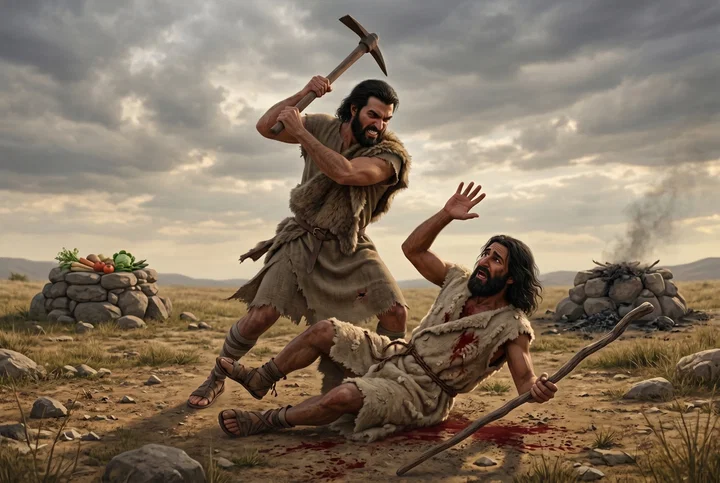
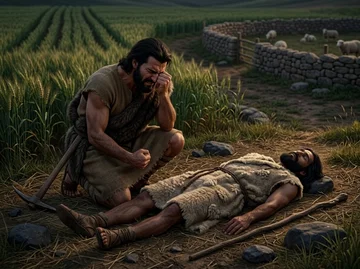
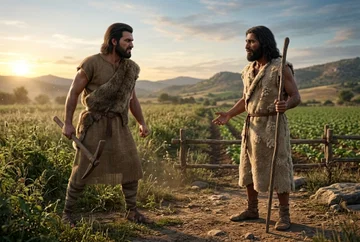
And Cain talked with Abel his brother: and it came to pass, when they were in the field, that Cain rose up against Abel his brother, and slew him.
Translations
American King James Version, King James Version, KJV Cambridge Paragraph Bible
And Cain talked with Abel his brother: and it came to pass, when they were in the field, that Cain rose up against Abel his brother, and slew him.
And Cain talked with Abel his brother: and it came to pass when they were in the field, that Cain rose up against Abel his brother, and slew him.
Revised Version, American Standard Version
And Cain told Abel his brother. And it came to pass, when they were in the field, that Cain rose up against Abel his brother, and slew him.
And Cain saith unto Abel his brother, ['Let us go into the field;'] and it cometh to pass in their being in the field, that Cain riseth up against Abel his brother, and slayeth him.
And Cain spoke to Abel his brother, and it came to pass when they were in the field, that Cain rose up against Abel his brother, and slew him.
And Cain said unto Abel his brother Let us go into the field And it came to pass when they were in the field that Cain rose up against Abel his brother, and slew him.
Berean Standard Bible, Majority Standard Bible
Then Cain said to his brother Abel, “ Let us go out to the field.” And while they were in the field, Cain rose up against his brother Abel and killed him.
Cain said to Abel, his brother, “ Let’s go into the field.” While they were in the field, Cain rose up against Abel, his brother, and killed him.
And Cain said to his brother, Let us go into the field: and when they were in the field, Cain made an attack on his brother Abel and put him to death.
Then Kain spake to Habel his brother. And when they were in the fielde, Kain rose vp against Habel his brother, and slewe him.
Douay-Rheims (Challoner revision)
And Cain said to Abel his brother: Let us go forth abroad. And when they were in the field, Cain rose up against his brother Abel, and slew him.
Pictures
Cross-references 20 of 34
- 1 John 3:12
Not as Cain, who was of that wicked one, and slew his brother. And wherefore slew he him? Because his own works were evil, and his brother’s righteous.
Cain murdered Abel because Cain’s works were evil and Abel’s were righteous.
- Hebrews 11:4
By faith Abel offered unto God a more excellent sacrifice than Cain, by which he obtained witness that he was righteous, God testifying of his gifts: and by it he being dead yet speaketh.
Abel’s faithful offering witnessed that he was righteous, and he speaks after death.
- Exodus 20:13
Thou shalt not kill.
Cain’s killing of Abel violated the commandment against murder.
- Matthew 23:35
That upon you may come all the righteous blood shed upon the earth, from the blood of righteous Abel unto the blood of Zacharias son of Barachias, whom ye slew between the temple and the altar.
Abel is named as the first of the righteous whose blood was shed.
- Genesis 4:23-24
And Lamech said unto his wives, Adah and Zillah, Hear my voice; ye wives of Lamech, hearken unto my speech: for I have slain a man to my wounding, and a young man to my hurt.
Lamech, like Cain, kills a man and compares his guilt with Cain’s.
- Genesis 9:6
Whoso sheddeth man’s blood, by man shall his blood be shed: for in the image of God made he man.
It states the penalty for murder, connecting the later prohibition to Cain’s killing.
- Genesis 4:25
And Adam knew his wife again; and she bare a son, and called his name Seth: For God, said she, hath appointed me another seed instead of Abel, whom Cain slew.
Seth given to replace murdered Abel
- Genesis 4:15
And the LORD said unto him, Therefore whosoever slayeth Cain, vengeance shall be taken on him sevenfold. And the LORD set a mark upon Cain, lest any finding him should kill him.
God marks and spares Cain, forbidding vengeance for Abel’s murder.
- Genesis 4:1
And Adam knew Eve his wife; and she conceived, and bare Cain, and said, I have gotten a man from the LORD.
Eve’s words at Cain’s birth reflect her hope that he was the promised deliverer.
- John 8:44
Ye are of your father the devil, and the lusts of your father ye will do. He was a murderer from the beginning, and abode not in the truth, because there is no truth in him. When he speaketh a lie, he speaketh of his own: for he is a liar, and the father of it.
The devil is called a murderer from the beginning, linking his character to Cain’s killing of Abel.
- Genesis 4:4
And Abel, he also brought of the firstlings of his flock and of the fat thereof. And the LORD had respect unto Abel and to his offering:
Abel’s accepted offering and Cain’s rejected offering explain Cain’s anger.
- Genesis 4:12
When thou tillest the ground, it shall not henceforth yield unto thee her strength; a fugitive and a vagabond shalt thou be in the earth.
Cain’s murder is followed by a curse on the ground and a life as a fugitive.
- Matthew 5:21-22
Ye have heard that it was said by them of old time, Thou shalt not kill; and whosoever shall kill shall be in danger of the judgment:
Jesus extends the command against murder to anger and hatred toward a brother.
- Genesis 4:17
And Cain knew his wife; and she conceived, and bare Enoch: and he builded a city, and called the name of the city, after the name of his son, Enoch.
Cain later builds a city, departing from simple agricultural life.
- 1 John 3:15
Whosoever hateth his brother is a murderer: and ye know that no murderer hath eternal life abiding in him.
Hatred of a brother is identified with murder, as Cain’s act demonstrates.
- Hebrews 12:24
And to Jesus the mediator of the new covenant, and to the blood of sprinkling, that speaketh better things than that of Abel.
Jesus’ blood speaks better than Abel’s speaking blood.
- Jude 1:11
Woe unto them! for they have gone in the way of Cain, and ran greedily after the error of Balaam for reward, and perished in the gainsaying of Core.
Cain’s murder exemplifies the sinful way of the ungodly.
- Genesis 4:13
And Cain said unto the LORD, My punishment is greater than I can bear.
Cain calls his punishment for sin too great to bear.
- Genesis 4:2
And she again bare his brother Abel. And Abel was a keeper of sheep, but Cain was a tiller of the ground.
Identifies Abel and the brothers’ occupations before the murder.
- Luke 11:51
From the blood of Abel unto the blood of Zacharias, which perished between the altar and the temple: verily I say unto you, It shall be required of this generation.
Jesus names Abel among those whose blood was shed.
Commentary part 1 of 2
Each commentary is drawn from primary sources: the writings of Ellen G. White and Adventist pioneers and periodicals. Each commentary is separate. Its own words are not a quotation; follow the references to read the source passages.
Ellen G. White
101 sources
Cain talked with Abel his brother about their sacrifices, and when they were in the field he rose up against him and slew him.Ms 78, 1901, par. 3–11Lt 16, 1897, par. 8–11Lt 10, 1909, par. 4–9 It was the first death in the human family, the first shedding of innocent blood and the first murder.Ms 78, 1901, par. 3–11ST Dec 25, 1901SG3 50.2 He killed him from anger, envy and hatred because his own disobedient offering without blood was rejected while Abel's obedient offering of a lamb pointing to the promised Redeemer was accepted.Ms 78, 1901, par. 3–11Ms 77, 1897, par. 20–212RED 20.1–2COL 150.1–152.2 Under Satan's working his jealousy over Abel's righteousness, which condemned his own evil course, ripened into revenge and violence when Abel would not abandon God's way for his own.Ms 77, 1897, par. 20–21Ms 136, 1899, par. 5–81SP 55.3ST Feb 6, 1879PP 651.3 Thus the two brothers stand as the first representatives of the two classes of worshipers, the obedient and the disobedient, and the slaying is the beginning of persecution of the righteous for godliness.1SP 57.1SG3 50.12RED 20.1–2AA 576.1–2
Words and Setting
Genesis 4:8 belongs to the account of Cain and Abel, whose characters stood in contrast, for Cain was rebellious and murmured against God while Abel was meek and submitted to God's authority, and both were tested for obedience after being taught God's provision for salvation through sacrificial offerings pointing to the promised Redeemer. Cain talked with Abel his brother about their sacrifices, arguing with him, and then when they were in the field he rose up against him and slew him.Ms 78, 1901, par. 3–11Lt 16, 1897, par. 8–11ST Dec 25, 1901 The killing followed God's acceptance of Abel's offering with no sign of recognition for Cain's, and God's reasoning with angry Cain over his wrath and fallen countenance rather than giving up His own way and will to conciliate him, becoming the necessary contention between Cain insisting on his own plans and Abel steadfastly carrying out God's directions and refusing to be converted to Cain's way because he could not concede without disobedience to God's special commands.Lt 16, 1897, par. 8–11 Cain was a tiller of the ground and Abel a keeper of sheep, showing that healthful employment of the physical powers continued after Eden.Lt 10, 1909, par. 4–9 The verse belongs to the whole story told in Genesis 4 of departure from God's plain commands, a departure that filled the world with transgression and sin and led to God's work in destroying the world.Lt 10, 1909, par. 4–9
The slaying in the field was the first death in this world, caused by jealousy and hatred.Ms 78, 1901, par. 3–11ST Dec 25, 1901 It was the first death in the human family and the first time Adam encountered death among his descendants.SG3 50.2ST Feb 6, 1879 It was the first shedding of innocent blood on earth, when righteous Abel was killed by his brother Cain.ST May 2, 18783SP 66.2–67.1 It was the first murder, beginning the record of righteous people slain for faithfulness to God.SG3 50.2ST May 2, 18783SP 66.2–67.1
When Cain rose up and slew Abel there was a Witness, the heavenly Watcher who established the system of sacrifices and offerings, who saw the whole transaction.Ms 136, 1899, par. 5–8 Afterward Cain walked away from the lifeless body left lying on the ground, a deed revealing what man becomes apart from Christ.PP 79
Motives for Murder
Cain refused to correct his wrong course after God warned him, talking with Abel while still in opposition to God and putting the blame for his rejected offering on Abel and on God.Ms 204, 1903, par. 34–36 He would not listen to God's warning, though he was not forced to act unrighteously and could have chosen to do well.RH Jun 12, 1900
He was angry that his own offering was not accepted because of his disobedience while the offering of Abel his younger brother was accepted.Ms 78, 1901, par. 3–11ST Dec 25, 1901 He was angry with Abel for maintaining that God is just, and his anger was directed against both Abel and God.Ms 78, 1901, par. 3–11ST Dec 25, 1901LC1 124.1–2 He charged God with partiality while Abel pleaded with him.Ms 136, 1899, par. 5–8 He spoke many things hot with passion against Abel and against the Lord and nothing against himself while justifying his own course, exceedingly wroth not with himself but with Abel and with the Lord.Lt 71, 1896, par. 2–9 He refused to see that his own disobedience had made his offering unacceptable, and refused to answer God, turning instead to Abel with words hot with passion because Abel would not sustain him in disregard of God's requirements.Ms 78, 1901, par. 3–11Ms 77, 1897, par. 20–21ST Dec 25, 1901
His anger grew from jealousy, envy, hatred, bitterness and malice because Abel was preferred before him.Ms 136, 1899, par. 5–8ST Jan 9, 1896 It grew because Abel's works were righteous and his own were evil, and because Abel's blameless life and right-doing condemned his sinful course and cast reproach upon him.ST Feb 6, 1879PP 651.3ST Jan 9, 1896RH Apr 3, 1900 Abel meekly pointed out Cain's error and appealed to God's compassion, yet Cain's anger grew until he killed him in the field.1SP 55.3 Envy is the offspring of pride, and if entertained in the heart it will lead to hatred and eventually to revenge and murder, revealing the murderous nature of hatred and the absence of brotherly love.PP 651.3RH Apr 3, 1900
Abel pleaded with Cain, repeated God's own command and definite directions about the offerings required, and tried to reason with him in the field.Ms 77, 1897, par. 20–21Ms 136, 1899, par. 5–8 Cain was provoked that his younger brother presumed to teach him, being the elder he thought Abel should follow his example, and he hated Abel because God favored him and showed him favor by holy fire consuming the sacrifice.Ms 136, 1899, par. 5–8SPBC 143.4–144.1Lt 57, 1895, par. 4–714MR 114.3–116.1 He preferred his own plan and expected Abel to follow it, insisting his own plans were best and that the Lord would come to his terms.SPBC 143.4–144.1Lt 57, 1895, par. 4–714MR 114.3–116.1 He rejected the offering of a slain lamb because it reminded him of sin and expressed dependence on a power outside himself, feeling as torture to his proud, high spirit the keeping of sin ever before the mind and the confession of entire dependence, and thinking Adam had been treated harshly in being expelled from Eden.SPBC 143.4–144.1Lt 57, 1895, par. 4–714MR 114.3–116.1 God condescended to explain matters to him, but he would not be reconciled to God.SPBC 143.4–144.1Lt 57, 1895, par. 4–714MR 114.3–116.1
He would not sustain Abel's loyalty and would not join Abel's obedience but insisted on carrying out his own plans in his offering and demanded Abel follow him.Lt 16, 1897, par. 8–11ST Feb 6, 1879 Abel steadfastly carried out God's directions, decided to obey God, and refused to be converted to Cain's way, since he could not concede without disobedience to God's special commands.Lt 16, 1897, par. 8–11Lt 100, 1895, par. 31–32ST Jan 13, 1898 Abel brought his sacrifice in obedience to express direction, presenting the blood of a slain lamb representing the blood of Christ, while Cain reasoned it made no difference whether he presented firstfruits of the ground or offered a lamb and made his offering according to his own human ideas.Lt 100, 1895, par. 31–32ST Jan 13, 1898 Because Cain could not triumph over his brother and could not compel Abel to disobey God and leave the way of the Lord for his brother's way, the necessary contention between Cain's way and God's way ended when he rose up in anger in the field and took his life.Lt 16, 1897, par. 8–11Ms 136, 1899, par. 9–10Lt 100, 1895, par. 31–32ST Jan 13, 1898 Abel did not use force to make Cain obey God.Ms 136, 1899, par. 9–10
Abel reproved Cain for disregarding God's expressed requirements and gave him a straight, decided warning by repeating God's express direction that every sacrificial offering was to be accompanied by a slain lamb as acknowledgment and confession of sin and as representation of Christ saving the fallen race by becoming Himself the great Sacrifice.Lt 19a, 1897, par. 25–28Lt 280, 1904, par. 1–421MR 416.1–3Lt 280a, 1904, par. 1–3 Cain's offering was faultless except that he did not follow God's plan by bringing a lamb.Lt 280, 1904, par. 1–421MR 416.1–3Lt 280a, 1904, par. 1–3 Cain thought Abel had done him damage, became very angry because Abel told him God's directions, and rose up against him in the field and slew him.Lt 19a, 1897, par. 25–28Lt 280, 1904, par. 1–421MR 416.1–3Lt 280a, 1904, par. 1–3 Those reproved for a wrong course that harms God's cause and imperils souls may rise up in indignation against God's messenger and seek to bring the law against him, though in doing so they bring it against Christ who gave the reproof and warning, the act of a heart accustomed to resistance turning to harm the one who reproved him.Lt 19a, 1897, par. 25–285MR 413.3–414.2 His avarice and hypocrisy having been reproved by truth he could not controvert, and the noble, spotless character of righteousness standing far higher than his own, he was intent on putting the righteous one out of the way.Ms 51, 1897, par. 19–22
He saw his mistake in offering only his own substance without the fitting sacrifice of a lamb, but he determined to vindicate himself and condemn Abel.Ms 136, 1899, par. 5–8 He had obeyed Satan, who told him he need not follow God's express command to present a slain lamb as an offering, heeding the voice of the great apostate instead of the voice of the true and living God.Ms 59, 1899, par. 10–11 It was the same deception by which Adam was told he need not obey God and would not die for transgressing the law.Ms 59, 1899, par. 10–11
Under Satan's inspiration his wrath rose until he slew his brother, Satan working through him and inspiring the desire to slay him.Ms 77, 1897, par. 20–21Ms 136, 1899, par. 5–8 Evil spirits worked with Cain, energizing him as a child of rebellion and disobedience.Ms 104, 1897, par. 10–12 Satan, the parent of unbelief, murmuring and rebellion, filled him with doubt and madness against God and against Abel because his offering was refused and Abel's was accepted.2RED 20.1–2LC1 124.1–2 In insane madness he killed his innocent brother, hating a purity that reproved his sins and refusing to repent, acknowledge his need of a Redeemer, and renounce his evil ways.RH Mar 3, 18742RED 20.1–2 His refusal to connect blood with his offering of the fruit of the ground expressed his refusal to show repentance for sin and faith in a coming Saviour, which his proud heart felt as dependence and humiliation, while Abel in solemn faith offered the blood of beasts signifying he was a sinner with sins to put away, penitent, believing in the efficacy of the blood of the future great offering.RH Mar 3, 18742RED 20.1–2
Sacrifice and Obedience
God had shown that He would accept His created beings only through implicit obedience to His law, and in the field Abel tried to reason with Cain and laid before him God's definite directions about the offerings to be made to Him, but Cain did not change his attitude and under Satan's inspiration his wrath rose until he slew him.Ms 77, 1897, par. 20–21 God directed that every sacrificial offering brought to Him was to be accompanied by a slain lamb as the acknowledgment and confession of sin and as a representation of Christ, who was to save the fallen race by becoming Himself the great Sacrifice.Lt 280, 1904, par. 1–421MR 416.1–3Lt 280a, 1904, par. 1–3 Cain's offering was faultless except that he did not follow God's plan by bringing a lamb, and because Abel told him and repeated God's express direction Cain became very angry and killed him.Lt 280, 1904, par. 1–421MR 416.1–3Lt 280a, 1904, par. 1–3
Cain and Abel were the first representatives of two great classes of worshipers.2RED 20.1–2COL 150.1–152.2 Abel came as a sinner in solemn faith offering the blood of beasts, signifying that he was a sinner with sins to put away, that he was penitent, and that he believed in the efficacy of the blood of the future great offering, relying on God's unearned love.2RED 20.1–2COL 150.1–152.2 Cain considered himself righteous and brought only a thank-offering of the fruit of the ground without blood, without confessing sin or recognizing his need of mercy.2RED 20.1–2COL 150.1–152.2 He refused to connect blood with his offering, refusing to show repentance for sin and faith in a coming Saviour and to acknowledge his need of a Redeemer, which his proud, high spirit felt as dependence and humiliation.RH Mar 3, 1874SPBC 143.4–144.12RED 20.1–2
To Cain the blood reminded him of sin and expressed dependence on a power outside himself, and the idea of keeping sin ever before the mind and offering the blood of the slain lamb as a confession of entire dependence upon a Power outside of himself was torture to his high spirit.SPBC 143.4–144.1Lt 57, 1895, par. 4–714MR 114.3–116.1 He thought his father Adam had been treated harshly in being expelled from Eden.SPBC 143.4–144.1Lt 57, 1895, par. 4–714MR 114.3–116.1 Being the eldest he thought Abel as the younger brother should follow his example and that the Lord would come to his terms, for he thought his own plans were best and preferred his own plan while Abel was determined to worship God according to the direction God had given.SPBC 143.4–144.1Lt 57, 1895, par. 4–714MR 114.3–116.1 God gave evidence of acceptance of Abel by holy fire consuming the sacrifice and gave no sign of recognizing Cain's, then condescended to explain matters to him and promised acceptance if he did well while warning that sin lay at the door and must be ruled over, but Cain would not be reconciled to God and hated Abel because God showed him favor.Lt 19a, 1897, par. 25–28Lt 57, 1895, par. 4–714MR 114.3–116.1
Cain made his offering according to his own human ideas and human inventions, exalting his own judgment above God, reasoning and arguing that it made no difference whether he presented the firstfruits of the ground or offered a lamb, and God rejected it and will never accept the spurious for the true.Lt 100, 1895, par. 31–32ST Jan 9, 1896Lt 98, 1900, par. 9–17 Because he could not triumph over his brother he rose up in anger and took his life.Lt 100, 1895, par. 31–32 His refusal to offer the blood of the Son of God meant he would not acknowledge himself as a sinner lost and undone in need of a Saviour and would not believe in the only-begotten Son of God, acting on the deceiver's counsel to refuse God's command to present a slain lamb.RH Mar 3, 1874RH Jun 26, 1900ST Jan 16, 1896 Whoever blinds himself to light, hardens his conscience, and will not acknowledge his lost condition and need of a Saviour does as Cain did, refuses the provision for removal of sin, and his sin remains upon him.ST Jan 16, 1896
God's law already existed in Abel's day, the same law Satan refused to obey and Adam transgressed, and Abel kept the commandment of the Lord and was murdered because he obeyed it.COL 150.1–152.2Ms 43, 1900, par. 26MR 146.1 Recognizing one's sin and need is the first condition of acceptance with God.COL 150.1–152.2 God had prepared sacrificial offerings whose shed blood typified and symbolized the blood of Christ to be shed for the world, with Christ as the foundation of the whole system in the school of obedience to save sinners by the blood of Jesus Christ.1MR 131.5Ms 87, 1900, par. 2 Cain refused the shedding of blood, refusing salvation by Christ, and Abel's death was the consequence and the beginning of the ceremonial system's work as schoolmaster to bring sinful human agents to consider Christ as the foundation of the whole Jewish economy.1MR 131.5Ms 87, 1900, par. 2
The killing exposes the mark of false religion, which opposes the way and will of God and bears the marks of oppression even to the taking of human life, working by disregarding a Thus saith the Lord and working with deceiving power on human minds since the fall of Adam.Lt 100, 1895, par. 31–32ST Jan 9, 1896 Abel brought his sacrifice in obedience to the express direction of God while Cain exalted his own judgment above God and determined to bring an offering according to his own ideas, and when God approved Abel and refused Cain's offering, Abel's righteous obedience condemned Cain's sinful course.ST Jan 9, 1896 Cain's substitution is the same as men honoring a day of their own inventing rather than the day God blessed, setting aside the Sabbath command for a spurious day and offering what God never commanded while ignoring what He plainly commanded, and accepting a spurious rest day and exalting Sunday above the Sabbath of the Bible is choosing a religion like that of Cain, dishonoring God by putting human invention in place of God's requirement and becoming angry at God's commandment-keeping people who will not respect it.Lt 100, 1895, par. 31–32ST Jan 9, 1896Lt 98, 1900, par. 9–17
Two Classes in Conflict
Cain and Abel stand as the first representatives of the two great classes that would exist from the fall to the second coming and till the close of earth's history, the wicked unbelievers and the righteous believers, the disobedient and the obedient.1SP 57.1SG3 50.12RED 20.1–2Ms 136, 1899, par. 9–10Ms 136, 1899, par. 11 Abel stands for obedience, for the well-doer who keeps God's holy law and keeps the way of the Lord to do justice and judgment, who loved and revered God and was accepted and blessed.Ms 136, 1899, par. 9–101SP 107.1Ms 136, 1899, par. 11 Cain stands for refusal to do God's expressed will, for those who follow their own way, disregard God and His commandments, follow a corrupt course, oppress and persecute their fellow men, and follow Satan as accuser of God and of those made perfect through obedience.Ms 136, 1899, par. 9–101SP 107.1Ms 136, 1899, par. 11
The slaying shows that the wicked will envy and hate the righteous because they are better than themselves, because their right-doing condemns the wicked's sinful course and exposes selfishness and corruption.1SP 57.1SG3 50.1ST Feb 6, 1879GC 46.2 Abel's godly character rebuked Cain's sin, and his righteousness exposed and rebuked Cain's evil.GC88 46.14SP 47.1GC 46.2 The same hatred of goodness and resistance to the Holy Spirit leads to killing God's people, to rejecting and crucifying Christ whose purity likewise provoked rejection, and to hatred and opposition against faithful disciples who follow sin not.GC88 46.14SP 47.1GC 46.2
Abel's death begins the record of righteous people slain for their faithfulness to God, beginning with the first shedding of innocent blood when righteous Abel fell by the hand of Cain.ST May 2, 18783SP 66.2–67.1DA 618.3–619.2 That same history was repeated in every age with increasing guilt, as prophets lifted up their voices against sin, speaking the words God gave them and obeying Him at peril of their lives.DA 618.3–619.2 From Abel to Christ a terrible punishment was heaped up for rejecters of light and truth, and by rejecting Christ the priests and rulers made themselves responsible for the blood of all the righteous slain from Abel to Christ, filling to overflowing their cup of iniquity soon to be poured upon their heads in retributive justice.3SP 66.2–67.1DA 618.3–619.2
The killing was the first persecution after the fall and the first slaying of one of the Lord's chosen, the beginning of persecution of God's chosen for godliness driven by bitter hostility against unlikeness to the world.AA 576.1–2Lt 25b, 1892, par. 29 It stands at the opening of Scripture history as counterpart to the final persecution in prophecy against those who refuse the mark of the beast, showing that persecution of the righteous both opens and closes the conflict.Lt 25b, 1892, par. 29 Its underlying principle and spirit has slain God's chosen ever since, opposing Christ Himself and awaiting all who live godly in Christ Jesus and are imbued with His Spirit; its outward form changes with the times but its underlying spirit remains the same, so that following Christ means expecting self-denial, reproach and persecution rather than earthly glory and a life free from trial.AA 576.1–2 That beginning came from a cold, critical, unforgiving, accusing spirit devoid of love, and from the will to force a brother to comply with his own ideas of what is right when milder means fail, which is the secret of all religious laws ever enacted and all persecution, including what the Jews did in the days of Christ and what the church has done whenever she has lost the grace of Christ and, destitute of the power of love, has reached for the strong arm of the State to enforce her dogmas and execute her decrees, whereas Christ does not drive but draws men unto Him and employs only the constraint of love. Abel was the first martyr, an early example of suffering endured by those true to God.LS 129.1
The conflict developed the two principles of right and wrong and represents the clash of two orders in humanity.18MR 364.4Ms 57, 1896, par. 21 Abel was faithful and loyal to God and was preferred by the Lord, while Cain was disloyal and wished his own ideas, methods and plans to have supremacy, claiming that place as the eldest.18MR 364.4Ms 57, 1896, par. 21 Abel protested against Cain's principles as disloyal and would not concede to his views, and Cain became very angry because Abel would not concede, and his anger burned so hot that he killed his brother.18MR 364.4Ms 57, 1896, par. 21
Abel did not use force to make Cain obey God, while Cain, inspired by Satan and filled with wrath, used force because he could not compel Abel to disobey God and could not control his conscience.Ms 136, 1899, par. 9–10Ms 104, 1897, par. 10–1219MR 164.1–2 It was the first working of false religion against true religion, in which the disobedient under a false standard use law and compulsion, including compelling worship of a false sabbath, while true worshipers keep God's commandments.Ms 55, 1894, par. 7–8Ms 99, 1894, par. 5–6 Evil spirits energized Cain as a child of rebellion and disobedience, working effectually in him with the same apostate spirit that moves religious persecutors to silence those calling to obedience and to provoke the loyal to become disloyal as Cain tried to provoke Abel.Ms 104, 1897, par. 10–1219MR 164.1–2 Cain was unrighteous and disobedient to God's holy law, and demoniacal hatred led him to rend and destroy a man formed in the divine similitude because he could not make him disloyal.Ms 104, 1897, par. 10–1219MR 164.1–2 That killing reveals the spirit of Cain, which is the spirit of persecution, religious bigotry and revenge that would force conscience and destroy life, whose indulgence is the strongest evidence of possessing it, opposite to Christ who came not to destroy men's lives but to save them and is kind even to enemies, who ever showed mercy, never afflicted or tortured rejecters, never compelled service, but seeks to win the soul to surrender and obedience through love and the Holy Spirit's transforming power.Ms 55, 1894, par. 7–8Ms 99, 1894, par. 5–6
The same apostate spirit that moved Cain moved the priests and rulers against Jesus, working in the children of disobedience to silence those calling to obedience.Ms 104, 1897, par. 10–1219MR 164.1–2 Cain rose up from furious anger because his avarice and hypocrisy had been reproved and he could not controvert the truth, and because the noble, spotless character of righteousness and goodness stood far higher than his own, so he was intent on putting the righteous one out of the way; the scribes, Pharisees and Sadducees repeated Cain's act when Christ laid open their ignorance and rebuked their avarice and hypocrisy with true arguments they could not answer.Ms 51, 1897, par. 19–22 The same satanic inspiration moved the Jews when, though Pilate found no fault in Christ, they fiercely pressed false charges to have Him put to death, from a murderous determination to destroy life rather than to save it.Ms 112, 1897, par. 1–6 Abel being dead yet speaks by his righteous sacrifice, but the blood of Jesus the Mediator of the new covenant speaks better things than that of Abel, and those who turn away from Him that speaks from heaven will not escape.Ms 104, 1897, par. 10–1219MR 164.1–2
The scene was often repeated when innocent Abel falling before his murderous brother became the picture of Rome's determination to blot the Waldenses from the earth for holding the faith of the ancient church as a constant testimony to Rome's apostasy and for refusing to surrender the Scriptures, sending terrible crusades and inquisitors against God's people in their mountain homes out of bitter hatred, hunting them down and killing them for holding to the faith.4SP 82.2–3GC88 75.5–76.3ST Jul 2, 1885GC 76.2
The same spirit that moved Cain to murder his innocent, righteous brother beloved of his father was fastening upon Joseph's brothers, so that they hated Joseph because he was innocent and righteous and beloved of his father while they were wicked and a grief to their father, admiring his purity and goodness yet refusing to leave their wicked course to become virtuous and noble like him, that same spirit kindling toward Joseph when his inspired character and purity exposed their sin.ST Dec 18, 1879PP 209.4–210.3 Cain rose up because he hated a purity that reproved his sins and would not renounce his evil ways, hating truth and the precepts of God with a hatred put into his heart by Satan.PP 209.4–210.3Ms 143, 1901, par. 70–76 Satan will imbue human minds with the same hatred when enmity against the law of God becomes intense in prevailing iniquity at the end, producing persecution of God's people.Ms 143, 1901, par. 70–76
Curse Grief and Judgment
The murder brought a second heavy curse upon the ground after Adam's transgression, a double curse felt far more heavily than the first.SG3 50.1Lt 71, 1896, par. 2–9 It did not immediately strip the earth of its beauty and abundance.ST Feb 27, 1879 Cain's neglect of the specific requirement to mingle the blood of a slain lamb with his offering was the first step of disobedience in following his own will, ideas and reason, and that step led to his brother's death.Lt 71, 1896, par. 2–9 Placing one's own judgment against God's warns that self-will blends with Satan's will and leads where was not contemplated.Lt 71, 1896, par. 2–9
Abel's death was Adam's first encounter with death in the human family, making the reality of death known to him.SG3 50.2ST Feb 6, 18791SP 57.2PP 82.2 It deepened his grief and remorse over his own transgression and the misery it brought upon his descendants.SG3 50.2ST Feb 6, 1879 He was left doubly bereaved in Abel's death and Cain's rejection, bowed down with anguish and the keenest remorse for his own sin, grieving also over Cain as the murderer and over the curse pronounced on him.1SP 57.2PP 82.2 It began his nearly thousand-year beholding of the wide-spreading results of sin.PP 82.2
Adam related the rupture in his family ending in Abel's death to his children and to their children to the ninth generation, together with the perfections of his Eden home and his fall and its dreadful results.SG3 51.1 He used it to teach the necessity of strictly adhering to God's law, to declare that sin will be punished in whatever form it exists, and to entreat obedience to God who will deal mercifully with those who love and fear Him.SG3 51.11SP 58.2
The murder merited the sentence of death, yet a merciful Creator spared the first murderer's life and gave him opportunity for repentance.PP 78.1–2 That sparing demonstrated to the universe what results from permitting sin to go unpunished, giving a lesson in the great controversy illustrating what would happen if the sinner were permitted to live forever carrying out rebellion against God.PP 78.1–2PP 324.3–325.3 Cain used that prolonged life only to harden his heart, to rebel against divine authority, and, led on by Satan, to become a tempter and the head of a line of bold, abandoned sinners whose example and demoralizing influence corrupted the earth and filled it with violence until it called for its destruction by the Flood.PP 78.1–2 Fifteen centuries later the crime and pollution flooding the earth was the fruition of Cain's influence and example, for divine forbearance only made the wicked more bold and defiant.PP 78.1–2
The history of the antediluvians proves that long life is not a blessing to the sinner and that great forbearance does not repress wickedness, for the longer men lived the more corrupt they became.PP 78.1–2PP 324.3–325.3 The evils that followed from sparing Cain prove that prompt punishment of transgression is mercy, to prevent greater evils, save the many by punishing the few, and cut sinners short in love before they destroy one another. This makes manifest that the sentence of death pronounced on the fallen race for transgressing God's law is both just and merciful, because the longer men live in sin the more abandoned they become, and the divine sentence cutting short a career of unbridled iniquity and freeing the world from the influence of those hardened in rebellion is a blessing rather than a curse.PP 78.1–2 Sparing Cain thus proves that the rebels at Sinai could not be spared, for unless punishment had been speedily visited the same results would have followed on a larger scale, the earth becoming as corrupt as in the days of Noah, with evils greater than resulted from sparing Cain, requiring judgments upon millions to save the many by punishing the few.PP 324.3–325.3
The day Cain lifted his hand against Abel marks the beginning of the world's rejection of every provision heaven has made to restore the moral image of God in man, a rejection continuing among atheists and worldly religionists.Ms 90, 1897, par. 6ST May 26, 1898 It is the beginning of the history of the world under sin and of the unceasing conflict between good and evil.ST Nov 10, 1909DA 533.1–534.2 From that death comes the suffering and sorrow, tears and death that became the lot of man, revealing the terrible effects of transgression of God's law.ST Nov 10, 1909DA 533.1–534.2 At the grave of Lazarus Jesus saw that whole history from Abel onward and the years to come, with His heart pierced by the pain of the human family of all ages and in all lands and the weight of the grief of ages heavy upon His soul, and longing to relieve all their distress broke up the fountain of His tears.ST Nov 10, 1909DA 533.1–534.2
The murder continued the evil opened in Paradise when Satan deceived Adam and Eve, with a divided family in which Cain chose to serve Satan and Abel chose to serve God.Ms 55, 1902, par. 9–139MR 237.3–238.1 Cain killed his brother because Abel would not follow Cain's example.Ms 55, 1902, par. 9–139MR 237.3–238.1 Through the senses Satan gained control of man's power of action, turning man from reflecting the moral image of his Creator to selfishness bearing Satan's selfish image instead.Ms 55, 1902, par. 9–139MR 237.3–238.1 Sin thus became a universal, dreadful evil extending down through influence to children and through the ages.Ms 55, 1902, par. 9–139MR 237.3–238.1
Warning and Application
To have the spirit of Cain is to be governed by deadly hatred that can lead to killing a brother, for indulging one known sin deadens the conscience and makes the next temptation easier to yield to until step by step the heart is hardened and sin ripens into crime.ST Dec 18, 1879 That killing reveals the spirit of persecution, religious bigotry and revenge that would force the conscience of others and destroy men's lives, and indulging and manifesting that persecuting spirit is the strongest evidence that a man possesses the spirit of Cain.Ms 55, 1894, par. 7–8 That spirit is the opposite of the Spirit of Christ, who came not to destroy men's lives but to save them and who is kind even to enemies.Ms 55, 1894, par. 7–8
Cherished envy, mistrust and selfishness lead to standing aloof, taking no part and staying away, which shows a person is not right with God.Lt 37, 1879, par. 10 This spirit is dangerous and will ruin the soul unless it is worked away by earnest effort, by putting trust in God, by working away from selfishness with an eye single to the glory of God, and by closely investigating motives and feelings by the Word of God and cleansing the soul temple from envy and mistrust and selfishness.Lt 37, 1879, par. 10 The Cain-spirit of cherished hatred is next of kin to murder and must not be allowed to enter the heart.Ms 164, 1898, par. 4–5 That spirit is hatred in the heart toward others when the ideas and methods one calls truth are not accepted and appreciated by them, showing itself in angry passion, obstinacy and evil-surmising, and proving that Christ is not dwelling within, since His presence removes hatred and reveals itself in good words, pleasant actions and sweetness of temper.Ms 164, 1898, par. 4–5
Cain rose up in envy, jealousy, hate, bitterness and malice and slew Abel because Cain's own works were evil and Abel's were righteous, Abel bringing his sacrifice in obedience to the express direction of God while Cain exalted his own judgment above God and determined to bring an offering according to his own ideas.ST Jan 9, 1896 When God approved Abel and refused Cain's offering, Abel's righteous obedience condemned Cain's sinful course, revealing the spirit of those unreconciled to the law of God toward those who magnify the law as holy, just and good, and those who obey God as Abel did still receive the same treatment from the disobedient.ST Jan 9, 1896 Cain was exceedingly angry when his own way was not regarded with sacredness, an anger repeated by transgressors of the fourth commandment who have made the first day of the week, a common working day with no sanctity, into a spurious sabbath and are exceedingly angry because the whole world does not treat it with the sacredness belonging only to the Sabbath of the Lord.Ms 163, 1897, par. 14–15 Cain's spirit is not satisfied with personal disobedience but oppresses others who choose to respect the words of Jehovah, now manifested by those who have had light from the living oracles of God yet choose the sayings of men, insult God's law themselves, and enforce observance of a spurious Sabbath day that bears not the signature of God upon Sabbathkeepers.Ms 56, 1902, par. 23–24
Cain hated Abel because Cain refused to heed the instruction of God while Abel sought God and followed His will, and that hatred led Cain to kill him.Lt 51a, 1895, par. 28 The same cause produces bitterness against God's delegated ministers who bear His message, and rejecting their message is rejecting Christ the Giver of the message.Lt 51a, 1895, par. 28 The same resentment warns against holding bitterness toward brethren who know one's wrongdoing and therefore consider one unsafe to be entrusted with the flock of God and credentialed as a safe teacher.Lt 15, 1897, par. 2 Cain slew Abel because Abel was determined to worship God according to the direction God had given while Cain insisted his own plans were best and that the Lord would come to his terms.Lt 57, 1895, par. 4–714MR 114.3–116.1 In his offering Cain did not acknowledge dependence upon Christ, for he thought his father Adam had been treated harshly in being expelled from Eden, and keeping sin ever before the mind and offering the blood of the slain lamb as a confession of entire dependence upon a Power outside himself was torture to his high spirit.Lt 57, 1895, par. 4–714MR 114.3–116.1
Being the eldest he thought Abel should follow his example, and when Abel's offering was accepted and holy fire consumed the sacrifice Cain's anger became exceedingly great.Lt 57, 1895, par. 4–714MR 114.3–116.1 The Lord condescended to explain matters to him, but he would not be reconciled to God and hated Abel because God showed him favor, until he became so angry that he slew his brother.Lt 57, 1895, par. 4–714MR 114.3–116.1 The same spirit moves those who say in their hearts that the Lord delays His coming to beat their fellow servants.Lt 57, 1895, par. 4–714MR 114.3–116.1 Cain's hatred turning into violence against his brother is applied to family members who resent those who love Jesus and, like Cain, would destroy them.ST Nov 26, 1894 Cain was working contrary to the plainly expressed will of God and refused to acknowledge God's authority, while Abel was obedient, and Cain resorted to violence and slew his brother because Abel was obedient, because Cain's own works were evil and Abel's were righteous.Lt 22, 1895, par. 2–5
The same spirit was manifested against Christ Himself and is sure to arise against God's work, so it must be met with full preparation in meekness and submission, permitting injustice if need be rather than retaliating or indulging the spirit of Cain.Lt 22, 1895, par. 2–5 The slaying records the first persecution after the fall, standing at the beginning of Scripture history as the counterpart to the final persecution in Scripture prophecy against those who refuse to receive the mark of the beast, showing that persecution of the righteous both opens and closes the conflict and that God's people must never indulge the spirit of persecution against those bearing God's message.Lt 25b, 1892, par. 29 To be after the order of Cain is to have an unsanctified heart, to serve self instead of serving and glorifying the Lord, to deal with human souls in a way God does not approve, and to act in word and deed without mercy, justice and the love of God.Ms 2, 1902, par. 7–8 It means placing a wrong mold upon those under one's charge, acting in spirit and temper as a director and judge and lawyer rather than as a father.Ms 2, 1902, par. 7–8
Cain's heart rose up in rebellion against God, and he stands as the pattern of the enemies of God, whose wicked course is daily reproved by the righteous conversation and godly lives of those who love, obey and exalt God.ST Mar 20, 1879 The people of Shinar, like Cain, rose up in rebellion against God.CE 208.2 The same rebellious feeling arose in people who believed God had sent the Flood to destroy the antediluvian race, repeated by those after the Flood who resented God for destroying that race and cursing the earth the third time by a flood.SG3 96.1ST Mar 20, 1879 The same heart rose up in those at Babel who believed a supreme being had destroyed the antediluvian world yet defied Him to secure their own safety, exalt their pride and turn minds away from God into idolatry, as in Cain's resentment over God's judgment which led him to kill Abel.PP 119.11SP 91.1
Cain killing his brother Abel was part of humanity's turning from God into wickedness and violence as people refused to obey God's will, while Abel's obedience was an example others could have followed.ST Oct 6, 1898 Cain stands for refusal to do God's expressed will and to obey His law, and Abel stands for obedience, and had men cooperated with God there would have been no Cain-worshipers and Abel's example of obedience would have been followed by all.Ms 78, 1897, par. 62–64 Obeying God's law brings safety and salvation, and with help from God and the heavenly universe keeps men in the divine likeness with longevity preserved.Ms 78, 1897, par. 62–64 Cain rejected God's requirement of a blood sacrifice and hated God's law, like those who call the law a bloody old law dead and buried and feel relieved to stamp it down.Ms 53, 1890, par. 48–59 He brought a sacrifice without the shedding of blood, was provoked because Abel would not accept his reasoning but obeyed God's injunction and offered the blood of a victim representing Christ as a Lamb without blemish, and could not tolerate him, slaying him because Cain's own works were evil and Abel's were righteous.Ms 53, 1890, par. 48–59
Cain as the first murderer, a brother rising up and slaying his brother in the field, shows that to kill in this way makes a man to be looked upon as a murderer, a second Cain, causes his teaching to be rejected and despised, and destroys his power to do good to his fellow men.PP 153.3 Cain's murderous guilt was expressed in his face, in contrast with the innocence, serenity and benevolence revealed in Christ's face as the image of God.ST Dec 8, 1898 Christ's accusers ignored this visible sign of His character, and His face was hidden from view during His final suffering.ST Dec 8, 1898
Sources
Pioneers and periodicals
246 sources
Cain talked with his brother Abel, lured him alone into the field and rose up and killed him in secret by a deliberate act.ST Dec 16, 1886ST Dec 16, 1886RH Dec 23, 1915RH Jun 6, 1912
Both brothers had been taught to bring a sacrificial offering pointing to the promised Redeemer, and Abel by faith brought blood in obedience confessing himself a sinner trusting the substitute, while Cain in unbelief brought bloodless fruit of his own devising without confession or felt need of a Saviour.RH Mar 3, 1874ST Jul 1, 1889RH Jun 6, 1912ST Jul 1, 1889
When God accepted Abel and rejected Cain, Cain refused correction, blamed God, vented on his brother the anger he felt toward God, and under Satan's influence his envy and cherished hatred ripened from doubt to murder.RH Mar 3, 1874ST Dec 25, 1901RH Jun 25, 1901RH Mar 10, 1868ST Mar 10, 1898
It was the first murder, the first shedding of innocent blood and first death in the world, and it was transgression of the known law against killing long before Sinai, proving the moral law was already binding.RH Dec 25, 1913ST Apr 8, 1913RH Oct 18, 1853ST Aug 25, 1914
Abel died as the first martyr for obedience and true worship, beginning the godly line while Cain began the ungodly line, the seed of the woman against the seed of the serpent, warning ever after against envy, anger, hatred and forced worship.ST Jul 27, 1915ST Oct 7, 1897ST Nov 19, 1894ST Nov 18, 1897ST Jan 17, 1911
Text and Setting
Genesis 4:8 records that Cain talked with Abel his brother, and when they were in the field Cain rose up against Abel and slew him.ST Dec 16, 1886RH Dec 23, 1915 The killing came from anger because God had respect to Abel and his offering but not to Cain and his offering, and though the Lord warned him about sin and told him that if he did well he would be accepted, Cain stayed rebellious and his anger grew until he killed his brother.ST Jul 14, 1898RH Jun 27, 1878 The murder followed Cain's rejection of God's counsel and arose from the contrast between Cain's evil works and Abel's righteous ones, and following his own way led Cain from anger to murder.ST Jul 14, 1898 Abel's death is the reason Seth is later described as born in Abel's place, and Cain's descendant Lamech is also described as killing a man, repeating the violence associated with Cain's line.RH Dec 23, 1915
Cain invited Abel into the field and waited until they were alone, concealing his intent and killing him there in secret by a deliberate, presumptuous act.ST Dec 16, 1886RH Jun 6, 1912ST Jul 14, 1898 Their offerings had been brought at a shared place of worship at the appointed time, at the end of days, where others were present at the service, and Cain waited until he was alone with Abel in the field before acting out his unrighteous anger.RH Jun 6, 1912 While nursing unbelief, resentment and anger against God and his brother, Cain invited Abel into the fields, and though Abel defended God's goodness and explained why his offering was not accepted, Cain's jealousy and refusal to receive correction opened his heart to Satan's temptation.ST Dec 16, 1886 Satan drove Cain to murder Abel, placing the sin of murder on Cain's soul, for Satan was a murderer and liar and Cain imitated both by murdering his brother and deceiving him, and the act was presumptuous, following his refusal to master the sin that desired to rule him.ST Dec 16, 1886ST Dec 16, 1886ST Jul 14, 1898
The killing is described as a stunning murderous blow that put Abel into an unconscious sleep in the grave where he feels no passing of time.ST Jan 18, 1877 When Abel wakes at the resurrection it will seem to him that not a moment has passed since the blow, and he will look around for the altar on which his offering was made and expect to see his angry brother near with rage still unappeased, but the altar will have disappeared and Cain will not be seen.ST Jan 18, 1877 He will then behold the glory of the Son of God and be escorted with all the righteous to the everlasting gates of the New Jerusalem, unable at first to believe that centuries have passed while he has been sleeping in the grave.ST Jan 18, 1877 Abel was left rolled in blood in the field after Cain rose up against him, yet he remains known and seen by God, whose eye is always over His own and whom time, place, speech or apparel cannot obscure, so that unlike creaturely love and knowledge estranged by ignorance and forgetfulness, God being everywhere in eye and essence can still call Abel by name and send His angels to comfort him.RH Nov 4, 1858 The record that Cain spoke with Abel before killing him is used as an example of speech followed by violence, but it does not explain what Cain said or identify the conversation as the cause of the murder.RH May 17, 1870
The verse belongs to the first mention in the Bible of sacrificing, when Cain the farmer brought of the fruit of the ground and Abel the keeper of sheep brought of the firstlings of his flock and of the fat thereof, and the Lord had respect unto Abel and to his offering but unto Cain and to his offering He had not respect.ST Jul 1, 1889ST Nov 1, 1899 The difference was not fault in God but something not right with Cain, for if he did well he would be accepted, but he did not do well and sin lay at the door.ST Jul 1, 1889 By faith Abel offered unto God a more excellent sacrifice than Cain, by which faith he obtained witness that he was righteous, God testifying of his gifts by having respect thereto, and by his faith he being dead yet speaks.ST Jul 1, 1889ST Nov 1, 1899 The chapter presents humanity's early descendants as living in an already developed society in which they worshiped God, farmed and tended flocks, worked as miners and metalworkers, and cultivated music and other arts, so that the verse is part of this account of the first generations, not evidence that people began as primitive savages.RH Dec 6, 1870ST Dec 29, 1909 The story told in chapters 3 and 4 covers the fall, the promise of the Seed, and the difference between the characters of Cain and Abel, and stands alongside the account of the descendants of Cain showing that men at that early date were skilled in metal-working and in music, with the murder of Abel occurring in connection with that sacrificial worship.ST Dec 29, 1909ST Sep 17, 1902
The account is literal history of the murder of Abel by his brother Cain, both real sons of Adam and Eve, not myth like the capture of Troy by a wooden horse or the founding of Rome by Romulus and Remus.ST Mar 9, 1888ST Mar 21, 1911 Cain slew Abel because Cain was of the wicked one and his own works were evil while Abel's works were righteous, and Abel had offered to God by faith a more excellent sacrifice than Cain, by which God testified that he was righteous.ST Mar 9, 1888 To call it myth puts the Bible on a level with other collections of Hebrew law, history and literature to be studied and judged by human reason, denies that an infallible book is possible and that the Bible is inerrant and the sure rule of all doctrine able to instruct in all truths necessary for salvation, and is infidelity and a departure from true Protestantism.ST Mar 21, 1911 Treating the opening chapters of Genesis as evolutionary hypotheses rejects their historic character.RH Aug 23, 1906 The verse belongs to the period after sin entered the world when God instructed people by speaking to them in an audible voice, Cain being one of those to whom God spoke, and God communicated with Cain both before and after Cain killed Abel, showing that God revealed His will even to the wicked.PGGC 5.1–2RH Oct 18, 1853
Cause in Worship and Unbelief
Both had been taught God's provision of salvation through sacrificial offerings pointing to the promised Redeemer, and both were tested for obedience in what they brought.ST Dec 16, 1886GSAM 39.2 They came to a shared place of worship at the appointed time, at the end of days, with others present at the service.RH Jun 6, 1912 Cain waited until he was alone with Abel in the field before acting out his unrighteous anger and killing him.RH Jun 6, 1912 Before Abel was killed both had been taught about the future sacrifice, and Eve's hopes for the promised Seed were brought to grief by the murder.GSAM 39.2
Abel by faith obeyed God's plan and brought blood in the slain lamb, because he saw meaning and necessity in it.ST Jul 1, 1889ST Jul 1, 1889ST Jul 1, 1889 His lamb showed faith in the coming Sacrifice and confessed him a lost sinner trusting the substitute Lamb of God to take away sin, while Cain saw nothing in blood and saw no necessity for it.RH Mar 3, 1874ST Jul 1, 1889ST Nov 4, 1897 God had respect to Abel and to his offering, testifying by that respect that he was righteous, and by that faith he being dead yet speaks.ST Feb 24, 1887ST Jul 1, 1889 Cain's refusal to offer the prescribed blood sacrifice expressed refusal to repent and acknowledge need of a Redeemer, and the murder arose from rebellion against God's ordinance and against Abel's accepted worship.RH Mar 3, 1874ST Mar 14, 1878
Cain disbelieved, reasoned God did not mean what He said and would not be very particular, and would worship according to his own ideas.ST Sep 11, 1884ST Jul 1, 1889 He chose what to offer instead of what God directed and brought a bloodless fruit offering of produce from the ground, suitable as a thank offering but showing no faith in a Savior from sin, without confession, faith, or felt need of a Saviour.ST Mar 10, 1898ST Nov 4, 1897GSAM 39.2 His pride in his gardening and its success led him to think his own work would satisfy God though God had required otherwise, and had he offered a lamb as required his offering would have been accepted.ST Nov 9, 1915RH Nov 7, 1907 His offering had no Saviour, faith, or obedience, for he did not recognize that the slain lamb represented Christ, and the sacrificial blood had no saving value for him because he rejected the salvation it represented.ST Mar 14, 1878ST May 10, 1905
In doing so he worshiped not God at all but a god of his own making, which was self, exalting his own judgment above God.ST Jul 1, 1889 His course was salvation by works and human righteousness, defending that belief by killing Abel to vindicate it.ST Jun 9, 1890ST Jan 10, 1906ST Dec 26, 1906 He had another way of his own and wanted Abel to leave the way of the Lord and follow his brother's way, and because Abel would not yield God's way for Cain's way he was killed.ST Jan 13, 1898 This shows Christ already at work as the Way, the Truth, and the Life in the days of Adam, with Abel holding fast to that way.ST Jan 13, 1898
When God accepted Abel and rejected Cain, Cain refused correction and would not listen to God's warning though he could have chosen to do well and was not forced to act unrighteously.ST Dec 23, 1886RH Jun 12, 1900 He murmured against God because of the curse following Adam's sin, blamed God for the result of his own disobedience, and accused God of partiality in accepting Abel and rejecting him.ST Mar 10, 1898ST Dec 24, 1902 He refused to see that his own disobedience had made his offering unacceptable, was angry that his younger brother's offering was accepted while his own was rejected and angry with Abel for maintaining that God is just.ST Dec 25, 1901 He vented on Abel the anger and bitterness he felt toward God and turned that wrath against his brother and slew him in the field.ST Dec 25, 1901ST Mar 10, 1898 The whole matter rested upon doing or not doing as God had said, not upon one being elected to be chosen and the other to be rejected by an arbitrary purpose.ST Dec 23, 1886
Unbelief ripened from feeding upon doubts to murmuring to hatred and murder, and that same unbelief that made him ignore what the spotless offering taught, that lost man can be saved only in God's appointed way through Christ, insisted on being saved in his own way until he killed Abel.ST Jul 1, 1889ST Jul 1, 1889 Without unbelief he would have offered a lamb and would not have become a murderer.ST Jul 1, 1889 His unbelieving offering God counted as sin, and the murder was the next step after that sin and the high crime growing out of refusing faith in the Redeemer to come.ST May 27, 1889ST Feb 22, 1877ST Jul 18, 1900 Abel's act of faith in the coming Redeemer sealed his righteous character, cost him his life, and put him at the head of the holy martyrs of Jesus, while Cain's murder sealed his character as a vagabond in the earth and brought an increased curse upon the earth.ST May 27, 1889ST Feb 22, 1877ST Jul 18, 1900 Cain's killing is the fruit of unbelief and Abel represents faith.ST Mar 18, 1903
Those who hold the Sabbath reckoning teach that God had respect to Abel's offering and blessed his obedience in bringing an offering on the seventh day of the week, while God had no respect to the first-day-of-the-week offering of time and promised no blessing for it. In that teaching, wrath and fallen countenance over this difference led to rising up while the Sabbath-keeper was in his garden attending to his own business and taking counsel how to destroy his influence and put him to shame by complaint to the officer and arrest and trial for not respecting the first day.
The promised offering was the second Being in the Godhead, who could not be seen, yet Abel trusted God's word while Cain relied on earthly wisdom.ST May 7, 1894 Abel's acceptance was confirmed by God's acceptance of his sacrifice, and he triumphed through his death.ST May 7, 1894
Cain's killing of Abel was murder, the same kind of sin committed in the Christian dispensation, proving people in the former dispensation were sinners just like people now.ST Apr 8, 1897 A murderer can be pardoned only through divine blood, and since the blood of Christ is the only divine blood ever shed in this world, Cain's sin like all murder, lying, stealing and adultery in every age can be forgiven only through Christ, the one compassionate Saviour for men in both the Mosaic and the Christian dispensation.ST Apr 8, 1897
Sources