Genesis 40:7
And he asked Pharaoh’s officers that were with him in the ward of his lord’s house, saying, Wherefore look ye so sadly to day?
Translations
And he asked Pharaoh’s officers that were with him in the ward of his lord’s house, saying, Why look you so sadly to day?
King James Version, KJV Cambridge Paragraph Bible
And he asked Pharaoh’s officers that were with him in the ward of his lord’s house, saying, Wherefore look ye so sadly to day?
And he asked Pharaoh's officers that were with him in the ward of his lord's house, saying, Why look ye so sad to-day?
And he asked Pharaoh’s officers that were with him in ward in his master’s house, saying, Wherefore look ye so sadly to day?
And he asked Pharaoh’s officers that were with him in ward in his master’s house, saying, Wherefore look ye so sad to-day?
and he asketh Pharaoh's eunuchs who [are] with him in charge in the house of his lord, saying, 'Wherefore [are] your faces sad to-day?'
And he asked Pharaoh's chamberlains that were with him in custody in his lord's house, saying, Why are your faces [ so] sad to-day?
So he asked Pharaoh’s courtiers who were with him in the ward of his lord’s house, saying, Why are your faces troubled to-day!
Berean Standard Bible, Majority Standard Bible
So he asked the officials of Pharaoh who were in custody with him in his master’s house, “ Why are your faces so downcast today?”
He asked Pharaoh’s officers who were with him in custody in his master’s house, saying, “ Why do you look so sad today?”
And he said to the servants of Pharaoh who were in prison with him, Why are you looking so sad?
And he asked Pharaohs officers, that were with him in his masters warde, saying, Wherefore looke ye so sadly to day?
Douay-Rheims (Challoner revision)
He asked them, saying: Why is your countenance sadder today than usual?
Pictures
Cross-references
- Genesis 40:14-15
But think on me when it shall be well with thee, and shew kindness, I pray thee, unto me, and make mention of me unto Pharaoh, and bring me out of this house:
Joseph asks the restored butler to remember him and help secure his release.
- Genesis 41:1-16
And it came to pass at the end of two full years, that Pharaoh dreamed: and, behold, he stood by the river.
The butler remembers Joseph, leading to his release and interpretation of Pharaoh’s dreams.
- Genesis 41:25-32
And Joseph said unto Pharaoh, The dream of Pharaoh is one: God hath shewed Pharaoh what he is about to do.
Joseph interprets Pharaoh’s dreams as predicting seven years of plenty and famine.
- Psalms 105:17-19
He sent a man before them, even Joseph, who was sold for a servant:
Joseph’s imprisonment was part of his affliction before his rise.
- Genesis 40:11
And Pharaoh’s cup was in my hand: and I took the grapes, and pressed them into Pharaoh’s cup, and I gave the cup into Pharaoh’s hand.
The verse contributes to dating the Exodus and Israel’s sojourn in Egypt.
Commentary
Each commentary is drawn from primary sources: the writings of Ellen G. White and Adventist pioneers and periodicals. Each commentary is separate. Its own words are not a quotation; follow the references to read the source passages.
Ellen G. White
5 sources
In the verse Joseph speaks in prison to Pharaoh's officers who were confined with him in the ward of his master's house.SG3 146.2–147.1PP 219.1ST Jan 15, 18801SP 134.1–2ST Jan 8, 1880 The officers were Pharaoh's chief butler and chief baker.SG3 146.2–147.1ST Jan 15, 1880 They had been put there for offending Pharaoh and placed under Joseph's charge, and he served them, bringing them food one morning.SG3 146.2–147.1
Joseph's exemplary conduct, humble deportment and faithfulness had won the confidence of everyone in the prison.SG3 146.2–147.1 Although himself confined and unjustly deprived of liberty, he did not mourn his own distress but remained patient, useful and attentive to others.SG3 146.2–147.1ST Jan 15, 18801SP 134.1–2ST Jan 8, 1880
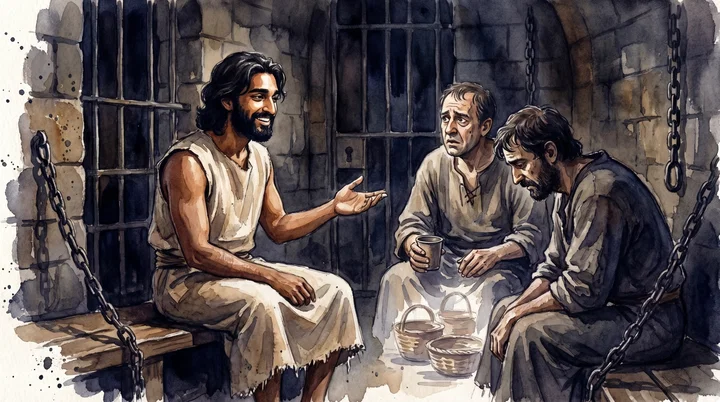
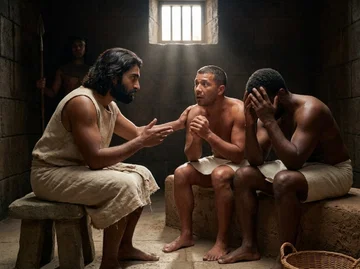
Seeing that the officers looked sad and troubled, he kindly asked why they were sad and what troubled them, showing interest, kindness and sympathy.SG3 146.2–147.1PP 219.1ST Jan 15, 18801SP 134.1–2ST Jan 8, 1880 His sympathy relieved their distress of mind and opened the way for him to hear their dreams and tell them that interpretations belong to God.SG3 146.2–147.1
Sources
Pioneers and periodicals
18 sources
In the prison in the morning Joseph noticed the chief butler and chief baker who had been put in his charge looking sad and asked why they looked so sad that day.ST Nov 3, 1898ST Oct 9, 1901ST Nov 3, 1898 They were anxious and troubled because each had dreamed in the night in prison with no professional interpreter at hand and no knowledge of what the king would decide for them.ST Nov 3, 1898ST Nov 3, 1898ST Oct 9, 1901 His question opened the way for them to tell their dreams and for him to point them to God for the meaning, and what he foretold came to pass and later led the butler to remember him when Pharaoh was troubled by dreams.ST Nov 3, 1898ST Apr 9, 1894ST Mar 24, 1887 The question shows his practical, kindly sympathy and attentiveness to men in trouble even while he himself was unjustly confined as a prisoner and exile, not wrapped up in his own suffering but still on duty to the Lord.ST Jan 15, 1880ST Jan 3, 1911ST Oct 9, 1901RH Jan 11, 1912 That simple act of service was no trivial thing but the gate to his liberty, bringing him to the king's notice and raising him to be a high ruler in Egypt and a witness to the living God, for prison discipline prepared him for what God intended and God brought him safely to it.ST Jan 3, 1911RH Jan 19, 1860RH Jan 11, 1912
Prison Setting and Sequence
In the ward of his lord's house in prison in the morning, Joseph noticed Pharaoh's chief butler and chief baker, who had been put in his charge, looking sad and asked why they looked so sad that day.ST Nov 3, 1898ST Oct 9, 1901ST Nov 3, 1898 His noticing their sadness showed attentiveness and concern for them while they were in prison with him.ST Nov 3, 1898ST Oct 9, 1901 He discerned in the morning that both officers were sad after each dreaming a dream in the prison in the same night.ST Nov 3, 1898ST Nov 3, 1898
Their sadness came from those mysterious dreams in the night, which left them anxious and troubled.ST Nov 3, 1898ST Nov 3, 1898ST Oct 9, 1901 Shut up in prison they had no access to the professional interpreters, and an Egyptian official not knowing what fate the king might decide could be deeply troubled by such a dream.ST Oct 9, 1901 The exchange with Pharaoh's imprisoned officers, together with surrounding events including Egyptian customs such as the chief baker's execution, belongs to an account Egyptian in setting and detail and supports the story's historical Egyptian background.ST Dec 14, 1915
Together with verse 11, the verse dates Israel's going into Egypt to 1706 B.C. and coming out to 1491 B.C., making 215 years in Egypt.ST Aug 12, 1913 His kindly question opened the way for them to tell him their dreams and for him to point them to God for the interpretation.ST Nov 3, 1898 Imprisoned alongside the two officers, he interpreted both dreams, and what he said came to pass.ST Nov 3, 1898ST Apr 9, 1894 Their distress was connected with the dreams he interpreted, and the dreams and the outcomes he foretold led the butler to remember him when Pharaoh was later troubled by dreams.ST Mar 24, 1887
Sympathetic Service and Providence
Joseph noticed the troubled, downcast faces of his fellow prisoners in the morning and asked why they looked so sad that day, out of practical, kindly sympathy and attentiveness to their distress.ST Jan 15, 1880ST Oct 9, 1901ST Oct 9, 1901 He was himself unjustly confined as a prisoner and an exile among strangers, yet he patiently cared for men in trouble and desired to help them rather than focusing only on his own suffering.ST Jan 15, 1880ST Jan 8, 1880ST Oct 9, 1901ST Feb 22, 1899 His question asked after what troubled them and opened a way of service to them in their sadness.ST Jan 8, 1880ST Oct 9, 1901
Though innocent, mistreated, and suffering, he was not wrapped up in his own troubles but showed integrity and purity in bonds.ST Jan 8, 1880ST Jan 3, 1911RH Jan 11, 1912 Whether in bonds or free a person belongs to the Lord and is always on duty, never knowing what may prove the road of highest service.RH Jan 11, 1912 That simple, kindly asking how they felt was no trivial thing but the first of a long train of circumstances and the gate to his liberty.RH Jan 11, 1912 Without it he might have languished in prison till the day of his death, but through it he was brought to the king's notice and raised to be a high ruler in Egypt, a benefactor to his race, and a witness to the living God before all the empire, and the same faithfulness that marked his life in prison continued in the court of the king.RH Jan 11, 1912
His time in prison provided discipline that prepared him for the position to which God later raised him.ST Jan 3, 1911 Whatever God has intended a person for, He can be safely trusted to bring them to it, leading roundabout yet guiding right.RH Jan 19, 1860 Though his own earlier dreams of exaltation among his brethren had been answered by the opposite experience of humiliation and imprisonment, he did not dismiss dreams as uncertain and deceptive but gave heed to their dreams.ST Feb 22, 1899 He retained confidence in dreams because his trust was in God the interpreter of dreams, looking at the invisible and knowing his own dreams would yet be fulfilled though present appearances were forbidding.ST Feb 22, 1899
The experience holds an underlying principle to guide dealing with the contingencies of life, recording a kind of human experience that has its counterpart in experiences people still go through.ST Nov 29, 1905 The Bible is thus a guidebook to be trusted to the very end, and its practical lesson is to be made as familiar as one's own name for one's own soul's good and for counseling others who come for advice in similar difficulties.ST Nov 29, 1905 Joseph was guided and preserved in his youth by the unchanging God of Noah, Abraham, and Daniel, who still delivers those who fear Him and put their trust in Him, with the angel of the Lord encamping around them to deliver them, proving every child and youth should want the God of Israel for a friend and seek Him early, so angels will guard them in time of trouble.RH Nov 24, 1874 His life in Egypt serves as an example of how God's workers are to live and work in the world in its closing period.RH Dec 20, 1906
Sources