Genesis 40:14
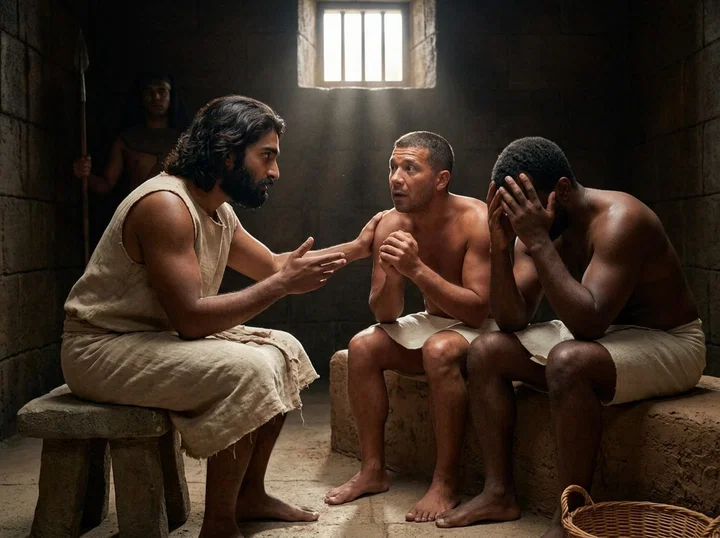
But think on me when it shall be well with thee, and shew kindness, I pray thee, unto me, and make mention of me unto Pharaoh, and bring me out of this house:
Translations
But think on me when it shall be well with you, and show kindness, I pray you, to me, and make mention of me to Pharaoh, and bring me out of this house:
King James Version, KJV Cambridge Paragraph Bible
But think on me when it shall be well with thee, and shew kindness, I pray thee, unto me, and make mention of me unto Pharaoh, and bring me out of this house:
But think on me when it shall be well with thee, and show kindness to me, I pray thee, and make mention of me to Pharaoh, and bring me out of this house:
But have me in thy remembrance when it shall be well with thee, and shew kindness, I pray thee, unto me, and make mention of me unto Pharaoh, and bring me out of this house:
But have me in thy remembrance when it shall be well with thee, and show kindness, I pray thee, unto me, and make mention of me unto Pharaoh, and bring me out of this house:
'Surely if thou hast remembered me with thee, when it is well with thee, and hast done (I pray thee) kindness with me, and hast made mention of me unto Pharaoh, then hast thou brought me out from this house,
Only bear a remembrance with thee of me when it goes well with thee, and deal kindly, I pray thee, with me, and make mention of me to Pharaoh, and bring me out of this house;
But if thou remember how I was with thee when it shall go well with thee, then wilt thou I pray thee do me a lovingkindness,—and make mention of me unto Pharaoh, and bring me forth out of this house;
Berean Standard Bible, Majority Standard Bible
But when it goes well for you, please remember me and show me kindness by mentioning me to Pharaoh, that he might bring me out of this prison.
But remember me when it is well with you. Please show kindness to me, and make mention of me to Pharaoh, and bring me out of this house.
But keep me in mind when things go well for you, and be good to me and say a good word for me to Pharaoh and get me out of this prison:
But haue me in remembrance with thee, when thou art in good case, and shew mercie, I pray thee, vnto me, and make mention of me to Pharaoh, that thou mayest bring me out of this house.
Douay-Rheims (Challoner revision)
Only remember me, when it shall be well with thee, and do me this kindness: to put Pharao in mind to take me out of this prison:
Pictures
Cross-references
- Genesis 41:14
Then Pharaoh sent and called Joseph, and they brought him hastily out of the dungeon: and he shaved himself, and changed his raiment, and came in unto Pharaoh.
The butler’s recollection leads Pharaoh to summon Joseph from prison.
- Genesis 40:23
Yet did not the chief butler remember Joseph, but forgat him.
The restored cupbearer forgets Joseph’s plea to remember him.
- Genesis 41:28-54
This is the thing which I have spoken unto Pharaoh: What God is about to do he sheweth unto Pharaoh.
The seven years foretold in Pharaoh’s dream came to pass within the appointed time.
- Genesis 41:9-13
Then spake the chief butler unto Pharaoh, saying, I do remember my faults this day:
Pharaoh’s dreams prompt the butler to remember Joseph and admit his fault.
- Luke 23:42
And he said unto Jesus, Lord, remember me when thou comest into thy kingdom.
Both ask to be remembered when circumstances are favorable.
- Psalms 105:18
Whose feet they hurt with fetters: he was laid in iron:
Both describe Joseph’s imprisonment and suffering.
- Genesis 41:1
And it came to pass at the end of two full years, that Pharaoh dreamed: and, behold, he stood by the river.
Two years later, Joseph is brought out of prison.
- Genesis 40:8
And they said unto him, We have dreamed a dream, and there is no interpreter of it. And Joseph said unto them, Do not interpretations belong to God? tell me them, I pray you.
Joseph says dream interpretations belong to God.
- Genesis 40:20-22
And it came to pass the third day, which was Pharaoh’s birthday, that he made a feast unto all his servants: and he lifted up the head of the chief butler and of the chief baker among his servants.
The officers’ outcomes fulfilled Joseph’s interpretations.
- Genesis 41:12-13
And there was there with us a young man, an Hebrew, servant to the captain of the guard; and we told him, and he interpreted to us our dreams; to each man according to his dream he did interpret.
The butler recalls Joseph’s interpretation and its fulfillment.
- Genesis 41:40-41
Thou shalt be over my house, and according unto thy word shall all my people be ruled: only in the throne will I be greater than thou.
Joseph is raised to authority in Egypt.
- Genesis 39:20
And Joseph’s master took him, and put him into the prison, a place where the king’s prisoners were bound: and he was there in the prison.
Identifies the house as the prison.
- Genesis 42:6
And Joseph was the governor over the land, and he it was that sold to all the people of the land: and Joseph’s brethren came, and bowed down themselves before him with their faces to the earth.
Joseph’s brothers bow before him, fulfilling his dreams.
- Genesis 42:2
And he said, Behold, I have heard that there is corn in Egypt: get you down thither, and buy for us from thence; that we may live, and not die.
Jacob sends his sons to buy corn from Joseph during the famine.
- Genesis 41:16
And Joseph answered Pharaoh, saying, It is not in me: God shall give Pharaoh an answer of peace.
"it is not in me" in same story
- Genesis 37:5-11
And Joseph dreamed a dream, and he told it his brethren: and they hated him yet the more.
Joseph’s exaltation dreams contrast with his prison interpretations.
Commentary
Each commentary is drawn from primary sources: the writings of Ellen G. White and Adventist pioneers and periodicals. Each commentary is separate. Its own words are not a quotation; follow the references to read the source passages.
Ellen G. White
7 sources
Joseph's plea follows immediately upon his interpretation of the chief butler's dream, that in three days he would leave prison and be restored to Pharaoh's favor to put the cup into his hand as before.SG3 146.2–147.11SP 134.1–2 In that moment he asks to be thought upon when it goes well with the butler, to be shown kindness, to be mentioned to Pharaoh, and to be brought out of the prison house so that he may be released.SG3 146.2–147.1PP 219.1ST Jan 15, 18801SP 134.1–2ST Jan 15, 1880 He grounds the request in gratitude for the interest he had shown the butler, the kind treatment he had given him, and above all the relief from distress of mind brought by the interpretation.SG3 146.2–147.1PP 219.11SP 134.1–2 In touching manner he alludes to his own captivity and rests the plea on innocence and unjust imprisonment, that he was stolen away out of the land of the Hebrews and had done nothing to deserve being put into the dungeon.SG3 146.2–147.1PP 219.1ST Jan 15, 18801SP 134.1–2
The butler forgot the request after being restored to his position, but later remembered Joseph and acknowledged to Pharaoh his forgetfulness and ingratitude.ST Jan 15, 1880 The verse belongs to the account of the butler's and baker's dreams in Genesis 40:12-20, whose predicted events unfolded within three days.GC 323.2–324.2GC88 323.2 Those three days were once only a matter of prophecy and were then fulfilled in accordance with the prediction, making them an example of a stated prophetic time fulfilled as predicted.GC 323.2–324.2GC88 323.2
With other fulfilled time predictions, this proves that predicted events occur within the given time.GC 323.2–324.2 So the chronological periods of the Bible extending to the second coming of Christ are times beforehand appointed by God and revealed to His servants that will likewise be fulfilled.GC 323.2–324.2
Sources
Pioneers and periodicals
26 sources
In prison Joseph told the chief butler his dream meant he would be restored to office within three days, and asked him in return to remember him when well, to show kindness by speaking of him to Pharaoh, and to get him out of the prison house.RH Jul 28, 1904ST Nov 3, 1898ST Nov 3, 1898 He pleaded as a fellow sufferer sharing confinement and scanty fare, declaring he had been stolen from the land of the Hebrews and had done nothing to deserve the dungeon.ST Jan 15, 1880RH Jul 28, 1904ST Nov 3, 1898 The butler forgot his deliverer amid the joy of the palace, yet after two full years remembered him when Pharaoh needed an interpreter, for Joseph's lawful effort for release failed because God's time for deliverance had not yet come.RH Jul 28, 1904ST Nov 29, 1905ST Mar 24, 1887ST Oct 16, 1901ST Nov 29, 1905 The three days were first only foretold and then fulfilled exactly as predicted, showing that God foretells events to occur within a given time and fulfills them within that time, so the periods of Scripture are to be seriously considered.RH Apr 18, 1854RH Mar 31, 1868RH Feb 18, 1873 One freed from Satan's prison-house of sin and restored to sonship must likewise remember companions still in the dungeon, making mention of them before the King in interceding prayer and being willing to be sent to open the prison to them by preaching the gospel.RH Jul 28, 1904RH Jul 28, 1904
Prison Request and Outcome
In prison Joseph interpreted the chief butler's dream to mean that within three days Pharaoh would lift up his head and restore him to his place and office, and then asked him to remember him when it should be well with him, to show kindness by speaking of him to Pharaoh, and to bring him out of the prison house.ST Jan 15, 1880RH Jul 28, 1904ST Nov 3, 1898ST Nov 3, 1898ST Aug 21, 1884 He made the plea as deliverance came to the butler to go free and be restored to favor while he himself must remain, remembering the injustice of his own suffering as he foretold the butler's happy lot and begging to be remembered so he too might go free.RH Jul 28, 1904ST Nov 3, 1898 He made it as a fellow sufferer and companion in prison, sharing the same scanty fare, occupying adjoining cells, with feet hurt with fetters and laid in irons.RH Jul 28, 1904 He pleaded his innocence as the just reason for the request, that he was stolen out of the land of the Hebrews and had done nothing to deserve the dungeon.ST Jan 15, 1880RH Jul 28, 1904ST Nov 3, 1898
Even while himself reduced to the condition of a degraded, imprisoned culprit in exile among strangers and enemies, the very opposite of his earlier dreams of elevation and exaltation among his brethren, he still retained confidence in dreams.ST Feb 22, 1899 Instead of judging from his own forbidding outward and present appearances that dreams are uncertain and deceptive and not to be depended on, his trust was in God as the interpreter of dreams, looking at the invisible and knowing his own dreams would sometime be fulfilled.ST Feb 22, 1899 The request belongs to the move from prison to palace in which Joseph, though innocent, spent two years in prison, where his integrity and purity were evident, and where God gave him wisdom to interpret the dreams of the chief butler and chief baker as one who trusted God would give the interpretations and sought to help the troubled men.ST Jan 3, 1911ST Apr 9, 1894ST Oct 9, 1901 Both interpretations came to pass as predicted, with the butler restored and the baker executed, and Joseph was afterward brought to stand before Pharaoh, declaring that interpretation is not in him, and was raised from prison to the throne to rule in Egypt before Jacob's sons came to buy corn.ST Jan 3, 1911RH Jan 20, 1916ST Apr 9, 1894ST Oct 9, 1901
The joy of the king's palace made the butler unmindful of the one who had foretold his deliverance, so after being restored to his position and favor with the king he did not remember Joseph but forgot him and his promise to speak for him.ST Jan 15, 1880RH Jul 28, 1904ST Oct 16, 1901 After two years he remembered Joseph only when Pharaoh's troubling dreams created need for an interpreter and brought Joseph to mind, telling the king about him.ST Mar 24, 1887ST Oct 16, 1901ST Oct 16, 1901 In doing so he recognized and acknowledged his earlier forgetfulness as ingratitude.ST Jan 15, 1880ST Mar 24, 1887 The story's details fit Egyptian customs and place it in an Egyptian setting, in which the chief butler prepared grape juice as an offering, the chief baker was beheaded, and Joseph shaved before appearing before Pharaoh, a custom Semitic peoples abhorred.ST Dec 14, 1915
Timed Prophecy and Providence
The three days foretold in the dreams of the butler and baker were once only prophecy, and the events limited by them were afterward fulfilled in accordance with the prediction.RH Apr 18, 1854RH Mar 31, 1868RH Feb 18, 1873 The account of the butler's and baker's dreams illustrates a predicted event occurring within a specified time, three days.RH Apr 18, 1854RH Mar 31, 1868 It shows that God often foretells an event to occur within a given time and then fulfills it within that time.RH Apr 18, 1854RH Feb 18, 1873
Such fulfilled chronological periods show that the chronological periods of Scripture are profitable and are to be seriously considered in looking for the coming of the Saviour.RH Feb 18, 1873
Joseph's asking the chief butler to remember him when well, to speak to Pharaoh on his behalf, and to help free him from prison was a reasonable and natural effort to gain release.ST Nov 29, 1905ST Oct 16, 1901ST Nov 29, 1905 It did not bring his release because the time for his deliverance in God's plan had not yet come.ST Nov 29, 1905ST Nov 29, 1905 The butler forgot the request, but later remembered Joseph when Pharaoh's troubling dreams created need for an interpreter, and that later timing served God's providence.ST Nov 29, 1905ST Oct 16, 1901ST Nov 29, 1905
The history of Joseph shows that whatever God has intended a person for, He may be safely trusted to bring him to it, even leading him by a roundabout way yet guiding him right.ST Nov 29, 1905RH Jan 19, 1860ST Nov 29, 1905 When human plans fail, people should entrust their course to God and patiently wait for His time.ST Nov 29, 1905ST Nov 29, 1905 This is because God knows the end from the beginning and works things well.ST Nov 29, 1905ST Nov 29, 1905
Example and Spiritual Duty
The experiences of Joseph's life contain underlying principles designed to guide the handling of the various contingencies of life.ST Nov 29, 1905 An underlying principle is to be discovered in them so that anyone called to pass through a similar trial may be helped and guided by his example.ST Nov 29, 1905 The variety of human experiences recorded in Scripture provides a counterpart for every kind of experience a person may go through, and its practical lesson is to be as familiar as one's own name, for personal good and for counseling others in similar difficulties, as a guidebook to be trusted to the very end.ST Nov 29, 1905
The request in prison belongs to the beautiful story of Joseph in Egypt showing faithfulness, conscientiousness, integrity and purity, and the fulfillment of the dreams for which his brothers hated him.ST It belongs to the account of his imprisonment and eventual rise to rule in Egypt, in which though innocent he spent two years in prison, his integrity and purity were evident there, and he was brought from prison to the throne.ST Jan 3, 1911 His guidance and preservation in youth prove that the God of Israel befriends youth and guards them by angels in time of trouble, so every child and youth should want Him for friend and seek Him early to find Him.RH Nov 24, 1874
One who has been freed from Satan's prison-house of sin and restored to sonship with access to the throne of grace must remember wretched companions still languishing in the dungeon.RH Jul 28, 1904RH Jul 28, 1904 As the prisoner asked one soon to be released to remember him, speak on his behalf to Pharaoh, and help bring him out of prison, so those freed from spiritual bondage must plead before God for those still imprisoned by Satan and help bring them out.RH Jul 28, 1904RH Jul 28, 1904 To make mention of them before the King means to intercede in prayer for their release.RH Jul 28, 1904 To ask that they be brought out of that house means both praying for their deliverance and being willing to be sent to open the prison to them by preaching the gospel to them as a debtor to all.RH Jul 28, 1904RH Jul 28, 1904
Sources