Genesis 40:8
And they said unto him, We have dreamed a dream, and there is no interpreter of it. And Joseph said unto them, Do not interpretations belong to God? tell me them, I pray you.
Translations
American King James Version, Webster Bible
And they said to him, We have dreamed a dream, and there is no interpreter of it. And Joseph said to them, Do not interpretations belong to God? tell me them, I pray you.
King James Version, KJV Cambridge Paragraph Bible
And they said unto him, We have dreamed a dream, and there is no interpreter of it. And Joseph said unto them, Do not interpretations belong to God? tell me them, I pray you.
Revised Version, American Standard Version
And they said unto him, We have dreamed a dream, and there is none that can interpret it. And Joseph said unto them, Do not interpretations belong to God? tell it me, I pray you.
And they say unto him, 'A dream we have dreamed, and there is no interpreter of it;' and Joseph saith unto them, 'Are not interpretations with God? recount, I pray you, to me.'
And they said to him, We have dreamt a dream, and there is no interpreter of it. And Joseph said to them, [ Do] not interpretations [ belong] to God? tell me [ your dreams], I pray you.
And they said unto him, A dream, have we dreamed, but there is none, to interpret, it. Then said Joseph unto them—Is it not unto God, that interpretations belong? Relate it. I pray you, to me.
Berean Standard Bible, Majority Standard Bible
“ We both had dreams,” they replied, “ but there is no one to interpret them.”Then Joseph said to them, “Don’t interpretations belong to God? Tell me your dreams.”
They said to him, “ We have dreamed a dream, and there is no one who can interpret it.”Joseph said to them, “Don’t interpretations belong to God? Please tell it to me.”
Then they said to him, We have had a dream, and no one is able to give us the sense. And Joseph said, Does not the sense of dreams come from God? what was your dream?
Who answered him, We haue dreamed, eche one a dreame, and there is none to interprete the same. Then Ioseph saide vnto them, Are not interpretations of God? tell them me nowe.
Douay-Rheims (Challoner revision)
They answered: We have dreamed a dream, and there is nobody to interpret it to us. And Joseph said to them: Doth not interpretation belong to God? Tell me what you have dreamed.
Pictures
Cross-references
- Genesis 41:16
And Joseph answered Pharaoh, saying, It is not in me: God shall give Pharaoh an answer of peace.
Joseph again credits God, not himself, with providing the dream’s interpretation.
- Genesis 40:18-22
And Joseph answered and said, This is the interpretation thereof: The three baskets are three days:
Joseph interprets the baker’s dream, and events follow as foretold.
- Genesis 40:12-13
And Joseph said unto him, This is the interpretation of it: The three branches are three days:
Joseph explains the butler’s dream and its meaning.
- Genesis 41:38-40
And Pharaoh said unto his servants, Can we find such a one as this is, a man in whom the Spirit of God is?
Pharaoh recognizes God’s presence and wisdom in Joseph and appoints him to rule.
- Genesis 37:5-11
And Joseph dreamed a dream, and he told it his brethren: and they hated him yet the more.
Joseph’s dreams of exaltation provoke his brothers’ envy.
- Genesis 42:6
And Joseph was the governor over the land, and he it was that sold to all the people of the land: and Joseph’s brethren came, and bowed down themselves before him with their faces to the earth.
Joseph’s brothers bow before him, fulfilling his dreams.
- Daniel 2:28
But there is a God in heaven that revealeth secrets, and maketh known to the king Nebuchadnezzar what shall be in the latter days. Thy dream, and the visions of thy head upon thy bed, are these;
Daniel, like Joseph, identifies God as the source of dream interpretation.
- Genesis 41:14
Then Pharaoh sent and called Joseph, and they brought him hastily out of the dungeon: and he shaved himself, and changed his raiment, and came in unto Pharaoh.
Joseph is brought from prison to interpret Pharaoh’s dreams.
- Genesis 40:4
And the captain of the guard charged Joseph with them, and he served them: and they continued a season in ward.
shares charge to serve officers
Commentary
Each commentary is drawn from primary sources: the writings of Ellen G. White and Adventist pioneers and periodicals. Each commentary is separate. Its own words are not a quotation; follow the references to read the source passages.
Ellen G. White
5 sources
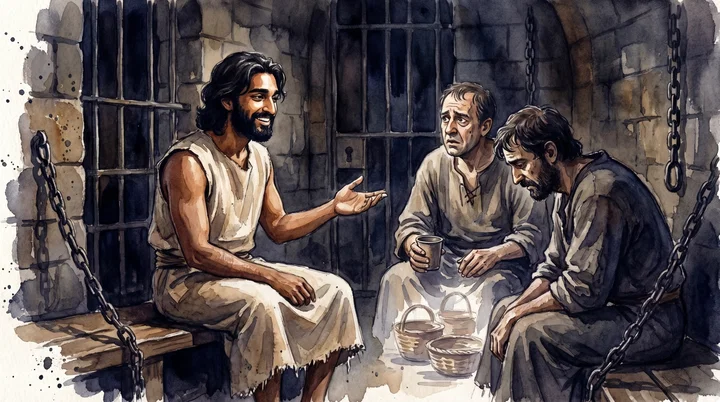
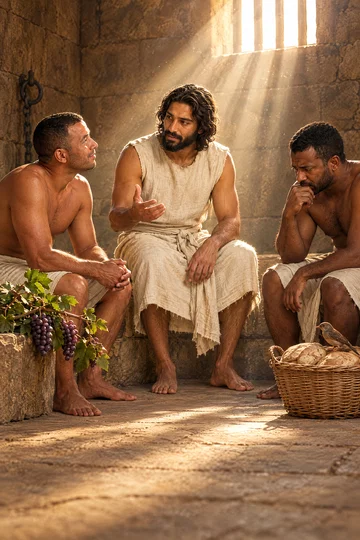
Joseph was still confined in prison when Pharaoh became offended with his chief butler and chief baker, and they were cast into prison and placed under Joseph's especial care.SG3 146.2–147.1ST Jan 15, 1880 One morning as he was serving them and bringing them food, he noticed that they looked very sad.SG3 146.2–147.1ST Jan 15, 1880 He kindly asked them why they looked sad.SG3 146.2–147.1ST Jan 15, 1880
They answered that they had dreamed a dream and had no interpreter to explain it.SG3 146.2–147.1ST Jan 15, 1880 Joseph answered that interpretations and the meaning and power and ability to explain dreams belong to God, acknowledging God as the source.SG3 146.2–147.1PP 219.1ST Jan 15, 18801SP 134.1–2STGC 77.3–4 He asked them to tell the dreams to him.SG3 146.2–147.1PP 219.1ST Jan 15, 18801SP 134.1–2STGC 77.3–4
God enabled him to explain what the dreams meant, foretelling that in three days the butler would be restored to the king's favor to serve Pharaoh's cup as before, and foretelling the baker's death.ST Jan 15, 18801SP 134.1–2 The interpretations he gave were fulfilled as foretold.PP 219.1 In this he made his life useful in prison instead of mourning the injustice that had deprived him of liberty, showing exemplary conduct, humble deportment, faithfulness and kind interest that won the confidence of all in the prison and relieved the officers in their great distress of mind.SG3 146.2–147.1 The encounter formed a turning-point in his life.ST Jan 15, 1880
Sources
Pioneers and periodicals
21 sources
Joseph was confined in prison with Pharaoh's chief butler and chief baker, who had been cast there for offending their king and placed under his care, and when each dreamed in one night and looked sad in the morning he kindly asked the cause of their sorrow.ST Jan 15, 1880ST Nov 3, 1898ST Oct 9, 1901 Their distress was that they had dreamed with no one to explain the meaning, and his answer declares that the power to interpret belongs to God and not to himself or to any human wisdom, skill or magic.ST Oct 9, 1901RH Jan 20, 1916ST Apr 9, 1894 On that ground he asked them to tell him their dreams, trusting that God was with him and would honor his faith by making the meaning known and seeking help for the troubled men while giving God the glory.ST Oct 9, 1901ST Apr 9, 1894RH Sep 3, 1903 Both explanations he gave came to pass three days later, with the butler restored to serve Pharaoh's cup as before and the baker hanged.ST Jan 15, 1880ST Apr 9, 1894RH Jun 23, 1903 The moment stands at the start of his rise from prison to palace and to power in Egypt, showing that God can be safely trusted to bring a person to what He intends by leading him roundabout yet guiding him right, and leaving principles to guide anyone passing through like experiences.ST Jan 15, 1880ST Jan 3, 1911RH Jan 20, 1916ST Nov 29, 1905RH Jan 19, 1860
Prison Setting and Meaning
Joseph was still confined in prison with Pharaoh's chief butler and chief baker, who had been cast there for offending Pharaoh and placed under his especial care.ST Jan 15, 1880ST Nov 3, 1898 After each of the two officers dreamed a dream in one night, they appeared very sad in the morning, and Joseph kindly asked why they looked sad.ST Jan 15, 1880ST Nov 3, 1898 They answered that they had dreamed and had no one to explain it, which distressed them because they had no interpreter.ST Jan 15, 1880ST Nov 3, 1898ST Oct 9, 1901 Dreams were a matter of great concern to Egyptians, and many wise men claimed to explain them, but in prison the officers could not reach those professionals.ST Oct 9, 1901 With their fate uncertain and potentially dependent on the king's whim, an unexplained dream caused them real sadness.ST Oct 9, 1901
Joseph answered that interpretations belong to God, and that the power and ability and wisdom to explain dreams belong to God and not to himself nor to human wisdom, skill, or magic.ST Jan 15, 1880ST Oct 9, 1901RH Jan 20, 1916ST Mar 24, 1887ST Oct 16, 1901 He acknowledged God as the source of interpretation and declared that the meaning of dreams belongs to God and not in himself.ST Oct 9, 1901RH Jan 20, 1916RH Sep 3, 1903ST Mar 24, 1887ST Oct 16, 1901 On that basis he asked the men to tell him their dreams, inviting the imprisoned officials to relate them because God is the source of their interpretation.ST Oct 9, 1901RH Sep 3, 1903ST Oct 9, 1901ST Mar 24, 1887 He trusted that God was with him and would honor his faith by giving him the understanding needed and making the meaning known.RH Jun 23, 1903ST Oct 9, 1901 His concern for the troubled men led him to seek help for them from God while giving God the glory.ST Oct 9, 1901
Though he spoke as a humbled, exiled, and imprisoned culprit among strangers and enemies, whose own dreams of exaltation among his brethren had met with the decided reverse, he still retained confidence in dreams.ST Feb 22, 1899 His confidence was not in dreams themselves as uncertain and deceptive, but in God as the giver of interpretations.ST Feb 22, 1899 He looked at the invisible and knew his own dreams would sometime be fulfilled though outward and present appearances seemed forbidding.ST Feb 22, 1899
Both interpretations he gave to the fellow prisoners came to pass and were fulfilled three days later.ST Apr 9, 1894ST Oct 9, 1901 The butler was restored to the king's favor to serve Pharaoh's cup as before and returned to his office, while the baker was hanged.ST Jan 15, 1880ST Oct 9, 1901 Joseph's wisdom in interpreting them came from God.ST Apr 9, 1894 His later interpretation of Pharaoh's dreams about seven years of plenty and seven years of famine is presented as prophecy.RH Jun 23, 1903
Rise and Lasting Example
Genesis 40:8 stands at the turning-point of Joseph's life while he was still confined in prison, and at the start of his move from prison to palace and on to Egypt's throne.ST Jan 15, 1880ST Jan 3, 1911RH Jan 20, 1916 Pharaoh had become offended with the chief butler and chief baker, they had been cast into prison and placed under Joseph's especial care, and one morning Joseph saw they looked very sad and kindly asked why they looked sad.ST Jan 15, 1880 They answered that they had dreamed and had no one to explain it, and Joseph answered that the power to explain dreams belongs to God and not in himself, and asked them to tell the dreams to him.ST Jan 15, 1880RH Jan 20, 1916 The butler then told his dream and Joseph explained that in three days he would be restored to the king's favor to serve Pharaoh's cup as before, before the sons of Jacob came to buy corn from Joseph.ST Jan 15, 1880RH Jan 20, 1916 That rise came through the severe discipline by which God developed his character.ST Jan 3, 1911
The verse belongs to the story of Joseph whose own dreams stirred his brothers' envy and hatred.ST Jan 3, 1911ST Those dreams were later fulfilled when his brothers bowed before him and when the sons of Jacob came to buy corn from him.ST Jan 3, 1911RH Jan 20, 1916 It is a story of faithfulness, conscientiousness, and integrity, in which the Lord was preparing Joseph to preserve the holy Seed.ST Jan 21, 1913ST The history shows that whatever God has intended a person for, God can be safely trusted to bring him to it, leading him roundabout yet guiding him right, and that God guided and saved Joseph in his youth.RH Jan 19, 1860RH Nov 24, 1874
Joseph's life contains principles designed to guide the various contingencies of life.ST Nov 29, 1905 The underlying principles recognized in his case are to be discovered so that his example helps and guides anyone called to pass through similar experiences.ST Nov 29, 1905 Experiences like his have their counterpart in every kind of human experience, and their practical lessons should be as familiar as one's own name for personal good and for giving counsel to others in similar difficulties, with the Bible trusted with confidence as the guidebook to the very end.ST Nov 29, 1905
By giving God credit for interpreting the butler's dream and giving God the honor due to His name, Joseph was brought honor.ST Oct 16, 1901 He trusted God to give him the understanding needed, invited the troubled men to tell their dreams because he believed God was with him and would honor his faith, and sought help for them from God while giving God the glory.ST Oct 9, 1901 God's presence with him led Pharaoh to choose him, since Pharaoh judged that a man endowed by God would be wiser and more discreet than one relying only on his own wisdom.ST Oct 16, 1901 Joseph in Egypt is in this way an example of what God wants His workers to be in the closing act of the world, with God fulfilling the new covenant promise by leading each worker individually in his work.RH Dec 20, 1906 He stands as an example of one who could interpret a dream, though in one account the man understood his own dream without needing Joseph to interpret it.RH Oct 23, 1900
Sources