Genesis 48:17
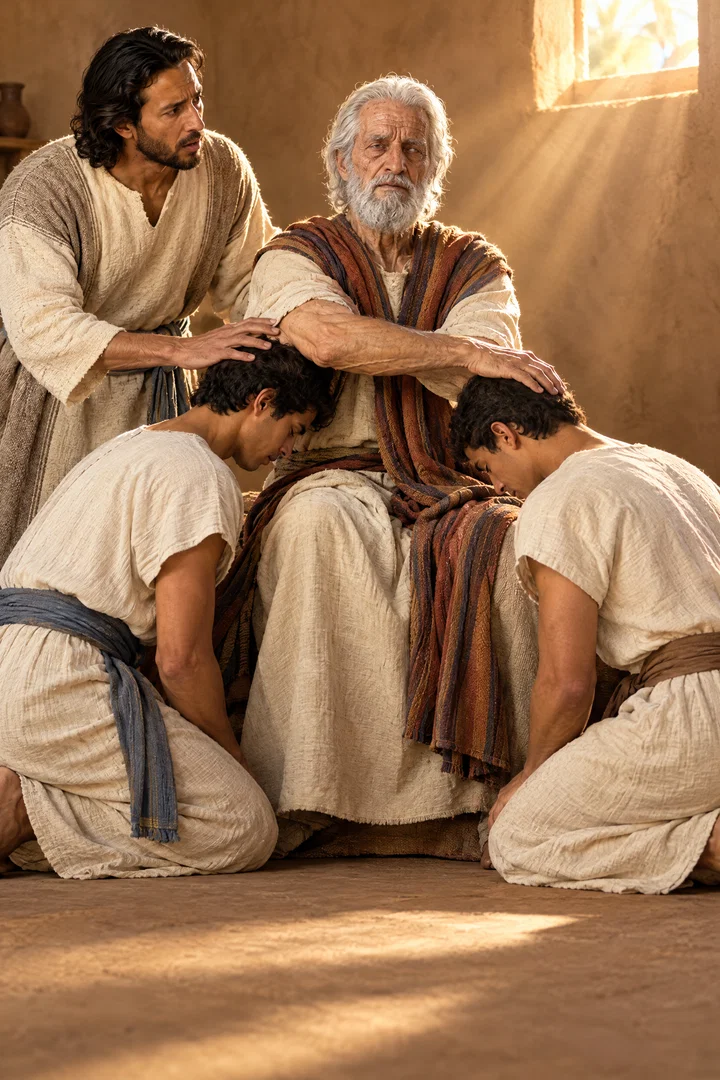
And when Joseph saw that his father laid his right hand upon the head of Ephraim, it displeased him: and he held up his father’s hand, to remove it from Ephraim’s head unto Manasseh’s head.
Translations
And when Joseph saw that his father laid his right hand on the head of Ephraim, it displeased him: and he held up his father’s hand, to remove it from Ephraim’s head to Manasseh’s head.
King James Version, KJV Cambridge Paragraph Bible, Revised Version, American Standard Version
And when Joseph saw that his father laid his right hand upon the head of Ephraim, it displeased him: and he held up his father’s hand, to remove it from Ephraim’s head unto Manasseh’s head.
And when Joseph saw that his father laid his right hand upon the head of Ephraim, it displeased him: and he lifted his father's hand, to remove it from Ephraim's head to Manasseh's head.
And Joseph seeth that his father setteth his right hand on the head of Ephraim, and it is wrong in his eyes, and he supporteth the hand of his father to turn it aside from off the head of Ephraim to the head of Manasseh;
When Joseph saw that his father laid his right hand on the head of Ephraim, it was evil in his eyes; and he took hold of his father's hand to remove it from Ephraim's head to Manasseh's head.
And Joseph saw that his father had laid his right hand on the head of Ephraim and it was displeasing in his eyes,—so he took hold of his father’s hand to remove it from off the head of Ephraim, on to the head of Manasseh.
Berean Standard Bible, Majority Standard Bible
When Joseph saw that his father had placed his right hand on Ephraim’s head, he was displeased and took his father’s hand to move it from Ephraim’s head to Manasseh’s.
When Joseph saw that his father laid his right hand on the head of Ephraim, it displeased him. He held up his father’s hand, to remove it from Ephraim’s head to Manasseh’s head.
Now when Joseph saw that his father had put his right hand on the head of Ephraim, it did not seem right to him; and lifting his father's hand he would have put it on the head of Manasseh.
But when Ioseph sawe that his father layde his right hande vpon the head of Ephraim, it displeased him: and he stayed his fathers hand to remooue it from Ephraims head to Manassehs head.
Douay-Rheims (Challoner revision)
And Joseph seeing that his father had put his right hand upon the head of Ephraim, was much displeased: and taking his father’s hand he tried to lift it from Ephraim’s head, and to remove it to the head of Manasses.
Pictures
Cross-references
- Jeremiah 31:9
They shall come with weeping, and with supplications will I lead them: I will cause them to walk by the rivers of waters in a straight way, wherein they shall not stumble: for I am a father to Israel, and Ephraim is my firstborn.
Calls younger Ephraim firstborn.
- Genesis 27:1-29
And it came to pass, that when Isaac was old, and his eyes were dim, so that he could not see, he called Esau his eldest son, and said unto him, My son: and he said unto him, Behold, here am I.
Rebekah schemes so her favored son receives Isaac’s blessing.
- 1 Chronicles 5:1-2
Now the sons of Reuben the firstborn of Israel, (for he was the firstborn; but, forasmuch as he defiled his father’s bed, his birthright was given unto the sons of Joseph the son of Israel: and the genealogy is not to be reckoned after the birthright.
Reuben’s birthright was transferred to Joseph’s sons.
- Leviticus 1:4
And he shall put his hand upon the head of the burnt offering; and it shall be accepted for him to make atonement for him.
Both describe laying a hand on someone’s head to signify devotion.
Commentary
Each commentary is drawn from primary sources: the writings of Ellen G. White and Adventist pioneers and periodicals. Each commentary is separate. Its own words are not a quotation; follow the references to read the source passages.
Ellen G. White
3 sources
This moment belongs to the later history of Joseph in Egypt, after the seven years of dearth had begun in all lands, when ten of Jacob's sons came from Canaan to buy grain and bowed down before Joseph with their faces to the earth without recognizing him.PP 224.3–225.1 It displays the meaningful, significant Jewish form in which a father blessed his children by reverently placing his hands upon their heads.RH May 11, 1911SLP 44.1 The laying on of hands was a reverent asking of God to bestow His blessing upon those devoted to Him.SLP 44.1
The same meaning was carried when one with priestly authority laid his hand upon the head of an animal devoted to sacrifice.SLP 44.1 This practice helps explain the significance of the ministers and church leaders at Antioch laying their hands upon Paul and Barnabas, those God had chosen for a specific work, to ask God's blessing upon their appointed work.RH May 11, 1911SLP 44.1
Sources
Pioneers and periodicals
14 sources
Joseph was displeased when he saw his father lay his right hand on the head of Ephraim the younger and his left on Manasseh the elder, and he took hold of his father's hand to lift and move it from Ephraim's head to Manasseh's head, whom he expected to receive the greater blessing.ST Dec 1, 1898ST Jan 10, 1911ST Dec 1, 1898 He did so because he thought his aged father whose eyes were dim had mistaken which son was older after he had set them in place, but the crossing of the hands was done wittingly and deliberately and kept there because Jacob knew which was older and was delivering God's message.ST Oct 29, 1902ST Nov 10, 1914ST Dec 1, 1898 The laying of hands was a meaningful act by which a father blessed his children upon their heads.RH May 11, 1911RH Jan 23, 1913 God made Ephraim the firstborn though Manasseh was firstborn in point of time, so firstborn does not mean first in date but denotes pre-eminence by appointment, and Ephraim is counted first in pre-eminence and not by age or birth order, just as Jacob was counted before Esau though Esau was older.ST Apr 9, 1902ST Oct 29, 1902 The birthright still went to Ephraim by that appointment, so Christ remains the First-born from the dead and the first-fruits as the pre-eminent One even though others were raised before Him, because all others are brought from the dead by virtue of His offering and life, and God's providence carries out its purposes even when human plans and objections intervene as when Joseph tried to move his father's hand.ST Nov 15, 1910ST Apr 9, 1902ST Oct 29, 1902RH Oct 3, 1907
Setting and Immediate Action
The verse stands in Jacob's prophetic blessing upon Joseph's sons in the closing chapters of Genesis that finish the story of Joseph and his brethren. It belongs to the blessing upon his sons and the adoption of Joseph's sons among the twelve tribes, set within Israel's journey to Egypt, reception by Joseph and Pharaoh, meeting with the brethren, blessing, death and burial of Jacob, and death of Joseph.ST Jan 28, 1913 That whole movement displays God's care for preserving the progenitors of the Seed.
Joseph was displeased when he saw his father lay his right hand upon the head of Ephraim the younger and his left hand upon the head of Manasseh the elder firstborn.ST Jan 10, 1911ST Dec 1, 1898ST Apr 23, 1894 He took hold of his father's hand to lift it and move it from Ephraim's head to Manasseh's head, whom he expected to receive the greater blessing.ST Dec 1, 1898ST Dec 1, 1898 The act introduces contention over the blessing of Joseph's sons, in which Jacob gave Ephraim preference over Manasseh.ST Dec 1, 1898ST Apr 23, 1894 Because Manasseh was older, Joseph objected to the right hand being on Ephraim rather than Manasseh, and the account shows that birth order does not guarantee favor with God, since Manasseh like Reuben did not receive the expected firstborn privilege.ST Jan 10, 1911
Joseph tried to correct the placing because he thought his aged father, whose eyes were dim for age and nearly blind, had mistaken which son was older.ST Nov 10, 1914ST Dec 1, 1898 He had himself set Ephraim toward Jacob's left hand and Manasseh toward Jacob's right hand, and sought to remove the right hand to Manasseh's head.ST Oct 29, 1902ST Dec 1, 1898 The placing was done wittingly and deliberately and was kept there, for Jacob knew which son was older and was delivering God's message rather than acting in error.ST Nov 10, 1914ST Dec 1, 1898 In so keeping his right hand on Ephraim though Manasseh was older, he gave the birthright to Ephraim.ST Oct 29, 1902
The laying on of hands was a meaningful act in which a father blessed his children by placing his hands on their heads.RH May 11, 1911 That practice helps explain the significance of the church leaders laying hands on Paul and Barnabas to ask God's blessing on their appointed work.RH May 11, 1911 Jacob's blessing of Joseph's sons Ephraim and Manasseh is an instance of the Hebrew word bah-rach being used to mean bless.RH Jan 23, 1913
Firstborn Means Preeminence
Ephraim was the younger of Joseph's two sons, yet the usual order Ephraim and Manasseh puts the younger name first because he is the most noted, illustrating that being named first does not mean being born first and explaining why Abram is named first among Terah's sons though he was not the first-born. Joseph was displeased when he saw his father lay his right hand on Ephraim the younger and tried to move it to Manasseh the elder, showing that birth order does not guarantee favor with God, since Manasseh, like Reuben, did not receive the expected firstborn privilege.ST Jan 10, 1911
God made Ephraim the firstborn though Manasseh was firstborn in point of time, so firstborn does not mean priority of time or first in date but denotes pre-eminence by appointment, just as first-fruits denotes what is pre-eminent.ST Apr 9, 1902ST Oct 29, 1902 Ephraim is counted first in pre-eminence not by age or birth order, just as Jacob was counted before Esau though Esau was older.ST Oct 29, 1902 Jacob kept his right hand on Ephraim though Manasseh was the older son when Joseph tried to remove it to Manasseh's head, giving the birthright to Ephraim, which shows firstborn is a place of pre-eminence and appointment rather than mere order of birth.ST Apr 9, 1902ST Oct 29, 1902
The birthright still went to Ephraim, for firstborn rank depends on appointment and preeminence rather than age order.ST Nov 15, 1910ST Oct 29, 1902 So Christ remains the First-born from the dead and the first-fruits as the pre-eminent One even though others were raised before Him, because all others are brought from the dead by virtue of His offering, work, and life.ST Nov 15, 1910ST Apr 9, 1902ST Oct 29, 1902
Providence and Enduring Identity
Joseph's history shows that God can guide a person safely to the purpose intended for him even by a winding path, and this displeasure at the placing of the hands belongs to that history.RH Jan 19, 1860 Jacob crossed his arms to lay his right hand upon Ephraim rather than upon Manasseh the elder, and Joseph took hold of his father's hand to move it from the younger to the elder.RH Oct 3, 1907 That attempted correction illustrates that God's providence can carry out its purposes even when human plans or objections intervene.RH Oct 3, 1907
By this laying on of hands Ephraim and Manasseh were made two distinct tribes by birth from Joseph's two sons.ST Oct 13, 1881 An Ephraimite remains an Ephraimite and a Manassehite remains a Manassehite, with no change of tribal identity by descent or migration.ST Oct 13, 1881 Descendants of English Ephraimites who colonized America remain Ephraimites and cannot become Manassehites, for merely crossing the Atlantic from Liverpool to New York cannot change a child of Ephraim into a child of Manasseh or the reverse.ST Oct 13, 1881
Sources