Genesis 48:18
And Joseph said unto his father, Not so, my father: for this is the firstborn; put thy right hand upon his head.
Translations
And Joseph said to his father, Not so, my father: for this is the firstborn; put your right hand on his head.
King James Version, KJV Cambridge Paragraph Bible, Revised Version
And Joseph said unto his father, Not so, my father: for this is the firstborn; put thy right hand upon his head.
And Joseph said to his father, Not so, my father; for this is the first-born; put thy right hand upon his head.
And Joseph said unto his father, Not so, my father; for this is the first-born; put thy right hand upon his head.
and Joseph saith unto his father, 'Not so, my father, for this [is] the first-born; set thy right hand on his head.'
And Joseph said to his father, Not so, my father, for this is the firstborn: put thy right hand on his head.
And Joseph said unto his father—Not so, my father! for, this, is the firstborn, lay thy right hand upon his head.
Berean Standard Bible, Majority Standard Bible
“ Not so, my father!” Joseph said. “ This one is the firstborn; put your right hand on his head.”
Joseph said to his father, “ Not so, my father, for this is the firstborn. Put your right hand on his head.”
And Joseph said to his father, Not so, my father, for this is the older; put your right hand on his head.
And Ioseph sayde vnto his father, Not so, my father, for this is the eldest: put thy right hand vpon his head.
Douay-Rheims (Challoner revision)
And he said to his father: It should not be so, my father: for this is the firstborn, put thy right hand upon his head.
Pictures
Cross-references
- Psalms 89:27
Also I will make him my firstborn, higher than the kings of the earth.
Firstborn describes Christ’s pre-eminence, not birth order.
- Jeremiah 31:9
They shall come with weeping, and with supplications will I lead them: I will cause them to walk by the rivers of waters in a straight way, wherein they shall not stumble: for I am a father to Israel, and Ephraim is my firstborn.
Ephraim is called Israel’s firstborn.
- 1 Chronicles 5:1
Now the sons of Reuben the firstborn of Israel, (for he was the firstborn; but, forasmuch as he defiled his father’s bed, his birthright was given unto the sons of Joseph the son of Israel: and the genealogy is not to be reckoned after the birthright.
Reuben lost the birthright because Joseph was the firstborn.
- Exodus 4:22
And thou shalt say unto Pharaoh, Thus saith the LORD, Israel is my son, even my firstborn:
Israel is called God’s firstborn by choice, not by age.
- Genesis 48:14
And Israel stretched out his right hand, and laid it upon Ephraim’s head, who was the younger, and his left hand upon Manasseh’s head, guiding his hands wittingly; for Manasseh was the firstborn.
Jacob deliberately places his right hand on Ephraim.
- Genesis 27:1-29
And it came to pass, that when Isaac was old, and his eyes were dim, so that he could not see, he called Esau his eldest son, and said unto him, My son: and he said unto him, Behold, here am I.
Rebekah schemes to secure Isaac’s blessing for Jacob instead of Esau.
- Leviticus 1:4
And he shall put his hand upon the head of the burnt offering; and it shall be accepted for him to make atonement for him.
Both describe placing a hand upon the head as an act of dedication.
- Revelation 1:5
And from Jesus Christ, who is the faithful witness, and the first begotten of the dead, and the prince of the kings of the earth. Unto him that loved us, and washed us from our sins in his own blood,
Christ is called the Firstborn, though others rose earlier.
- Acts 13:3
And when they had fasted and prayed, and laid their hands on them, they sent them away.
same act asks God's blessing on chosen work
Commentary
Each commentary is drawn from primary sources: the writings of Ellen G. White and Adventist pioneers and periodicals. Each commentary is separate. Its own words are not a quotation; follow the references to read the source passages.
Ellen G. White
4 sources
This belongs to the history of Joseph as ruler in Egypt during the famine.PP 224.3–225.1 Ten sons of Jacob came from Canaan to buy grain and bowed down before Joseph with their faces to the earth without knowing him.PP 224.3–225.1 In answer to his questioning they told him of twelve brethren, with the youngest at home with their father and one not.PP 224.3–225.1
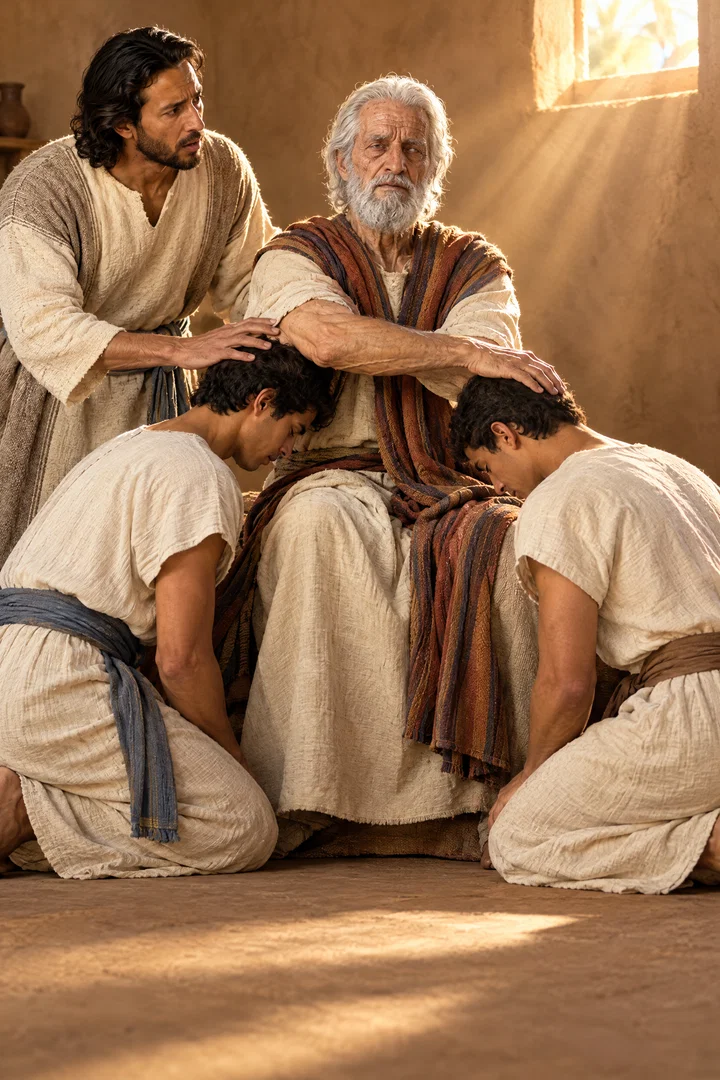
The scene depicts a father laying his hand on a child's head while blessing him, which was a familiar Jewish custom and form of blessing children.3SP 349.1–2RH May 11, 1911SLP 44.1 The mention of the right hand reflects that the hand itself had significance in the blessing of children.3SP 349.1–2 The laying on of hands was a meaningful act of both blessing and designation.RH May 11, 1911 Fathers laid their hands reverently on their children's heads when blessing them, as the significant form for asking blessing from God upon the person, with the same meaning as when priestly authority laid a hand on the head of an animal devoted to sacrifice.SLP 44.1
Sources
Pioneers and periodicals
16 sources
When Jacob crossed his hands to place his right hand of preeminence and firstborn blessing on the younger Ephraim, Joseph objected that Manasseh was the firstborn and asked for the right hand to be put on him, thinking his father had mistaken one son for the other, but Jacob knew which was older and deliberately gave Ephraim the first place and greater blessing.ST Dec 1, 1898ST Jan 10, 1911ST Nov 10, 1914 Manasseh was Joseph's firstborn in point of time, yet God made Ephraim the firstborn in rank and blessing and gave him the preference.ST Jan 10, 1911ST Apr 9, 1902 Firstborn does not necessarily mean oldest or first in time, but frequently denotes pre-eminence and birthright as given by God rather than fixed by birth order.ST Nov 15, 1910ST Apr 9, 1902ST Oct 29, 1902 This proves Jesus Christ can be the First-born of the dead by pre-eminence, by virtue of whose work all others are brought from the dead, even though others were raised before Him.ST Nov 15, 1910ST Oct 29, 1902 Jacob's crossing of his hands against Joseph's request illustrates that God's providence can direct events differently from human plans and does not make mistakes.RH Jan 19, 1860RH Oct 3, 1907
Setting and Immediate Meaning
Genesis 48:18 belongs to the closing chapters of Genesis, the Book of Beginnings, covering Israel in Egypt.RH Jan 20, 1916 It stands within Jacob's journey with all he had through Beer-sheba into Egypt and the bringing of all his seed with him into Egypt.ST Dec 1, 1898 It belongs to their reception by Joseph and Pharaoh, and to the last days and death of Jacob and Joseph.RH Jan 20, 1916 It belongs to Jacob's adoption of Joseph's sons among the twelve tribes together with his prophetic blessing upon Joseph's sons and upon his own sons and his prophecy concerning them, and to Jacob's death and burial.ST Jan 28, 1913 The regard paid to Jacob at his burial shows the impression Israel made upon Egypt, and the whole rest of the story of Joseph and his brethren is full of lessons on the surface as well as deeper ones and shows God's care for the preservation of the progenitors of the Seed.
When Jacob crossed his hands he placed his right hand, a sign of preeminence and the customary firstborn blessing, on the younger Ephraim rather than on Manasseh.ST Nov 10, 1914RH Oct 3, 1907ST Apr 23, 1894 Joseph objected and asked him to put his right hand on Manasseh's head, insisting that Manasseh was the firstborn.ST Dec 1, 1898ST Jan 10, 1911ST Dec 1, 1898RH Oct 3, 1907ST Apr 23, 1894 Joseph thought Jacob had mistaken one son for the other.ST Nov 10, 1914ST Dec 1, 1898 But Jacob knew which son was older and deliberately chose Ephraim for the first place, greater blessing and precedence, conveying the message entrusted to him, so the blessing and precedence are not determined by birth order.ST Dec 1, 1898ST Nov 10, 1914ST Dec 1, 1898
The verse shows a father laying his hand on a child's head when blessing him, and the laying on of hands was a meaningful act of blessing and designation.RH May 11, 1911 It is part of the account of Jacob blessing Joseph's sons in which the Hebrew word bah-rach is used to mean bless.RH Jan 23, 1913 It is part of the account involving Ephraim and Manasseh whose tribal identities are invoked in claims that the English are Ephraim and the Americans are Manasseh, and those claims conflict with the stated ancestry of the populations.ST Oct 13, 1881
Firstborn, Providence, and Application
Manasseh was the firstborn in point of time, yet God made Ephraim the firstborn in rank and blessing and gave Ephraim the preference.ST Jan 10, 1911ST Apr 9, 1902 Being older or holding the birthright does not ensure favor with God, and in this account Manasseh loses the birthright.ST Jan 10, 1911ST Apr 9, 1902 Firstborn does not necessarily mean priority of time or first in date or oldest, but frequently denotes pre-eminence.ST Nov 15, 1910ST Apr 9, 1902ST Oct 29, 1902 It is a title of birthright and pre-eminence given by God, not fixed by age or birth order.ST Nov 15, 1910ST Apr 9, 1902ST Oct 29, 1902
Manasseh is the firstborn and Ephraim is the younger, yet the usual order is Ephraim and Manasseh. Naming order does not follow birth order, because the youngest son is very often named first when he is the most noted. Therefore Abram being named first among Terah's sons does not make him the firstborn. This proves Jesus Christ can be the First-born of the dead by pre-eminence, even though others were raised from the dead before Him.ST Nov 15, 1910ST Oct 29, 1902 It is by virtue of His offering and work that all others are brought from the dead.ST Nov 15, 1910ST Oct 29, 1902
Ephraim was counted firstborn though Manasseh was older by birth, just as Jacob was counted firstborn though Esau was born first. This shows that firstborn can mean pre-eminence in character or station and not simply priority in time. In this same sense the 144,000 are called first-fruits, not as the first people ever saved but as given pre-eminence. Jacob's crossing his arms to bless Joseph's sons differently from Joseph's request illustrates that God's providence can direct events differently from human plans and does not make mistakes.RH Oct 3, 1907 Joseph's history shows that God may lead a person by a roundabout path while guiding him to the purpose intended for him.RH Jan 19, 1860RH Oct 3, 1907
Sources