Genesis 48:16
The Angel which redeemed me from all evil, bless the lads; and let my name be named on them, and the name of my fathers Abraham and Isaac; and let them grow into a multitude in the midst of the earth.
Translations
The Angel which redeemed me from all evil, bless the lads; and let my name be named on them, and the name of my fathers Abraham and Isaac; and let them grow into a multitude in the middle of the earth.
The Angel which redeemed me from all evil, bless the lads; and let my name be named on them, and the name of my fathers Abraham and Isaac; and let them grow into a multitude in the midst of the earth.
the Angel which redeemed me from all evil, bless the lads; and let my name be named on them, and the name of my fathers Abraham and Isaac; and let them grow into a multitude in the midst of the earth.
The angel who hath redeemed me from all evil, bless the lads; and let my name be named on them, and the name of my fathers Abraham and Isaac: and let them grow into a multitude in the midst of the earth.
the angel which hath redeemed me from all evil, bless the lads; and let my name be named on them, and the name of my fathers Abraham and Isaac; and let them grow into a multitude in the midst of the earth.
the angel who hath redeemed me from all evil, bless the lads; and let my name be named on them, and the name of my fathers Abraham and Isaac; and let them grow into a multitude in the midst of the earth.
the Messenger who is redeeming me from all evil doth bless the youths, and my name is called upon them, and the name of my fathers Abraham and Isaac; and they increase into a multitude in the midst of the land.'
the Angel that redeemed me from all evil, bless the lads; and let my name be named upon them, and the name of my fathers Abraham and Isaac; and let them grow into a multitude in the midst of the land!
The Messenger—who hath been my redeemer from all evil—bless the lads! And may there be called upon them, my name, and the name of my fathers. Abraham and Isaac; And may they swarm into a multitude, in the midst of the earth!
Berean Standard Bible, Majority Standard Bible
the angel who has redeemed me from all harm—
may He bless these boys.
And may they be called by my name
and the names of my fathers Abraham and Isaac,
and may they grow into a multitude upon the earth.”the angel who has redeemed me from all evil, bless the lads,
and let my name be named on them,
and the name of my fathers Abraham and Isaac.
Let them grow into a multitude upon the earth.”The angel who has been my saviour from all evil, send his blessing on these children: and let my name and the name of my fathers, Abraham and Isaac, be given to them; and let them become a great nation in the earth.
The Angel, which hath deliuered me from all euill, blesse the children, and let my name be named vpon them, and the name of my fathers Abraham and Izhak, that they may growe as fish into a multitude in the middes of the earth.
Douay-Rheims (Challoner revision)
The angel that delivereth me from all evils, bless these boys: and let my name be called upon them, and the names of my fathers Abraham, and Isaac, and may they grow into a multitude upon the earth.
Pictures
Cross-references
- Genesis 32:29
And Jacob asked him, and said, Tell me, I pray thee, thy name. And he said, Wherefore is it that thou dost ask after my name? And he blessed him there.
The Angel who blessed Jacob is identified as his Redeemer.
- Hosea 12:4
Yea, he had power over the angel, and prevailed: he wept, and made supplication unto him: he found him in Beth-el, and there he spake with us;
Jacob wept and prevailed with the Angel who blessed and redeemed him.
- Jeremiah 31:9
They shall come with weeping, and with supplications will I lead them: I will cause them to walk by the rivers of waters in a straight way, wherein they shall not stumble: for I am a father to Israel, and Ephraim is my firstborn.
Both texts call Ephraim the firstborn despite his younger status.
- Hebrews 11:21
By faith Jacob, when he was a dying, blessed both the sons of Joseph; and worshipped, leaning upon the top of his staff.
Jacob blesses Joseph’s sons as an act of faith.
- Genesis 48:5
And now thy two sons, Ephraim and Manasseh, which were born unto thee in the land of Egypt before I came unto thee into Egypt, are mine; as Reuben and Simeon, they shall be mine.
gives adoption setting for the blessing prayer
- Isaiah 63:9
In all their affliction he was afflicted, and the angel of his presence saved them: in his love and in his pity he redeemed them; and he bare them, and carried them all the days of old.
listed together as angelic ministration
- Exodus 23:20
Behold, I send an Angel before thee, to keep thee in the way, and to bring thee into the place which I have prepared.
both listed as angels helping God's people
- 1 Chronicles 5:1-2
Now the sons of Reuben the firstborn of Israel, (for he was the firstborn; but, forasmuch as he defiled his father’s bed, his birthright was given unto the sons of Joseph the son of Israel: and the genealogy is not to be reckoned after the birthright.
explains adoption as Joseph receiving double portion
- Genesis 42:36
And Jacob their father said unto them, Me have ye bereaved of my children: Joseph is not, and Simeon is not, and ye will take Benjamin away: all these things are against me.
contrasts old complaint with present gratitude
- Genesis 22:11
And the angel of the LORD called unto him out of heaven, and said, Abraham, Abraham: and he said, Here am I.
listed together as angelic ministration
- Hebrews 1:14
Are they not all ministering spirits, sent forth to minister for them who shall be heirs of salvation?
defines the angelic work Jacob's blessing illustrates
- Exodus 4:22
And thou shalt say unto Pharaoh, Thus saith the LORD, Israel is my son, even my firstborn:
another birthright by pre-eminence, not birth order
- Genesis 37:35
And all his sons and all his daughters rose up to comfort him; but he refused to be comforted; and he said, For I will go down into the grave unto my son mourning. Thus his father wept for him.
Jacob mourned Joseph before recognizing God’s care.
- Acts 27:23
For there stood by me this night the angel of God, whose I am, and whom I serve,
both listed as angels helping God's people
Commentary
Each commentary is drawn from primary sources: the writings of Ellen G. White and Adventist pioneers and periodicals. Each commentary is separate. Its own words are not a quotation; follow the references to read the source passages.
Ellen G. White
7 sources
The verse belongs to the time when Joseph was ruler in Egypt during the famine, when Jacob's ten sons came from Canaan to buy grain and bowed before him without recognizing him.PP 224.3–225.1 In it Jacob lays his hands on Ephraim and Manasseh to make them full sons of Israel, praying to the God before whom Abraham and Isaac walked to bless the lads.PP 234.2–235.1RH May 11, 1911 The laying on of hands was a meaningful, reverent Jewish act in which fathers laid hands reverently on their children's heads when blessing or dedicating them, as a priest laid a hand on a sacrificial animal.3SP 349.1–2RH May 11, 1911SLP 44.1
In the same sense, the laying on of hands on Paul and Barnabas was an act of asking God to bestow His blessing upon those devoted to the specific work God had chosen for them.3SP 349.1–2SLP 44.1 The verse is Jacob's evening-of-life review looking back over fraud, exile, and retribution and recognizing the sustaining power of God.ED 147.4ST Nov 17, 1909 The God who fed him all his life long and the Angel who redeemed him from all evil are God Himself as his preserver, support, and provider through his whole pilgrimage, who rescued him from every evil and gives light at eventide.ED 147.4ST Nov 17, 1909PP 234.2–235.1
The blessing carries no spirit of self-dependence and no reliance on human power or cunning, offers no complaint about past evil days, no longer views trials and sorrows as against him, and remembers only mercy and loving-kindness.PP 234.2–235.1 After distress, Jacob repented, sought to right his wrong to Esau, wrestled in weeping supplication and prevailed, and was forgiven, blessed, and transformed from supplanter to prince with God.ED 147.4ST Nov 17, 1909 He was delivered not only from his brother but from himself with the power of evil in his nature broken and his character changed, proving that through grace the curse is transformed into blessing without annulling the law that what is sown is reaped.ED 147.4ST Nov 17, 1909
Sources
Pioneers and periodicals
22 sources
Jacob in his sickness in Egypt gave his prophetic blessing upon Joseph's sons Ephraim and Manasseh, asking the Angel who had redeemed him from all evil to bless the lads, to put upon them his own name and the covenant heritage of Abraham and Isaac, and to make them grow into a multitude in the midst of the earth.ST May 12, 1890ST Dec 14, 1915ST Dec 1, 1898 He knowingly crossed his hands to lay his right hand upon the younger Ephraim and his left upon the elder Manasseh, adopting them among the tribes and giving the greater blessing and birthright to the younger, for birth order does not ensure favor with God.ST Jan 28, 1913ST Jan 10, 1911ST Nov 10, 1914ST Dec 1, 1898RH Oct 3, 1907 The Angel he named is Jehovah Himself, who had sustained, delivered and redeemed him every day from all evil, forgiving him after his wrestling supplication, breaking the power of evil in his nature and changing him from supplanter to prince with God.ST Nov 17, 1909ST Dec 14, 1915ST Dec 1, 1898RH Sep 11, 1913 By this it is proved that God sends His angels as ministering spirits to guide the affairs of individuals and serve those who shall be heirs of salvation.ST Aug 13, 1874RH May 16, 1854ST Apr 14, 1887 So the verse teaches quiet trust in God's daily deliverance instead of worry, and shows how Christ is the First-born from the dead and the first-fruits by pre-eminence and right, though others were raised before Him.ST Nov 15, 1910ST Apr 9, 1902ST Oct 29, 1902RH Sep 11, 1913
Blessing in Egypt
The verse belongs to Jacob's prophetic blessing upon Joseph's sons, Ephraim and Manasseh, given after Israel's journey to Egypt and reception by Joseph and Pharaoh.ST Jan 10, 1911 It stands in the closing story of Joseph and his brethren in the Book of Beginnings and shows God's care for the preservation of the progenitors of the Seed and for the promised Seed itself.ST Jan 10, 1911 When Joseph brought his two sons to him in his sickness in Egypt, Jacob blessed Joseph in his two sons.ST Dec 1, 1898 That history of Joseph shows God may lead a person by a roundabout path while still bringing him where He intends.RH Jan 19, 1860
In the blessing Jacob calls upon the God before whom Abraham and Isaac walked and who fed him all his life, and upon the Angel who redeemed him from all evil, to bless the lads.ST May 12, 1890ST Dec 14, 1915ST Dec 1, 1898 He asks that his name be named on them, and the name of his fathers Abraham and Isaac, placing them under that name and covenant heritage and legacy.ST May 12, 1890ST Dec 14, 1915ST Dec 1, 1898STST Oct 13, 1881 He asks also that they grow into a multitude and become numerous in the midst of the earth.ST May 12, 1890ST Dec 1, 1898RH Oct 3, 1907STST Oct 13, 1881 Through this blessing God's blessings pass to the sons of Israel.ST Jan 10, 1911
Through this blessing Joseph's sons are adopted among the twelve tribes.ST Jan 28, 1913 It was given in Egypt as part of Jacob's blessing of his sons and prophecy concerning them before his death.ST Jan 28, 1913
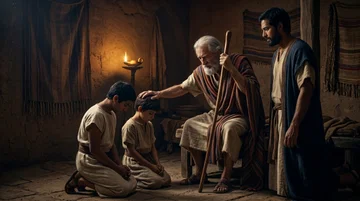
Jacob knowingly and deliberately crossed his hands to lay his right hand upon the younger Ephraim and his left hand upon the elder firstborn Manasseh.ST Nov 10, 1914ST Dec 1, 1898RH Oct 3, 1907 This was not a mistake from dim eyesight but a divinely given message.ST Nov 10, 1914 Later generations showed that Ephraim would excel Manasseh.ST Nov 10, 1914
The laying on of hands was a reverent gesture used by Jewish fathers in blessing their children, as Jacob lays his hands on Joseph's sons in asking God to bless them.RH May 11, 1911 Here bless means a blessing given to them, not a greeting or farewell.RH Jan 23, 1913 It is the prayer of an old and tried patriarch and servant of God for the younger members of his family and the next generation, and God is pleased with such prayers.ST Sep 4, 1907
The verse is relevant to the claims that the English people are Ephraim and the Americans are Manasseh.ST Oct 13, 1881
Angel and Redemption
At the end of his life Jacob looked back over fraud, exile, and retribution and recognized God's sustaining provision for him all his life.ST Nov 17, 1909 After repenting and seeking to right his wrong to Esau, he wrestled in weeping supplication and prevailed, and was forgiven and blessed and transformed from supplanter to prince with God.ST Nov 17, 1909 He was delivered not only from his brother but from himself, with the power of evil in his nature broken and his character changed.ST Nov 17, 1909 Near the end of life he confessed God's care through troubles he had failed to understand earlier, that God had been present and working for his good even when he saw only sorrow and feared things were against him.ST Nov 17, 1909ST Dec 14, 1915 This proves that at eventide there is light, and that through grace the curse is transformed into blessing without annulling the law that what is sown is reaped.ST Nov 17, 1909
He calls God the Angel who redeemed him from all evil, showing that Jehovah blessed and redeemed him through His angel.ST Dec 14, 1915ST Dec 1, 1898ST Apr 14, 1898 The Angel is asked to bless the lads and to put upon them his name and the names and covenant heritage of Abraham and Isaac.ST Dec 14, 1915ST Dec 1, 1898ST God is Redeemer who delivers from all evil every day.RH Sep 11, 1913 He should be known and claimed as Redeemer long before death, with quiet trust in His daily deliverance.RH Sep 11, 1913
The verse proves that God sends His angels to minister to His children.ST Aug 13, 1874ST Apr 14, 1898 It shows angels guiding the affairs of individuals, with the Angel who redeemed Jacob from all evil blessing the lads as one instance of that personal guidance.RH May 16, 1854ST Apr 14, 1887 They are ministering spirits sent to execute His will and serve those who shall be heirs of salvation.ST Apr 14, 1898
Birthright and Trust
Birth order does not ensure favor with God, for Manasseh though the elder did not receive the greater blessing but the birthright was given to the younger Ephraim.ST Jan 10, 1911ST Nov 15, 1910ST Oct 29, 1902 Firstborn and first-fruits do not necessarily mean first in date of birth but denote pre-eminence, appointment, and right.ST Nov 15, 1910ST Apr 9, 1902ST Oct 29, 1902 This is seen as with Jacob set over Esau and Joseph set over Reuben, and with Ephraim counted firstborn although Manasseh was older by time of birth.ST Apr 9, 1902ST Oct 29, 1902 So first-born status belongs by preeminence and appointment, not by birth order or by who came first.ST Nov 15, 1910ST Oct 29, 1902 This explains how Christ is the First-born from the dead and the first-fruits, the One by virtue of whose offering and work and life all others are brought from the dead, even though others were raised before Him and He was not the earliest among the loyal children of earth.ST Nov 15, 1910ST Apr 9, 1902ST Oct 29, 1902
Joseph's history shows that God may lead a person by a roundabout path while still bringing him where God intends, and Jacob's blessing of Joseph's sons belongs to that history.RH Jan 19, 1860 In that blessing Jacob deliberately crossed his arms to place his right hand on the younger son Ephraim and his left on the elder Manasseh when asking that they bear the names of Jacob, Abraham, and Isaac and become numerous.RH Oct 3, 1907 Jacob's crossed hands thus illustrate that God's purposes can prevail even when human plans interfere.RH Oct 3, 1907
In his last act Jacob called God the Angel who redeemed him from all evil, showing God as Redeemer who delivers from all evil every day.RH Sep 11, 1913 He should therefore be known and claimed as Redeemer long before death.RH Sep 11, 1913 The verse teaches quiet trust in that daily deliverance instead of worry, because God supplies every need and strength comes in quietness and confidence, not by fretting.RH Sep 11, 1913
Sources